By Robert Balgac, Founder, Black Swan Insurance Group | October 5, 2026
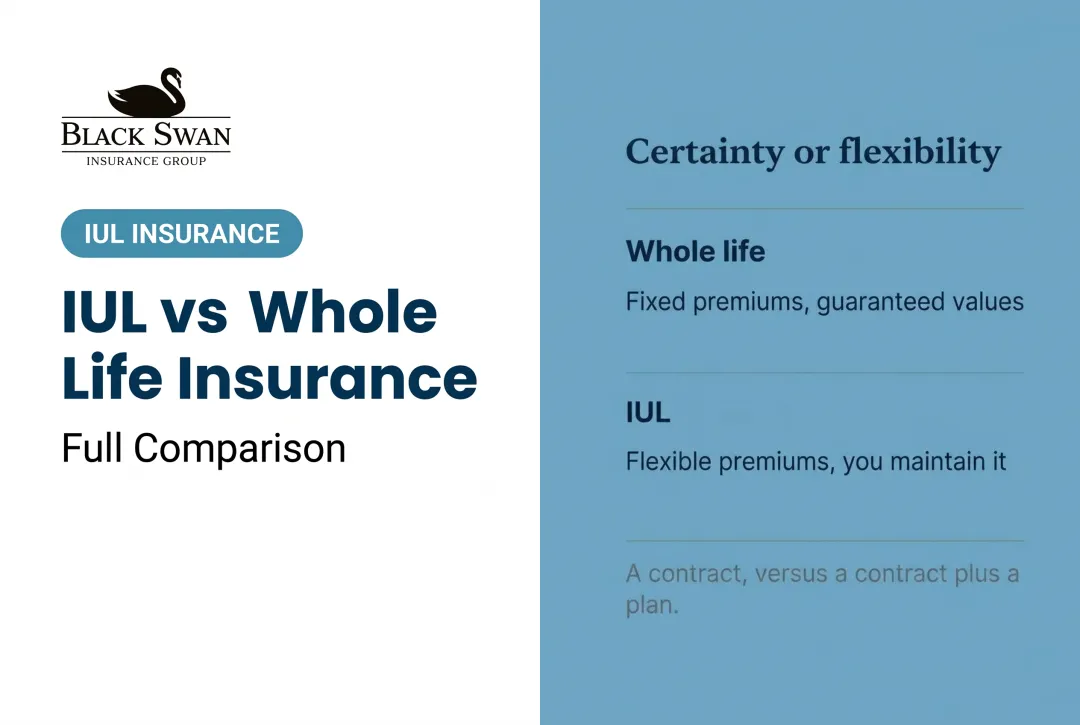
The choice between indexed universal life and whole life comes down to one question, and it is not about returns. It is about how much certainty you want, and how much ongoing management you are willing to accept in exchange for flexibility.
Both provide lifelong coverage and build cash value. They make very different promises about premiums, growth, and how much work falls on you to keep the policy healthy. Whole life shifts more risk onto the insurer's guarantees. An IUL shifts more monitoring onto you.
Permanent coverage remains a large market: IUL new premium reached $4.5 billion in 2025, up 17% year over year, while whole life new premium hit $6.4 billion, per LIMRA's 2025 individual life insurance sales data.
For a $150K+ earner, picking the wrong structure on the strength of an attractive illustration creates funding gaps, liquidity problems or lapse risk years later — usually at an age when fixing it is expensive.
The short answer: Whole life prioritises fixed premiums and contractual cash-value growth, backed by the insurer's claims-paying ability. An IUL offers premium flexibility and index-linked growth potential, with caps, participation rates and charges shaping the actual result. The IUL floor limits negative index crediting, not the impact of ongoing insurance costs and fees. Neither replaces term insurance, a 401(k), an IRA or diversified investments. Suitability turns on funding capacity, risk tolerance, time horizon and willingness to monitor.
Key Takeaways
- Whole life prioritises fixed premiums and contractual cash-value growth, backed by the insurer's claims-paying ability
- An IUL offers premium flexibility and index-linked potential, with caps, participation rates and charges shaping results
- The IUL floor limits negative index crediting, not the impact of ongoing insurance costs and fees
- Neither replaces term insurance, a 401(k), an IRA or diversified investments
- Suitability turns on funding capacity, risk tolerance, time horizon and willingness to monitor
The Core Comparison
| Feature | IUL | Whole life |
|---|---|---|
| Premiums | Adjustable within policy limits; skipped payments raise lapse risk if cash value cannot cover costs | Fixed and predictable when paid as scheduled |
| Cash-value growth | Index-linked crediting with caps, participation rates and spreads; often trails full index returns | A guaranteed accumulation schedule, plus possible non-guaranteed dividends |
| Death benefit | May change with policy values, underwriting and funding | Generally fixed; loans, withdrawals or unpaid charges can reduce it |
| Guarantees | A floor, often 0%, on index crediting; other terms depend on carrier design and continued funding | Contractual guarantees on premiums, cash value and death benefit, subject to the insurer's claims-paying ability |
| Oversight required | High — review illustrations, charges, caps and funding adequacy over time | Lower — still monitor loans, dividend assumptions and beneficiary details |
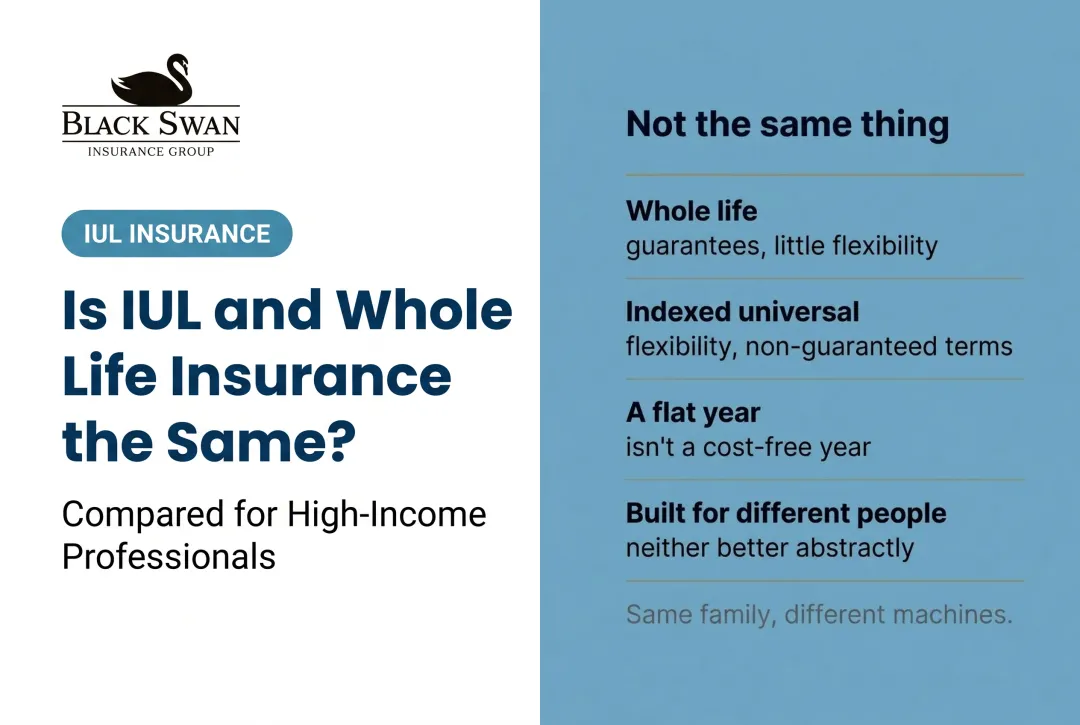
The key distinction: whole life shifts more risk to the insurer's guarantees; an IUL puts more ongoing monitoring on the policyholder. Everything else follows from that.
How an IUL Works
Permanent life insurance combining a death benefit with a cash-value account. Interest is credited based on an external index's performance, and the policy is not invested in that index.
- Cap — the maximum crediting rate for a period, however high the index climbs
- Participation rate — the percentage of index gains applied, commonly 50% to over 100%
- Floor — a guaranteed minimum crediting rate, often 0%, preventing a negative index year from directly reducing credited interest
- Spread — a deduction some carriers apply before crediting
Carriers describe participation rates in more detail in resources such as Guardian's IUL overview. Index performance is only part of the equation. Cost of insurance, administrative charges, surrender charges and any loans or withdrawals all affect actual cash value.
This is why illustrations matter. Under the NAIC model, insurers must clearly label guaranteed elements separately from non-guaranteed elements, with guaranteed figures shown before the non-guaranteed projections on the same page (NAIC Life Insurance Illustrations Model Regulation). Never treat an illustrated rate as an expected return.

Zero is your hero in a down year — but the floor applies to the credit, not to the charges. That is the sentence that separates this product from whole life.
Any potential tax-advantaged access is conditional on the policy being properly structured, funded and managed.
How Whole Life Works
Fixed premiums, a level death benefit, and cash value accumulating on a guaranteed schedule set at issue. On nonparticipating policies, premium, death benefit and cash value stay the same for the life of the contract.
Participating policies may also pay dividends. These are not guaranteed — they depend on the insurer's investment results, mortality experience and expense management, declared annually by the board (Guardian on whole life dividends).
It appeals to families and owners who want predictability in premiums and cash-value growth, a structured legacy or estate-planning tool, and a long-term, low-maintenance strategy.
Loans and withdrawals reduce both cash value and death benefit, accrue interest, and create lapse or tax consequences if left unmanaged. Loans get tracked, not ignored — that applies to both products.
What the Critics Get Right
Both products attract criticism and both deserve some of it.
Critics of whole life are right that the guarantees come at a cost: lower growth potential and a premium that does not flex when your income does. Critics of IUL are right that the flexibility is the same mechanism that lets a policy starve, and that the caps are carrier-controlled and can be reduced after you commit.
Both sets of critics are right that permanent coverage sold to someone with a temporary need is an expensive way to solve a cheap problem, and that term insurance would have covered it for a fraction of the premium.
Where the criticism stops is that certainty has a price and someone has to bear the risk. Whole life prices the guarantee in. An IUL hands you the risk and charges you less for the shell. Neither is a trick — they are two positions on the same trade-off, and the right one depends on which side of it you can live with.
Which One Fits
Start with the job the policy has to do: permanent protection, predictable legacy funding, flexible accumulation, or supplemental income. There is no universal winner.

Weigh these: whether you need a guaranteed, stable death benefit or can accept one that adjusts with policy performance; whether your funding is reliable enough for whole life's fixed premium; your tolerance for crediting assumptions and rising internal costs; and your age, health, funding period and whether you could still qualify later if you delay.
Stronger Fit for Whole Life
- Predictable lifelong protection with stable premiums is the priority
- Reliable cash flow for the required premium, and a preference for lower complexity
- A structured legacy or estate-planning purpose
- Business owners exploring cash value only after emergency reserves, retirement contributions and business liquidity are addressed
Stronger Fit for an IUL
- A genuine permanent coverage need alongside a real requirement for premium flexibility
- Household income of $150K+ with income that varies year to year
- Acceptance of non-guaranteed, index-linked crediting and a commitment to monitoring
- Funding sustainable under conservative assumptions, not the best-case illustrated rate
- Evaluated alongside — never instead of — term coverage, employer plans and other alternatives
Weaker Fit for Either
Not everyone should buy an IUL, or whole life. Wanting certainty above all else usually points away from indexed crediting entirely.
- The protection need has an end date, where term insurance is cheaper and cleaner
- Emergency reserves or retirement contributions are not yet handled
- Funding cannot be sustained through a lean stretch
- Nobody intends to review the policy after issue
Due Diligence Before Applying
- Compare guaranteed against current illustrated values, side by side
- Review caps, participation rates and how they have changed historically
- Confirm the cost of insurance and how it rises with age
- Check surrender charges and loan provisions
- Verify MEC limits if you plan to overfund for cash value
- Stress-test with conservative assumptions, not maximum rates
The Ultimate IUL Blueprint
If the flexible route is where you land, the Blueprint covers the design decisions that determine whether it survives: funding levels, the MEC line, loan timing and what to demand from an illustration.
Two Households, Two Answers
The high-income professional seeking predictability. A 45-year-old physician earning $300,000 wants permanent protection for estate liquidity and a guaranteed cash-value component. Cash flow is stable; the horizon to retirement is 15 to 20 years. Before recommending whole life, the funding commitment gets stress-tested against maxed retirement accounts, emergency reserves and existing term coverage. A guaranteed death benefit and fixed premium may well outweigh index-linked upside here.
The business owner with variable cash flow. A 40-year-old agency owner with revenue swinging between $150,000 and $400,000 wants permanent coverage with premium flexibility in slower years. An IUL's adjustable structure may fit — but only if conservative funding assumptions, not optimistic illustrations, carry the policy through the lean ones.
Regulators have flagged exactly this. New York's Department of Financial Services warned that most universal life policies, including IUL, do not guarantee premium payments will remain sufficient, and that additional payments may be required if earnings underperform assumptions (NY DFS Consumer Alert, 2019). Wisconsin's regulator has issued similar warnings, noting universal life policies that lapsed with little or no value after underfunding.

The best policy is not the biggest illustration. It is the one that survives real life — and for someone with variable income, that sentence decides the whole comparison.
Risks to Understand Before You Choose
- Whole life's fixed premium is an obligation, and it does not flex when income does
- Whole life dividends are not guaranteed and depend on the insurer's results
- IUL charges continue in a 0% crediting year, so cash value can fall with the floor intact
- IUL caps and participation rates are non-guaranteed and can be reduced after you commit
- Cost of insurance rises with age inside both, and is deducted regardless of crediting
- Universal life policies do not guarantee premiums will remain sufficient, per state regulator warnings
- Underfunding causes lapse, and regulators have documented policies terminating with little or no value
- Loans reduce cash value and death benefit in both, and a lapse with a loan outstanding and gain in the contract creates taxable income
- Crossing the seven-pay limit makes either contract a MEC and changes distribution taxation permanently
- Guarantees depend on the insurer's claims-paying ability
Find Out Where You Actually Stand
This starts with the Tax-Free Wealth Blueprint Fit Review. If you earn $150K+ and are weighing these two, we test whether a permanent need exists at all, model your funding through a genuinely bad year, compare the guaranteed columns side by side, and price term insurance alongside both. If it does not fit, we will tell you that too.
Frequently Asked Questions
Which is better, IUL or whole life?
Neither universally. Whole life buys certainty at a higher premium and lower growth potential. An IUL buys flexibility and index-linked potential in exchange for you carrying more of the risk and the monitoring.
Are whole life dividends guaranteed?
No. They depend on the insurer's investment results, mortality experience and expense management, and are declared annually by the board. Treat them as possible, not planned.
Does the IUL floor protect my cash value?
No. It applies to the credited interest. Cost of insurance and administrative charges are deducted regardless, so cash value can fall in a flat year.
Which is better for variable income?
An IUL's flexibility is genuinely useful there — provided the funding plan works under conservative assumptions rather than the illustrated rate, because regulators have documented what happens when it does not.
Can either policy lapse?
Yes. Whole life lapses if premiums stop and cash value is exhausted. An IUL lapses more easily, because flexible premiums make underfunding easy and the charges continue regardless.
Should I buy term insurance instead?
If the protection need has an end date, yes — term is cheaper and simpler than either of these, and it deserves pricing before anyone designs permanent coverage.
Sources
- LIMRA — 2025 individual life insurance new premium data
- NAIC — Life Insurance Illustrations Model Regulation (Model 582)
- Guardian Life — Indexed universal life
- Guardian Life — Whole life dividends and returns explained
- New York Department of Financial Services — universal life consumer alert, 2019
Disclosure: This article is educational and is not personal tax, legal or investment advice. Indexed universal life is life insurance first. Guarantees on either product are subject to the claims-paying ability of the issuing insurer, and whole life dividends are not guaranteed. Actual results depend on policy design, carrier, crediting options, caps, participation rates, expenses, funding and ongoing management. Policy loans and withdrawals may reduce cash value and death benefit and can create tax consequences if the policy lapses or becomes a modified endowment contract. This strategy is not appropriate for everyone. Illustrated values are not guarantees; actual results depend on policy terms, crediting, costs and funding. Consult your own tax, legal and financial professionals for advice specific to your situation.
And remember, it's not what you earn, it's what you keep… enjoy the ride.