By Robert Balgac, Founder, Black Swan Insurance Group | October 5, 2026
Surrendering an indexed universal life policy looks like a simple transaction. Call the insurer, sign a form, collect the cash value. It is not simple, and the figure on your last statement is almost never the figure that arrives.
Surrender ends the policy permanently. It terminates the death benefit and typically pays out well below the displayed cash value, because surrender charges, outstanding loans and accrued interest all come off first.
If you are considering it, four questions need answering before anything gets signed: how much will the policy actually pay, what reduces that number, could the payout trigger a tax bill, and is there an alternative that solves your problem without giving up the coverage?
The short answer: Cash surrender value equals cash value minus surrender charges, outstanding loans and accrued interest — a gap that can run 30% or more. Surrendering ends coverage permanently, and replacement policies may cost more or be unavailable if your age or health has changed. Loans, withdrawals, reduced coverage or a 1035 exchange can often solve a funding problem without cancelling. And MEC status or a loan balance can create taxable income even when you receive little cash in hand.
Key Takeaways
- Cash surrender value = cash value − surrender charges − outstanding loans − accrued interest
- Surrendering ends coverage permanently; replacement may cost more or be unavailable on health grounds
- Contract-specific charges, credited interest and loan balances mean you need actual numbers, not estimates
- Loans, withdrawals, reduced coverage or a 1035 exchange can solve the problem without cancelling
- MEC status and loan balances can create taxable income even when little cash reaches you
Three Numbers People Confuse
Surrendering means voluntarily ending the policy in exchange for whatever cash the insurer calculates you are owed. The death benefit is gone permanently — you do not get it back by resuming premiums next year.
- Death benefit — paid to beneficiaries on death, reduced by any unpaid loan balance
- Cash value (account value) — the internal accumulation, built from premiums and credited interest, reduced by insurance costs and fees
- Cash surrender value — what you would actually receive today, after surrender charges and any loan payoff
These rarely match. The NAIC's Universal Life Insurance Model Regulation defines net cash surrender value as the maximum amount payable on surrender; the exact arithmetic lives in your contract's nonforfeiture section. A statement showing $45,000 in cash value can produce a cheque thousands lower.
Index crediting adds a layer. Interest is linked to an index such as the S&P 500 without owning it or being invested in the market, subject to a cap, a participation rate and typically a 0% floor.
Zero is your hero in a down year — but the floor applies to the credit, not to the insurance charges, the loan interest or the withdrawals, all of which can pull the balance down in a good index year.
Flexible premiums cut both ways. Underfunding shrinks cash value, raises lapse risk, and reduces whatever is left to surrender later. Whatever potential tax-advantaged access the policy once promised was always conditional on it being properly structured, funded and managed — and if it was not, that is usually why you are on this page.
Surrender Is Not the Only Exit
Surrender is a choice. Lapse is what happens when you stop funding and the policy runs out of value to cover its own charges — coverage ends, sometimes with no payout. Neither is the same as:
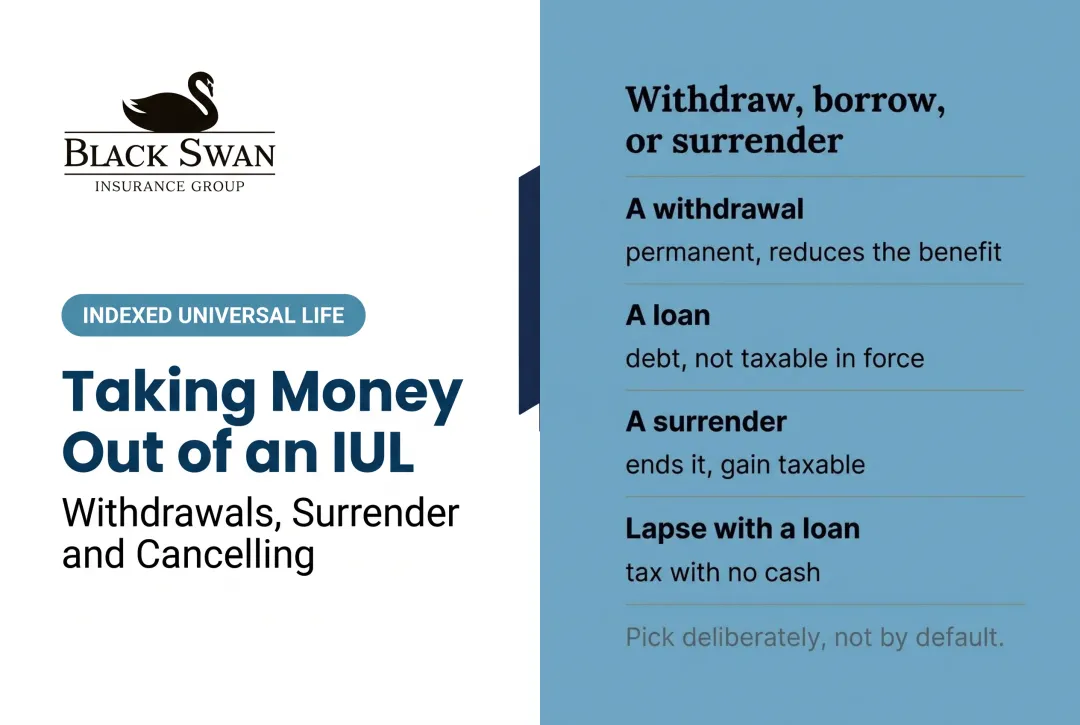
- A partial withdrawal, pulling out some cash while keeping the policy active
- A policy loan, borrowing against cash value without withdrawing it
- Reduced paid-up coverage, lowering the death benefit in exchange for eliminating future premiums
- A 1035 exchange, moving value into a new contract without recognising gain
Surrender is the only one that guarantees the protection is gone for good.
Calculating What You Would Actually Receive
Your surrender value comes from your contract applied to your premium history, loan activity and crediting results. The general framework:
Current cash value − surrender charge − outstanding loans − accrued loan interest = cash surrender value
That is a starting point. The nonforfeiture provisions control the real arithmetic.
Pull these before deciding anything: the latest annual statement for current cash value and death benefit; the policy contract for the surrender charge schedule; an in-force ledger for carrier projections; a loan statement for the balance plus accrued interest; and a written surrender-value quote stating what the carrier will pay today.
What pulls the payout below the original illustration: surrender charges in the early years; premium loads and monthly charges; cost of insurance rising with age; rider charges; withdrawals taken over the life of the policy; and loan balances with unpaid interest.
Illustrated values also drift for reasons outside the charges — crediting changes year to year, carriers may adjust caps or participation rates, and actual premiums may not have matched the original funding assumption.

A Worked Example
Invented numbers, not a quote, average or prediction:
| Component | Amount |
|---|---|
| Current cash value | $60,000 |
| Surrender charge (year 8 of 15) | −$9,000 |
| Outstanding policy loan | −$12,000 |
| Accrued loan interest | −$800 |
| Estimated cash surrender value | $38,200 |
$60,000 displayed becomes roughly $38,200 — a 36% difference driven by charges and debt. Your numbers will differ. Request the written quote.
Charges, Loans and Tax
Surrender Charges and Loan Interest
Surrender charges are contract-defined penalties applying if you cancel during a set period after issue, often the first 10 to 15 years. Some products carry full charges for 12 years, others 15. There is no industry standard, so read the schedule in your own contract.
Outstanding loans are subtracted dollar-for-dollar from both surrender value and death benefit, and they accrue interest the entire time. A loan taken five years ago can be substantially larger today through compounding.
Tax, Including the Phantom Income Problem
Receive more than your tax basis — generally total premiums paid, less prior withdrawals and untaxed loan amounts — and the excess is taxable as ordinary income. IRS Publication 525 confirms that surrender proceeds exceeding your cost in the contract must be included in income.
Then the trickier version. Phantom income: if the policy lapses or is surrendered with an outstanding loan larger than your remaining basis, that loan amount can become taxable even though you never received the cash. That is the scenario that catches people hardest, because the bill arrives with no money attached to pay it.
If the policy is a modified endowment contract, the rules shift further: distributions are taxed income-first rather than basis-first; loans are typically treated as taxable distributions rather than tax-free borrowing; and a 10% additional tax may apply to the taxable portion before age 59½.
MEC status usually results from overfunding relative to IRS testing limits, and your policy documents will state it.

What the Critics Get Right
The criticism that these policies are far easier to enter than to exit is simply accurate.
Critics are right that a surrender schedule running 10 to 15 years means the product is illiquid for a period most buyers underestimate at the point of sale. They are right that the gap between displayed cash value and the actual cheque is rarely explained until someone tries to leave. And they are right that phantom income — a tax bill with no cash attached — is the kind of outcome that should have been disclosed in bold at issue.
Where the criticism does not help is at the decision point you are standing at now. If you already own the policy, the relevant question is not whether it should have been sold to you. It is which exit, or which adjustment, leaves you in the best position from here.
What You Lose by Surrendering
Once you surrender, your beneficiaries no longer have the death benefit. If there is still a mortgage, dependents, a business partner or a legacy goal tied to that coverage, the safety net is gone — not paused.
Replacing it later carries real risk. The NAIC's Life Insurance and Annuities Replacement Model Regulation notes that a new policy typically means new underwriting at your current age and health, higher premiums if health has changed, a fresh two-year contestability period, reset suicide exclusion periods, and slower cash-value buildup as surrender charges and acquisition costs start over.
If your health has declined since the original policy was issued, you may not qualify for comparable coverage at any price. That is the consideration that should slow the decision down more than any other.
There is also a strategic cost. If the policy was funding a retirement-income plan, a tax-diversification strategy or a business-continuity arrangement, surrender ends that role too. A lump sum today trades away tax-deferred growth and future flexibility.
When Surrender Genuinely Makes Sense
- The protection need has actually gone away — children grown, debts paid, business sold
- You can no longer sustain the funding and no other option works
- The policy was poorly designed for your goals from the start, and repair is not viable
- You have compared the alternatives and this remains the most sensible move
Surrender should follow a current policy review, not replace one.
The Alternatives Worth Exhausting First
Access cash without cancelling:
- Policy loans — borrowing against cash value, generally not taxed unless the policy is a MEC or lapses with a large balance outstanding
- Partial withdrawals — taking a portion of cash value, up to basis, without full surrender
Both reduce the death benefit and available cash value, and both carry lapse risk if the remaining value cannot cover ongoing charges.
Adjust rather than end:
- Reduce the death benefit to lower ongoing cost-of-insurance charges
- Adjust premium payments within contract limits
- Use existing cash value to cover charges during a cash-flow crunch
- Modify or drop riders where the contract allows
Move rather than cash out: a 1035 exchange transfers value into another qualifying contract without recognising gain, though it restarts a surrender schedule and requires fresh underwriting on a new life policy.
And if the underlying issue is that you are paying for permanent coverage you no longer need, term insurance for a defined remaining period may cover the real exposure at a fraction of the cost — worth pricing before you surrender into nothing.

This is not on you. You were the client. You were supposed to be guided. The job now is to X-ray the policy and see whether it can be repaired before anyone cancels it.
The Ultimate IUL Blueprint
If the policy can be repaired rather than surrendered, the Blueprint covers what a working design requires: funding levels, the MEC line, loan timing and the numbers to demand from an in-force illustration.
Who Should Pause Before Surrendering
Strong Reasons to Pause
- Household income of $150K+ with a protection need that still exists — a mortgage, dependents, a business obligation or an estate liquidity gap
- Health has changed since issue, making replacement coverage expensive or unavailable
- A loan balance exceeds remaining basis, creating phantom income exposure
- The policy is inside the surrender charge period
- The underlying problem is cash flow, which a premium adjustment or reduced death benefit may solve
Reasons Surrender May Be Right
- No remaining protection need, verified rather than assumed
- Funding is genuinely unsustainable and every adjustment has been modelled
- The design was wrong from the start and cannot be repaired economically — not everyone should buy an IUL, and some of these policies should never have been sold
- The surrender charge period has ended and the tax position has been checked with a professional
Risks to Understand Before You Surrender
- The cheque can be far below the statement figure — 30% or more in the worst cases
- Phantom income can create a tax bill with no cash attached, where a loan exceeds remaining basis
- MEC status taxes distributions income-first with a possible 10% additional tax before 59½
- Coverage ends permanently, and replacement requires new underwriting at your current age and health
- A fresh contestability period and suicide exclusion apply to any replacement policy
- Surrender charges may still be running, and waiting until they expire can be worth thousands
- The strategic role ends too — any retirement-income or business-continuity function stops with the contract
- Basis calculations are specific to your premium and withdrawal history and need a tax professional
Find Out Where You Actually Stand
This starts with the Tax-Free Wealth Blueprint Fit Review. If you are considering surrendering a policy, we pull the in-force illustration and the written surrender quote, calculate the actual net after charges, loans and tax, model the repair options — reduced death benefit, adjusted funding, a 1035 exchange — and price term insurance for any remaining protection need. If it does not fit, we will tell you that too, and "surrender it" is a conclusion we reach when the numbers support it.
Frequently Asked Questions
Why is my surrender value lower than my cash value?
Surrender charges, outstanding loans and accrued interest are all deducted. In the early to middle policy years that gap can be substantial.
What is phantom income?
A taxable amount arising when a policy lapses or is surrendered with a loan larger than your remaining basis. The loan becomes taxable income even though no cash reaches you.
How long do surrender charges last?
Often 10 to 15 years, varying by product. There is no industry standard, so read your contract's schedule rather than assuming.
Can I get the coverage back later?
Only by buying a new policy, with new underwriting at your current age and health, a fresh contestability period, and a new surrender schedule. If your health has declined, comparable coverage may not be available.
What should I do instead?
Exhaust the alternatives first: a policy loan, a partial withdrawal, a reduced death benefit, adjusted premiums, dropping riders, or a 1035 exchange. Get an in-force illustration before choosing.
Should I replace it with term insurance?
Possibly, if the remaining protection need has a defined end date. Price the term policy and get it approved and in force before surrendering anything — a coverage gap cannot be undone.
Sources
- NAIC — Universal Life Insurance Model Regulation (Model 585)
- NAIC — Life Insurance and Annuities Replacement Model Regulation (Model 613)
- IRS Publication 525 — Taxable and Nontaxable Income
- NAIC — Life Insurance
- I.R.C. § 7702A and Rev. Proc. 2008-39 (modified endowment contracts and the seven-pay test)
Disclosure: This article is educational and is not personal tax, legal or investment advice. Indexed universal life is life insurance first. The worked example uses invented figures and is not a quote or projection. Basis calculations depend on your specific premium and withdrawal history. Actual results depend on policy design, carrier, crediting options, caps, participation rates, expenses, funding and ongoing management. Surrendering a policy ends coverage permanently and may create taxable income. Consult qualified tax and insurance professionals before acting. Policy loans and withdrawals reduce cash value and the death benefit, and can create tax consequences if the policy lapses or becomes a modified endowment contract. Illustrated values are not guarantees; actual results depend on policy terms, crediting, costs and funding. This strategy is not appropriate for everyone.
And remember, it's not what you earn, it's what you keep… enjoy the ride.