By Robert Balgac, Founder, Black Swan Insurance Group | October 5, 2026
A policy loan is the feature that makes indexed universal life interesting to high earners and the feature that destroys the most policies. Both of those are consequences of the same mechanic: the insurer will lend against your cash value without underwriting, without a repayment schedule, and without ever telling you to stop.
Freedom from a repayment schedule sounds like an advantage. It is the reason unmanaged balances quietly compound for fifteen years.
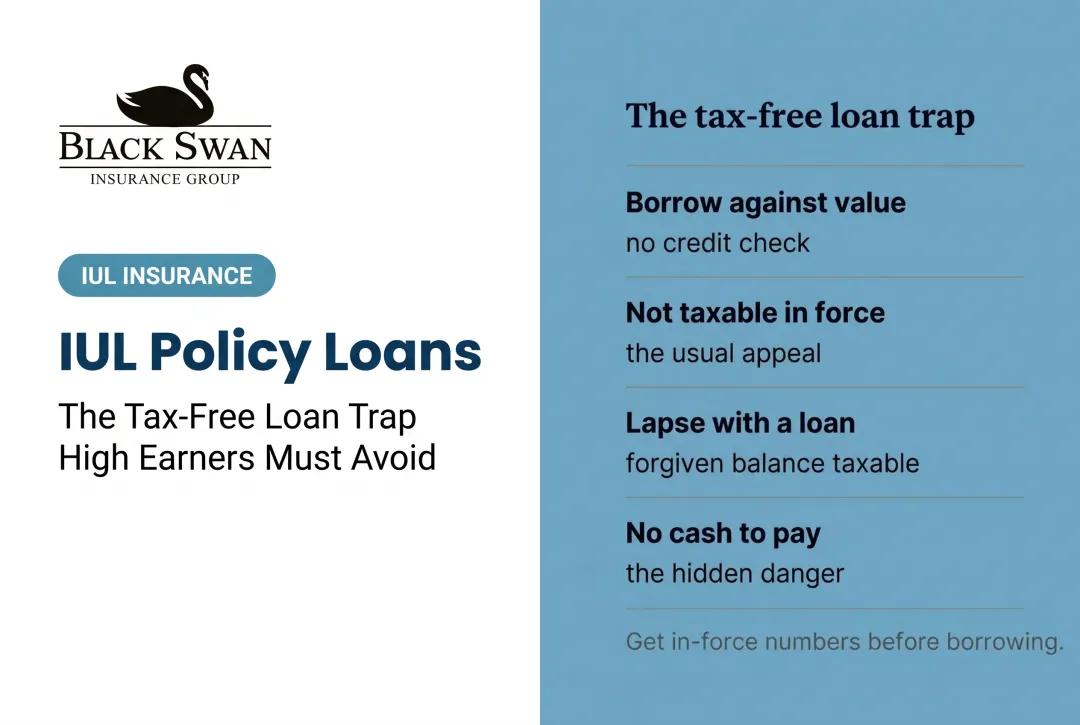
The short answer: The insurer advances money using your cash value as collateral. Interest accrues from day one whether or not you pay it, the death benefit is reduced by the outstanding balance, and monthly insurance charges continue throughout. Proceeds are generally not taxable while the policy stays in force. If the policy lapses or is surrendered with an outstanding loan and gain in the contract, the balance can become taxable income with no cash received to pay it.
Key Takeaways
- The loan is collateralised by cash value, not taken from the death benefit, and the two are different numbers
- No credit check and no required repayment schedule, which is the convenience and the hazard
- Interest accrues whether or not you pay, and unpaid interest compounds into the balance
- Policy charges continue on top of the loan, so a flat year with a balance outstanding is doubly negative
- An annual review is what separates a working loan strategy from a collapsed contract
The Mechanics, Step by Step
An IUL is permanent life insurance first. Any potential tax-advantaged access through loans depends on the policy being properly structured, funded and managed.
- You request a loan. The insurer checks available net loan value — generally cash surrender value less existing debt.
- Funds are advanced. This is the carrier's money, lent to you, with your policy as collateral. It is not a withdrawal of your cash value.
- Collateral is set aside. Depending on the loan type, the borrowed amount is either moved to a declared-rate account or left in the indexed account.
- Interest accrues. From day one, at the contract's loan rate, whether or not you make payments.
- Charges continue. Cost of insurance, administrative and rider charges are deducted monthly as normal.
- The death benefit is reduced by the outstanding balance plus accrued interest.

Think of It Like Home Equity
Your cash value is equity in a financial house you have been building. You can borrow against it without selling it. That analogy is useful right up to its limit: this only works if you manage the debt. A home equity line with no payments due and interest rolling up would be dangerous too. The difference is that nobody sends you a monthly statement demanding action.
Tax-free income is not magic. It is policy management.
Why Loans Collapse Policies
The failure sequence is always the same and always slow enough to be preventable.
A loan is taken, often in a year when cash was tight. Interest is not paid, so it capitalises. The balance grows. Meanwhile the policy keeps deducting cost of insurance, which rises with age. Crediting comes in below the illustrated assumption for a few years. Available value stops covering charges plus accruing interest. Under most contracts, when policy debt exceeds accumulated value less surrender charges, the contract terminates.
At that moment, if there is gain in the contract, the forgiven loan becomes taxable income — and the cash was spent years ago.

What the Critics Get Right
Critics are right that "tax-advantaged retirement access through policy loans" is presented as a product feature when it is really an outcome that depends on active management for thirty years. They are right that owners are rarely warned that unpaid interest compounds, and that the tax consequence of a lapsed loaned policy is the harshest outcome in personal finance — a bill with no asset behind it.
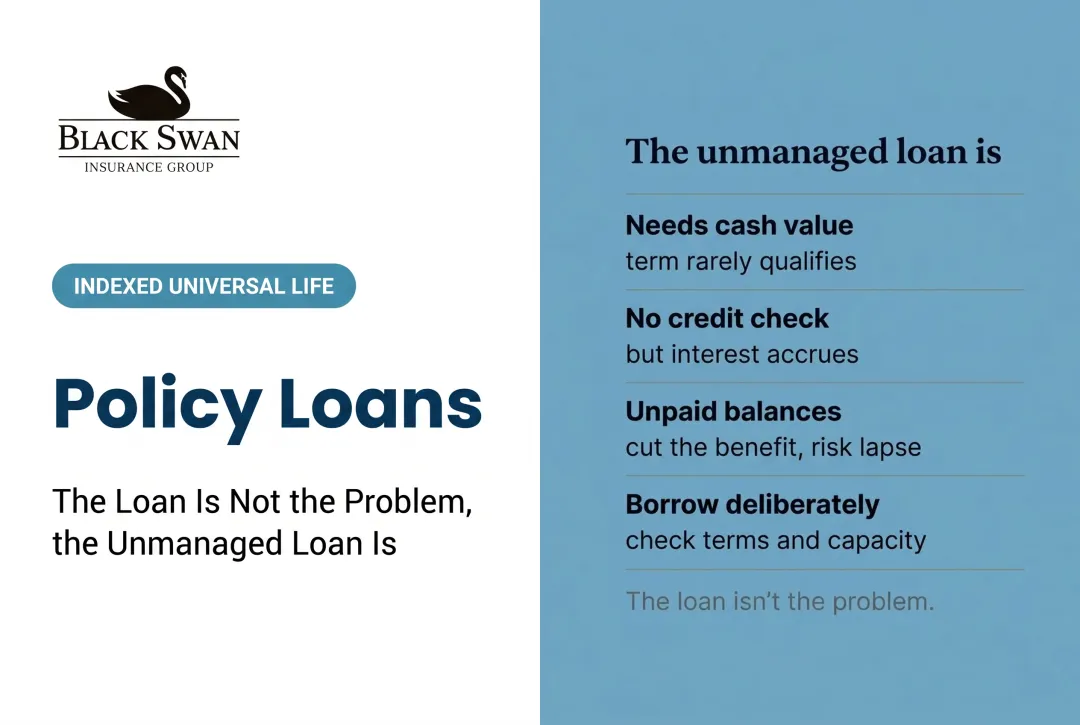
Where the criticism overreaches is in treating the mechanic as inherently predatory. A loan taken deliberately against a well-funded policy, with interest serviced and an annual in-force illustration reviewed, is an ordinary and legitimate liquidity tool.
Managing a Loan Properly
- Service the interest rather than capitalising it, wherever cash flow allows
- Request an in-force illustration annually, at guaranteed and non-guaranteed values
- Model the balance forward ten years at a lower credited rate than illustrated
- Keep funding the policy where possible; a contract still receiving premium carries debt far better
- Know your contract's termination trigger — the exact formula is policy-specific
Compare It Against the Alternatives
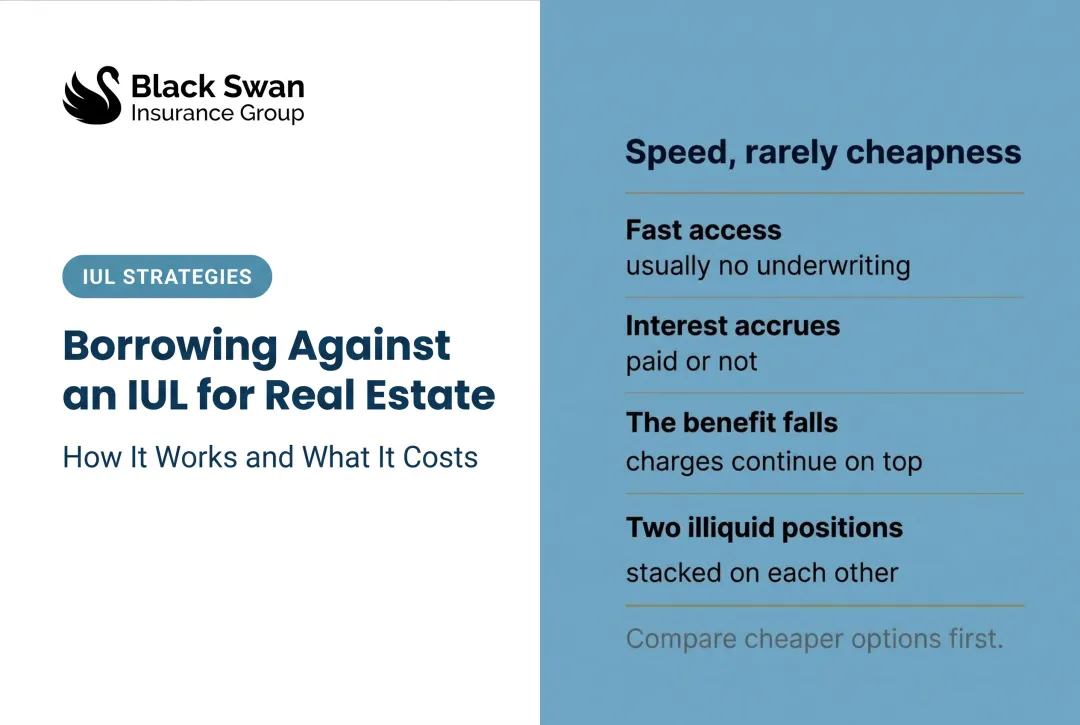
A HELOC, a 401(k) loan, a securities-based line of credit, a business line of credit, or simply cash reserves. Each has a defined repayment structure, which is precisely the discipline a policy loan lacks. And if the underlying need is protection rather than liquidity, term insurance plus a brokerage account solves it without creating a loan at all.
The Annual Review That Prevents the Failure
Almost every collapsed policy shares one feature: nobody looked at it. A review takes an hour and needs five things.
One: a current in-force illustration at guaranteed and non-guaranteed values. Not the original sales illustration — a fresh one, reflecting what has actually happened.
Two: the loan balance and accrued interest, stated separately, so you can see how much of the growth is interest capitalising rather than principal.
Three: the projected year of lapse under two scenarios — the carrier's current assumption, and a scenario two percentage points lower. The gap between those two years tells you how much margin you have.
Four: the premium required to hold the policy to age ninety-five with the loan outstanding. If that number has risen since last year, the policy is drifting.
Five: a decision. Repay some principal, start servicing interest, reduce the death benefit to cut cost of insurance, or accept the trajectory knowingly. Doing nothing is only acceptable when it is chosen rather than defaulted into.
This is not set-it-and-forget-it. It is design-it, fund-it, review-it. An hour a year is what separates a policy loan that works from one that ends in a tax bill for money you spent a decade ago.
The Ultimate IUL Blueprint
A plain-English walkthrough of loan mechanics, collateral, lapse triggers and the questions to ask before you borrow.
Who a Policy Loan May Fit
Stronger Fit
- $150K+ stable income and a policy funded well above the minimum premium
- A defined purpose for the money and a written repayment intention
- Capacity to service interest rather than let it capitalise
- Acceptance that beneficiaries receive less while the balance is outstanding
- An annual review already part of how the contract is managed
Weaker Fit
Not everyone should buy an IUL, and a policy bought primarily for the loan feature is the most common version of this that fails.
- Thin cash value or an early-year policy inside the surrender period
- An existing large balance
- No repayment plan and no habit of reviewing the contract
- A cheaper secured borrowing option already available
- Income that could interrupt premium payments

Risks to Understand Before You Borrow
- Interest accrues from day one whether or not you pay it, and compounds if unpaid.
- Policy charges continue and are deducted regardless of the loan.
- The death benefit falls by the outstanding balance plus accrued interest.
- Crediting can be reduced on the borrowed portion depending on loan type.
- Lapse risk rises as debt outpaces available value; the termination trigger is contract-specific.
- A lapse or surrender with gain and an outstanding loan can create taxable income with no cash received. MEC contracts are taxed last-in-first-out with a possible 10% additional federal tax before 59½ (I.R.C. § 72).
Find Out Where You Actually Stand
Start with the Tax-Free Wealth Blueprint Fit Review. If you earn $150K+ and are planning to borrow — or already have — we model the balance forward against your contract's actual charges and termination trigger, at a credited rate lower than the one you were shown. If IUL does not fit, we will tell you that too.
Frequently Asked Questions
How does an IUL policy loan actually work?
The insurer lends you money using your cash value as collateral. Interest accrues, the death benefit is reduced by the balance, and the policy continues deducting its normal charges.
Am I borrowing my own money?
No. You are borrowing the carrier's money against your cash value. That is why interest is charged.
Do I have to pay it back?
Most contracts do not require a schedule. Interest still accrues, and an unpaid balance reduces the death benefit and raises the chance the policy terminates.
Is the loan taxable?
Generally not while the policy remains in force. On lapse or surrender with gain and an outstanding balance, amounts above basis can become taxable income.
What happens to my death benefit?
It is reduced by the outstanding loan plus accrued interest, so beneficiaries receive less.
How do I stop a loan from collapsing the policy?
Service the interest, keep funding the policy, request an in-force illustration every year, and model the balance at a lower credited rate than illustrated.
How much interest will I actually pay?
It depends on the contract rate, the loan type and whether you service the interest or let it capitalise. Ask the carrier for a projection of the balance ten years out under your actual rate.
Can I repay a policy loan early?
Generally yes, and in most contracts there is no penalty. Ask whether repayments apply to interest or principal first, because it changes how quickly the balance falls.
Will my beneficiaries know about the loan?
They will see the reduced death benefit. Telling them beforehand is usually kinder than letting them discover it during probate.
Sources
- NAIC — Life Insurance — cash value and policy loan definitions
- National Life Group — loan mechanics and processing
- Guardian — typical borrowing limits against cash value
- NAIC, Life Insurance Illustrations Model Regulation (Model #582) — in-force illustrations
- I.R.C. § 7702A — Modified Endowment Contract and the seven-pay test
- I.R.C. § 72 — additional tax on early distributions
Disclosure: The information on this page is educational in nature and does not constitute personalized financial, tax, or legal advice. Actual results depend on policy design, carrier, crediting options, caps, participation rates, expenses, funding, loans, and ongoing management. Policy loans and withdrawals reduce cash value and the death benefit, and can create tax consequences if the policy lapses or becomes a modified endowment contract. Consult a licensed insurance professional and, where appropriate, a tax or financial advisor before making any insurance or financial decision. Indexed universal life is life insurance first. Illustrated values are not guarantees; actual results depend on policy terms, crediting, costs and funding. This strategy is not appropriate for everyone.
And remember, it's not what you earn, it's what you keep… enjoy the ride.