By Robert Balgac, Founder, Black Swan Insurance Group | October 5, 2026
If you searched "IUL bank account" hoping to find a savings product you can open at a bank, the answer is short: it does not exist. No bank and no insurer offers anything by that name.
The confusion is not your fault. IUL marketing borrows banking vocabulary — "cash value," "tax-free access," sometimes "be your own bank" — and the words do real work in making an insurance contract sound like a deposit account.
The difference matters for one concrete reason. A bank account is built for liquidity and carries FDIC deposit protection. An indexed universal life policy is permanent life insurance issued by an insurance carrier, with a cost of insurance charged monthly, a surrender schedule, and no FDIC coverage of any kind.
If you earn $150K+ and someone has framed this as a place to park money, the category error is the first thing to fix.
The short answer: An IUL is a life insurance policy from an insurance company — not a bank-issued checking, savings or brokerage account, and not FDIC-insured. Cash value grows through index-linked interest credits limited by caps, participation rates and policy charges. Loans and withdrawals reduce the death benefit and can create tax consequences if mismanaged. Fund protection needs, emergency reserves and retirement-plan contributions before a policy enters the conversation.
Key Takeaways
- An IUL is a life insurance policy from an insurance carrier, not a bank product
- Cash value grows through index-linked credits, limited by caps, participation rates and charges
- Loans and withdrawals can reduce the death benefit and trigger taxes if mismanaged
- Protection needs, emergency reserves and retirement-plan contributions come first
- "Infinite banking" is a whole life strategy, not an IUL one, and the two are not interchangeable
Why the Name Is Wrong
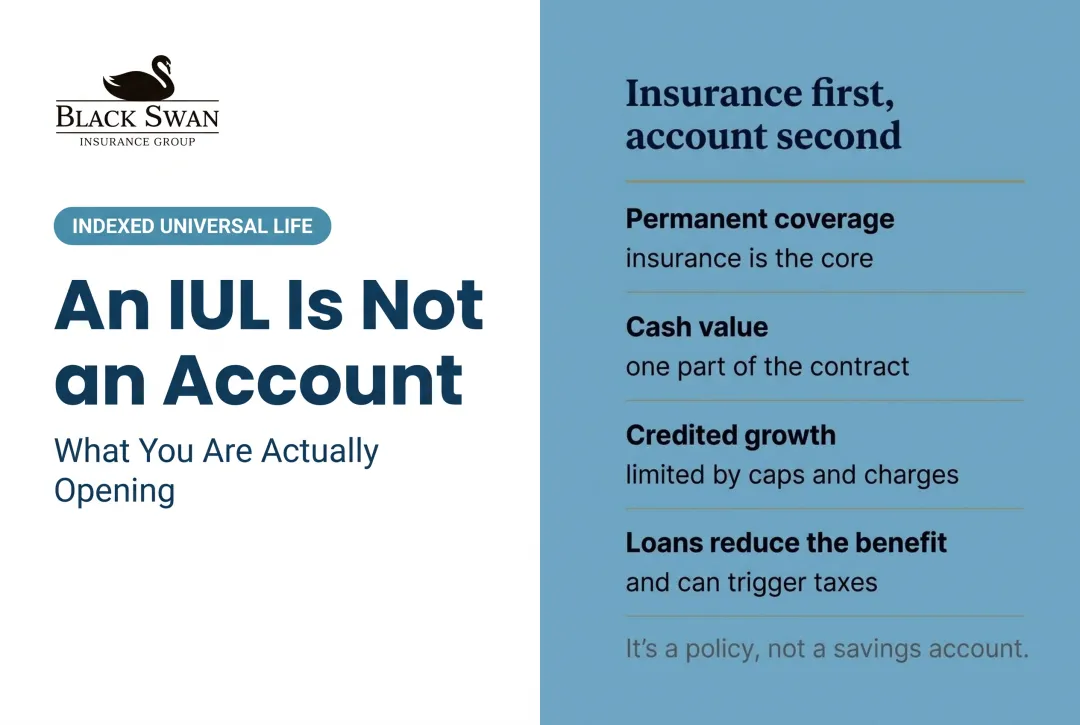
Indexed universal life is permanent life insurance with two core parts: a death benefit paid to named beneficiaries, and a cash value component that may grow through index-linked interest credits.
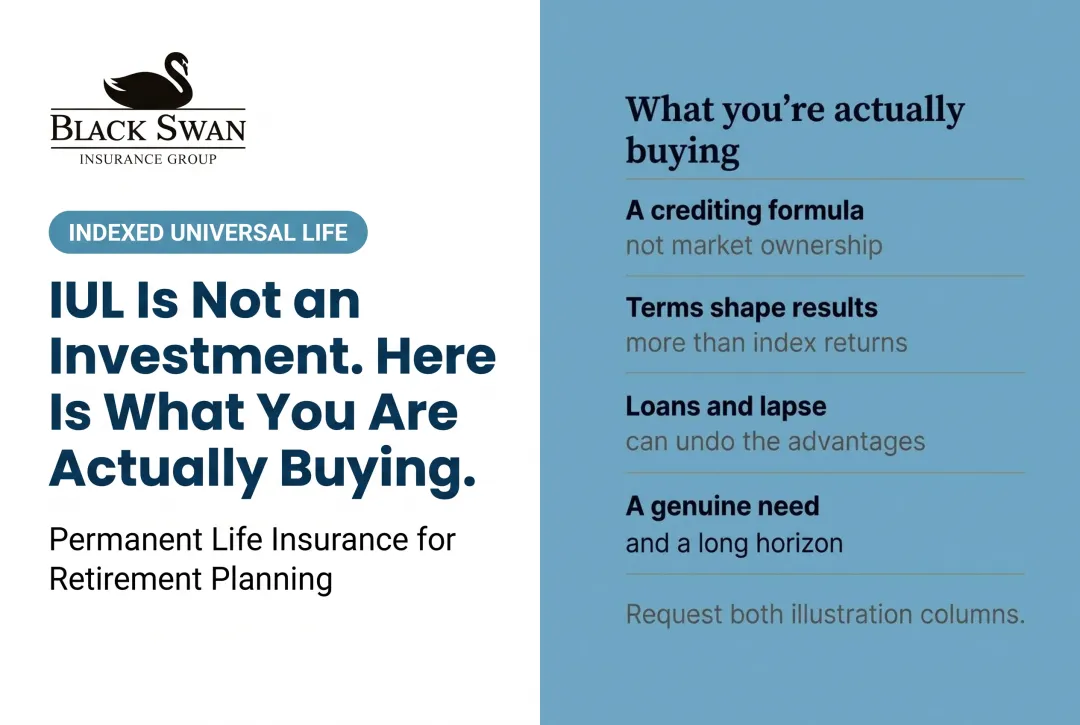
The policy is not invested in the S&P 500 or any index. The insurer uses a formula tied to index performance to decide how much interest to credit. You are not buying shares.
| Feature | Bank account | IUL policy |
|---|---|---|
| Issued by | Bank or credit union | Life insurance carrier |
| Primary purpose | Transactions, savings, liquidity | Permanent death benefit protection |
| Deposit protection | FDIC-insured up to $250,000 per depositor, per bank | Not FDIC-insured; backed by the insurer's claims-paying ability |
| Access to funds | Immediate withdrawal | Loans or withdrawals, subject to policy terms |
| Fees | Minimal or none | Cost of insurance, admin charges, surrender charges |
The FDIC insures deposit accounts up to $250,000 per depositor, per insured bank, per ownership category, covering checking, savings and CDs. Life insurance sits entirely outside that protection.
A bank may refer you to an insurance product or help finance one. It does not issue or administer the policy. A licensed life insurance carrier does, and that carrier's financial strength is what stands behind the guarantees.
How the Policy Actually Works
Every premium splits. Part covers policy charges including the cost of insurance and administrative fees. What remains contributes to cash value.
The Terms That Decide Your Credit
- Floor — the minimum crediting rate for an indexed strategy, often 0%
- Cap — the maximum rate the policy can credit, however well the index performs
- Participation rate — the percentage of index gains reflected in the credit
- Index allocation — many policies let you split cash value between indexed strategies and a fixed account
Per Guardian Life's overview of indexed universal life, a 0% floor does not guarantee total policy value will not decline. Cost of insurance, fees, loans and withdrawals can still reduce it.
Zero is your hero in a down year — but the floor applies to the credit, not to the charges. A bank account does not charge you a mortality cost. This one does, every month.
Premiums are flexible, with limits. The policy needs enough cash value or funding to cover ongoing charges. Skip too many payments, or underfund from the start, and it lapses.
Reaching the Money
- Withdrawals — permanently removing value, reducing cash value and potentially the death benefit
- Policy loans — borrowing against cash value while it continues earning credits, with interest accruing and careful management required
The failure mode to understand: insufficient funding, high charges, weak crediting or an unmanaged loan can drain cash value quickly — quickly enough to lapse the policy entirely.

What the Critics Get Right
The people who bristle at banking language attached to insurance products are right, and it is worth saying so plainly.
They are right that "be your own bank" is marketing, not a product feature, and that it invites people to picture liquidity that a surrender schedule specifically prevents. They are right that the absence of FDIC protection is rarely volunteered. And they are right that an illustration promising tax-free access is describing a conditional outcome in unconditional language.
Where the criticism runs out is the underlying contract. Permanent life insurance is a legitimate thing to own when you need permanent coverage. The problem is not the policy — it is the vocabulary it gets sold in, and the buyers who were never going to need it.
Benefits, Costs and Risks
What it genuinely offers: permanent death-benefit protection that does not expire; tax-deferred cash value growth under current rules; flexible funding that can adapt to changing cash flow; and access to cash value without liquidating market investments.
Any potential tax-advantaged access is conditional on the policy being properly structured, funded and managed. Consider one only with a genuine long-term protection need — estate planning, business succession or legacy goals. It is a poor short-term savings vehicle, full stop.
What to find in the illustration:
- Cost of insurance charges, which rise with age and reduce cash value
- Administrative and premium expense charges taken from premiums or account value
- Surrender charges, heaviest in the early years
- Rider charges for optional benefits you may not need
- Loan interest rates if you borrow against cash value
Index-linked crediting is not direct market investing. Upside is limited by caps and participation rates, dividends are generally excluded, and none of it is guaranteed.
Loans and Tax
- Loans accrue interest and reduce the net death benefit
- Loans generally are not taxable when taken, while the policy stays in force
- Withdrawals above your basis are taxable
- If a policy with an outstanding loan lapses or is surrendered, unpaid debt can create taxable income to the extent of gain in the contract, per Prudential's disclosure on indexed universal life
Caps, participation rates and illustrated returns change over time and vary by carrier. Never rely on an old illustration or a figure from an article. Verify against a current carrier document.
How It Compares
Against a savings account. A high-yield savings account offers immediate access and FDIC protection within limits. An IUL offers permanent insurance and long-term cash-value potential with more complexity, real fees and slower liquidity. Different jobs entirely.
Against a 401(k). A 401(k) offers employer matching, statutory contribution limits and an investment menu. An IUL offers a death benefit and index-linked crediting, with no match and no direct market investment. Before redirecting a dollar from the plan, confirm you are capturing the full match — that is almost always the higher-priority decision.
Against term and whole life.
- Term insurance — affordable, temporary death-benefit protection with no cash value, and the right answer whenever the need has an end date
- Whole life — guaranteed premiums and guaranteed cash value growth
- IUL — flexible premiums and index-linked crediting, more upside potential and fewer guarantees than whole life
One clarification worth making: "infinite banking," the strategy of using policy loans as a personal financing source, is most commonly associated with dividend-paying whole life, not IUL. The guarantees and crediting mechanics differ enough that treating them interchangeably produces bad plans.

A Quick Decision Framework
- Need immediate liquidity? A savings account wins, and it is not close
- Want guaranteed growth? Whole life fits better
- Employer match uncaptured? The 401(k) comes first
- Need affordable temporary coverage? Term insurance is more cost-effective
- Need permanent protection with sustainable long-term funding? A policy may deserve a closer look
The Ultimate IUL Blueprint
If the last box is the one you tick, the Blueprint covers the design decisions that follow: funding levels, the MEC line, loan timing and what to demand from an illustration.
Who This Fits
Stronger Fit
- A genuine, lasting need for permanent insurance protection
- Household income of $150K+ with stable finances and the capacity to keep funding on track
- Emergency reserves already in place and tax-advantaged retirement accounts already funded
- Beneficiaries and income needs clearly defined
- Premiums sustainable through a career change, business downturn or late-start retirement window
- Willingness to review the contract every year
Weaker Fit
Not everyone should buy an IUL. If the pitch you heard involved banking on yourself, the product being described is not what the contract does.
- Liquidity, simplicity, low cost or guaranteed outcomes matter more right now
- No permanent protection need — where coverage is temporary, term insurance is the responsible answer
- Emergency reserves are thin or high-interest debt is running
- The employer match is not fully captured
- You are looking for a place to park cash, which is what a savings account is for
Evaluating a Proposal
Compare multiple carrier designs. Do not rely on one illustration, and do not limit yourself to whatever product a bank happens to distribute. Work with an independent licensed professional who can compare across carriers.
In any illustration, check:
- Guaranteed and non-guaranteed columns side by side
- Policy charges and how they change over time
- Surrender values and the break-even timeline
- Loan assumptions and their effect on the death benefit
- Projections at lower, more conservative crediting rates
Stress-test the funding. Ask what happens if premiums are reduced, paused or delayed. A policy that only works under perfect funding is a fragile policy.

The application process: submit financial and health information; complete underwriting, often including a medical exam; receive carrier approval and terms; take policy delivery and pay the first premium; select allocations among indexed strategies and any fixed account.
Risks to Understand Before You Fund One
- It is not a bank product and carries no FDIC protection — guarantees depend on the insurer's claims-paying ability
- Charges continue in a 0% crediting year, so cash value can fall with the floor intact
- Cost of insurance rises with age and is deducted every month
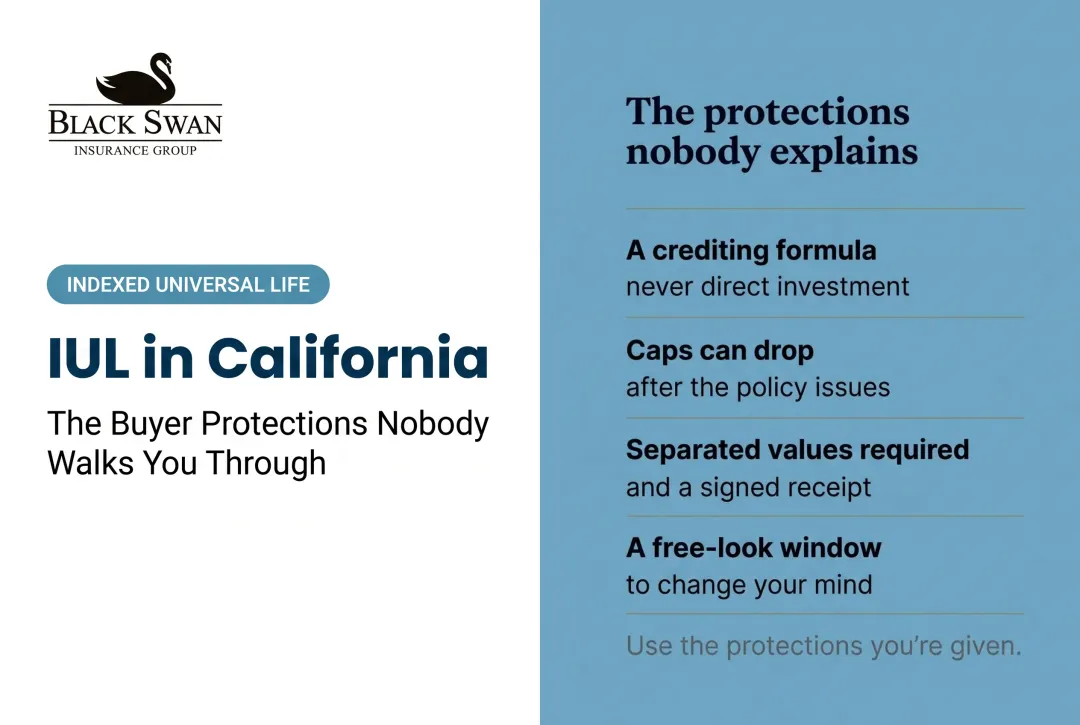
- Caps and participation rates are non-guaranteed and can be reset after you commit
- Surrender charges make the early years the worst time to need the money, which is also when people most often do
- Underfunding causes lapse, and flexible premiums make drifting easy
- Loans reduce the death benefit and accrue interest, and a lapse or surrender with a loan outstanding and gain in the contract can create taxable income with no cash received
- Crossing the seven-pay limit makes the contract a MEC under I.R.C. § 7702A and changes distribution taxation
- Dividends are excluded from index crediting, so it is not comparable to a total-return benchmark
Find Out Where You Actually Stand
This starts with the Tax-Free Wealth Blueprint Fit Review. If you earn $150K+ and have been looking at this as somewhere to put money, we start with what job actually needs doing — liquidity, protection, tax diversification — and price the right tool for it. If it does not fit, we will tell you that too, and "keep it in the savings account" is a legitimate answer.
Frequently Asked Questions
Can I get an IUL through my bank?
A bank may refer, distribute or help finance one, but a licensed life insurance carrier issues the policy. Compare any bank-offered option against independent alternatives before deciding.
Is an IUL FDIC-insured?
No. FDIC protection covers deposit accounts at insured banks. Life insurance sits outside it entirely, and the guarantees rest on the issuing insurer's claims-paying ability.
How much do I need to start one?
There is no universal starting premium. It depends on age, health, desired death benefit, carrier requirements and design. Fund at a level you can sustain long term, not the minimum that merely keeps it open.
How does an IUL pay out?
Beneficiaries receive the death benefit when the insured dies. While the policy is in force, the owner can separately access cash value through withdrawals or policy loans, each with consequences.
Is it better than a 401(k)?
They serve different purposes. Compare employer matching, tax treatment, contribution limits, investment choice and liquidity before redirecting money from one to the other — and capture the match first.
Is this the same as infinite banking?
No. That strategy is usually built on dividend-paying whole life, which has different guarantees and crediting mechanics. Treating the two as interchangeable produces plans that do not work.
Sources
- FDIC — Understanding deposit insurance
- Guardian Life — Indexed universal life
- Prudential — Indexed universal life insurance
- NAIC — Life Insurance
- I.R.C. § 7702A and Rev. Proc. 2008-39 (modified endowment contracts and the seven-pay test)
Disclosure: This article is educational and is not personal tax, legal or investment advice. Indexed universal life is life insurance first and is not a bank product; it is not FDIC-insured, and guarantees are subject to the claims-paying ability of the issuing insurer. Actual results depend on policy design, carrier, crediting options, caps, participation rates, expenses, funding and ongoing management. Policy loans and withdrawals may reduce cash value and death benefit and can create tax consequences if the policy lapses or becomes a modified endowment contract. This strategy is not appropriate for everyone. Illustrated values are not guarantees; actual results depend on policy terms, crediting, costs and funding. Consult your own tax, legal and financial professionals for advice specific to your situation.
And remember, it's not what you earn, it's what you keep… enjoy the ride.