By Robert Balgac, Founder, Black Swan Insurance Group | October 9, 2026
If you earn $150K+, you have maxed the 401(k), and you are now being shown an index-linked insurance contract, there is a decent chance two very different products have been placed in front of you as though they were competing versions of the same idea. A fixed index annuity and an indexed universal life policy do share a vocabulary — caps, participation rates, spreads, index crediting. They do not share a job.
That shared vocabulary is the trap. Both are insurance contracts. Both link interest credits to an external index. Both are tax-deferred. And both are frequently sold by the same person in the same meeting, which makes it very easy to end up with an annuity when what you actually needed was permanent protection, or a life policy when what you actually needed was a payment that keeps arriving after the account value is gone.
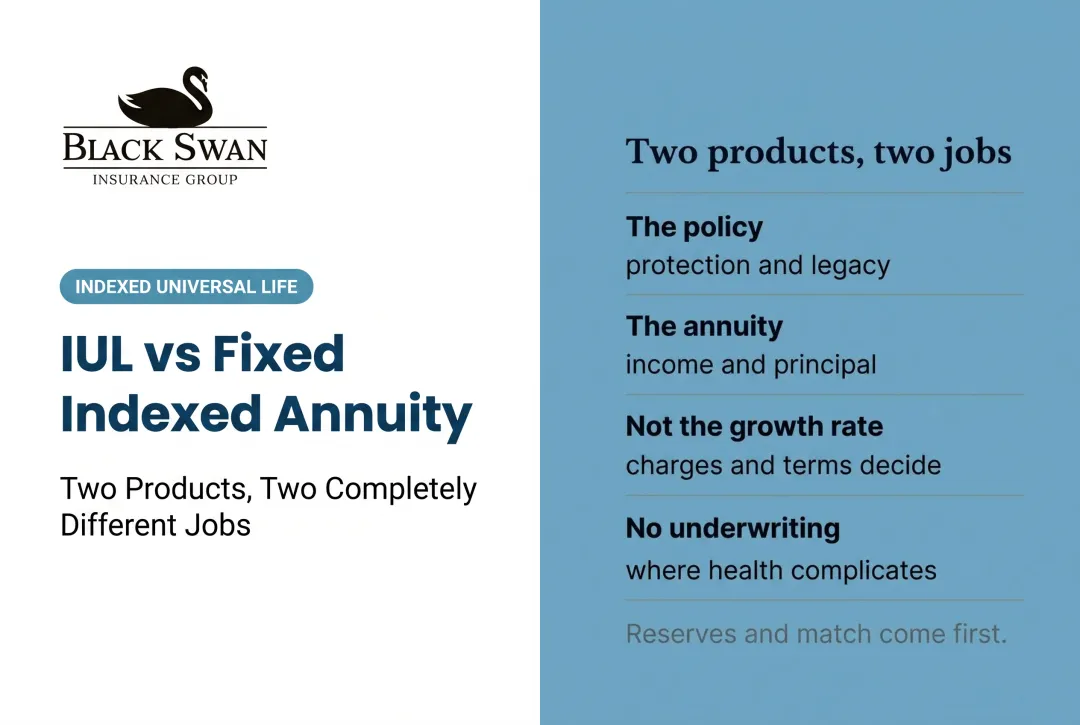
The short answer: A fixed index annuity exists to accumulate money and convert it into retirement income, usually with contractual income guarantees and a six-to-ten-year surrender schedule. An IUL is permanent life insurance first — a death benefit at the core, cash value second, and potential tax-advantaged access when properly structured, funded and managed third. The correct answer for you is one, both, or neither, and it depends entirely on which problem you are actually solving.
Start with the problem, not the product. That sounds obvious until you are sitting in front of an illustration with an attractive number on the cover page.
Key Takeaways
- Both credit interest from an index formula — you own neither the index nor the underlying stocks
- FIA is built for income and longevity risk; lifetime income usually requires annuitization or a paid rider
- IUL is life insurance first; results depend on funding, charges and loan management
- A 0% floor limits a negative index credit — it does not stop policy charges in a flat or down year
- FIA surrender charges often run six to ten years; IUL access is debt or a reduction, not a withdrawal from a savings account
- The right answer may be neither, if term life plus a 401(k) and Roth strategy already covers the goal
The Comparison, Stated Plainly
| Factor | Fixed Index Annuity | IUL |
|---|---|---|
| Purpose | Grow assets and convert them into retirement income | Permanent life insurance with a cash value component |
| Primary benefit | Principal-protection features; optional contractual income | Death benefit plus potential cash value growth |
| Index crediting | Caps, participation rates and spreads set credited interest | Caps, floors and participation rates shape account value, net of charges |
| Access / liquidity | Surrender charges, free-withdrawal limits, possible market value adjustment | Loans and withdrawals reduce cash value and death benefit |
| Best starting question | Do I need dependable retirement income? | Do I have a lasting insurance need I can fund long-term? |
The Crediting Mechanics Are Cousins, Not Twins
With either contract you are not invested in the index. The insurer credits interest from a formula tied to index performance, and you do not own the underlying stocks or funds — a point the NAIC fixed annuity buyer's guide makes without hedging.
The structural difference sits underneath. A fixed index annuity applies the crediting formula at the end of each term and that is largely the end of the story for that period. An IUL applies a similar formula to cash value, then subtracts cost of insurance, administrative charges and any rider costs — whether the index rose, fell or sat still.

Liquidity Is Where People Get Hurt
Liquidity rules are product-specific, and conflating them is one of the most expensive planning mistakes in this category.
- Fixed index annuities: surrender charges often run six to ten years, per FINRA
- Free withdrawals: many contracts permit a penalty-free amount, often up to 10% per year, but the exact limit is contract-specific and you should read it rather than assume it
- IUL access: loans and withdrawals are debt against, or reductions of, cash value. An unpaid loan that lapses the policy can create a tax bill with no cash arriving to pay it
Neither product is an emergency fund. If you do not have liquid reserves outside the contract, you are not ready for either one.
What a Fixed Index Annuity Actually Does
An FIA is an insurance contract. Interest credits are based partly on an external index, with a contractually defined minimum value that protects you from direct index losses. Guarantees vary by carrier and contract — verify the actual terms before you lean on them.
During accumulation, your premium sits in one or more crediting strategies, often alongside a fixed-interest option. Caps, participation rates or spreads limit how much interest you earn even in a strong index year. That limit is the price of the floor, and it is not a hidden fee — it is the trade.
During the income phase, you typically choose among taking withdrawals or systematic distributions; annuitizing for payments over a set period or for life; or adding an optional income rider for guaranteed lifetime withdrawals, usually at extra cost. These are not interchangeable. Annuitizing generally means surrendering access to the remaining account value in exchange for the payments.
The NAIC describes a common income-rider mechanic that is worth understanding precisely: payments can continue for life even if withdrawals drive the account value to zero. That continuation promise is the guarantee. Future index credits and the eventual account value are separate, non-guaranteed questions, and conflating the two is how buyers end up disappointed by a contract that did exactly what it said it would.
What an FIA Costs You
Potential principal protection, tax-deferred accumulation and reduced exposure to direct market losses are real. So are these:
- Surrender charges and limited liquidity in the early contract years
- Inflation risk, since many fixed payouts carry no cost-of-living adjustment
- Insurer credit risk tied to the issuing company's claims-paying ability
- Rider costs that reduce net returns
- Credited interest that can land well below an illustration's headline rate
What an IUL Actually Does
Indexed universal life is permanent life insurance. Death benefit, flexible premium within policy limits, and cash value that may receive index-linked interest credits. At Black Swan we treat it as permanent protection first, with cash value growth as the secondary benefit — never the headline.
Every premium dollar splits among cost of insurance, administrative charges, rider costs and cash value allocation. Paying only the policy minimum rarely produces the outcome shown in an illustration. That is how universal life contracts are built; it is not a hidden catch.
The Floor Misconception
IUL crediting uses caps, participation rates, floors and spreads — the same vocabulary as an FIA, applied to a life insurance chassis. A 0% crediting floor protects you from a negative index credit. It does not protect you from policy charges eroding cash value in a flat or down year.
Zero is your hero in a down year — but the floor applies to the credit, not to the charges.

Living access runs through withdrawals and policy loans, and each carries consequences. Loans accrue interest and reduce the death benefit if unpaid. Withdrawals reduce cash value and future growth potential. An unpaid loan combined with a lapse can create a taxable event nobody planned for. And favourable tax treatment on access depends on the policy staying in force and avoiding modified endowment contract status.
Who an IUL Suits
Affluent professionals, executives and business owners with a genuine permanent insurance need and the cash flow to fund a long commitment. We pay particular attention to late-start high earners, typically ages 45 to 55, who reached peak income later and face a compressed runway for retirement, tax diversification and legacy planning.
For that group the sequence is fit and funding capacity first, caps and crediting formulas last:
- Age and insurability
- Years realistically available for funding
- Whether existing retirement contributions already cover the goal
- Liquidity reserves outside the policy
- Whether IUL complements, rather than replaces, qualified plans
This is not set-it-and-forget-it. It is design-it, fund-it, review-it.
The Ultimate IUL Blueprint
If you are weighing an annuity against a policy, the Blueprint covers what an IUL design has to survive: funding levels, caps and charges, the MEC line, loan timing, and what to demand from an illustration before you sign.
What the Critics Get Right
The strongest criticism of this whole category is that both products are commission-rich, complex enough to be hard to audit, and sold by people who earn more when you buy more. That is true and it deserves to be said out loud rather than discovered later.
The second fair point: illustrated values diverge from guaranteed values over time, often substantially, and the illustration is the main sales document. A headline crediting rate is the least binding number in the file.
An illustration is a model, not a guarantee.
What the criticism usually misses is that complexity is not the same as deception. The caps, the surrender schedule, the 7-pay limit and the guaranteed column are all disclosed, calculable numbers. The failures happen when nobody reads them — and reading them is work the buyer can demand be done in front of them.
Which One Is Better
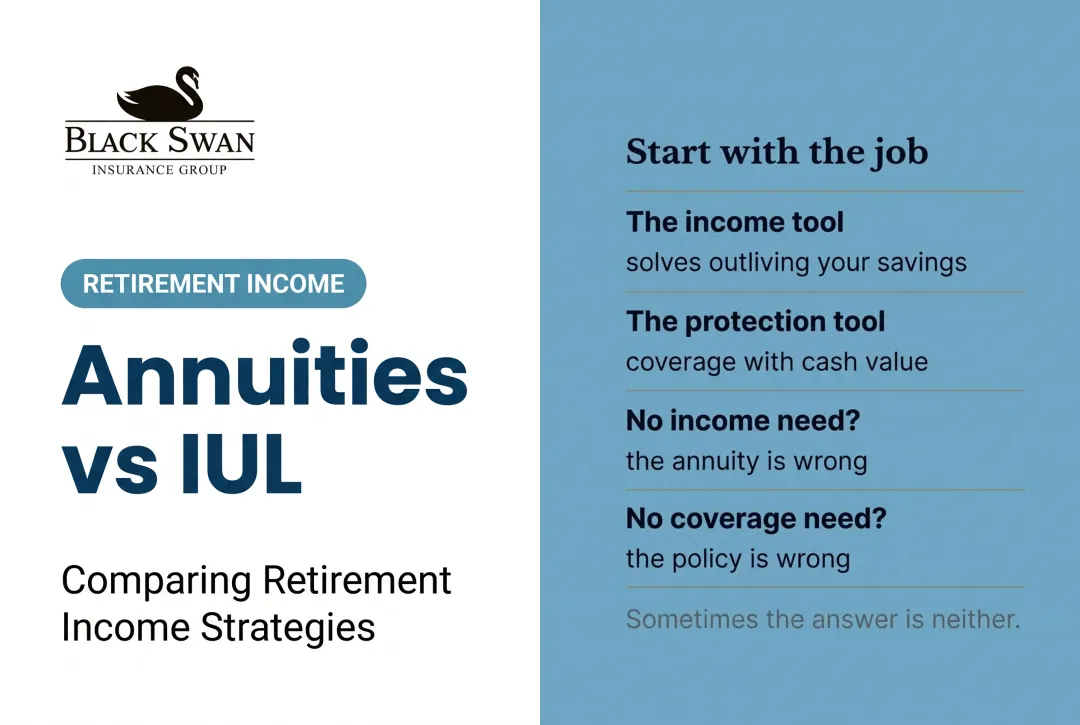
Neither is universally better. One question settles most of it: what does this money have to do first?
- Need predictable retirement income and protection against outliving your assets, and can you accept the surrender terms without needing a primary death benefit? The FIA is usually stronger.
- Need a death benefit for beneficiaries, lasting coverage and multi-year funding capacity? The IUL is usually stronger.
Guarantees Are Not Interchangeable
FIA guarantees typically attach to contract value or income rider features. IUL guarantees depend on how the policy is funded and designed. Both rest on the same foundation — the issuing insurer's financial strength and claims-paying ability. An AM Best rating is an opinion on the insurer, not a promise about your contract.
Taxes, Without the Oversimplification
- FIA distributions before annuitization are taxed income-first, then return of cost basis, under IRS Publication 575 rules for nonqualified annuities. A 10% additional tax can apply before age 59½, with exceptions.
- IUL loans and withdrawals generally avoid current income tax if the policy stays in force and avoids MEC status. Surrender or lapse with an outstanding loan can create taxable income.
- MEC loans are treated as distributions with gain-first taxation and a possible 10% additional tax.

Two Scenarios Worth Reading Carefully
The FIA Income Illustration
A carrier guide modelling a $100,000 fixed index annuity with an optional lifetime income rider showed hypothetical annual income of $15,855 at age 65, $20,637 at age 70 and $25,266 at age 75, assuming a 4% annual growth rate on the income benefit base, per Nationwide's rider guide.

Those figures are explicitly hypothetical. The rider's guarantee is continued lifetime payments if contract value reaches zero — not the illustrated growth rate that produced the numbers.
The IUL Estate Liquidity Case
Carriers position survivorship IUL for couples holding illiquid assets — a family business, real estate — where death benefit proceeds can fund estate settlement without forcing a sale. No universal premium or death benefit figure applies, and continued coverage still depends on funding and any no-lapse guarantee value. This is an estate planning decision before it is a product decision.
Stronger Fit
- Earning $150K+, maxed on qualified plans, with surplus cash flow that survives a weak year
- A genuine permanent insurance need (IUL) or a real longevity-income gap (FIA)
- Liquid reserves held outside the contract
- Willingness to review funding and performance annually
Weaker Fit
This strategy is not appropriate for everyone, and the honest answer for a lot of people is neither product:
- You need short-term liquidity, or the premium would compete with an emergency fund
- You have high-interest debt or unused lower-cost tax-advantaged capacity
- You only need a death benefit for a defined period — buy term, it is cheaper and simpler
- Your income is unstable enough that a multi-year funding commitment is a guess
- You want something you can buy and ignore
Risks to Understand Before You Sign Either Contract
- Surrender schedules bite. An FIA exit inside the surrender period, and possibly a market value adjustment, can cost real principal.
- Charges continue in flat years. An IUL's floor caps the downside of the credit, not the cost of insurance or administrative expenses.
- Caps and participation rates are not fixed for life. Carriers can change them within contract limits.
- Lapse with a loan outstanding is the sharp edge. The loan is not the problem. The unmanaged loan is the problem.
- MEC status is generally permanent and changes loan and withdrawal taxation for good.
- Insurer strength matters more than the brochure. Every guarantee here is a promise from one company.
Find Out Where You Actually Stand
This starts with the Tax-Free Wealth Blueprint Fit Review. If you earn $150K+ and someone has put an annuity and an IUL illustration side by side, we separate the two questions — income certainty versus permanent protection — and test each against your funding capacity, your liquidity outside the contract, and the guaranteed column rather than the illustrated one. Sometimes the answer is an annuity. Sometimes it is a policy. Sometimes it is term plus a brokerage account. If IUL does not fit, we will tell you that too.
Frequently Asked Questions
Fixed index annuity vs IUL — which is better?
Neither universally. An FIA is built for retirement accumulation and income. An IUL is permanent life insurance with potential cash value growth. Suitability turns on your goal, your funding ability and whether you have a real insurance need.
How much monthly income does a fixed index annuity provide?
It depends on principal, age, payout start date, payout type, interest rates and any income rider. Request a current carrier-specific quote rather than relying on a generic figure.
Is a fixed index annuity safer than an IUL?
They carry different risks, not a simple ranking. FIAs carry surrender restrictions and insurer risk. IUL adds policy charges, crediting limits and lapse risk if funding falls short.
Can an IUL replace an annuity for retirement income?
Not automatically. An IUL gives access to cash value through loans and withdrawals, but that is not a contractual income guarantee. Evaluate lapse risk and compare guaranteed against non-guaranteed values first.
Are withdrawals from an FIA or an IUL tax-free?
No. Annuity earnings are generally taxed as ordinary income when distributed. IUL loans may avoid current taxation while the policy stays in force, but surrender, lapse or MEC status changes that.
Can I own both?
Yes. Some households use an FIA for income planning and an IUL for permanent protection. That requires sufficient cash flow, a genuine insurance need and coordination with existing retirement savings — not two separate sales conversations.
Sources
- NAIC — Buyer's Guide to Fixed Deferred Annuities
- FINRA — The Complicated Risks and Rewards of Indexed Annuities
- IRS Publication 575 — Pension and Annuity Income
- Nationwide — lifetime income rider guide
- NAIC — Life Insurance Illustrations
Disclosure: This article is educational and is not personal tax, legal or investment advice. Indexed universal life is life insurance first. Annuity and life insurance contract terms, guarantees, caps, participation rates, surrender schedules and state availability vary by carrier and must be confirmed in the contract. Illustrated values are not guarantees; actual results depend on policy terms, crediting, costs and funding. Actual results depend on policy design, carrier, crediting options, caps, participation rates, expenses, funding and ongoing management. This strategy is not appropriate for everyone. Policy loans and withdrawals reduce cash value and the death benefit, and can create tax consequences if the policy lapses or becomes a modified endowment contract. All guarantees are subject to the claims-paying ability of the issuing insurer. Consult your own tax, legal and financial professionals for advice specific to your situation.
And remember, it's not what you earn, it's what you keep… enjoy the ride.