By Robert Balgac, Founder, Black Swan Insurance Group | October 5, 2026
An indexed universal life policy and a fixed indexed annuity both use a market index to determine interest credits. That is where the similarity ends, and the confusion begins.
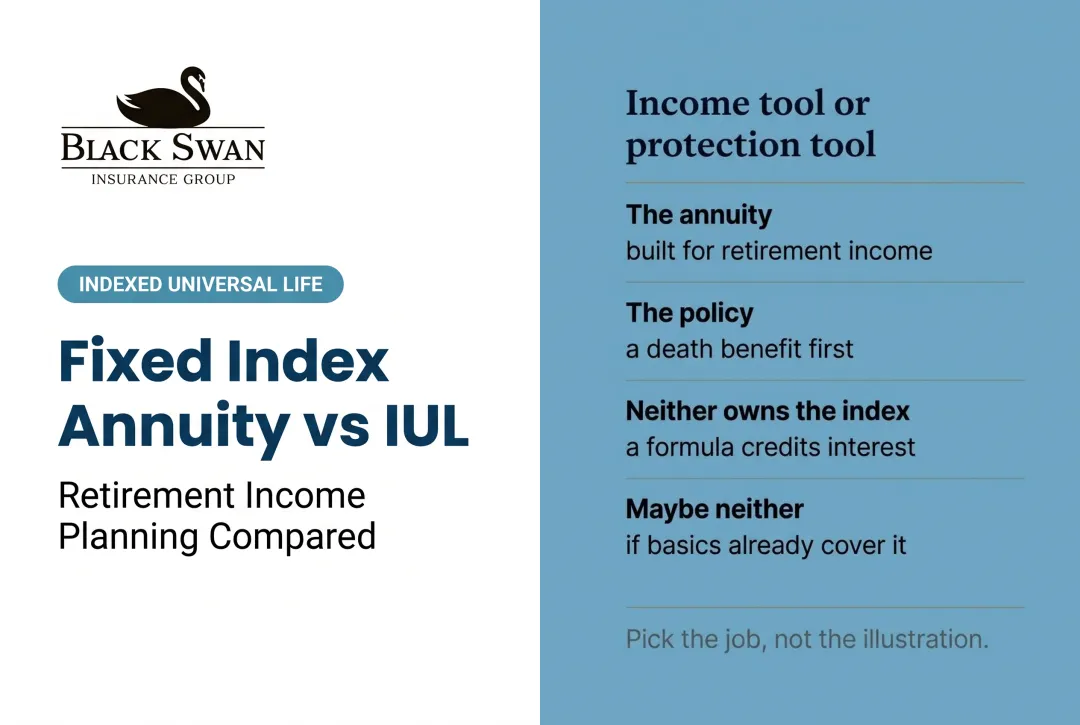
An IUL is a life insurance policy built around a death benefit. An FIA is an annuity contract built around retirement income. They get conflated because both promise growth potential without direct market losses, and that shared headline hides the fact that they solve opposite problems.
Buy the wrong one and a family ends up underinsured, or a retiree ends up without the income guarantee they were actually after. The mismatch also locks you into surrender charges or coverage you never needed.
The short answer: An IUL is permanent life insurance with a death benefit and cash value. An FIA is an annuity built for tax-deferred accumulation and income, with no meaningful life insurance component. Choose the policy for permanent protection and legacy goals; choose the annuity for income guarantees and principal protection. Judge neither on its illustrated growth rate — review caps, charges, surrender terms and guarantees. Most strong plans use qualified accounts, Roths, brokerage assets and term coverage first, and reach for either of these only when a specific job remains.
Key Takeaways
- IUL is permanent life insurance with a death benefit and cash value; FIA is an annuity for accumulation and income
- Pick the policy for permanent protection and legacy; pick the annuity for income guarantees and principal protection
- Do not judge either by its illustrated growth rate — caps, charges, surrender terms and guarantees decide the outcome
- An FIA usually requires no medical underwriting, which matters where health would complicate a policy
- Neither belongs in the plan before reserves, debt payoff and the employer match are handled
The Core Comparison
Both fall under state insurance regulation and both use index-linked crediting. Their contractual purpose diverges sharply.
| Factor | IUL | FIA |
|---|---|---|
| Purpose | Permanent life insurance, with cash value as a secondary feature | Annuity contract for accumulation and income |
| Death benefit | Core feature, sized by underwriting and design | Not life insurance; beneficiary value depends on contract terms |
| Retirement income | Via withdrawals or loans, with no contractual lifetime guarantee | Via annuitisation or an optional income rider, subject to rider costs |
| Funding | Requires medical underwriting and ongoing premium | Often no medical exam; funded by lump sum or rollover |
| Liquidity | Loans and withdrawals reduce cash value; excess borrowing risks lapse | Free-withdrawal provisions apply; surrender charges beyond that |
Why Purpose Decides Everything
An IUL exists first to pay a death benefit. The NAIC describes it as permanent life insurance with interest credits tied to an external index and a guaranteed minimum rate. Cash value is a byproduct of the insurance structure, not the primary contract.
An FIA is a deferred annuity — a fixed annuity earning interest based on index changes, with an accumulation period followed by a payout period. It carries a basic death benefit, and that is a secondary feature rather than the reason the contract exists.
Demand reflects both roles. IUL sales hit a new annualised-premium record in 2024, up 4% year over year, per LIMRA's 2024 individual life insurance sales report. FIA sales have risen too, largely among pre-retirees focused on income guarantees.
How the IUL Works
Permanent life insurance with a cash-value account credited on an index-linked formula. The policy does not invest in the index, so you own no shares and receive no dividends.
- Premium allocation and cost of insurance — part of each payment covers the death benefit, and that cost rises with age
- Floor and cap — a floor, often 0%, protects against a negative index credit; a cap limits the maximum
- Participation rate — the share of index gain actually credited
- Guaranteed versus non-guaranteed — every illustration shows both, and only the guaranteed column is contractually promised
What it offers the right buyer: lifetime legacy protection rather than a term period; tax-deferred cash-value growth with potential tax-advantaged access through withdrawals or loans when the policy is properly structured, funded and managed; premium flexibility within contract limits, useful for variable-income professionals; and supplemental access without RMDs applying to the policy itself.

Where it goes wrong: lapse risk when cash value cannot cover rising insurance costs, especially after underfunding or heavy loans; loan drag, where outstanding balances reduce the death benefit and can create a taxable event if the policy lapses with debt attached; and long funding horizons, since early surrender charges and underwriting make it a poor fit for short-term goals.
Zero is your hero in a down year — but the floor applies to the credit, not to the charges.
How the FIA Works
An insurance contract crediting interest based on an external index while generally shielding accumulated value from direct index losses.
- Accumulation value — the money actually in the contract
- Index-crediting method — annual point-to-point, monthly point-to-point, or averaging
- Cap, participation rate and spread — each can reduce credited interest below the raw index return
- Income-benefit base — a separate figure used for lifetime withdrawals under an optional rider, and not the cash-out contract value
That last distinction matters enormously and gets glossed over routinely. The benefit base is not money you can walk away with.
The downside protection. Per NAIC's Buyer's Guide to Fixed Deferred Annuities, if the index declines during a measurement period the contract credits zero interest rather than a loss, provided no money is withdrawn during that period.
The trade-offs: caps and spreads prevent you capturing a strong market year in full; guaranteed lifetime withdrawal benefits usually require a separate rider fee; and surrender periods commonly restrict access for six to ten years, sometimes longer.
Because FIAs do not require medical underwriting, they remain accessible to buyers whose health would complicate a life policy. For a retiree focused purely on income, that is a genuine advantage.
What the Critics Get Right
Both products attract criticism, and most of it lands.
Critics are right that the shared "index-linked, no market loss" headline is used to blur two products that do opposite things, and that the blurring usually favours whoever is selling. They are right that surrender periods on both are longer than buyers expect and that early exit can mean a real loss. And they are right that the income benefit base on an annuity gets quoted as though it were a balance, when it is not.
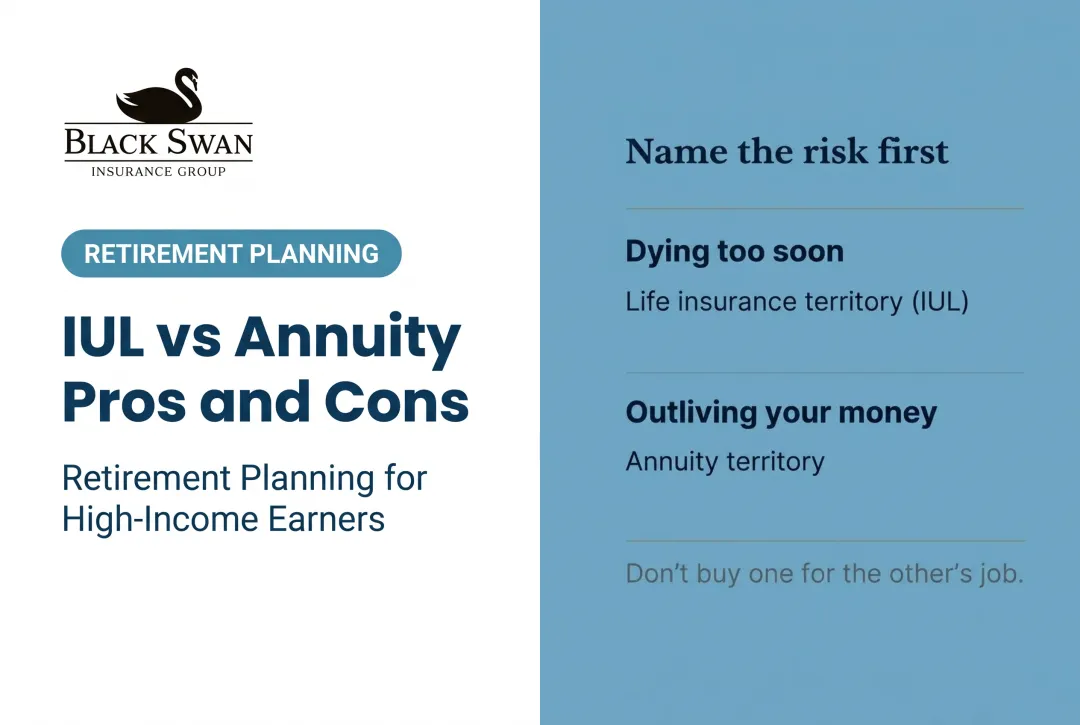
Where the criticism stops is that both address risks that are genuinely real. Longevity risk is real; so is the risk of a family losing an earner. The problem is not that these products exist — it is that they are frequently sold to people carrying the other risk.
Which One Fits
Stronger Fit for an IUL
- A genuine permanent death-benefit need standing on its own merits
- Household income of $150K+ with surplus cash flow, insurable, able to commit to sustainable long-term funding
- Legacy planning and flexible cash-value access matter more than a lifetime income guarantee
- Already maxing employer plans, IRAs or Roths and seeking tax diversification alongside protection
- Late-start high earners, roughly 45 to 55, with a shorter runway but enough time and insurability to fund responsibly
Stronger Fit for an FIA
- Retirement income and principal protection outrank a death benefit
- A rollover or non-qualified lump sum to deploy, and a wish to reduce longevity risk without buying more life insurance
- Protection needs already covered, and a wish for guaranteed income alongside Social Security and pensions
- Health conditions that would complicate life insurance underwriting
- Willingness to accept a multi-year surrender period in exchange for income guarantees
Weaker Fit for Either
Not everyone should buy an IUL. If you need income rather than a death benefit, the annuity is the correct tool and the comparison ends there.
- Emergency reserves are missing
- Near-term liquidity is needed
- Premium payments cannot be sustained
- The actual need is low-cost temporary protection — term insurance covers that far better than either product
- High-interest debt is still running
FINRA warns that exiting an indexed annuity early can mean a real loss once surrender charges and potential tax penalties apply. The same caution applies to surrendering an underfunded policy.
The Ultimate IUL Blueprint
If the protection side is where you land, the Blueprint covers the design decisions that follow: funding levels, the MEC line, loan timing and what to demand from an illustration.
Due Diligence Before Either
- Guaranteed values against current, non-guaranteed assumptions
- Caps, participation rates and spreads — and whether the carrier can change them
- Surrender schedules and loan provisions
- Insurer financial-strength ratings from AM Best, S&P or Moody's
- Compensation and commission disclosures
- What happens if you stop paying premiums or start withdrawing early

Three Households, Three Answers
Illustrative, not documented client outcomes. Actual results depend on underwriting, funding and contract terms.
The high-income professional. A 47-year-old physician with strong cash flow, no immediate income need, and dependents relying on his income, already maxing the 401(k). A permanent protection need plus a long funding runway makes an IUL worth evaluating — provided the illustration shows he can sustain premiums through retirement without leaning on optimistic crediting.
The pre-retiree seeking income. A 61-year-old teacher retiring in four years, wanting predictable income and no exposure to another downturn. An FIA with a guaranteed lifetime withdrawal rider fits her priorities better. She has no ongoing life insurance need and values the surrender-period trade for income certainty.
The business owner. A 50-year-old practice owner with both a legacy goal and an income gap outside the practice's value. The honest answer is probably a combination — term or permanent coverage for protection, plus other retirement-income tools alongside. Not one product doing every job.

In every case the next step is identical: ask for side-by-side guaranteed and non-guaranteed illustrations, and ask how the plan performs if premiums change, index credits run low, or the contract is surrendered early.
The product is not the strategy. The design is the strategy — and choosing the wrong product entirely is a design failure before anyone opens the illustration.
Risks to Understand Before You Choose
- Buying the wrong category is the biggest risk here: a family underinsured, or a retiree without the income guarantee they needed
- Charges continue in a 0% crediting year inside a policy, so cash value can fall with the floor intact
- Cost of insurance rises with age and is deducted regardless of index performance
- Caps, participation rates and spreads are non-guaranteed on both products
- The income benefit base on an annuity is not a cash-out value
- Surrender periods run six to ten years or longer on an FIA and a decade or more on a policy
- Rider fees reduce what a guaranteed lifetime withdrawal benefit actually delivers
- Loans reduce the death benefit, and a lapse with a loan outstanding and gain in the contract creates taxable income
- Crossing the seven-pay limit makes a policy a MEC and changes distribution taxation permanently
Find Out Where You Actually Stand
This starts with the Tax-Free Wealth Blueprint Fit Review. If you earn $150K+ and are being shown both of these, we start by identifying which risk you are actually carrying — protection or longevity — then compare only the product that addresses it, on guaranteed terms. If it does not fit, we will tell you that too, and "neither of these" is a legitimate outcome.
Frequently Asked Questions
What is the main difference?
Purpose. An IUL is life insurance with cash value; an FIA is an annuity for accumulation and income. They use similar crediting language to solve opposite problems.
Can an FIA replace life insurance?
No. Its death benefit is a secondary contract feature, not protection sized to a family's need. If protection is the requirement, a life policy — often term — is the answer.
Do I need underwriting for an FIA?
Usually not, which makes it accessible where health would complicate life insurance. That accessibility is a real advantage for retirees focused on income.
Which provides guaranteed income?
An FIA, via annuitisation or an optional rider with its own cost. A policy provides access through loans and withdrawals, with no contractual lifetime guarantee.
Is the income benefit base my account value?
No, and confusing the two is a common and costly error. The benefit base supports rider withdrawals; the accumulation value is what you could actually walk away with.
Should I buy term insurance instead?
If the need is temporary protection, yes — term is cheaper and cleaner than either of these, and it deserves pricing first.
Sources
- NAIC — Buyer's Guide to Fixed Deferred Annuities
- FINRA — The complicated risks and rewards of indexed annuities
- LIMRA — 2024 individual life insurance premium record
- NAIC — Life Insurance
- I.R.C. § 7702A and Rev. Proc. 2008-39 (modified endowment contracts and the seven-pay test)
Disclosure: This article is educational and is not personal tax, legal or investment advice. Indexed universal life is life insurance first; a fixed indexed annuity is not life insurance. Guarantees on either product are subject to the claims-paying ability of the issuing insurer. Actual results depend on contract design, carrier, crediting options, caps, participation rates, expenses, funding and ongoing management. Policy loans and withdrawals may reduce cash value and death benefit and can create tax consequences if a policy lapses or becomes a modified endowment contract. Early surrender of either contract can result in a loss. This strategy is not appropriate for everyone. Illustrated values are not guarantees; actual results depend on policy terms, crediting, costs and funding. Consult your own tax, legal and financial professionals for advice specific to your situation.
And remember, it's not what you earn, it's what you keep… enjoy the ride.