By Robert Balgac, Founder, Black Swan Insurance Group | October 9, 2026
If you earn $150K+, you have maxed the 401(k), and someone has suggested an indexed universal life policy as "the better 401(k)," you are right to be suspicious. The framing is wrong, and the people using it are usually selling.
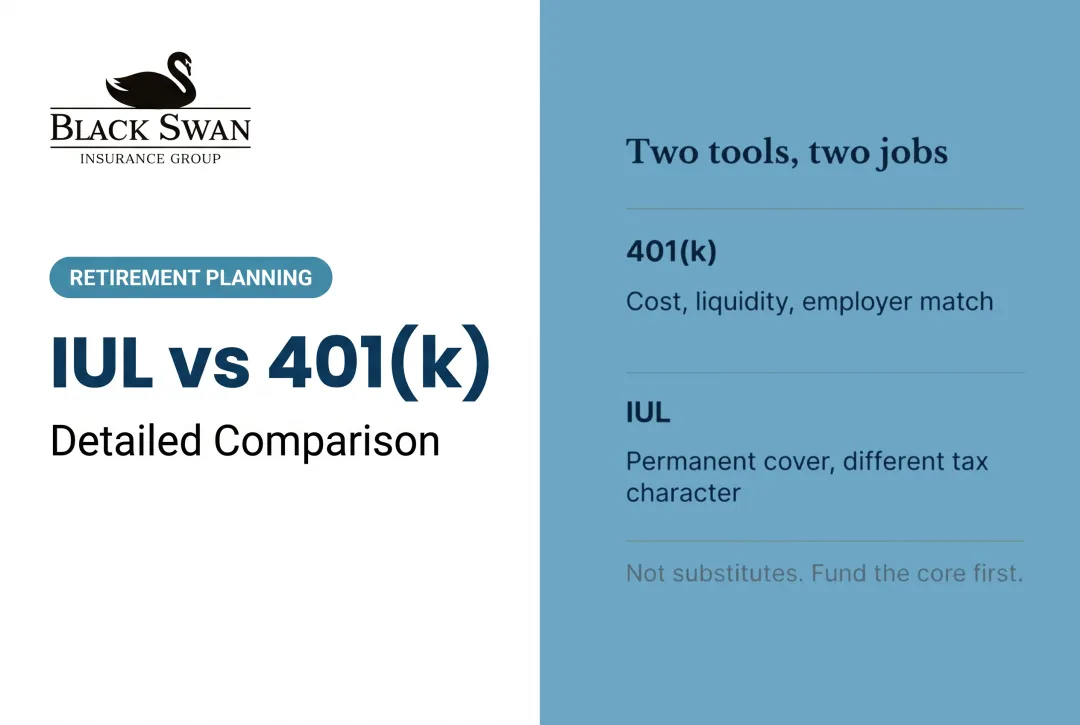
A 401(k) is an employer-sponsored retirement plan built to accumulate savings through payroll deferrals and, often, a matching contribution. An IUL is permanent life insurance. It carries a death benefit, and its cash value is credited based on an external market index, not through direct investment in the market. Those are different instruments doing different jobs, and the comparison only becomes useful once you stop asking which one wins.
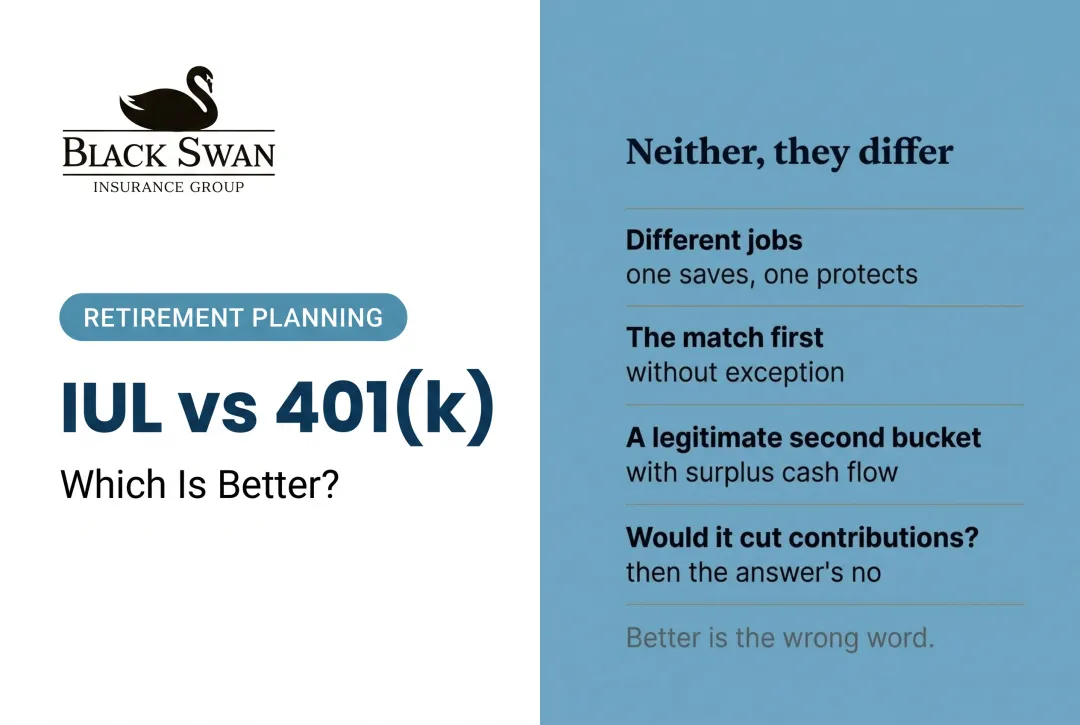
The short answer: They are not substitutes. Capture every dollar of employer match first — no insurance illustration beats an unmatched match. Then, if you have a genuine permanent protection need and surplus cash flow that survives a bad year, an IUL can sit alongside the 401(k) as a differently-taxed second bucket. It is not a replacement for one.
The 401(k) is not the villain. A one-bucket retirement plan is the villain.
For high-income professionals, business owners and families balancing tax planning, protection and retirement funding, treating these two as interchangeable creates tax, liquidity and protection gaps. This is life insurance first — and a retirement account is not insurance at all.
Key Takeaways
- An IUL is permanent life insurance with index-linked cash value; a 401(k) is a retirement savings account
- 401(k)s offer employer matching and low-cost market exposure; IULs offer permanent protection and loan access
- Index floors limit negative crediting — they do not cancel ongoing policy charges
- Capture the employer match first, always
- Consider an IUL only with a real insurance need and premiums you can sustain through a bad year
- A 401(k) cannot be rolled into an IUL; funding premiums from a distribution is a taxable event
The Comparison That Matters
Before comparing numbers, compare purpose.
Primary purpose. The IUL is built on lifelong protection, with cash value accumulating as a secondary feature that may support supplemental income later. The 401(k) exists to build retirement savings through deferrals, employer contributions and an investment menu.
Tax treatment. IUL cash value grows tax-deferred, and loans and withdrawals may receive favourable treatment if the policy stays in force and is not a Modified Endowment Contract — subject to how it is managed and to current tax law. Traditional 401(k) contributions defer taxes until withdrawal; a Roth 401(k) uses after-tax dollars with tax-free qualified withdrawals after five years and a qualifying event such as age 59½.
Contributions and costs. An IUL has no employee-style deferral cap, but premiums must stay within IRS life-insurance limits and remain affordable for decades. Expect cost-of-insurance charges, administrative fees and possible rider costs. For 2026, the IRS basic employee deferral limit is $24,500, with an $8,000 catch-up at 50+ (or $11,250 at ages 60–63 in place of the standard catch-up), per the IRS November 2025 limit announcement. The IRA limit is $7,500. Plans also charge administrative and fund expense fees — not free either.
Growth and risk. IUL interest is credited from index performance, adjusted by caps, participation rates, spreads and floors. The floor limits negative crediting; it does not stop charges from reducing cash value. A 401(k) reflects actual investment performance: no cap on gains, full exposure to losses.
Access and protection. IUL withdrawals and loans are available, but loans accrue interest and reduce both cash value and the death benefit if unpaid. 401(k) distributions follow IRS rules, including early-withdrawal penalties before 59½ with exceptions, and required minimum distributions on traditional accounts as early as age 73.

How an IUL Actually Works
An IUL is permanent life insurance. It stays in force for life as long as contractual requirements, including premium payments, are met, and it pays a death benefit to named beneficiaries.
Each premium is split three ways: insurance costs, policy expenses, and cash value. The cash-value portion can earn interest tied to an index such as the S&P 500 without the policyholder owning shares in it.
A simplified illustration of the crediting mechanics:
| Index change | Cap rate | Participation rate | Credited result |
|---|---|---|---|
| +12% | 10% cap | 100% | 10% (capped) |
| +12% | No cap | 50% participation | 6% |
| -8% | N/A | N/A | 0% (floor protects against loss) |
Notice what the floor covers. It applies to the index-linked credit and says nothing about ongoing charges. A 0% crediting year with active cost-of-insurance charges still means cash value can decline.
Zero is your hero in a down year — but the floor applies to the credit, not to the charges.
Policy loans work differently from withdrawals. A loan lets you access cash value while keeping the policy in force, but it accrues interest. Unpaid loans reduce available cash value and the eventual death benefit, and a large enough balance can cause the policy to lapse — sometimes creating a tax bill on money you spent years earlier.

Four questions before you consider one at all:
- Do I have a genuine need for permanent coverage?
- Am I insurable at a reasonable rate?
- Can I sustain premiums through income changes?
- Have I built emergency reserves and addressed other retirement priorities?
If the answer to the first question is no, stop there. Term insurance covers a temporary need at a fraction of the cost.
How a 401(k) Actually Works
A 401(k) is an employer-sponsored qualified retirement plan funded through payroll deductions, employer contributions, or both.
Traditional contributions reduce taxable income now and are taxed on withdrawal. Roth contributions are after-tax, with tax-free qualified withdrawals. Limits, catch-up provisions and RMD rules change periodically, so confirm current figures with the IRS or your plan administrator rather than a blog.
Most plans offer a defined investment menu: mutual funds, index funds, target-date funds and other employer-selected options.
Employer matching varies widely. According to Vanguard's How America Saves 2026 report, 49% of plans immediately vested matching contributions in 2025, with an average promised match of 4.7% of pay. Vesting schedules and formulas differ by employer; read your own plan documents.
One structural distinction matters more than any of the above: a 401(k) generally has no death benefit. Remaining assets pass to named beneficiaries subject to plan rules and applicable taxes, not as an insurance payout. If your family needs a guaranteed sum on your death, the 401(k) is not the instrument that provides it — and that gap, not a return comparison, is the honest reason some households add insurance.
The Ultimate IUL Blueprint
If you have filled the qualified buckets and are weighing a second one, the Blueprint covers what an IUL design has to survive: funding levels, caps and charges, the MEC line, loan timing, and what to demand from an illustration.
What the Critics Get Right
The criticism of IUL-versus-401(k) content is sharp and largely deserved, so here it is in full.
Much of this comparison exists because insurance commissions dwarf what anyone earns helping you increase a payroll deferral. A 401(k) costs the person advising you nothing and pays them nothing. An IUL pays a substantial first-year commission on premium. That asymmetry shapes which product gets recommended, and anyone who tells you otherwise is not being straight with you.
Critics are also right that the headline tax advantage is conditional on things that can go wrong: the policy must stay in force, avoid MEC status, and be managed for decades. A 401(k)'s tax treatment requires none of that maintenance.
Where the criticism overreaches is in treating the 401(k) as complete. It is not. It is fully exposed to sequence-of-returns risk, subject to RMDs, taxed at whatever ordinary rates exist in thirty years, and silent on protection. Pointing out that IUL is oversold does not make a single-bucket plan adequate for a $150K+ earner who has already hit every contribution ceiling available.
Which Fits, and When Both Do
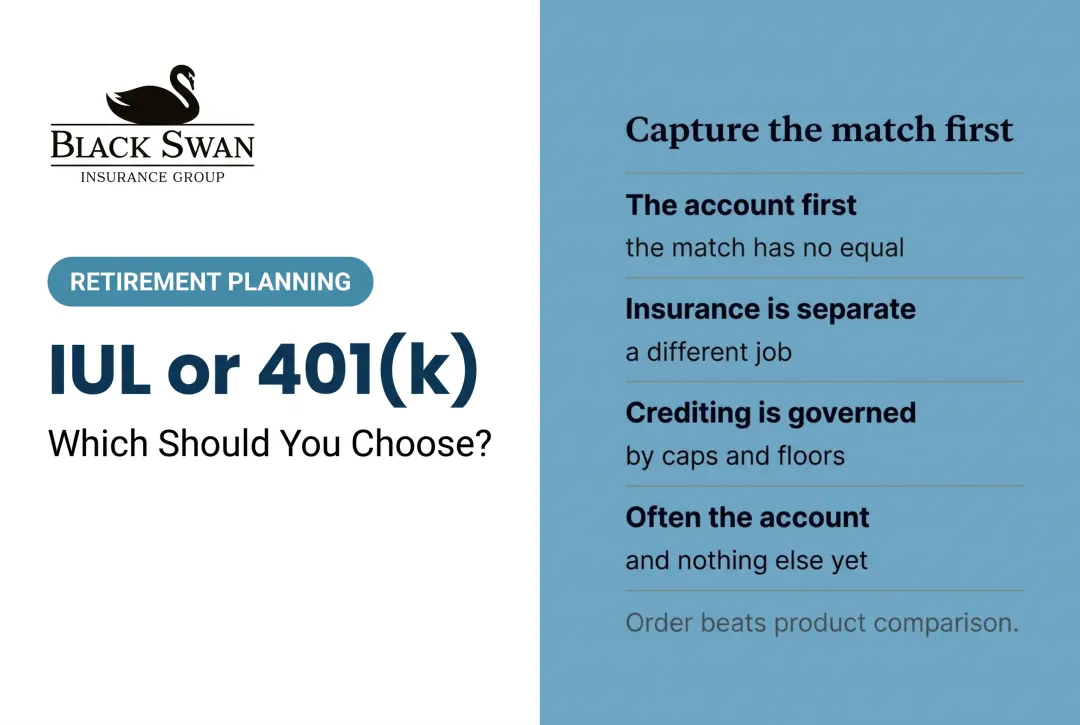
Neither product wins a universal comparison. Start with the non-negotiables: capture any available employer match and maintain an adequate emergency fund. A permanent insurance illustration rarely beats an unmatched 401(k) dollar or an empty reserve, however attractive the projection.
Stronger Fit for the 401(k) First
- You have an employer match you have not fully captured
- Your priority is straightforward retirement accumulation
- You want broad investment exposure without insurance underwriting
- You prefer a simpler account structure
- You have no genuine need for permanent life insurance
Stronger Fit for Adding an IUL
- You have a legitimate, ongoing need for permanent protection
- You earn $150K+ with cash flow that sustains premiums for the long haul, not just this year
- You have time to let the policy mature, or have honestly stress-tested a late start
- You want tax diversification and potential loan access alongside other accounts
Weaker Fit
Not everyone should buy this. Walk away if you would be redirecting matched 401(k) dollars, if your income is uneven, if emergency reserves are thin, if you carry high-interest debt, or if you need only temporary coverage — in which case term is cheaper and the right answer.
When Both Make Sense
A practical split for many high-income households: the 401(k) for the match and core accumulation, with an IUL evaluated only for permanent protection and supplemental flexibility. The IUL complements that savings. Walking away from a match to fund a policy almost never makes financial sense.
Due diligence before buying:
- Compare guaranteed values against illustrated (non-guaranteed) values
- Review current and guaranteed cap and participation rates
- Understand every charge: cost of insurance, admin fees, rider costs, surrender schedule
- Confirm premium requirements survive an income disruption
- Model a lapse scenario with an outstanding loan
- Compare against alternatives: term insurance, Roth contributions, IRAs, taxable brokerage
An illustration is a model, not a guarantee.
Three Planning Scenarios
Hypothetical, to illustrate decision-making rather than outcomes.
Employee with an available match. A 32-year-old marketing manager earning $95,000 with a 50% match on the first 6% of pay. The first move is not complicated: contribute enough to capture the full match before any IUL conversation happens.
High-income business owner. A 48-year-old practice owner earning $380,000, maxing the 401(k), carrying heavy business-concentration risk. With surplus cash flow and a real protection need, an IUL can sit alongside term coverage and business-continuity planning. The deciding question is whether premiums stay affordable in a slower revenue year.
Late-start high earner. A 52-year-old executive who hit peak earnings late and has a short runway. Age, insurability and funding capacity all need stress-testing. A best-case illustration can underperform badly if caps compress or charges rise, so this case demands conservative assumptions, not optimistic ones.

In each case the real evaluation covers the actual goal, available cash flow after essentials, current savings and tax diversification, a genuine rather than theoretical insurance need, the key risks of lapse and underfunding and insurability change, and the alternatives already considered.
This is not set-it-and-forget-it. It is design-it, fund-it, review-it.
Risks to Understand Before You Choose
- Redirecting matched dollars is the costliest mistake available in this comparison.
- Cost of insurance rises with age on an IUL, which is how late-life lapses happen.
- Caps and participation rates can be lowered after issue, subject to contract minimums.
- The 401(k) carries full market downside and sequence-of-returns risk near retirement.
- RMDs force taxable distributions from traditional accounts whether you need the income or not.
- The loan is not the problem. The unmanaged loan is the problem.
- MEC status is generally permanent and removes the tax-advantaged access that justified the policy.
Find Out Where You Actually Stand
This starts with the Tax-Free Wealth Blueprint Fit Review. If you earn $150K+ and have maxed the 401(k), we map what each bucket is actually doing, confirm whether a permanent protection need exists at all, read guaranteed against illustrated values on any proposed policy, and stress-test the funding through lower-crediting and reduced-income years. If the answer is "increase the deferral and buy term," we will say so. If IUL does not fit, we will tell you that too.
Frequently Asked Questions
Is an IUL better than a 401(k)?
Neither is universally better. A 401(k) is built for retirement savings; an IUL pairs permanent life insurance with cash value. The IUL fits only when the costs, risks and protection need match your situation.
Can I have both an IUL and a 401(k)?
Yes, and that is the common sensible arrangement — a 401(k) for employer contributions and core savings, with an IUL evaluated separately for protection and tax diversification.
Is an IUL a good retirement account?
An IUL is not a qualified retirement account and should not automatically replace a 401(k). It can supplement a plan when the insurance need is real, premiums are sustainable and the policy is actively managed.
What are the disadvantages of an IUL?
Complexity, insurance charges, capped growth, and terms that can change over time. Premium obligations, lapse risk and unmanaged loans can erode the intended benefit entirely.
Can I roll over or move a 401(k) into an IUL?
No. A 401(k) cannot roll into an IUL as a retirement-account transfer. Using a taxable distribution to fund premiums is a separate transaction with its own tax consequences, including potential penalties. Review it with a qualified professional first.
Are IUL policy loans tax-free?
Loans may receive favourable tax treatment when the policy stays in force and is not a Modified Endowment Contract. Interest, lapse risk and unpaid loans at surrender can change that outcome, so confirm current rules before relying on the strategy.
Sources
Disclosure: This article is educational and is not personal tax, legal or investment advice. Indexed universal life is life insurance first. Contribution limits, catch-up provisions and distribution rules change; confirm current figures with the IRS or your plan administrator. Illustrated values are not guarantees; actual results depend on policy design, carrier, crediting options, caps, participation rates, expenses, funding and ongoing management, and all guarantees are subject to the issuing insurer's claims-paying ability. This strategy is not appropriate for everyone. Policy loans and withdrawals reduce cash value and the death benefit, and can create tax consequences if the policy lapses or becomes a modified endowment contract. Consult your own tax, legal and financial professionals for advice specific to your situation. Any potential tax-advantaged access depends on the policy being properly structured, funded and managed.
And remember, it's not what you earn, it's what you keep… enjoy the ride.