By Robert Balgac, Founder, Black Swan Insurance Group | October 9, 2026
Some indexed universal life products will accept a monthly premium of $25. That number is real, it is published, and it is the most misleading figure in this entire category.
If you earn $150K+, have maxed the 401(k) and are past the Roth phase-out, the relevant fact is not how low the carrier floor goes. It is how enormous the distance is between that floor and a policy that works. A documented North American illustration funds a $150,000 death benefit for a 45-year-old Preferred Plus applicant at $3,000 a year. Twenty-five dollars a month and three thousand a year are both "starting an IUL." Only one of them is a plan.
The short answer: Carrier minimums are far lower than most buyers expect and tell you almost nothing. The premium that gets an application approved may cover only cost of insurance and policy fees, leaving nothing for growth. What matters is the funding level the design needs to stay healthy for thirty years — and that figure comes from your sustainable surplus cash flow, not from the carrier's floor.
This is life insurance first. It is a contract funded over years, not a purchase made in a day.
Key Takeaways
- Starting cost depends on carrier, age, health, coverage and design — no universal minimum exists
- The lowest premium that activates a policy rarely builds meaningful cash value
- Carrier floors can be as low as $25 per payment; a working design can be a hundred times that
- Higher funding strengthens cash value goals but raises MEC, liquidity and lapse risk
- Weigh IUL against term, 401(k), Roth and brokerage investing before you commit
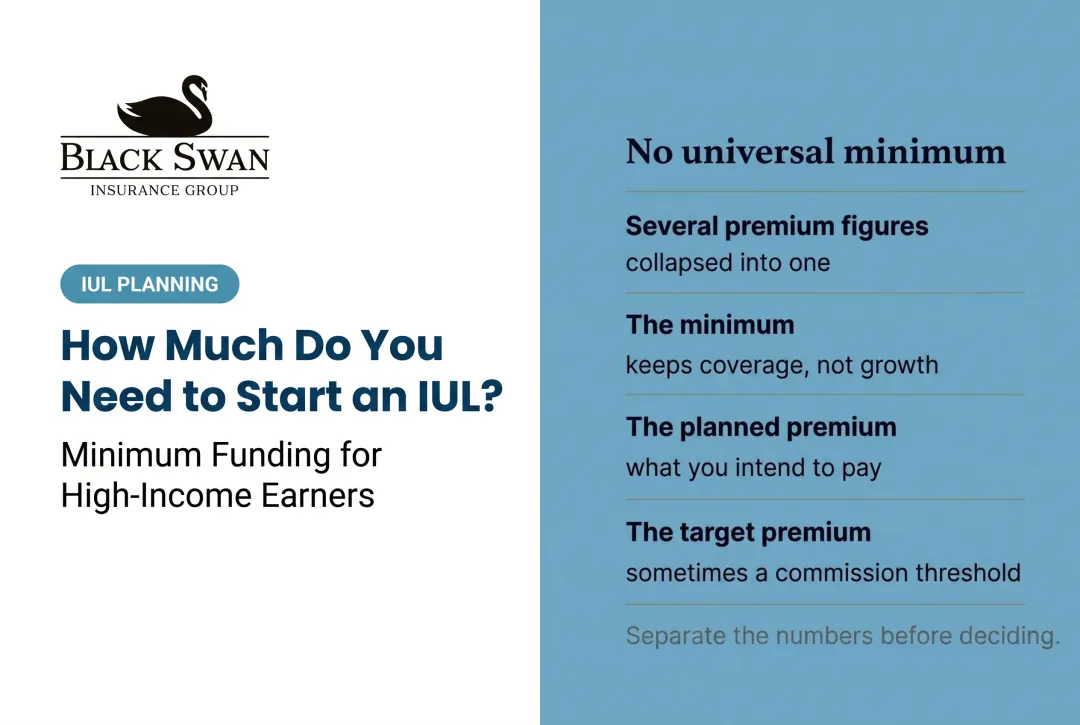
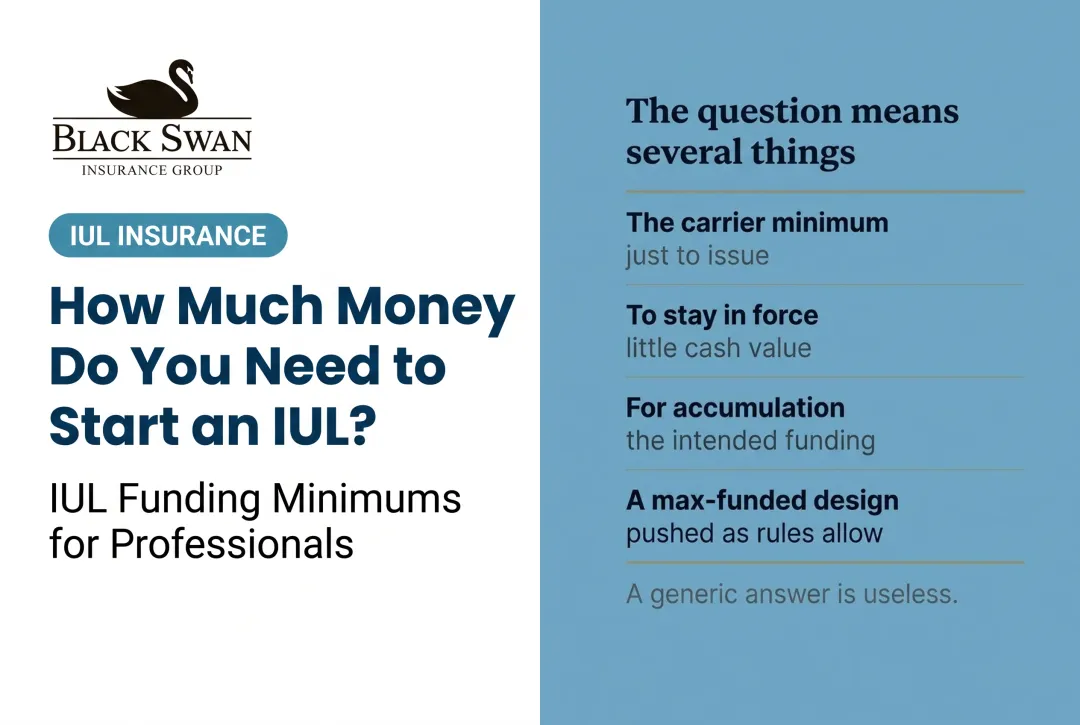
Four Numbers, All Called "Starting"
- The initial premium required to get your application approved
- The insurer's published minimum premium needed to keep the policy active
- The planned premium you intend to pay monthly or annually going forward
- The funding target used in an accumulation-focused design
Confusing them is where buyers get surprised later — usually in policy year eight, when the statement looks nothing like the conversation.
What Carriers Actually Require
Transamerica's Financial Foundation IUL II lists a $25 initial and $25 renewal premium per payment in its 2025 product highlights, though the guide stops short of calling it a flat monthly rate.
Mutual of Omaha's IUL Express ties its minimum to a "no-lapse protection premium" that varies by applicant rather than publishing a dollar figure.
Compare that with North American Company's illustrated example: a 45-year-old Preferred Plus applicant funding a $150,000 death benefit with $3,000 in annual premium. That is not a minimum. It is an illustration of a working policy design, and the gap between $25 and $3,000 a year is the whole story of this page.

Why the Cheapest Option Rarely Works
A premium satisfying a carrier's minimum keeps coverage in force. It usually leaves little or nothing for cash value growth once cost of insurance, administrative charges and premium loads come out.
A quoted premium typically covers cost of insurance and base administrative charges. It often does not include optional riders such as disability waiver or chronic illness benefits; extra deposits toward cash value; underwriting-related rate changes; loan interest if you borrow later; or future increases in policy charges.
The first premium guarantees no particular cash value outcome. That is what the illustration is for — and it should lay out planned premiums, death benefit, cash value, surrender value, charges and projected results across scenarios, not just the favourable one.
What Determines the Cost
Age and Health
Issue age and underwriting class drive the base cost of insurance. Carriers also weigh medical history and current medications, tobacco use (a major swing factor), family health history, and occupation or hazardous hobbies such as flying or scuba diving.
Underwriting classes run from Preferred Plus or Preferred Elite down to Standard or Tobacco. The same applicant can land in different classes, at different prices, at different carriers — one insurer's "Preferred" may be another's "Standard Plus." Comparing is worth the extra step.
Coverage Amount and Structure
More death benefit means higher cost of insurance. Cutting the death benefit too far to lower premiums can backfire: it may affect underwriting approval, suitability, or your MEC headroom.
Funding Plan and Duration
How you pay matters as much as how much:
- Single premium: one large upfront deposit, maximum commitment, little payment flexibility
- Limited-pay: heavier funding over a set number of years, then payments stop
- Ongoing pay: smaller monthly or annual premiums stretched over decades
Each trades upfront funding against liquidity and long-term commitment. Irregular or insufficient payments carry real risk — if premiums do not keep pace with internal charges, cash value erodes and the policy can lapse, sometimes with tax consequences attached.
Design, Index Options and Riders
Death benefit options, crediting methods, caps, participation rates, floors and multipliers all shape projected performance.
Nationwide's Indexed UL Accumulator III, for example, lists a 10.50% cap with 100% participation on its S&P 500 point-to-point strategy. A different multi-index option on the same product may show a 25% cap and carry its own strategy charge. Carriers reset these rates periodically; they are not guaranteed for the life of the policy.

Index-linked crediting is not direct market investment. Caps and participation rates can change, and charges continue when the index is flat or down.
Zero is your hero in a down year — but the floor applies to the credit, not to the charges.
The MEC Ceiling
The IRS seven-pay test limits how much premium you can pay relative to the death benefit before the policy becomes a Modified Endowment Contract. Cross that line and distributions are generally taxed gain-first, with a possible 10% additional tax on early withdrawals, according to IRS guidance on MEC taxation. Confirm current rules with a tax professional before funding aggressively.
The Ultimate IUL Blueprint
Before you settle on a starting figure, the Blueprint covers what the design has to survive: funding levels, caps and charges, the MEC line, loan timing, and what to demand from an illustration before you sign.
What the Critics Get Right
The honest criticism of a $25 minimum is that it exists to make the product accessible at the point of sale, and accessibility at the point of sale is not the same as value over thirty years. A buyer who enters at the floor often does not discover the shortfall until the cash value column has had a decade to disappoint them.
The second fair point: cost of insurance rises with age, and caps can be reset downward. A design that pencils out at the minimum today has very little margin for either.
An illustration is a model, not a guarantee.
What the criticism misses is that the floor is not a recommendation. It is a product boundary. Nothing requires you to fund there, and the whole discipline of this product is choosing a level between the carrier's floor and the IRS ceiling that you can actually hold.
The Real Cost Structure
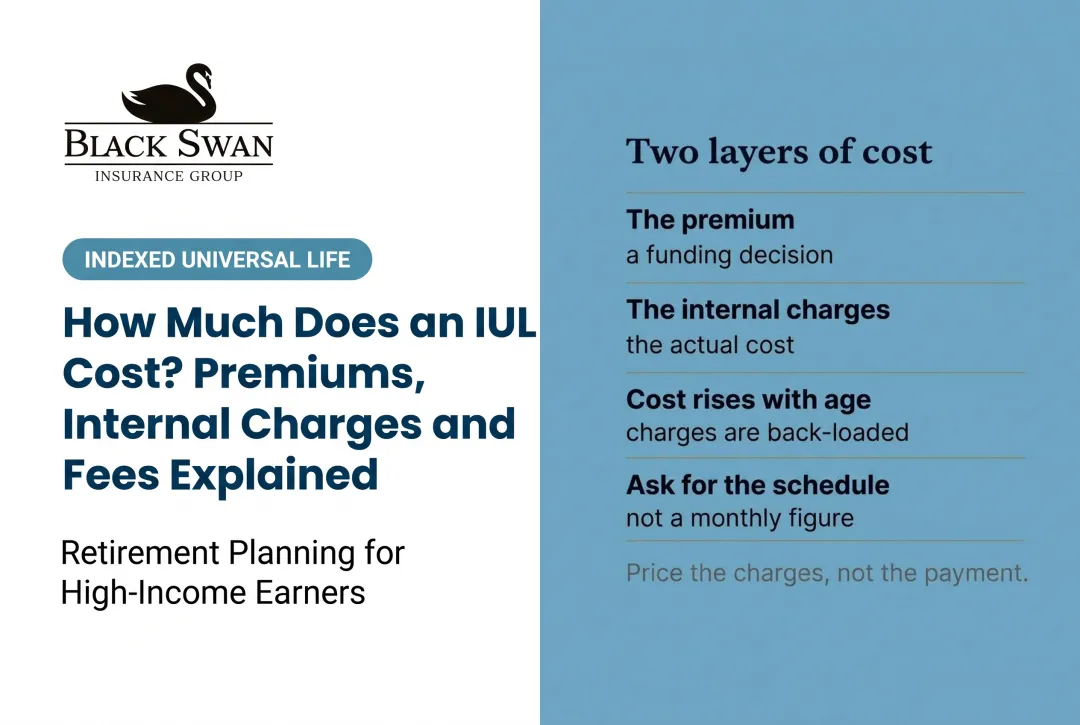
After your application and first premium, internal deductions continue every month:
- Cost of insurance — the mortality charge, rising with age
- Administrative fees — fixed or percentage expenses taken from cash value
- Rider charges — only if you elect them
These continue in flat crediting years. Surrender charges are separate, and an early exit can wipe out most early cash value.
Know the four funding terms carriers use:
- Planned premium — what you intend to pay, usually adjustable from year two
- Minimum premium — the smallest amount avoiding lapse, sometimes tied to a no-lapse guarantee
- Target premium — often used for agent compensation calculations, not a reliable guide to lifetime adequacy
- Guideline or maximum funding — the IRS ceiling before MEC status applies
A lower-cost design pairs a smaller death benefit with basic protection so premiums stay manageable. The trade-off is less cash value growth and less room later for retirement-income or education-funding goals.
A higher-funded design pushes more premium toward cash value after charges. It needs steadier surplus cash flow, a longer horizon and ongoing review as caps, cost of insurance and life circumstances change.

Do not judge a policy by its premium alone. Compare guaranteed versus non-guaranteed illustrated cash value; surrender value in early years, often minimal; death benefit under both scenarios; liquidity if you need access; and lapse risk if funding slows or stops. A higher premium is not automatically better, and a cheap policy is not automatically efficient.
Estimating Your Own Budget
Before running numbers, get clear on why you want the policy. The funding strategy for pure protection looks nothing like one built for supplemental retirement income, estate liquidity or business planning.
Confirm these first: an emergency reserve of three to six months of expenses; high-interest debt obligations; health insurance coverage; existing retirement contributions, especially any employer match. IUL funding comes after these, not instead of them.
Then run two scenarios — a conservative planned premium you could sustain in a tight year, and a higher-funding scenario aimed at cash value growth. Stress-test both against a temporary income drop, lower caps or participation rates than illustrated, an outstanding policy loan, and a missed or reduced premium.

If either scenario falls apart under those conditions, rework it before signing.
Request multiple carrier illustrations, each showing guaranteed and current-assumption values, annual premium and cash surrender values, death benefit over time, policy charges and break-even timing, and the conditions that could trigger a lapse.
Stronger Fit
- Earning $150K+ with genuine surplus beyond reserves, debt service and maxed retirement contributions
- A real permanent insurance need, not only an accumulation goal
- Able to fund meaningfully above the carrier minimum and sustain it
- A long enough horizon to absorb early-year charges
- Willing to review caps, charges and funding annually
Weaker Fit
This strategy is not appropriate for everyone. Hold off if:
- The only premium you can manage is near the carrier floor
- Your protection need is temporary — term is cheaper and simpler, and you should buy term
- Emergency reserves, high-interest debt or employer match are unresolved
- You may need liquidity during the surrender-charge period
- You are in your late 40s or 50s with strong cash flow but a short runway and have not weighed Roth conversions or a brokerage account against this
Risks to Understand Before You Start
- The first-payment trap. The opening premium says little about a 20- or 30-year commitment, or what happens if payments are missed later.
- An illustration is not a forecast. Only the guaranteed column is locked in at issue. Per NAIC guidance on life insurance illustrations, caps, participation rates and charges can all change.
- Surrender charges and loan interest. Early-year cash value is thin, and policy loans are real debt. Heavy borrowing or underfunding can drive a lapse with taxable fallout. The loan is not the problem; the unmanaged loan is the problem.
- Overfunding past the MEC limit. Extra premium can trip the seven-pay test, or pull dollars that belong in a tax-advantaged retirement account first.
- Fundamentals come first. IUL does not replace term coverage, an emergency fund, manageable debt or unused qualified-plan room.
Find Out Where You Actually Stand
This starts with the Tax-Free Wealth Blueprint Fit Review. If you earn $150K+ and are trying to work out what it really takes to start, we begin with a needs assessment before any policy is tailored, build a personalised illustration around your numbers rather than a generic example, run both a conservative and an accumulation-focused funding scenario, and stress-test each. Annual reviews after issue mean funding decisions get revisited as income, health and goals change — not just at the point of sale. Budget for a premium you can sustain for decades. The largest number on an illustration is the wrong target, and so is the smallest. If IUL does not fit, we will tell you that too.
Frequently Asked Questions
How much money is needed to start an IUL?
There is no universal minimum. It depends on the insurer, your age, health, coverage amount and design. The premium that gets you approved is often far less than what sustains the policy or builds meaningful cash value.
How much is a $1,000,000 policy per month?
For an IUL, monthly cost varies widely by age, health, tobacco status, underwriting class, death benefit structure, riders and carrier. Be cautious of any quote presented as "typical" without those assumptions spelled out.
Is it smart to get an IUL?
It can fit if you want permanent coverage, long-term cash value potential and funding flexibility, and can sustain premiums and monitor the policy. It is not automatically right for everyone and should not replace foundational retirement planning.
What factors determine how much an IUL costs?
Age, health, tobacco use, coverage amount and underwriting class, plus premium schedule, death benefit design, riders, carrier charges and the index-crediting structure.
Can I start an IUL with a small monthly premium?
Some policies accept relatively small premiums, but minimum funding rarely supports meaningful cash value and may require increases later. Review a full illustration and the lapse assumptions before applying.
Is $25 a month really enough to start?
It may satisfy one carrier's product rule. It will not build the outcome most buyers are picturing. Treat the floor as a boundary of the product, not as a funding recommendation.
Sources
- Transamerica — Financial Foundation IUL II product highlights
- IRS — guidance on Sections 7702 and 7702A (24-0008)
- NAIC — Life Insurance Illustrations
Disclosure: This article is educational and is not personal tax, legal or investment advice. Indexed universal life is life insurance first. Product minimums, caps, participation rates, charges and state availability vary by carrier and are subject to change; confirm them in the contract. Illustrated values are not guarantees; actual results depend on policy terms, crediting, costs and funding. Any potential tax-advantaged access depends on the policy being properly structured, funded and managed. Actual results depend on policy design, carrier, crediting options, caps, participation rates, expenses, funding and ongoing management. This strategy is not appropriate for everyone. Policy loans and withdrawals reduce cash value and the death benefit, and can create tax consequences if the policy lapses or becomes a modified endowment contract. Consult your own tax, legal and financial professionals for advice specific to your situation.
And remember, it's not what you earn, it's what you keep… enjoy the ride.