By Robert Balgac, Founder, Black Swan Insurance Group | October 9, 2026
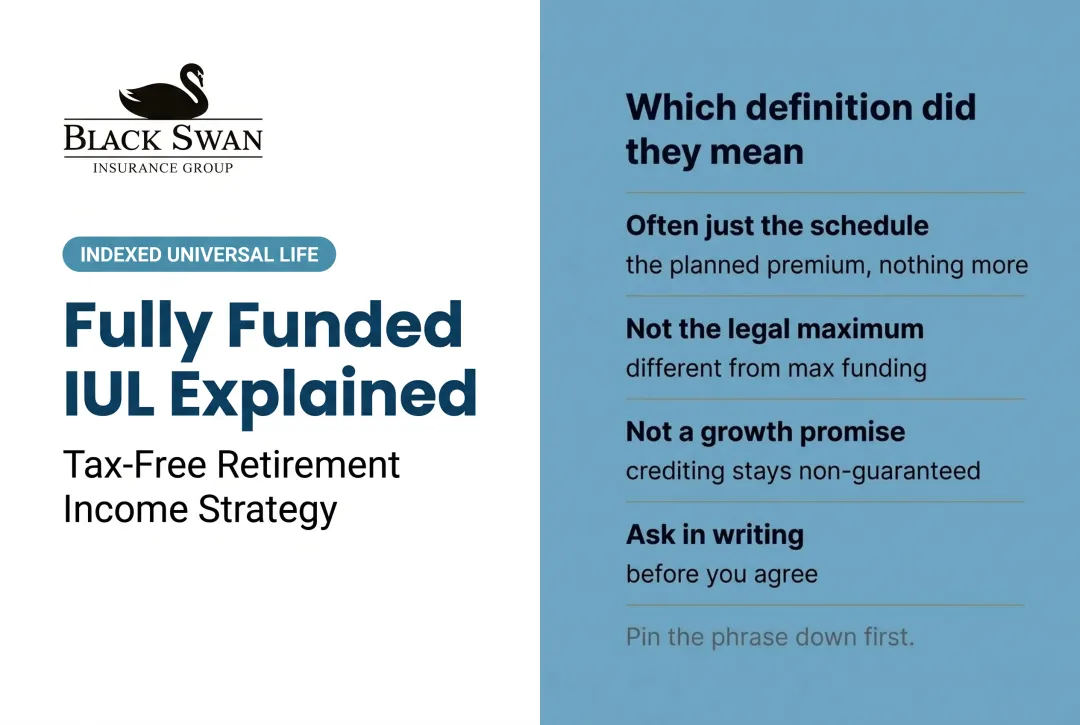
If you earn $150K+, you have maxed the 401(k), you are past the Roth phase-out, and someone has pitched you a "funded IUL," the first useful thing to know is that there is no such product. There is no shelf with funded IULs on it. A funded IUL is an ordinary indexed universal life policy receiving premiums under a particular design — and the design is where all the consequence lives.
That is not a semantic complaint. It matters because the same annual budget, run through two different designs, produces two policies that behave nothing alike. Same money in, entirely different outcomes. The word "funded" tells you almost nothing on its own.
The short answer: "Funded" describes a premium strategy, not a product tier. What determines your result is the relationship between the premium you pay and the death benefit you buy — because that ratio sets your charges, your cash value trajectory and how much room you have before the contract becomes a modified endowment contract. Ask to see two designs at your budget, not one.
This is life insurance first. Cash value is second. Potential tax-advantaged access when properly structured, funded and managed is third.
Key Takeaways
- A funded IUL is permanent life insurance designed to support both a death benefit and cash value growth
- Funding is not unlimited — Section 7702, the seven-pay test and policy design all cap it
- The premium-to-death-benefit ratio is the lever, not the premium alone
- You do not own the index; a crediting formula determines how much index movement reaches your policy
- Loans, withdrawals and charges require ongoing management, not a one-time decision
- Treat it as a complement to retirement accounts, never an automatic replacement
What "Funded" Actually Describes
Indexed universal life is permanent coverage pairing a death benefit with flexible premiums and a cash value account. That account can earn interest credits tied to an external index such as the S&P 500.
You do not own the index's stocks. The insurer applies a crediting formula that determines how much of the index's movement reaches your policy. That formula typically includes a participation rate (the percentage of index growth used), a cap (the maximum rate creditable in a period) and a floor (a minimum rate, often 0%, limiting the effect of a negative index year).
Funded, Overfunded and Max-Funded Are Three Different Things
- Funded IUL — premiums follow the policy's basic design
- Overfunded IUL — premiums exceed the minimum needed to keep the policy in force, within IRS limits
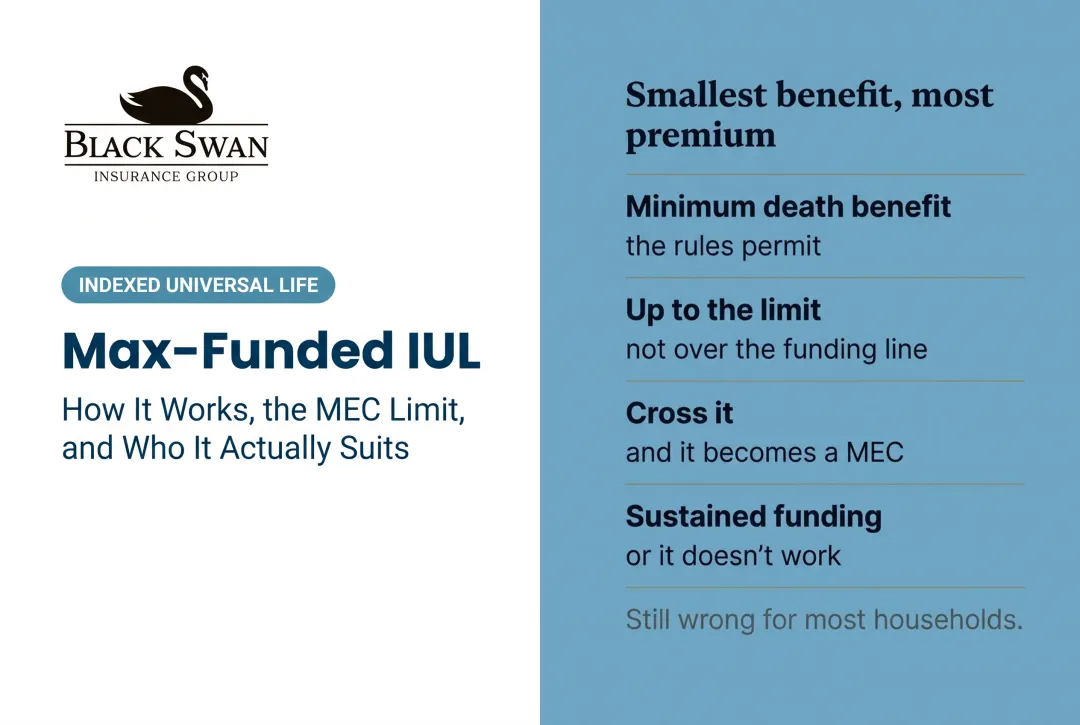
- Max-funded IUL — high premium relative to death benefit, built to grow cash value while staying under MEC status
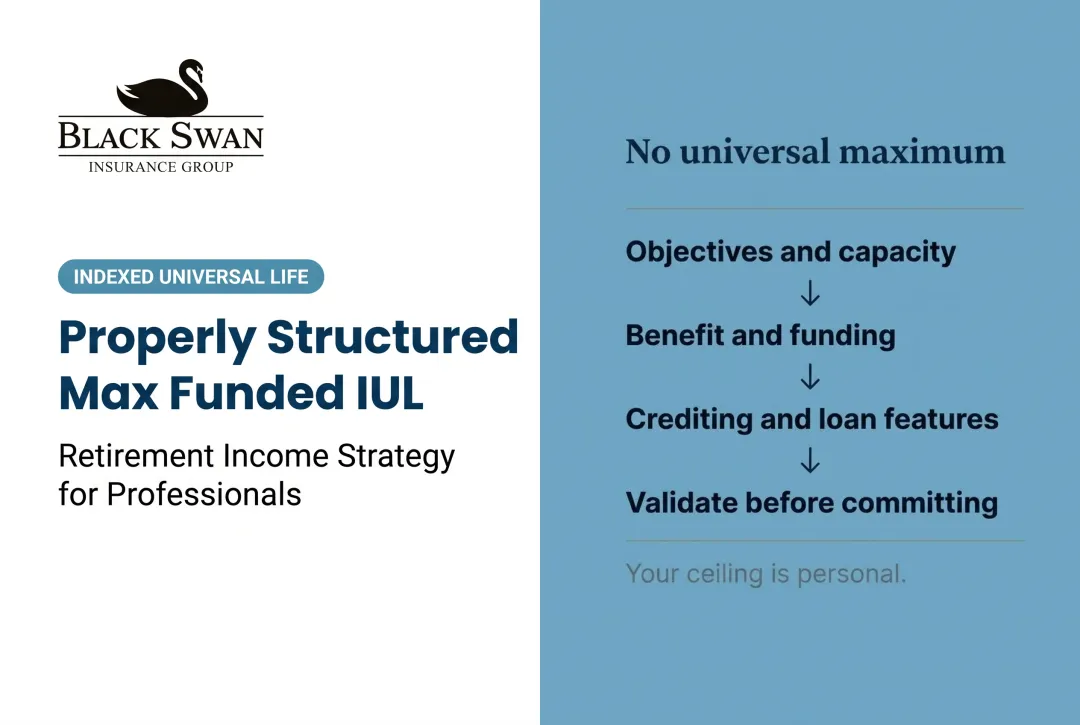
There is no dollar figure that makes a policy "funded" or "max-funded." It depends on your age, health, the death benefit you choose, how premiums are timed and the carrier's own rules.
Same Budget, Two Policies
Take a 45-year-old budgeting $20,000 a year.
- One design puts most of that toward a $1.5 million death benefit with modest cash accumulation
- Another lowers the death benefit to roughly $600,000 and pushes more of each dollar into cash value
Identical budget. Entirely different contracts. These figures are illustrative, not a projection for any real policy — but the principle is exact: lowering the death benefit relative to premium increases the share reaching cash value, and simultaneously shrinks your non-MEC headroom. You cannot adjust one without moving the other.
Both designs still carry ongoing insurance costs. That never goes away, however the policy is structured.
How the Mechanics Work
Every premium dollar follows a set path before any cash value builds, according to Pacific Life's client guide to indexed universal life insurance:
- Covers the premium load
- Pays monthly cost of insurance, administrative fees and rider charges
- Credits the remainder to cash value
Crediting, and What the Floor Does Not Do
The insurer tracks index performance over a segment period, then applies the cap, participation rate and any spread or threshold deduction specific to that contract. The result is your credited interest.
A 0% floor protects against negative index performance. It does not protect your overall cash value. Monthly charges come out whether the index rises, falls or sits still. Add an outstanding loan accruing interest and cash value can fall in a year with zero index losses.
Zero is your hero in a down year — but the floor applies to the credit, not to the charges.

Two Tax Rules That Control Different Outcomes
- Section 7702 sets the test a contract must pass to qualify as life insurance for federal tax purposes.
- Section 7702A decides whether a qualifying policy becomes a Modified Endowment Contract. Its seven-pay test checks whether premiums in the first seven years exceed a set limit, as defined under federal law.
Cross into MEC status and loans and withdrawals are taxed gain-first, with a possible 10% additional tax before age 59½. That is the precise opposite of how a properly structured policy is usually described.
Access Is Conditional
You tap cash value through withdrawals or loans. Both reduce available value. Loans also accrue interest and can shrink the death benefit if unpaid.
Favourable tax treatment on access depends on the policy staying in force, avoiding MEC status, and being managed. Let the policy lapse with a loan outstanding and that balance can become taxable income — with no cash arriving to pay the bill.
Consistent funding matters more than most buyers expect. Skip premiums or underfund and cash value may not cover rising insurance costs as you age, putting the whole contract at lapse risk.
This is not set-it-and-forget-it. It is design-it, fund-it, review-it.
The Ultimate IUL Blueprint
Before you pick a funding level, the Blueprint covers what the design has to survive: the premium-to-death-benefit ratio, caps and charges, the MEC line, loan timing, and what to demand from an illustration.
What the Critics Get Right
The sharpest criticism of funded IUL is that it is sold on the cash value column while being priced as insurance. Cost of insurance and premium loads reduce early cash value, sometimes substantially, and surrender charges mean the first several years are genuinely unforgiving if you change your mind.
The second fair point: caps and participation rates are not guaranteed. A design illustrated at today's cap can be credited at tomorrow's lower one, and nobody will call you to explain.
An illustration is a model, not a guarantee.
What the criticism misses is that none of this is hidden. The guaranteed column, the surrender schedule and the charge structure are all printed. A buyer who demands to see them — and who funds a design they can sustain rather than the largest number the contract will accept — is working with the same information the critics are.
How It Stacks Up
| Vehicle | Contribution Rules | Tax Treatment | Liquidity |
|---|---|---|---|
| Funded IUL | No fixed limit; governed by 7702/7702A and policy design | Tax-deferred growth; access can be tax-advantaged if structured properly | Loans/withdrawals reduce cash value and death benefit |
| 401(k) | $24,500 employee limit for 2026 per the IRS | Pre-tax contributions; taxed on withdrawal | Limited before 59½ without penalty |
| Roth IRA | $7,500 limit for 2026 (under 50); phase-out begins at $153,000 single / $242,000 joint | After-tax contributions; qualified withdrawals tax-free | Contributions withdrawable anytime; earnings restricted |
| Taxable brokerage | No limit | Capital gains and dividend taxes apply annually | Fully liquid |
Which is "better" depends entirely on the job. Employer matching makes a 401(k) hard to beat for retirement savings. Need liquidity? A brokerage account wins. Need permanent coverage plus tax diversification? That is where IUL earns a seat at the table — a seat, not the table.
High earners who have already maxed tax-advantaged accounts often look at IUL funding next. The mistake we see most is letting premium crowd out cash reserves, business liquidity, debt paydown or a diversified portfolio.

Before signing anything, ask: what is guaranteed versus illustrated; what is the carrier's financial strength rating; what is the surrender charge schedule and for how many years; what happens to my loan if I miss a premium; and how close is this design to the MEC limit?
How to Evaluate One Before You Buy
- Identify the actual insurance need — protection, cash value access, or both
- Set an affordable premium range you can sustain for decades, not just this year
- Review alternatives — 401(k), Roth, brokerage, term insurance
- Compare guaranteed against non-guaranteed values side by side
- Stress-test the illustration — lower crediting years, missed premiums, rising charges
A properly reviewed illustration should show, under more than one scenario, premiums and policy charges, death benefit, cash value and surrender value, and loan assumptions with projected outcomes. If someone only shows you one optimistic column, ask for the rest. The request is reasonable and the reaction to it is informative.
Also ask who watches the policy after you sign. Who tracks the MEC limit if you increase funding? Who flags it if cap rates change? Who reviews loan balances? At Black Swan that is the annual review step, and it exists because the alternative is finding out from a statement five years late.

Stronger Fit
- A genuine, ongoing need for permanent life insurance, not term-length coverage
- Stable surplus cash flow — not occasional extra income
- A long horizon, typically 15+ years
- Insurable at a reasonable rate
- Willing to review the policy annually
- High-income professionals, practice and business owners, and late-start high earners coordinating income on a compressed timeline
Weaker Fit
This strategy is not appropriate for everyone. It is probably not your answer right now if you:
- Need low-cost coverage for a specific term — buy term, it is cheaper and simpler
- Expect to need the cash within a few years
- Have inconsistent income
- Have not yet funded your 401(k) or Roth
- Have high-interest debt or thin emergency reserves
- Do not want to deal with policy complexity, because this product punishes inattention
Risks to Understand Before You Fund a Design
- Early cash value lags. Premium loads, cost of insurance and surrender charges front-load the cost.
- Caps and participation rates can be changed by the carrier within contract limits.
- Lowering the death benefit cuts your MEC headroom at the same time it boosts cash value allocation.
- Lapse with a loan outstanding can create taxable income. The loan is not the problem; the unmanaged loan is the problem.
- MEC status is generally permanent once triggered.
- Underfunding is its own failure — a thin policy may not survive rising insurance costs later.
Find Out Where You Actually Stand
This starts with the Tax-Free Wealth Blueprint Fit Review. If you earn $150K+ and you have a funding number in mind, we model that same budget across more than one death benefit design so you can see the trade-off directly, confirm the non-MEC room with the carrier, stress-test the schedule against a weak year, and read the guaranteed column alongside the illustrated one. If business ownership or estate planning is involved, we coordinate with your tax and legal professionals rather than around them. If IUL does not fit, we will tell you that too.
Frequently Asked Questions
How much money do I need to open a funded IUL?
There is no universal minimum or maximum. It depends on carrier, age, health, the death benefit, the design and what you can sustain long term. Treat any single headline figure with suspicion.
Can I cash out a funded IUL?
Surrendering, withdrawing and borrowing are three different actions with three different consequences. Surrender charges, a reduced death benefit, outstanding loans and tax can all apply depending on which you choose.
Is a funded IUL a good investment?
It is life insurance with cash value features, not a conventional investment account. Whether it is good depends on your permanent coverage need, horizon, funding capacity and tolerance for cost and complexity.
Is a funded IUL better than a 401(k)?
They do different jobs. A 401(k) offers employer matching and defined limits; an IUL offers permanent protection and different tax treatment. It does not automatically replace a 401(k), and usually should not.
Why do wealthy people use funded IULs?
Some use them for permanent protection, tax diversification and legacy planning — typically after other retirement strategies are already handled. That does not mean every high earner needs one.
What does "funded IUL" mean?
An IUL receiving premiums under a planned funding strategy, often with emphasis on cash value growth alongside coverage. Being funded guarantees neither growth nor unconditional tax-advantaged access.
Sources
- Pacific Life — client guide to indexed universal life insurance
- 26 U.S.C. § 7702A — Modified endowment contract defined
- IRS — 401(k) limit increases to $24,500 for 2026, IRA limit increases to $7,500
- IRS — prior-year release: 401(k) limit for 2025
- NAIC — Life Insurance Illustrations
Disclosure: This article is educational and is not personal tax, legal or investment advice. Indexed universal life is life insurance first. Contribution limits and phase-out thresholds are current figures and change over time; confirm them for your tax year. Illustrated values are not guarantees; actual results depend on policy terms, crediting, costs and funding. Actual results depend on policy design, carrier, crediting options, caps, participation rates, expenses, funding and ongoing management. This strategy is not appropriate for everyone. Policy loans and withdrawals reduce cash value and the death benefit, and can create tax consequences if the policy lapses or becomes a modified endowment contract. Consult your own tax, legal and financial professionals for advice specific to your situation.
And remember, it's not what you earn, it's what you keep… enjoy the ride.