By Robert Balgac, Founder, Black Swan Insurance Group | October 5, 2026
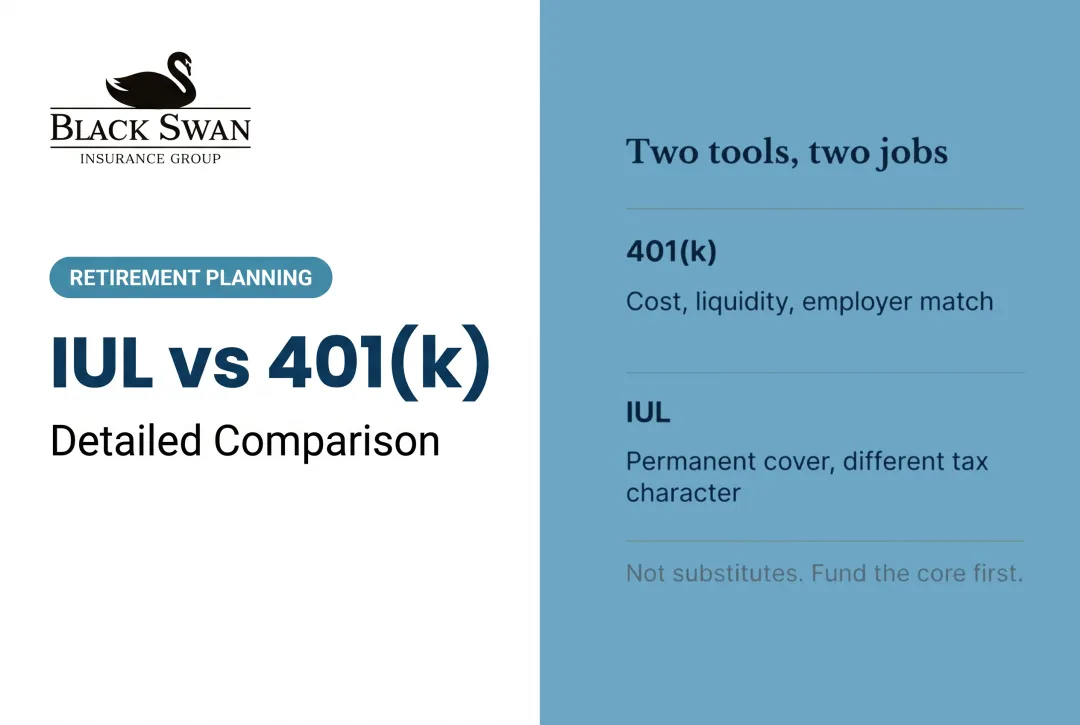
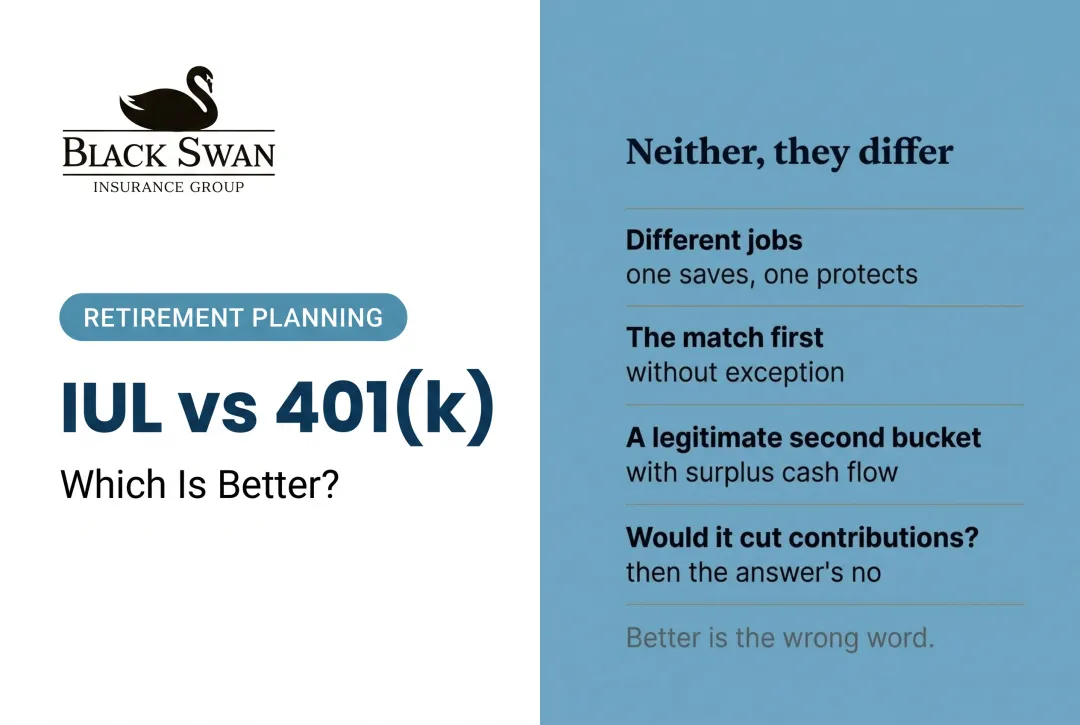
Somebody asks this every week, and the honest answer is that the question has a false binary buried in it. A 401(k) is an employer-sponsored retirement account. An indexed universal life policy is permanent life insurance with a cash-value component. They are built for different jobs, and ranking them against each other is like asking whether a point guard is better than a defence.
The 401(k) is not the villain here. A one-bucket retirement plan is. If you are earning $150K+, maxing the plan, and still feeling like the strategy is incomplete, that feeling is not irrational — it is just pointing at a different question than the one you asked.
Here is the balanced version up front: the 401(k) is almost always the starting point, and the employer match comes before everything. An IUL is a specialised tool worth evaluating only after several boxes are ticked around protection need, cash flow and funding discipline.
The short answer: For most high earners this is not either/or. Capture the full employer match first — nothing else in the stack competes with it. A 401(k) offers pre-tax contributions, uncapped market participation and full downside exposure, with a 10% additional tax on early withdrawals. An IUL offers permanent protection, index-linked crediting with a floor and a cap, and potential tax-advantaged access when the policy is properly structured, funded and managed. An IUL earns consideration as a second bucket once there is a real insurance need and surplus cash flow, not as a replacement.
Key Takeaways
- A 401(k) is a retirement account, often with an employer match and a current-year tax benefit; an IUL is life insurance first
- The employer match is the highest-certainty return in the stack and should be captured before any other conversation
- An IUL carries more complexity: policy charges, caps, funding discipline and lapse risk if underfunded
- Suitability depends on income, bracket, timeline and whether a permanent protection need actually exists
- Strong plans often use both, sequenced properly rather than treated as rivals
Where They Actually Differ
| Factor | IUL | 401(k) |
|---|---|---|
| Primary purpose | Permanent life insurance with cash value credited on an index-linked formula | Employer-sponsored retirement savings through selected investments |
| Tax treatment | After-tax premiums; access via loans and withdrawals depends on the policy staying in force and not becoming a MEC | Traditional: pre-tax in, taxable out. Roth: after-tax in, tax-free qualified withdrawals |
| Growth exposure | Capped or participation-rate crediting with a floor against a negative index credit | Full market gains and losses on the funds you pick — no cap, no floor |
| Access before retirement age | Cash value may be reachable earlier, with surrender charges and lapse risk attached | Withdrawals before 59½ generally trigger a 10% additional tax unless an exception applies |
| Costs | Cost of insurance, administrative charges, surrender charges, loan interest | Plan administration and investment fees |
| Protection | Income-tax-free death benefit | No built-in death benefit |
Two caveats the table cannot hold:
- The IUL floor protects against a negative index credit. It does not stop the cost of insurance from eating cash value in a flat year
- 401(k) withdrawals before 59½ generally face a 10% additional tax on the taxable portion, with limited exceptions
What Each One Actually Is
The IUL
An IUL is permanent life insurance. Funded correctly, it stays in force for life, and it builds a cash-value account credited on a formula referencing an external index such as the S&P 500.
You are not buying the index. You are buying a formula with:
- Caps — the maximum credited interest for that strategy period
- Participation rates — how much of the index-linked gain the policy can credit
- Spreads — a deduction some carriers apply before crediting
- Floors — a minimum crediting rate, often 0%, limiting index-related losses
Illustrations display these numbers as assumptions, not guarantees. The NAIC notes that illustrations contain both guaranteed and non-guaranteed elements, and the non-guaranteed side can move as the carrier's crediting terms change.

Cash value is reachable through loans or withdrawals. Loans are generally not taxable while the policy stays in force. An outstanding loan reduces the death benefit, and a lapse with a loan balance and gain in the contract can produce a tax bill at the worst possible moment.
An illustration is a model, not a guarantee. If it only works when everything goes right, it is not a plan — it is a wish with a binder.
The 401(k)
A 401(k) is an employer-sponsored plan funded through payroll deferrals, often matched. You choose from an investment menu, and the account moves with the market.
- Traditional — contributions reduce taxable income now; withdrawals are taxed later
- Roth — after-tax contributions, with qualified withdrawals tax-free once you satisfy the five-year rule and reach 59½
Capture the full match before anything else. Compared with an IUL, the 401(k) is far simpler to run: no premium schedule to monitor, no lapse risk, no cost-of-insurance charge working against the balance.
I am not against the 401(k). It can be extremely useful. But useful does not mean complete — and a million-dollar balance still has a partner with a claim on every taxable dollar coming out.
What the Critics Get Right
The people arguing that an IUL has no business near this comparison are right about several things.
They are right that most of the "IUL beats your 401(k)" content online skips the employer match, which is indefensible. They are right that comparing an insurance contract's illustrated cash value to a 401(k) balance without adjusting for fees, caps and the cost of insurance is not a real comparison. And they are right that anyone recommending you fund a policy before you have captured the match is solving their problem, not yours.
Where the criticism stops short is assuming that because the comparison is usually abused, the second-bucket question is illegitimate. For a high earner who has maxed the plan, is past the Roth phase-out, and has a real protection need, "what comes next" is a fair question. It just does not get answered by attacking the 401(k).
Which One Comes First for You
"Better" is not about which illustration projects the bigger number. It is about which job the money has to do.
Stronger Fit for Prioritising the 401(k)
- There is employer match you have not fully captured
- You want low-complexity retirement investing
- Current-year deductions matter to your bracket
- Surplus cash flow is limited
- You cannot commit to years of consistent premium funding
Stronger Fit for Evaluating an IUL
- A genuine permanent life insurance need exists on its own merits
- Household income of $150K+ with consistent surplus cash flow
- Emergency reserves are already solid
- You are insurable at a reasonable rate
- You want tax diversification or legacy protection beyond what the plan provides
- You are willing to review the contract every year
Weaker Fit for an IUL Right Now
Not everyone should buy an IUL. If the 401(k) match is not fully captured, the comparison in this article does not apply to you yet.
- Unstable income or thin reserves
- High-interest debt still running the household
- Money likely needed before the contract builds accessible value
- The need is really cheap temporary coverage — term insurance wins that outright and should be said plainly
- No permanent insurance need that stands without the retirement story attached
The risk trade-off is simple to state. A 401(k) gives uncapped upside with full downside exposure. An IUL limits index-related losses and also limits gains, and the charges apply every year regardless of what the market did.
Sequencing a "Both" Strategy
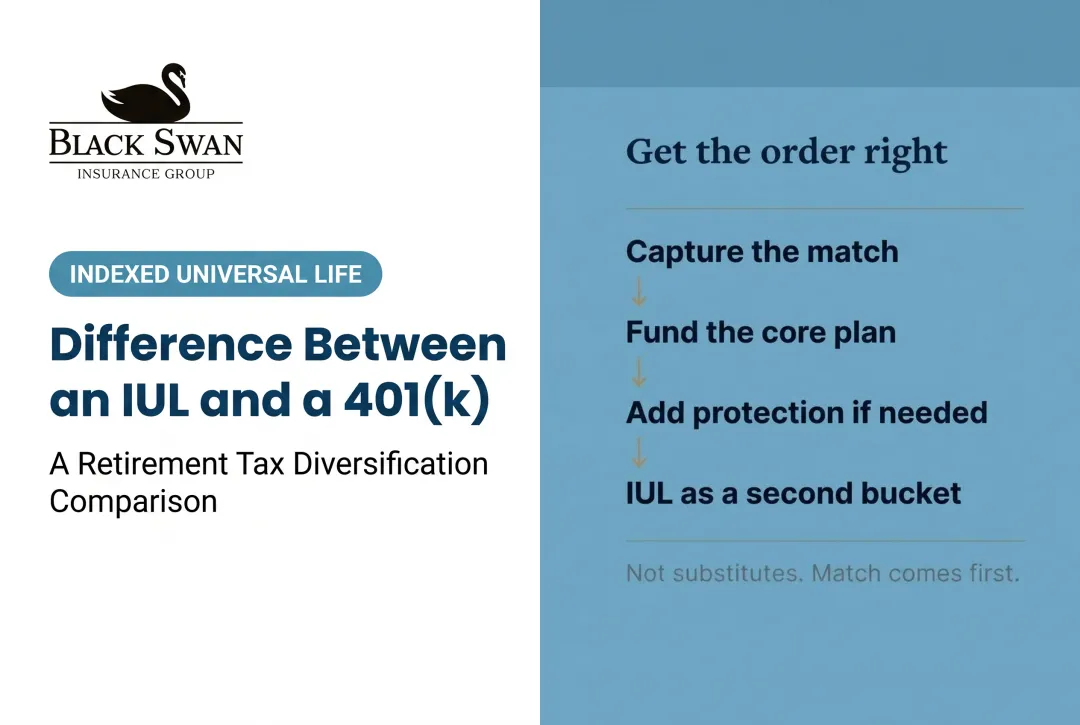
- Capture the full employer match
- Secure appropriate protection — term or permanent, depending on the need
- Fund the other tax-advantaged accounts available to you
- Only then stress-test whether an IUL improves the plan after premiums, caps and lapse scenarios

The Ultimate IUL Blueprint
If step four is where you are, the Blueprint covers what a policy has to survive to earn the slot: funding levels, the MEC line, loan timing and the numbers to demand before signing.
Three Households, Three Answers
Hypothetical illustrations for education, not projections of client results.
The employer-match professional. A 38-year-old marketing director earning $140,000, whose employer matches dollar-for-dollar up to 5% of pay, and who is not contributing enough to capture it. Nothing else belongs in the conversation until that deferral goes up. After that, look at the investment lineup and risk tolerance. Only then does permanent protection or additional tax diversification become a real question.
The business owner with surplus. A 47-year-old practice owner earning $400,000, already maxing a solo 401(k), with an expiring term policy and a succession plan that needs permanent coverage. Here an IUL may be evaluated alongside the existing accounts — not instead of them. The test is whether the death benefit, cash-value access and tax diversification improve the overall position once fees, caps and funding requirements are stress-tested.
The no-fit case. A 29-year-old teacher with $8,000 in savings and no emergency fund. Near-term liquidity matters, cash flow is not yet stable, and sustaining premiums long enough for the policy to work is unlikely. Term insurance alongside the existing 403(b) or a Roth IRA is the responsible answer. Selling an IUL into that situation almost always underperforms the simpler alternatives once surrender charges and lapse risk are counted.

Risks to Understand Before You Fund Anything
- Skipping the employer match to fund a premium is the single most expensive mistake available in this comparison
- Cost of insurance rises with age and is charged in flat crediting years too
- Caps and participation rates are not fixed and may be adjusted within contract limits
- Surrender charges restrict liquidity in the early years
- Underfunding is the most common IUL failure mode, particularly when premiums were set to an optimistic illustration
- A loan outstanding at lapse or surrender with gain in the contract can create taxable income with no cash received to pay it
- Crossing the seven-pay limit makes the contract a MEC under I.R.C. § 7702A and changes distribution taxation
- 401(k) withdrawals before 59½ generally carry a 10% additional tax on the taxable portion
- Moving 401(k) money into a policy is not a rollover. It is a distribution, with the tax consequences that implies
Find Out Where You Actually Stand
This starts with the Tax-Free Wealth Blueprint Fit Review. If you earn $150K+ and have maxed the obvious accounts, we look at what the match is doing, where the tax exposure actually sits, whether a protection need exists on its own, and what a policy would have to survive to be worth funding. If it does not fit, we will tell you that too — and "keep funding the 401(k)" is a common conclusion.
Frequently Asked Questions
Should I replace my 401(k) with an IUL?
No. They do different jobs, and the employer match has no equivalent anywhere else in the stack. An IUL is generally evaluated as a supplemental bucket after the plan is funded and a real protection need exists.
Can I hold both at the same time?
Yes, and many high earners do. The right combination depends on the match, the insurance need, cash flow and how much tax diversification the plan is missing.
What are the main disadvantages of an IUL?
Complexity, cost of insurance, caps on credited interest and surrender charges lead the list. Underfunding raises lapse risk, which can produce an unexpected tax bill on an outstanding loan.
Should I max out the 401(k) before buying a policy?
Capture the full match first without exception. Beyond that, additional plan contributions versus premiums depend on your bracket, your protection need and your liquidity.
Can I move money from a 401(k) into an IUL?
Not as a tax-free rollover. An IUL is not a recognised rollover destination, so funding one with plan money is treated as a distribution and can trigger tax and penalties. Talk to a tax professional before moving anything.
How much will $20,000 in a 401(k) be worth in 20 years?
It depends on contributions, returns, fees and timing, none of which can be guaranteed. Any projection is an estimate, and it should be labelled as one.
Sources
- IRS — 401(k) resource guide: general distribution rules
- IRS — Roth account in your retirement plan
- NAIC — Life Insurance Illustrations
- NAIC — Life Insurance
- I.R.C. § 7702A and Rev. Proc. 2008-39 (modified endowment contracts and the seven-pay test)
Disclosure: This article is educational and is not personal tax, legal or investment advice. Indexed universal life is life insurance first. Actual results depend on policy design, carrier, crediting options, caps, participation rates, expenses, funding and ongoing management. Policy loans and withdrawals may reduce cash value and death benefit and can create tax consequences if the policy lapses or becomes a modified endowment contract. This strategy is not appropriate for everyone. Illustrated values are not guarantees; actual results depend on policy terms, crediting, costs and funding. Consult your own tax, legal and financial professionals for advice specific to your situation.
And remember, it's not what you earn, it's what you keep… enjoy the ride.