By Robert Balgac, Founder, Black Swan Insurance Group | October 5, 2026
Indexed universal life and variable universal life sit on the same permanent insurance chassis. They diverge on one question, and it is the only question that matters: who carries the market risk.
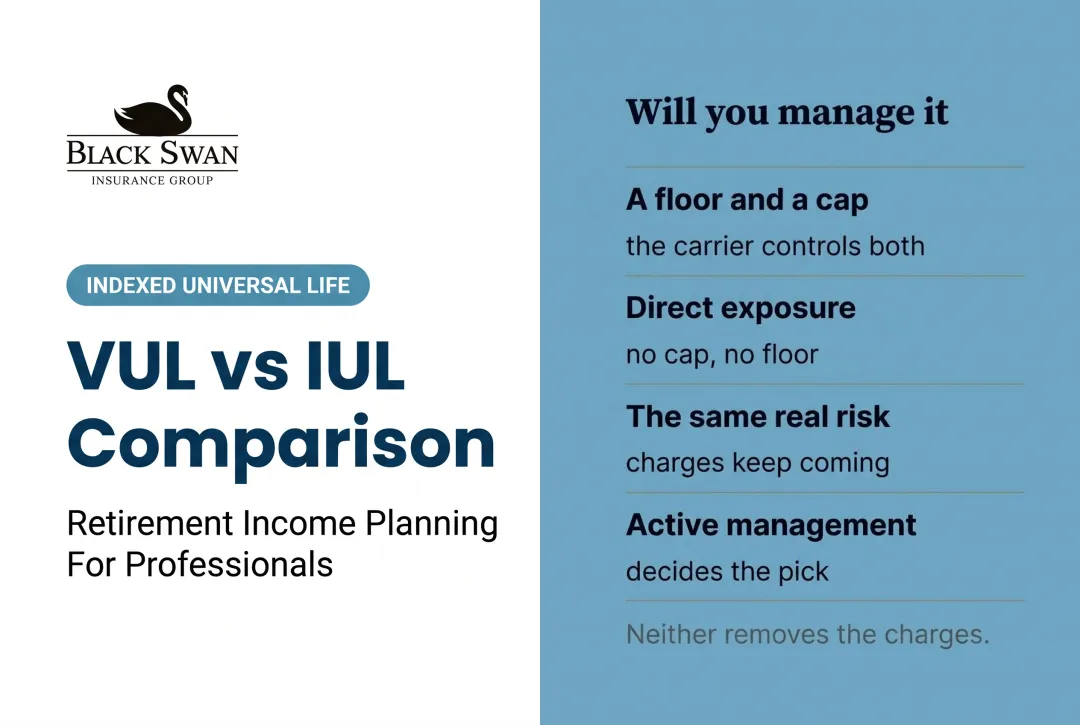
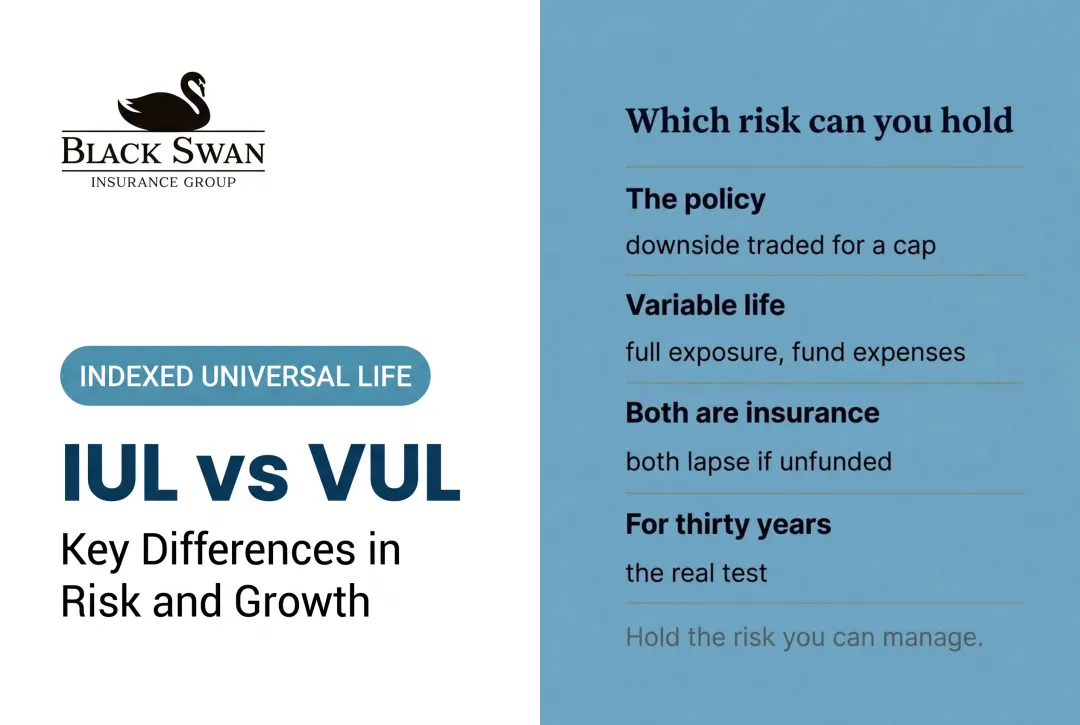
With an IUL, a formula stands between your cash value and the index. You get a floor and you pay for it with a cap. With a VUL, nothing stands in between — your cash value is in subaccounts holding actual securities, rising and falling with them.
That single difference sets your risk exposure, your upside, your fee structure, and how much of your attention the policy will demand for the next thirty years. For a $150K+ earner weighing supplemental retirement income or legacy planning, it also determines whether the coverage is still in force when it is needed.
The short answer: An IUL credits interest through an index-linked formula with a floor, usually 0%, and a cap limiting the upside. A VUL invests cash value directly in subaccounts, with real gains and real losses and no floor. Both are permanent life insurance first, both charge cost of insurance that rises with age, and both lapse if underfunded. VUL is a registered security with FINRA and SEC oversight and demands active monitoring. Neither wins by default — fit depends on risk tolerance, funding capacity, horizon and how much oversight you will genuinely provide.
Key Takeaways
- IUL credits interest with a floor and a cap or participation rate; cash value is not invested in the market
- VUL places cash value in subaccounts that can gain or lose with market performance
- Neither wins by default — fit depends on risk tolerance, funding capacity and time horizon
- Both carry insurance charges, fees and lapse risk; flexible premiums do not excuse underfunding
- Compare guaranteed and non-guaranteed illustrations side by side before signing
The Core Comparison
| Factor | IUL | VUL |
|---|---|---|
| Growth method | Interest credited via an index-linked formula | Cash value invested in separate-account subaccounts |
| Market risk | Floor limits negative index credits; fees and loans still apply | Direct exposure to investment losses |
| Upside potential | Limited by caps, participation rates or spreads | Greater potential; no guaranteed ceiling |
| Regulatory oversight | Typically not a registered security | Registered security regulated by FINRA and the SEC |
| Monitoring required | Moderate | High |
Growth
An IUL applies a crediting formula linked to a chosen index. You never own the S&P 500 or any benchmark. Your interest credit is calculated, not invested.
A VUL sends net premiums into insurer-managed separate accounts holding actual securities. When those subaccounts rise, cash value rises. When they fall, it falls.
Risk
The IUL floor, typically 0%, means a bad index year usually produces no negative index credit. That is not the same as cash value being protected. Cost of insurance, administrative fees, loans and withdrawals still reduce value regardless of index performance.
VUL carries direct investment risk. Per the SEC's guidance on variable life, poor investment performance can contribute to lapse when net cash value cannot cover monthly deductions and charges.
Costs
IUL upside is contractually limited by caps, participation rates or spreads. VUL has no ceiling — and no floor. Both layer insurance charges and administrative fees over the growth mechanism: IUL adds surrender charges and rider costs; VUL adds underlying fund expenses plus mortality-and-expense-risk charges.
The Question That Comes First
Before comparing crediting mechanics: do I have a genuine permanent insurance need, enough long-term cash flow, and a broader plan that can support this policy? If any of those is unclear, the growth mechanism is a secondary conversation and choosing between these two is premature.

How an IUL Works
Permanent life insurance with a death benefit, flexible premiums, and cash value earning interest linked to an external index through a contractual formula. Per Guardian Life, the policy is not invested in the tracked index.
A hypothetical policy with a 10% cap, 100% participation and a 0% floor:
- Index gains 15% — credited interest caps at 10%
- Index gains 6% — credited interest is the full 6%, below the cap
- Index drops 8% — credited interest is 0%, not −8%
Terms vary substantially by carrier and product. A participation rate below 100% reduces the credit further, and some contracts apply a spread instead of, or alongside, a cap.
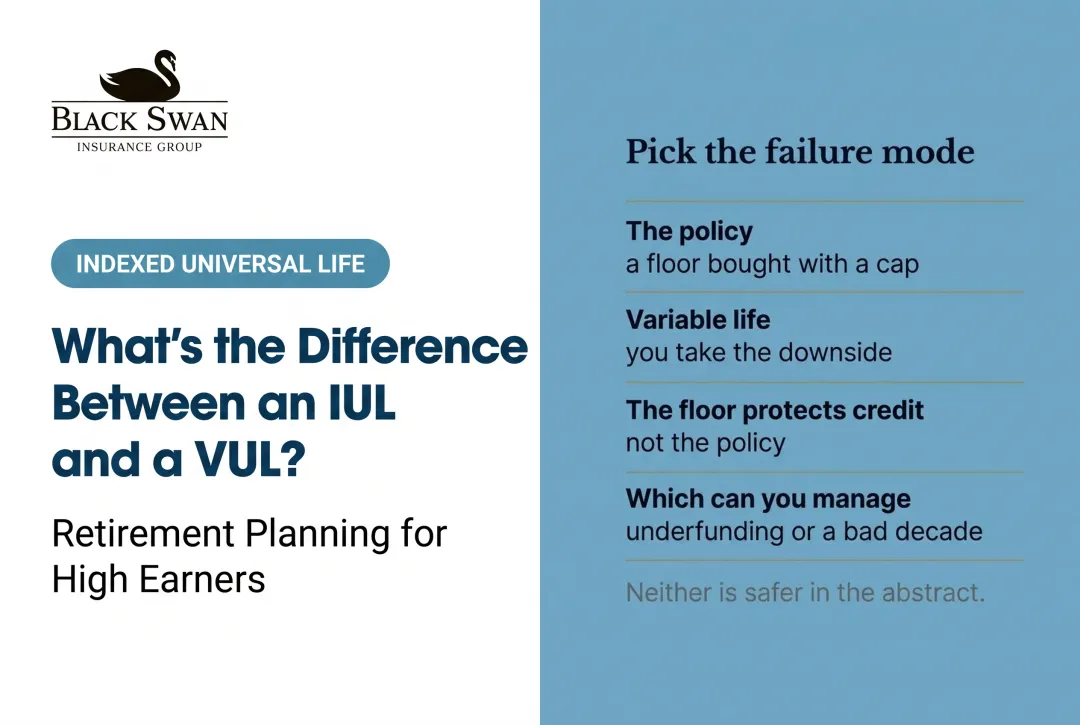
What the floor does not cover: total cash value or the death benefit. Mortality charges, administrative fees, loan interest and withdrawals can erode value even in a year the index credit was zero.
Zero is your hero in a down year — but only in the sense the credit did not follow the market off the cliff. The bill still arrives.
What it offers: permanent protection with tax-deferred cash-value growth; premium and death-benefit changes within contract limits; potential tax-advantaged access through loans or withdrawals when the policy is properly structured, funded and managed; crediting that does not pass through direct market losses.
What it costs: insurance and administrative charges rising with age; caps and participation rates the carrier can adjust; surrender charges on an early exit; compounding loan interest; and possible taxable income if the policy lapses with loans outstanding.

How a VUL Works
Permanent life insurance with flexible premiums and adjustable death benefit options, where you allocate cash value among insurer-provided subaccounts carrying direct investment exposure.
Performance mirrors whatever you select — a stock fund, a bond fund, a blend. No formula stands between your cash value and the market.
What it offers: broader subaccount choice where the carrier provides a full menu; higher long-term potential when the underlying investments perform; the premium and death-benefit flexibility common to universal life; tax-deferred growth.
What it risks: cash value can fall, and results are never guaranteed. Per Investor.gov, fund performance, premium payments and policy fees all affect account value, and poor performance can mean losing your initial investment.
Weak markets do more than shrink cash value. They raise funding pressure. Subaccounts underperforming while insurance costs climb with age means paying more just to keep the contract alive.
What owning one obligates you to:
- Review allocations regularly against risk tolerance and horizon
- Account for fund expenses layered on policy charges
- Watch cash value against rising insurance costs as you age
- Rebalance only inside a broader, coordinated plan
A VUL is not a low-cost brokerage account with a death benefit attached. Insurance costs, investment expenses, surrender provisions and contract guarantees are separate line items, not one bundled fee.

What the Critics Get Right
The criticism aimed at both of these products lands, and pretending otherwise would be dishonest.
Critics are right that a VUL is frequently an expensive wrapper around funds you could hold more cheaply in a brokerage account, and that the tax deferral rarely compensates for the layered fees unless the horizon is genuinely long. They are right that an IUL's floor is oversold, because it protects the credit and not the policy. And they are right that both are sold on illustrations rather than on contracts, which is a choice the industry made and deserves criticism for.
Where the criticism runs out is the protection need. If a permanent death benefit is genuinely required — estate liquidity, a business obligation, a lifelong dependent — then the comparison is not "policy versus brokerage account." It is which permanent structure survives your actual cash flow. Neither of these is a good way to invest. One of them may be a reasonable way to hold coverage you need anyway.
Which One Fits
Start with the insurance need, not the projected cash-value column.
Stronger Fit for an IUL
- A long-term permanent protection need and stable surplus cash flow
- Household income of $150K+ with adequate emergency reserves
- A preference for index-linked crediting over direct market investing
- Moderate appetite for ongoing oversight
- A funding plan that holds up under conservative assumptions
Stronger Fit for a VUL
- A genuine permanent insurance need and a long horizon
- High tolerance for volatility and real losses
- Enough liquidity to keep funding through a downturn
- Genuine interest in actively managing allocations, not just willingness to tolerate them
Weaker Fit for Either
Not everyone should buy an IUL, or a VUL. If you are comfortable carrying market risk directly, a brokerage account does it without insurance charges.
- Low-cost investment growth is the actual goal
- No genuine permanent coverage need — where the requirement is temporary protection, term insurance is the better and far cheaper answer, and it should be priced first
- Premiums would compete with emergency savings or core retirement contributions
- A short time horizon or uncertain premium capacity
- No appetite for reviewing the contract year after year
Late-start earners in their late 40s or early 50s should weigh time horizon and insurability carefully before assuming either fits a compressed runway.

The Ultimate IUL Blueprint
If the indexed route is where you are heading, the Blueprint covers the design decisions that determine the outcome: funding levels, the MEC line, loan timing and what to demand from an illustration.
Two Households, Two Answers
Hypothetical illustrations of a decision process, not promised results.
The IUL-oriented case. A 47-year-old physician earning $310,000 maxes her 401(k) and backdoor Roth, wants tax diversification and a permanent death benefit, and holds six months of reserves with stable surplus cash flow. The review runs a guaranteed illustration beside a deliberately conservative non-guaranteed scenario with a realistic cap and participation rate, then stress-tests the funding against a decade of flat index years. The question is whether sustainable funding supports the death benefit and long-term access without competing with her retirement contributions.
The VUL-oriented case. A 39-year-old tech executive with a long horizon and high risk tolerance wants direct market exposure inside a permanent policy, already runs a diversified brokerage portfolio, and understands subaccount volatility. The review covers fund expense ratios, mortality-and-expense-risk charges, and a scenario where a 20% decline early in the policy raises funding pressure for years afterwards. A weak sequence stacked on policy charges forces extra funding later just to keep the contract in force — and that risk outweighs any illustrated return.
LIMRA and Society of Actuaries research covering 2015–2021 found IUL lapse rates increased across nearly all policy years in that period. Funding discipline matters more than the crediting method.

The best policy is not the biggest illustration. It is the one that survives real life.
Risks to Understand Before You Choose
- The IUL floor protects the credit, not the policy — charges, loans and withdrawals still reduce cash value in a 0% year
- VUL has no floor at all, and a poor sequence early in the contract compounds into funding pressure for years
- Cost of insurance rises with age in both, and is charged whatever the market did
- IUL caps and participation rates are non-guaranteed and can be adjusted after you commit
- VUL adds fund expenses and mortality-and-expense-risk charges on top of the insurance costs
- Surrender charges make an early exit expensive on either
- Underfunding is the leading cause of lapse in both, and the lapse data bears that out
- Loan interest compounds, and a lapse or surrender with a loan outstanding and gain in the contract can create taxable income — IRS Publication 525 confirms surrender proceeds above cost basis are taxable
- Crossing the seven-pay limit makes either contract a MEC under I.R.C. § 7702A and changes distribution taxation
- VUL requires ongoing allocation review, and a contract nobody monitors is a contract drifting
Find Out Where You Actually Stand
This starts with the Tax-Free Wealth Blueprint Fit Review. If you earn $150K+ and are choosing between these two, we test whether a permanent need exists at all, compare the guaranteed columns, model a bad sequence and a funding pause on each, and price term alongside both. If it does not fit, we will tell you that too.
Frequently Asked Questions
Which is better, IUL or VUL?
Neither universally. It depends on your permanent coverage need, risk tolerance, funding capacity, appetite for market exposure and willingness to monitor the contract for decades.
Is a VUL a good place to invest?
It is an insurance product with investment subaccounts, not a standalone investment, and evaluating it as one is how people end up disappointed. Growth potential comes alongside market losses, fund fees and insurance costs.
Can either policy lose money?
A VUL has direct exposure to subaccount losses. An IUL has a floor limiting negative index credits, but fees, insurance charges, loans and withdrawals can still reduce value in either.
Why do affluent households use IUL?
Usually for permanent protection, tax-deferred growth with flexible access, and tax diversification alongside estate planning. It is not right for everyone and requires sustainable long-term funding to work as intended.
What should I compare before buying either?
Guaranteed and non-guaranteed illustrations, policy charges, caps or subaccount expenses, funding requirements, surrender terms, loan provisions, death benefit options, insurer financial strength — and the alternatives, including term insurance.
Should I just buy term and invest separately?
If the protection need is temporary, yes, and it is usually cheaper and simpler. That comparison deserves running before either of these designs.
Sources
- Investor.gov (SEC) — Variable life insurance
- Guardian Life — Indexed universal life
- LIMRA and Society of Actuaries — 2015–2021 UL lapse rate study
- IRS Publication 525 — Taxable and Nontaxable Income
- NAIC — Life Insurance Illustrations
Disclosure: This article is educational and is not personal tax, legal or investment advice. Indexed universal life is life insurance first. Variable universal life is a registered security sold by prospectus; read it before investing. Actual results depend on policy design, carrier, crediting options, caps, participation rates, subaccount performance, expenses, funding and ongoing management. Policy loans and withdrawals may reduce cash value and death benefit and can create tax consequences if the policy lapses or becomes a modified endowment contract. This strategy is not appropriate for everyone. Illustrated values are not guarantees; actual results depend on policy terms, crediting, costs and funding. Consult your own tax, legal and financial professionals for advice specific to your situation.
And remember, it's not what you earn, it's what you keep… enjoy the ride.