By Robert Balgac, Founder, Black Swan Insurance Group | October 5, 2026
Business owners look at policy cash value differently from everyone else. Where a W-2 earner sees retirement money, an owner sees a line of credit that does not require a bank, a covenant, or a conversation about last year's numbers.
That instinct is not wrong. It is incomplete. A policy loan has no covenants because it has no discipline, and working capital needs are recurring by nature. A borrowing source with no repayment schedule, used for a need that returns every quarter, is a structure that compounds quietly against you.
The short answer: You can borrow against IUL cash value for payroll, inventory, receivables gaps or equipment without underwriting, usually within days. Interest accrues whether or not you pay it, the death benefit falls by the balance, and policy charges continue. It works as a bridge with an identified repayment source. It fails as a substitute for a working capital facility.
Key Takeaways
- Speed and no covenants are the genuine advantages; cost and discipline are the genuine costs
- A policy needs many years of sustained funding before it can support meaningful business borrowing
- Recurring working capital needs are the wrong job for a facility with no repayment schedule
- Business risk and policy risk become correlated — a bad year strains the premium and the loan at once
- Compare against a business line of credit, SBA options, invoice factoring and retained earnings first
Where It Genuinely Works
An IUL is permanent life insurance first. Any potential tax-advantaged access depends on the policy being properly structured, funded and managed — and business borrowing tests that management harder than personal borrowing does.
- A receivables gap with a known collection date
- A seasonal inventory build repaid from the season's revenue
- Bridging to a scheduled event — a closing, a refinance, a contract payment
- Avoiding a covenant breach on an existing facility, as a one-off
The pattern is the same each time: short, defined, with an identified repayment source that is not "next year's profit."

Where It Fails
Payroll, month after month. Covering losses. Funding growth that has not been underwritten by anyone. These are not bridges; they are subsidies, and a policy loan makes them invisible for longer than a bank would allow. That invisibility is the danger. A lender saying no is information.
The loan is not the problem. The unmanaged loan is the problem — and in a business, the unmanaged loan usually has company.
The Correlation Problem
This is the structural issue owners miss. The year the business needs working capital is the same year cash flow is under pressure, which is the same year the premium becomes hard to maintain. So the loan grows at exactly the moment funding slows. Two forces push the policy toward lapse simultaneously, and the death benefit protecting your family is what absorbs it.

What the Critics Get Right
Critics are right that "be your own bank" marketing encourages owners to treat a protection asset as a credit facility, and that the absence of covenants removes a discipline that exists for good reason. They are right that policies funded specifically to serve as a business borrowing source usually end up doing neither job well.
Where the criticism overreaches is in ruling out the bridge use entirely. For an owner with a well-funded, mature policy and a defined short-term gap, it is a legitimate tool — and often faster than anything else available.
Compare It Against the Alternatives
- A business line of credit — covenants and reporting, but a defined structure and usually cheaper
- SBA lending — slower, cheapest for qualifying situations
- Invoice factoring — expensive, but matched precisely to a receivables gap
- Equipment financing — secured against the asset it buys
- Retained earnings — the cheapest capital in the business
- Term insurance plus a brokerage account — if the family protection need is the real driver, this covers it cheaply and keeps the business capital separate
Building the Discipline the Loan Does Not Impose
A bank imposes structure whether you want it or not. A policy loan imposes none, so you have to supply it. Owners who use this successfully build their own version of what a lender would have required.
Write a loan agreement with yourself. Amount, purpose, repayment source, repayment date. Put it in the file alongside the policy. It sounds artificial because it is, and it works for exactly that reason.
Set a standing interest payment. Treat it as a fixed monthly obligation like any other. Capitalised interest is how a manageable balance becomes an unmanageable one, and it happens invisibly.
Define a hard ceiling. Decide what proportion of net loan value you will never exceed, and check it before every draw rather than after.
Separate the policy from the operating account. If the policy is the only thing standing between a slow quarter and a missed payroll, the business is undercapitalised and the policy is not the fix.
Review annually, with the same seriousness as a bank covenant test. Pull an in-force illustration, check the balance against the termination trigger, and model a year with no crediting. If the projection has moved against you, act that year rather than the next.
Keep the family in the picture. The death benefit is reduced by the outstanding balance. If the coverage exists to protect dependants or fund a buy-sell, the people relying on it should know how much of it is currently pledged to the business.
Hope is not a retirement strategy, and it is not a working capital strategy either.
The Ultimate IUL Blueprint
A plain-English walkthrough of loan mechanics, funding requirements and what to establish before borrowing against a policy for the business.
Who This May Fit
Stronger Fit
- $150K+ income, with a mature policy funded well above minimum for many years
- A short, defined gap with an identified repayment source independent of future profit
- Business reserves that exist separately, so the policy is not the only liquidity
- Capacity to service interest rather than capitalise it
- Personal protection need genuinely met by the death benefit, independent of the business use
- An annual in-force review already in place
Weaker Fit
Not everyone should buy an IUL, and funding one in order to create a business borrowing facility is a poor reason to start. The policy should be protection that happens to have liquidity.
- Recurring working capital needs
- A young policy inside the surrender period
- Existing balance not yet repaid
- Business under genuine stress, where the premium itself is at risk
- A cheaper structured facility already available

Risks to Understand Before You Borrow
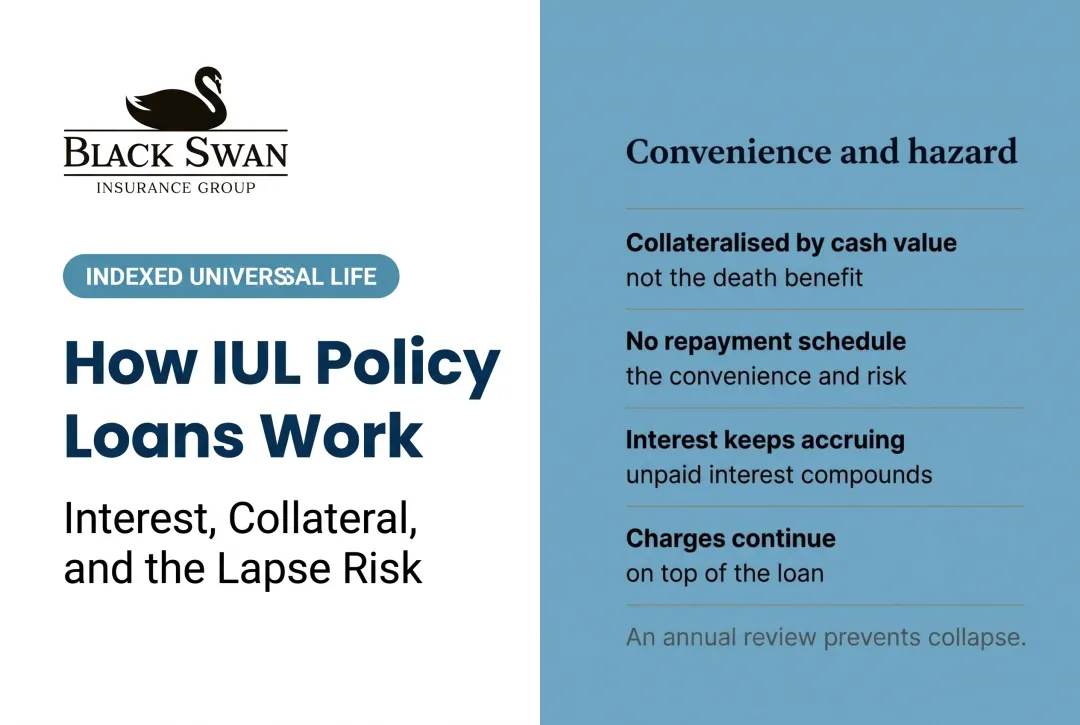
- Interest accrues whether or not you pay it and compounds into the balance if unpaid.
- Policy charges continue on top of the loan and rise with age.
- Business risk and policy risk correlate — a bad year strains both the premium and the balance.
- The death benefit falls by the outstanding balance, reducing the family protection you bought.
- Lapse risk rises as debt outpaces available value; the termination trigger is contract-specific.
- A lapse or surrender with gain and an outstanding loan can create taxable income with no cash received to pay it.
Find Out Where You Actually Stand
Start with the Tax-Free Wealth Blueprint Fit Review. If you earn $150K+ and are weighing a policy loan against a business facility, we price both, model the balance forward through a slow year, and show what it does to the death benefit and to the policy's survival. If IUL does not fit, we will tell you that too.
Frequently Asked Questions
Can I use IUL cash value for business expenses?
Yes. Loan proceeds can generally be used for any purpose, subject to available net loan value and your contract's provisions.
Is a policy loan cheaper than a business line of credit?
Often not. The advantages are speed, the absence of underwriting and no covenants — not price.
Do I need to tell my bank about the policy loan?
Existing facilities may have reporting or covenant obligations that capture it. Check your loan documents rather than assuming it is invisible.
Is the interest tax deductible as a business expense?
Deductibility of life insurance policy loan interest is restricted and fact-specific. Do not assume it; confirm with your tax adviser.
What happens if the business fails?
The loan remains outstanding against the policy and continues accruing. This is why an identified repayment source independent of the business matters.
How much can I borrow?
Generally a percentage of cash surrender value less existing debt. On a young policy that figure is far smaller than the accumulated cash value suggests.
How long does it take to get funds?
Often a few business days once the request is complete, though this varies by carrier and policy status. Confirm your own timeline before relying on it.
Can my business own the policy?
Sometimes, depending on structure and purpose, and it changes the tax and accounting treatment considerably. Discuss ownership with your accountant before applying, not afterwards.
What if I need the money every quarter?
Then this is the wrong facility. A recurring need requires a structured line of credit with a repayment schedule, not a loan that never asks for anything.
Does the loan appear on my business balance sheet?
It depends on who owns the policy and who borrowed. A personally owned policy loan used in the business creates a related-party question worth resolving with your accountant.
Is there a limit on how many loans I can take?
Practically, the limit is available net loan value. There is rarely a restriction on the number of draws, which is precisely why owners need a self-imposed ceiling rather than relying on the carrier to impose one.
What happens to the loan if I sell the business?
Nothing automatically. The loan sits against the policy and follows the policy owner, not the business, unless the business owns the contract. A sale is a good moment to clear it while proceeds are available.
Sources
- NAIC — Life Insurance — cash value and policy loan definitions
- National Life Group — loan mechanics and processing
- U.S. Small Business Administration — business financing alternatives
- I.R.C. § 264 — limitations on deductibility of interest on policy loans
- I.R.C. § 7702A — Modified Endowment Contract and the seven-pay test
- I.R.C. § 72 — additional tax on early distributions
Disclosure: The information on this page is educational in nature and does not constitute personalized financial, tax, or legal advice. Actual results depend on policy design, carrier, crediting options, caps, participation rates, expenses, funding, loans, and ongoing management. Policy loans and withdrawals reduce cash value and the death benefit, and can create tax consequences if the policy lapses or becomes a modified endowment contract. Consult a licensed insurance professional and, where appropriate, a tax or financial advisor before making any insurance or financial decision. Indexed universal life is life insurance first. Illustrated values are not guarantees; actual results depend on policy terms, crediting, costs and funding. This strategy is not appropriate for everyone.
And remember, it's not what you earn, it's what you keep… enjoy the ride.