By Robert Balgac, Founder, Black Swan Insurance Group | October 9, 2026
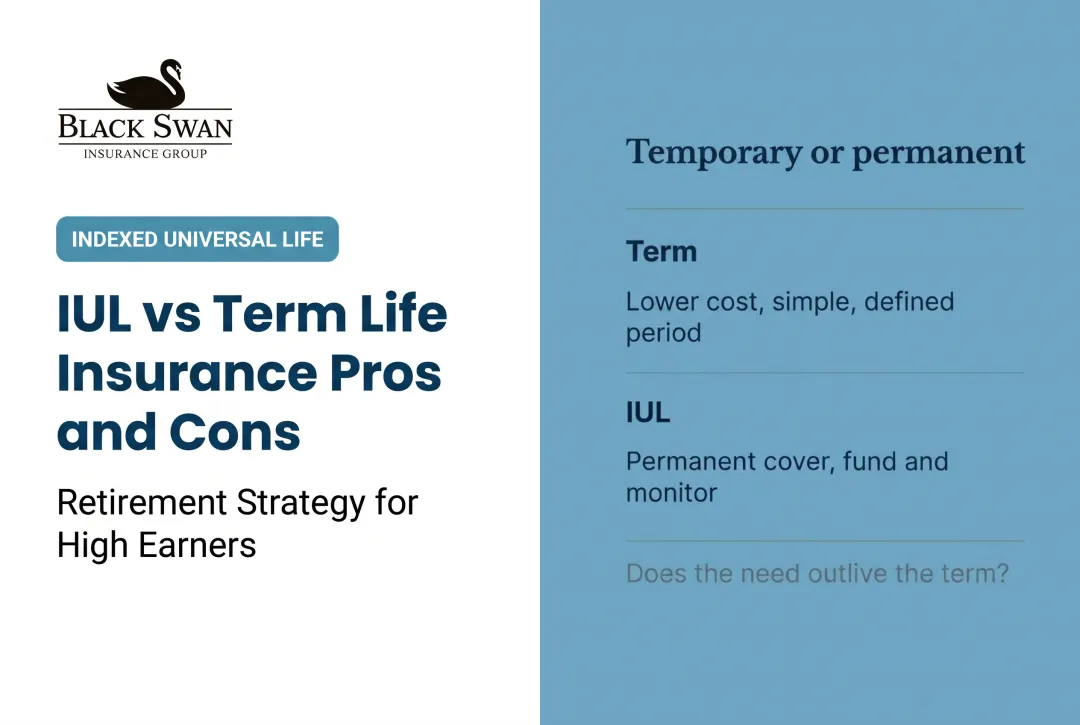
Both policies pay a death benefit if you die while coverage is active. That is the entire overlap. Everything else — cost, duration, complexity, what happens if you stop paying — runs in opposite directions, and the single question that resolves most of it is deceptively simple: how long does the need last?
Answer that honestly and the comparison largely settles itself. Term life is built for a defined window. Indexed universal life is built to last your whole life, with a cash-value component tied to an index. Picking the wrong one based on a low quoted premium or a flattering illustration leaves your family underinsured or saddles you with a contract you cannot sustain.
This matters most for $150K+ earners, because they are the ones most likely to be sold permanent coverage for a temporary problem — and most likely to afford the mistake quietly for a decade before noticing.
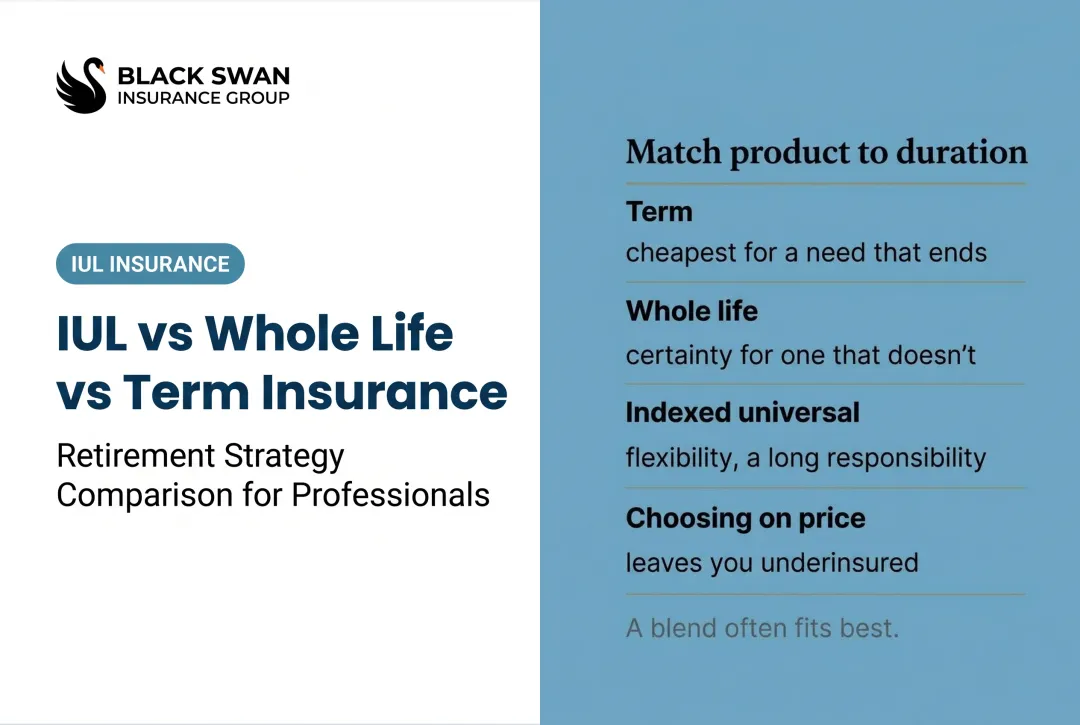
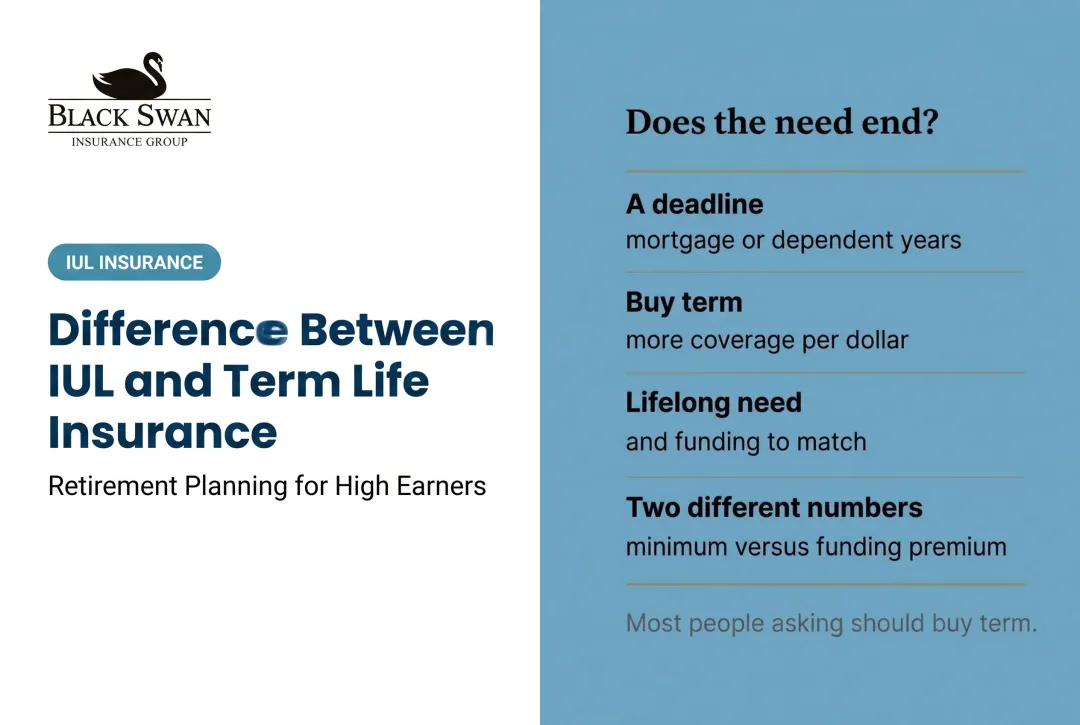
The short answer: Match duration to need. If the obligation has an end date — a mortgage, the years until the children are independent, a business loan — term is almost always the right instrument and the cheaper one. Permanent coverage earns its cost only when the need genuinely outlives any term you could buy. Most households need more term than they have, and far fewer need permanent coverage than are sold it.
A great IUL is engineered. A bad IUL is sold.
Key Takeaways
- Term life delivers affordable, time-bound coverage for income replacement, mortgages or dependents
- IUL pairs lifelong coverage with index-linked cash value, and it requires sustained funding plus ongoing review
- Neither illustration guarantees future performance — review guaranteed and non-guaranteed values separately
- Layer both when permanent needs and surplus cash genuinely coexist
- Choose term plus existing retirement savings when cost control comes first
Where the Two Diverge
Coverage duration
IUL is designed to last your whole life, provided required premiums are paid and the policy stays funded. Guarantees depend entirely on the contract — not every design guarantees lifetime coverage regardless of funding.
Term covers you for a set period, usually 10, 20 or 30 years. When the term ends, coverage stops unless you renew, often at a materially higher rate, or convert to a permanent policy.
Premium structure
- IUL: premiums are flexible within limits, but policy charges continue regardless. Underpaying erodes cash value until the contract lapses.
- Term: premiums are level and predictable for the entire term. Dollar for dollar, term buys far more temporary death benefit than any permanent policy.
Cash value
- IUL: credits interest tied to an index such as the S&P 500, shaped by participation rates, caps, floors and spreads. You earn interest on index performance within contract limits, not from direct investment in the index.
- Term: none. Premiums pay strictly for protection.
Flexibility and complexity
- IUL: allows premium and death benefit adjustments over time, but requires updated illustrations and periodic review to confirm the design is still on track.
- Term: simpler. You pick a term and a face amount, and they stay fixed until renewal or conversion.
Risk and maintenance
- IUL: lapse risk if cash value runs dry, plus surrender charges, loan interest and cost-of-insurance charges that rise with age.
- Term: the main risks are outliving the term, with steep renewal costs, or missing a conversion deadline.

What an IUL Actually Is
Permanent coverage pairing a death benefit with a cash-value account, where credited interest is tied in part to an external index, subject to caps, floors and other contract limits.
Simplified: a portion of your premium covers the cost of insurance and policy expenses, and the remainder goes toward cash value. If the index performs well, you are credited interest up to your cap. If the index drops, a floor — often 0% — prevents a negative index credit, but policy charges still apply, so cash value can still decline.
Zero is your hero in a down year — but the floor applies to the credit, not to the charges.
Features worth understanding before you commit:
- Flexible premiums, as long as funding stays high enough to keep the policy in force
- Adjustable death benefits that may require new underwriting or change your costs
- Index-crediting rules — caps, floors, participation rates and spreads — that set credited interest and can change over time
- Loans and withdrawals against cash value, where unpaid loans can cut the death benefit or cause a lapse
It may suit households with a real permanent need, stable surplus cash flow, emergency reserves and decades of funding discipline; high-income professionals, executives and business owners adding permanent protection beside retirement accounts; and late-start high earners who need a time-horizon and insurability review before relying on a shorter funding runway.
It is usually a poor fit when cash flow is unstable, emergency savings are thin, high-interest debt is unresolved, or you only need inexpensive temporary coverage. The NAIC notes that illustrations show both guaranteed and non-guaranteed values, and the gap between those two columns matters far more than the headline projection.

What Term Life Actually Is
Term life pays a death benefit if you die during a selected period, typically 10, 20 or 30 years. There is no cash-value component — it is pure protection.
Common structures:
- Level term — premium and coverage stay fixed for the term
- Renewable term — you can renew after the term ends, usually at a much higher premium
- Convertible term — you can convert to a permanent policy, often without new medical underwriting, though deadlines and eligible products vary by contract
Term fits time-bound obligations: income replacement while children are young, a mortgage balance, a business loan, education funding. It is the lower-cost option, straightforward to administer, and predictable for the whole term — which frees up budget to direct elsewhere, including retirement accounts.
The trade-off is that coverage can expire before the need does. Renewal gets expensive, new coverage may require fresh underwriting, and none of it builds cash value. Forbes Advisor notes that even specialists who sell permanent coverage often recommend term first when the need is genuinely temporary.
Pricing varies widely by age, health, tobacco use, term length and insurer. Treat published sample rates as illustrations, not a universal price.
The Ultimate IUL Blueprint
If the duration test points toward permanent coverage, the Blueprint covers what the design has to survive: funding levels, charges, the MEC line, loan timing and what to demand from an illustration.
What the Critics Get Right
The strongest argument against IUL in this comparison is the oldest one: buy term and invest the difference. It deserves to be taken seriously rather than brushed off.
The logic is sound and the arithmetic usually favours it. Term costs a fraction of permanent coverage for the same face amount. The difference, invested in a low-cost index fund, carries no cost of insurance, no surrender schedule, no lapse risk and no underwriting. For the large majority of households, that is simply the better plan, and anyone selling permanent coverage who refuses to say so is not being straight with you.
Where the argument weakens is in its two assumptions: that the need really does end, and that the difference really does get invested. For someone with an estate liquidity problem, a special-needs dependent, or a business that will owe money at their death regardless of how old they are, the need does not end — and buying twenty years of coverage for a forty-year obligation is a plan with a hole in it. That is the narrow case where permanent coverage earns its cost. It is narrow.
Stronger Fit
Choose term first when protection is the priority — when you have:
- Children or dependents relying on your income
- A mortgage or business debt tied to a specific payoff date
- A need expected to shrink or disappear over time
- A budget where funding both maximum protection and cash value is not realistic — adequate protection wins
Before buying, check the conversion rights: the conversion period, eligible permanent products and any restrictions, so you are not boxed out later if your circumstances change.
Consider an IUL only when permanent need and funding both hold up. Before moving forward:
- Compare guaranteed and non-guaranteed values side by side.
- Stress-test the illustration using conservative crediting assumptions, not the best case.
- Review policy charges, surrender schedules and loan provisions in writing.
- Compare the proposal against qualified retirement contributions, Roth strategies, taxable investing and a properly sized term policy.
Weaker Fit
Not everyone should buy permanent coverage. Walk away, for now, if:
- The obligation you are insuring has a clear end date
- Your emergency reserves are thin or high-interest debt is unresolved
- An employer match is unclaimed
- You cannot sustain the premium through a job change or a slow year in the business
- The appeal is the illustration rather than a named, lasting obligation
A Combination, Used Carefully
Some households layer a larger term policy for temporary income protection with a smaller permanent policy for a lifelong need such as estate liquidity or a legacy goal. That is not automatically the better answer. Total premiums still have to pencil out against the household budget, today and ten years from now.

A real case. One Black Swan client, Steven Curtiss, had a lapsed policy and needed it reinstated along with competitive rates on both term and IUL coverage. Working with an advisor, he secured reinstated coverage and pricing across both policy types. The point is that term and permanent were evaluated together rather than one automatically displacing the other.
For business owners and practice owners carrying concentration risk in a single company, permanent coverage more often sits beside existing retirement and investment assets rather than replacing them. Term still handles shorter-term debt or buy-sell obligations.
Decision Checklist
Before applying for either policy, confirm:
- The coverage amount and the specific obligation it protects
- Your age, health and insurability, alongside dependents, debt and estate goals
- Whether premiums stay affordable through a job loss, business downturn or retirement
- A clear explanation of fees, surrender charges, loan interest, and who reviews the policy annually
An illustration is a model, not a guarantee.
Risks to Understand Before You Apply
- Buying permanent coverage for a temporary need is the most expensive error in this category, and it is the most common one.
- Buying term for a permanent need is the mirror error: the coverage expires exactly when replacing it is hardest.
- Missing a conversion deadline can close the door on permanent coverage if your health changes.
- Underfunding an IUL causes lapse, and a lapse with an outstanding policy loan can create taxable income with no cash received.
- Caps and participation rates can be reduced going forward, subject to contract minimums.
- Cost of insurance rises with age, so a design built at 45 can strain at 70 if funding never changed.
- MEC status from overfunding is generally permanent and changes how every future distribution is taxed.
Find Out Where You Actually Stand
This starts with the Tax-Free Wealth Blueprint Fit Review. If you earn $150K+ and you are trying to decide between term, permanent or both, we start with the duration of the need rather than the product — then compare a properly sized term policy, retirement contributions and brokerage investing against any permanent design before recommending anything. We stress-test funding through lower-crediting and zero-credit years and show the charges in plain numbers. If IUL does not fit, we will tell you that too.
Frequently Asked Questions
Is IUL better than term life insurance?
Neither is universally better. Term fits temporary protection and affordability; a policy may fit certain permanent coverage and cash-value goals after a proper suitability review.
How much more expensive is IUL than term life insurance?
Pricing depends on age, health, coverage amount, design, insurer and funding level. Ask for current, labelled illustrations for your specific profile rather than relying on a generic multiplier.
Can I have both term life insurance and an IUL policy?
Yes — some households layer term for temporary income protection with a smaller permanent policy for a specific lasting need. Total premiums across both still need to stay sustainable.
Does an IUL guarantee cash-value growth?
No. Guaranteed policy elements are separate from non-guaranteed index-linked crediting, which depends on caps, floors, participation rates and fees. Read the guaranteed column.
What happens if I stop paying into an IUL?
Premium flexibility does not mean premiums are optional forever. Insufficient cash value can lead to reduced benefits, a required catch-up payment or an outright lapse.
Can term life insurance be converted to IUL?
Many term policies include conversion provisions, but eligibility, deadlines and available permanent products vary by carrier and state. Check your specific contract before assuming you have the option.
Sources
- NAIC — Life Insurance Illustrations
- Forbes Advisor — Indexed universal life insurance
- NAIC — Life Insurance
Disclosure: This article is educational and is not personal tax, legal or investment advice. Indexed universal life is life insurance first. Any potential tax-advantaged access depends on the policy being properly structured, funded and managed. Actual results depend on policy design, carrier, crediting options, caps, participation rates, expenses, funding and ongoing management. Illustrated values are not guarantees; actual results depend on policy terms, crediting, costs and funding. This strategy is not appropriate for everyone. Policy loans and withdrawals reduce cash value and the death benefit, and can create tax consequences if the policy lapses or becomes a modified endowment contract. Consult your own tax, legal and financial professionals for advice specific to your situation.
And remember, it's not what you earn, it's what you keep… enjoy the ride.