By Robert Balgac, Founder, Black Swan Insurance Group | October 9, 2026
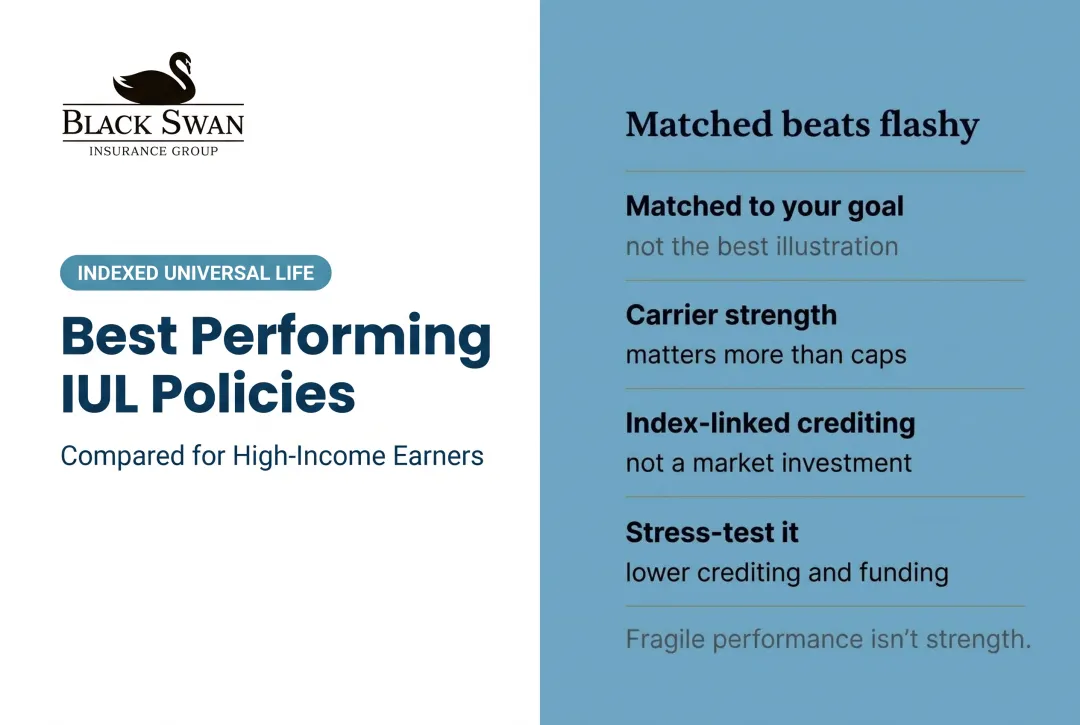
Shopping for IUL by chasing the highest advertised cap rate is like picking a car on top speed. It tells you nothing about how the thing drives over thirty years, and the cap you were quoted is a number the carrier can revise without breaching anything.
IUL is permanent life insurance. It pairs a death benefit with cash value credited partly from an external index such as the S&P 500, without your premium ever entering that index. Policy charges, cost-of-insurance deductions and shifting crediting terms decide what the contract actually delivers.
U.S. individual life insurance new premium reached $17.5 billion in 2025, per LIMRA's 2025 sales report, with IUL contributing $4.5 billion, up 17% year on year. More buyers than ever are comparing these contracts, mostly on the wrong variable.
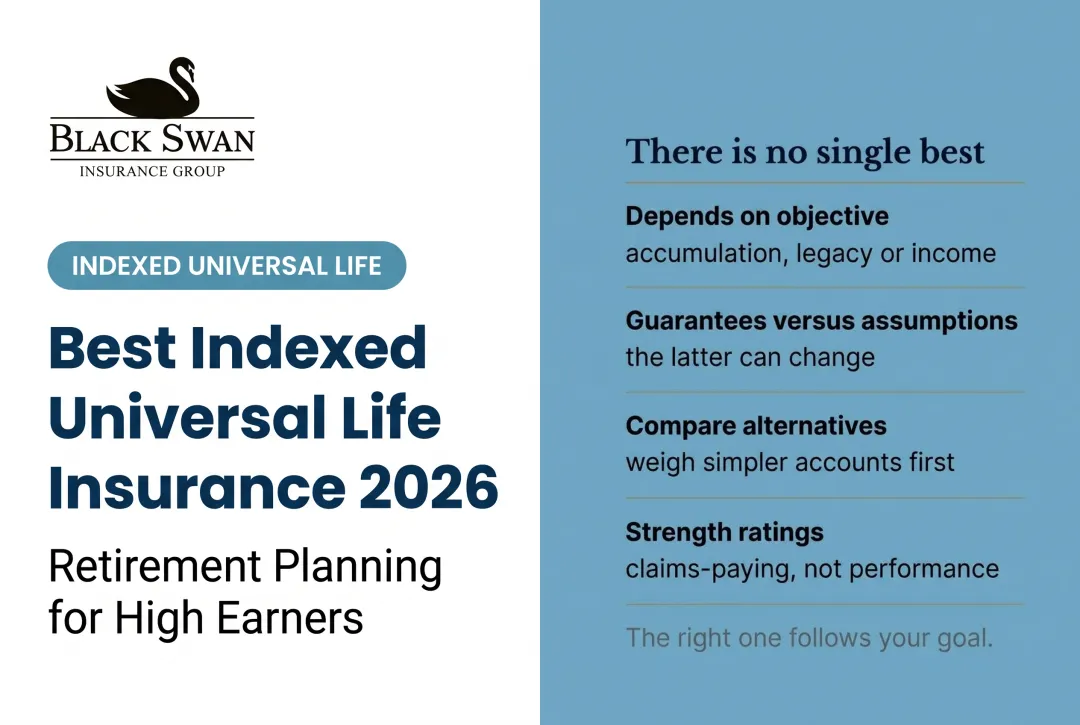
The short answer: There is no best IUL. There are carriers whose designs suit accumulation, others built for protection or living benefits, and others whose underwriting treats your health more kindly. The right one follows from your objective, your funding capacity and your insurability — never from a ranking, and never from the illustrated column.
Key Takeaways
- No single policy is best for everyone; it depends on age, health, funding capacity and goals
- Carrier financial strength, charges and loan provisions matter far more than one attractive current rate
- Brokerages design and compare coverage; carriers issue the policy and hold the guarantees
- Always review guaranteed, current and conservative illustrations before applying
- Compare against whole life, term, the 401(k), Roth accounts and annuities first
How the Product Works
Permanent life insurance with flexible premiums and a lifelong death benefit, where cash value grows through index-linked crediting rather than a fixed rate. It is not a market investment.
Three numbers drive most of what appears on an illustration. The floor is the minimum credit for a period, often 0%, blocking negative index credits but not the charges that still reduce cash value. The cap is the maximum index-linked credit. The participation rate is the share of index gain used in the calculation, subject to that cap.
Zero is your hero in a down year — but the floor applies to the credit, not to the charges.
Caps, participation rates, index options and rider charges vary by product and carrier, and many are not guaranteed. What you see at application is not locked in.
High earners, business owners and families look at IUL for permanent protection outlasting term, supplemental retirement access alongside the 401(k) and IRA, tax diversification across account types, liquidity held outside a concentrated business, and legacy planning. It works as one piece of a plan, not a replacement for retirement accounts or an emergency fund.

The Ultimate IUL Blueprint
Before comparing carriers, the Blueprint covers what any design has to survive: funding levels, caps and charges, the MEC line, loan timing, and what to demand from an illustration.
Options by Objective
Organised by likely use case, not a performance ranking. Verify everything against current policy forms, financial-strength ratings and a personalised illustration before applying — availability, underwriting and riders vary by state and applicant.
Black Swan Insurance Group — personalised evaluation and ongoing guidance
An Ohio-founded brokerage, not a carrier. It does not issue policies; it works out which carrier and design fit your situation, then stays involved afterwards. The firm has worked with over 20,000 families and businesses since 2017 and holds an A+ Better Business Bureau rating with more than 800 five-star Google reviews.
The process runs five steps: financial goals review, policy customisation, strategy design, application and approval, then annual review. It suits high earners and business owners, late starters with a compressed runway, and families weighing IUL against term or retirement accounts.
It will also tell you when IUL is the wrong answer — most often where lower-cost tax-advantaged accounts are not yet maxed, or the premium is not sustainable.

Pacific Life — affluent buyers, complex estate or business planning
The lineup includes Pacific Horizon IUL 2, Horizon ECV IUL (built for high early cash-surrender value), Trident IUL, and Horizon Survivorship IUL 2. Horizon IUL 2 covers issue ages 0–90 with optional Premier Chronic Illness and Living Benefits riders; ECV IUL carries a $50,000 minimum face amount for ages 18–75; Survivorship IUL 2 includes a Flexible Duration No-Lapse Guarantee Rider.
Ratings: AM Best A+, S&P AA−, Moody's Aa3. Confirm current issue limits before applying — product sheets change.
Nationwide — living benefits and multiple objectives
Indexed UL Accumulator III, Protector II 2020 and Survivorship Indexed UL 2020. Accumulator III carries a $100,000 minimum specified amount and offers chronic, critical and terminal illness benefits plus an LTC rider and Overloan Lapse Protection Rider II. Protector II 2020 covers chronic and terminal illness with the same riders; the survivorship product offers the LTC and overloan riders without the full illness suite.
Worth catching: Nationwide's own materials state the chronic-illness benefit is not available when the LTC rider is attached. Ratings: AM Best A+, Moody's A1.
Mutual of Omaha — simpler designs, broader accessibility
Life Protection Advantage IUL, Income Advantage IUL, and IUL Express, a simplified-issue product with no medical exam. IUL Express has historically used a $25,000 minimum initial death benefit with bands narrowing at older ages — up to $300,000 at ages 18–50 against $150,000 at 61–75. Terminal, chronic and critical illness accelerated-benefit riders attach automatically at issue, and using one reduces the remaining death benefit.
Ratings: AM Best A+, S&P A+, Moody's A1. Practical where you want simplified underwriting. Confirm current bands directly.
Penn Mutual — early cash value and mutual structure
Accumulation IUL, Protection IUL and Survivorship IUL, issued through The Penn Insurance and Annuity Company, a subsidiary of the mutual parent. The Surrender Benefit Enhancement Rider can raise early cash-surrender values for certain business-owned or premium-financed strategies by waiving early surrender charges — it is not automatic, so confirm availability for your state and product.
Ratings: AM Best A+, S&P A+, Moody's Aa3. Note the issuing subsidiary differs legally from the mutual parent.
John Hancock — lifestyle programmes and broad selection
Protection IUL, Accumulation IUL, survivorship versions of both, and LifeCare, a hybrid with built-in long-term-care benefits. The Vitality programme runs in two tiers: Vitality GO, included at no extra cost on eligible policies and unavailable in New York, and Vitality PLUS, adding potential premium savings from as little as $2 per month with health-review registration. Living benefits include a Chronic Illness Rider and an Accelerated Benefit Rider for terminal illness.
Ratings: AM Best A+, S&P AA−, Moody's Aa3. Treat Vitality rewards as a bonus, never the deciding factor — weigh expenses, guarantees and death-benefit structure first.
What the Critics Get Right
Be sceptical of this article, and of every other "best IUL" list.
These pieces are usually written by someone compensated when you buy, they rank on features that are current rather than contractual, and they imply a universal answer that does not exist. A cap quoted today can be cut next year without breaching your policy. A generous bonus structure usually arrives paired with a lower cap.
What a comparison can honestly do is narrow the field by objective and tell you which clauses to interrogate. What it cannot do is tell you which contract is right for you, because that depends on health, funding capacity and a protection need no article can see.
How These Were Assessed
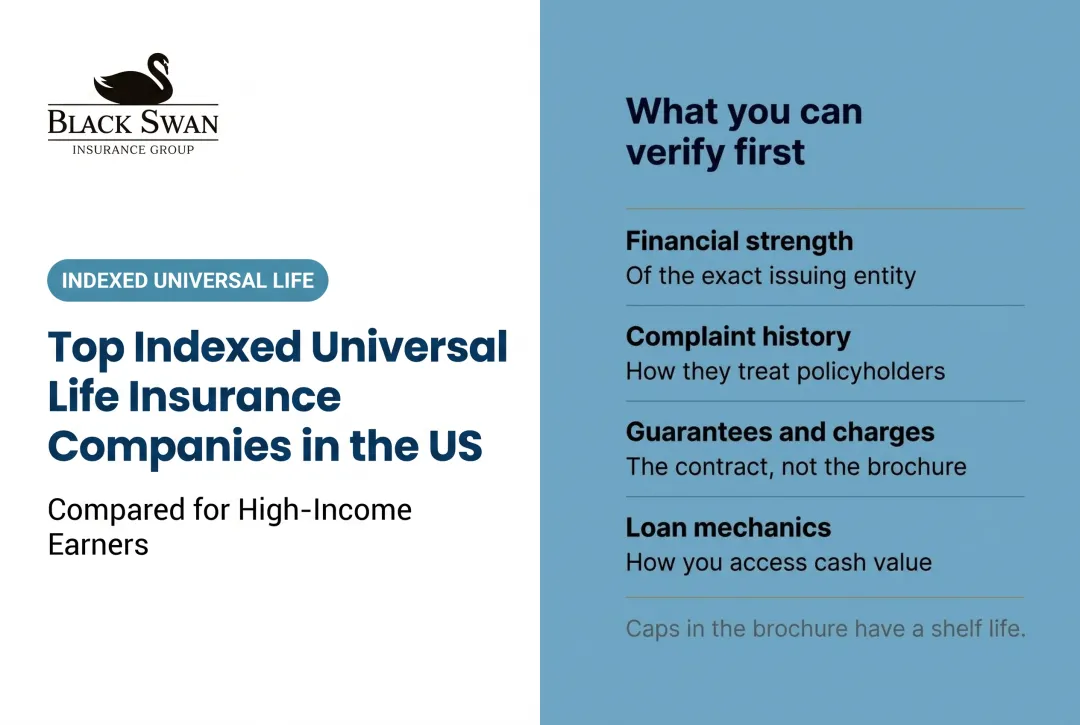
Financial strength first. An AM Best rating reflects an insurer's ability to meet ongoing obligations — not a judgment on any contract and not a suitability recommendation, per the AM Best ratings guide. On a contract lasting decades, that check is non-negotiable.
Design and guarantees: death-benefit options and no-lapse provisions, guaranteed minimums against illustrated values, premium flexibility and surrender schedules, cost-of-insurance structure and rider charges.
Crediting mechanics beyond the illustrated rate: index options, caps, participation rates and spreads — and crucially, whether the carrier has held in-force rates steady or cut them after issue. Past behaviour toward existing policyholders tells you more than any current rate.
Stress-testing. NAIC's Actuarial Guideline 49-A governs how indexed-crediting illustrations must be presented, with revisions tightening limits and strengthening disclosure, per NAIC guidance. Ask for guaranteed projections, conservative non-guaranteed assumptions, and scenarios with missed premiums, loans or rising charges.
An illustration is a model, not a guarantee.

Complaint data for the specific issuing subsidiary — complaint indexes are not interchangeable across affiliated companies, which catches people out.
Stronger Fit
- Earning $150K+ with surplus cash flow after reserves, debt and maxed retirement contributions
- A genuine permanent protection, business or legacy need
- Insurable at a reasonable rate, with a long funding horizon
- Willing to review the contract annually
Weaker Fit
Not everyone should buy one. Step back if you have an unclaimed employer match or thin reserves, need liquidity within five to ten years, only need a death benefit for a defined period — term is cheaper and sufficient — or are deciding on the strength of a projected number.
Risks to Understand Before You Apply
- Caps and participation rates can be lowered after issue, within contract limits.
- Cost of insurance rises with age, and underfunding is the leading cause of failure.
- Surrender charges can consume much of the cash value on an early exit.
- MEC status is generally permanent and removes the living-access advantage.
- An unpaid loan at lapse or surrender can create taxable income with no cash received.
- Ratings describe the carrier, not whether your specific design will hold up.
Find Out Where You Actually Stand
This starts with the Tax-Free Wealth Blueprint Fit Review. If you earn $150K+ and are comparing carriers, we work from your objective and health profile rather than a ranking, compare designs on guaranteed values and charges, and stress-test each through lower-crediting and zero-credit years with the loan assumptions shown plainly. If another strategy deserves priority — maxing the plan, or term plus a brokerage account — we will say so. If IUL does not fit, we will tell you that too. Insurance products are offered only where Black Swan Insurance Group LLC and its producers are properly licensed; availability and eligibility vary by state and underwriting.
Frequently Asked Questions
What is better than indexed universal life insurance?
It depends on the goal. Whole life, term, the 401(k), Roth accounts, taxable brokerage or annuities may each fit better depending on the guarantees, liquidity, horizon and funding capacity you need.
Is IUL a good investment?
It is life insurance first, not an investment. Its value depends on your protection need, policy costs, crediting terms and whether you can fund it consistently for decades.
Can you lose money in an IUL?
Yes. A 0% floor stops a negative index credit but not cost-of-insurance deductions, administrative charges or loan interest from reducing cash value or causing a lapse.
What should I compare between companies?
Financial strength, fees, caps, participation rates and index options, plus loan provisions, riders, complaint history, and both guaranteed and non-guaranteed illustrations — in roughly that order.
Are caps and participation rates guaranteed?
No. They vary by contract and can change at the carrier's discretion within contract limits. Your policy documents separate guaranteed provisions from current assumptions.
How much should I contribute?
It depends on death benefit, age, health and funding goal, and must stay under MEC limits. Stress-test it so the policy survives low-crediting years and a period of reduced income.
Sources
- LIMRA — U.S. individual life insurance new premium tops $17.5 billion in 2025
- AM Best — ratings guide
- NAIC — Life Insurance Illustrations
Disclosure: This article is educational and is not personal tax, legal or investment advice. Indexed universal life is life insurance first. Carrier products, riders, rates, issue limits and state availability change frequently and must be confirmed against current policy forms before applying; ratings cited reflect an insurer's claims-paying ability, not the suitability of any contract. Illustrated values are not guarantees; actual results depend on policy terms, crediting, costs and funding. Any potential tax-advantaged access depends on the policy being properly structured, funded and managed. Actual results depend on policy design, carrier, crediting options, caps, participation rates, expenses, funding and ongoing management. This strategy is not appropriate for everyone. Policy loans and withdrawals reduce cash value and the death benefit, and can create tax consequences if the policy lapses or becomes a modified endowment contract. Consult your own tax, legal and financial professionals for advice specific to your situation.
And remember, it's not what you earn, it's what you keep… enjoy the ride.