By Robert Balgac, Founder, Black Swan Insurance Group | October 9, 2026
Search "best IUL" and you will find lists ranking carriers by cap rate or illustrated cash value. Those rankings answer a question nobody should be asking. The best indexed universal life policy is the one whose guarantees, costs and loan terms match what you are actually trying to accomplish — and that answer changes by buyer, not by carrier.
If you earn $150K+, have maxed the 401(k) and hit the Roth phase-out, you are being shown headline projections rather than contract mechanics. An illustration showing 7% growth is not a promise. It is a model built on assumptions the carrier can revise.
The short answer: there is no best IUL carrier, and anyone publishing a single winner is ranking on the wrong variable. Rank on financial strength, policy economics, crediting mechanics, loan design and downside resilience — in that order — against the specific job your coverage has to do. Then compare the result with term insurance, a fully funded 401(k) and a brokerage account before you apply anywhere.
Key Takeaways
- No single IUL carrier fits every buyer; the right choice depends on funding ability, time horizon and goals
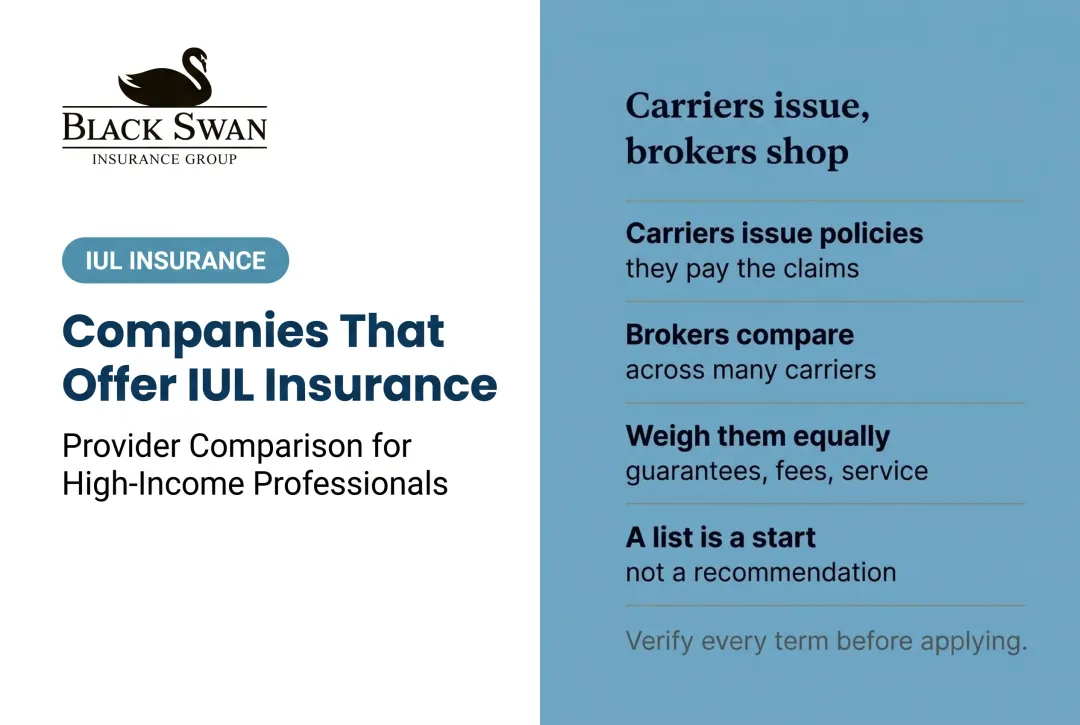
- A brokerage compares carriers; the carrier itself issues the contract and pays claims
- Always stress-test illustrations against lower-crediting scenarios, not just the best-case column
- Confirm how an IUL coordinates with your 401(k), Roth and other retirement assets before applying
- Downside resilience under weak crediting and a missed premium year is the test that actually separates designs
What Determines the Outcome
IUL is permanent life insurance. It pays a death benefit for life, assuming the contract stays funded, and builds cash value that may earn interest tied to an external index such as the S&P 500. Your money is never invested in that index.
What actually decides your result:
- Cost of insurance and administrative charges — deducted monthly regardless of index performance
- Floors and caps — a floor, often 0%, limits losses from a down market; a cap limits how much upside you capture
- Participation rates and spreads — determine what share of an index gain is credited
- Surrender charges — reduce accessible value if you exit early
- Policy loans — accrue interest and shrink both cash value and death benefit if mismanaged
Zero is your hero in a down year — but the floor applies to the credit, not to the charges.
Illustrations model these variables under assumptions that may not hold. The National Association of Insurance Commissioners tightened illustration rules through its revised AG 49-A actuarial guideline, which limits how aggressively insurers can project indexed credits and adds disclosure requirements for policies sold from April 2026.
That change helps you compare illustrations more fairly. It does not guarantee future cap levels, loan rates or tax treatment.

Treat the providers below as potential fits by goal. Caps, fees and ratings change, so verify every detail against the carrier's dated documents before applying.
Providers, Matched to Objectives
These notes weigh policy design, contractual guarantees, financial strength, crediting flexibility, living benefits and ongoing service capacity. Illustrations do not decide the ordering. One entry is a brokerage that compares carriers; the rest are insurers that issue the policies.
Black Swan Insurance Group
An Ohio-based insurance brokerage, not a carrier. We do not issue policies or pay claims. We compare IUL options across multiple insurers and match each client to a suitable design.
Founded in Springboro in 2017 by Robert Balgac, the firm has worked with more than 20,000 families and businesses and holds an A+ Better Business Bureau rating. We partner with Equis Financial to extend reach beyond Ohio.
The process runs in five steps: needs assessment (protection, income and liquidity goals), coverage exploration (comparing carrier options against those goals), policy tailoring (design, riders and funding), transparent enrollment (costs and terms walked through before signing), and annual review (monitoring the policy as circumstances change).

This structure matters most for high-income professionals juggling 401(k)s and Roth accounts, business owners wanting assets outside a concentrated company, and late-start high earners — typically ages 45 to 55 — with a shorter funding runway.
A brokerage review is not useful if you have not maxed lower-cost tax-advantaged accounts first, or if you need short-term liquidity. We will tell you that on the first call rather than the fifth.
Pacific Life: early cash value and flexible protection
Pacific Life Insurance Company offers Horizon IUL 2 with eight indexed account choices and an indexed loan option. Two chronic-illness riders are available as optional add-ons, along with a long-term-care alternative. Pacific Life carries an AM Best A+ rating, which reflects claims-paying strength for the company — not a guarantee of any policy's performance.
Good fit for: buyers prioritising flexible crediting options and optional living benefits alongside permanent protection. Weaker fit for: anyone wanting a simpler product with fewer moving pieces, or applicants who cannot commit to a longer funding horizon.
Allianz Life: accumulation-focused crediting
Allianz Life Insurance Company of North America offers Life Accumulator for cash-value growth through fixed and indexed allocations with caps and participation terms. Loans and withdrawals are available, though chronic and terminal illness access typically runs through optional riders rather than being built in. Allianz holds AM Best A+ and S&P AA ratings, among the stronger grades here.
Before assuming this fits an accumulation goal, request an apples-to-apples illustration: same insured profile, same premium schedule, same underwriting class as any competing carrier. Bonuses and current participation rates are not contractually locked and can shift over the life of the policy.
John Hancock: living benefits and underwriting speed
John Hancock Life Insurance Company (U.S.A.) offers indexed and fixed account choices with cash-value loans and optional chronic-illness and long-term-care benefits across its IUL lineup. Fitch rates the company's financial strength at AA.
John Hancock also offers accelerated underwriting and digital tools that can speed approval for some applicants. Faster underwriting is convenient and says nothing about how the policy performs over 20 or 30 years. Separate the sign-up experience from the long-term economics.
Watch for: rider eligibility rules, and the reality that tapping a living benefit reduces the death benefit dollar for dollar in most designs.
Nationwide: legacy and survivorship planning
Nationwide issues both accumulation- and protection-focused IUL products, including Protector II, aimed more at death-benefit durability than cash growth. That distinction matters for estate liquidity, business succession and survivorship planning, where the job is making sure coverage lasts rather than maximising illustrated upside. Ratings include AM Best A+, S&P A+ and Moody's A1.
If you are funding a buy-sell agreement, an irrevocable life insurance trust or executive coverage, evaluate on no-lapse guarantees and premium durability, not accumulation potential. Complex ownership structures call for coordinated insurance, tax and legal advice, not a brokerage alone.
The Ultimate IUL Blueprint
Before you shortlist a carrier, know what you are shortlisting against. The Blueprint covers what any IUL design has to survive: funding levels, caps and charges, the MEC line, loan timing, and what to demand from an illustration.
How This Comparison Was Built
It ranks suitability by use case rather than declaring a universal winner, and it separates the brokerage's role — comparing options — from the carrier's role, which is issuing and standing behind the contract.
| Factor | What we checked |
|---|---|
| Financial strength | Current AM Best, S&P, Moody's, or Fitch ratings for the actual issuing subsidiary |
| Policy economics | Cost of insurance, premium loads, surrender charges, and guaranteed minimums |
| Crediting mechanics | Index methodology, floors, caps, participation rates, and whether terms are guaranteed or adjustable |
| Loan design | Fixed versus variable loan rates, lapse risk, and overloan protection |
| Downside resilience | Performance under reduced crediting, missed premiums, or rising charges |
Downside resilience matters most in real ownership. A 2024 SOA/LIMRA experience study on universal life premium persistency found that lapse patterns vary significantly by design and funding discipline.
A policy that looks strong on paper still lapses if it is not funded the way the illustration assumed.

Before applying, stress-test any proposal against weak crediting, a missed premium year and an extended loan. Then compare those results with term insurance, whole life, a fully funded 401(k) and investing the difference in a brokerage account. If the IUL still holds up, you have a real comparison rather than a pitch.
This is not set-it-and-forget-it. It is design-it, fund-it, review-it.
What the Critics Get Right
The strongest criticism of carrier "best of" lists is that almost all of them are affiliate-driven, ranked on illustrated values, and published by people with no obligation to service the policy afterwards. That is accurate, and it applies to most of what you will find searching this question.
The second fair criticism applies to brokerages, including ours. A brokerage is paid when you buy. That conflict does not disappear because the firm is independent, and the only meaningful defences are showing more than one carrier on identical assumptions, leading with the guaranteed ledger, and being willing to conclude that no policy fits.
A great IUL is engineered. A bad IUL is sold.
The honest position is that a "best carrier" question usually masks a prior question the buyer has not answered yet: whether they need permanent coverage at all. Answer that first and the carrier shortlist narrows by itself.
Stronger Fit
An IUL from any of these carriers deserves consideration if you:
- Earn $150K+ with dependable surplus after reserves, debt and maxed retirement contributions
- Have a genuine lifelong protection, estate or business-continuity need
- Are insurable at a reasonable rate with a long funding horizon
- Will review funding, crediting and charges annually for the life of the contract
Weaker Fit
Not everyone should buy an IUL, from any carrier. Step back if you need inexpensive temporary coverage — term is cheaper and sufficient — or if you have uneven cash flow, higher-priority debt, unused tax-advantaged retirement room, a liquidity need inside ten years, or an expectation of uncapped market-level returns.
Risks to Understand Before You Choose a Carrier
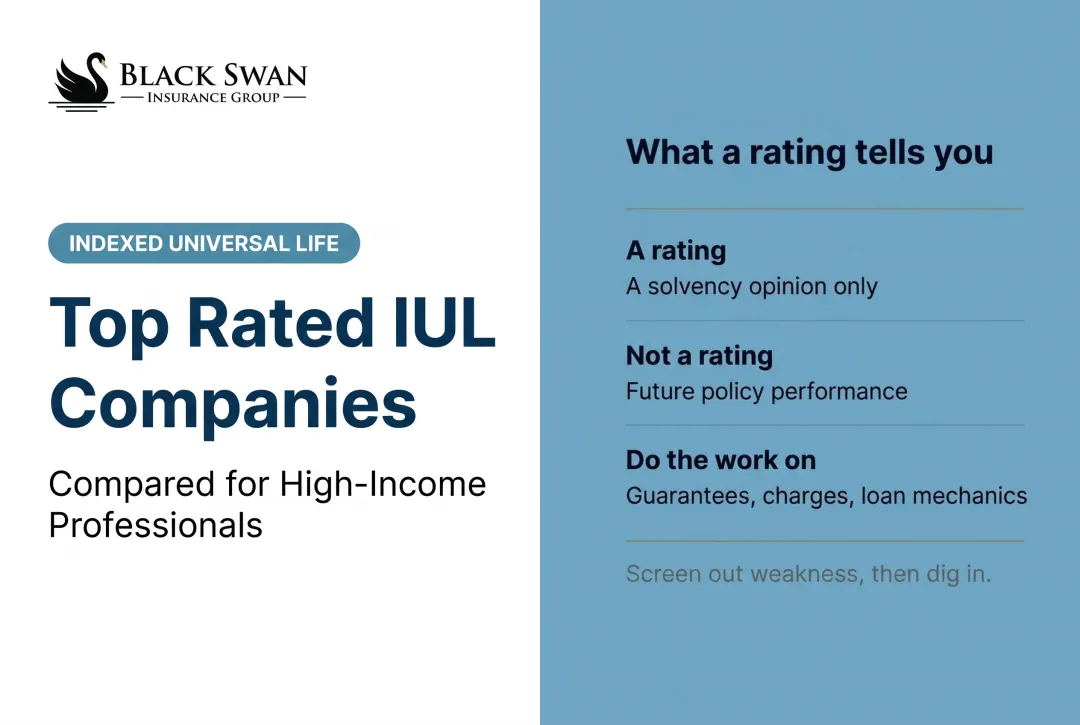
- Ratings are about the insurer, not your policy. An A+ carrier can still issue a design that fails on thin funding.
- Caps, participation rates and bonuses are adjustable, subject to contract minimums, and current terms are not locked.
- Cost of insurance rises with age, which is why late-year charges break underfunded contracts.
- Loan accumulation can erode cash value and the death benefit; a lapse with a loan outstanding can create taxable income with no cash received.
- Exceeding the IRS seven-pay test creates a modified endowment contract and changes distribution taxation.
- Surrender charges can make early exit expensive regardless of carrier.
- Accelerated underwriting speeds issue; it does not improve long-term policy economics.
Find Out Where You Actually Stand
This starts with the Tax-Free Wealth Blueprint Fit Review. If you earn $150K+ and you are trying to decide which carrier to apply to, we start one step earlier: the job the coverage has to do, then carrier designs compared on identical assumptions, guaranteed read against illustrated values, loan and access mechanics compared, and the whole thing stress-tested through lower crediting and a reduced-income year. If term solves your problem, we will say so and you will have spent nothing. If IUL does not fit, we will tell you that too.
Frequently Asked Questions
Who offers the best IUL policy?
There is no universal winner. The right carrier depends on your protection needs, funding capacity, time horizon, health, and whether you are prioritising accumulation, protection or legacy planning.
What should I look for in an IUL company?
Financial strength, guaranteed values, fees, caps, participation rates, loan provisions, surrender charges, and the carrier's underwriting and service model.
Is IUL a good option for high-income earners?
It can work for high earners with a long horizon, sustainable surplus cash flow and a genuine permanent-insurance need. It is not automatically preferable to a maxed-out 401(k) or Roth account.
What are the biggest risks of indexed universal life?
Complexity, non-guaranteed terms that can change, rising charges, loan accumulation and lapse. A lapse with an outstanding loan can trigger taxable income, and exceeding the seven-pay limit creates a modified endowment contract.
Carrier or independent brokerage?
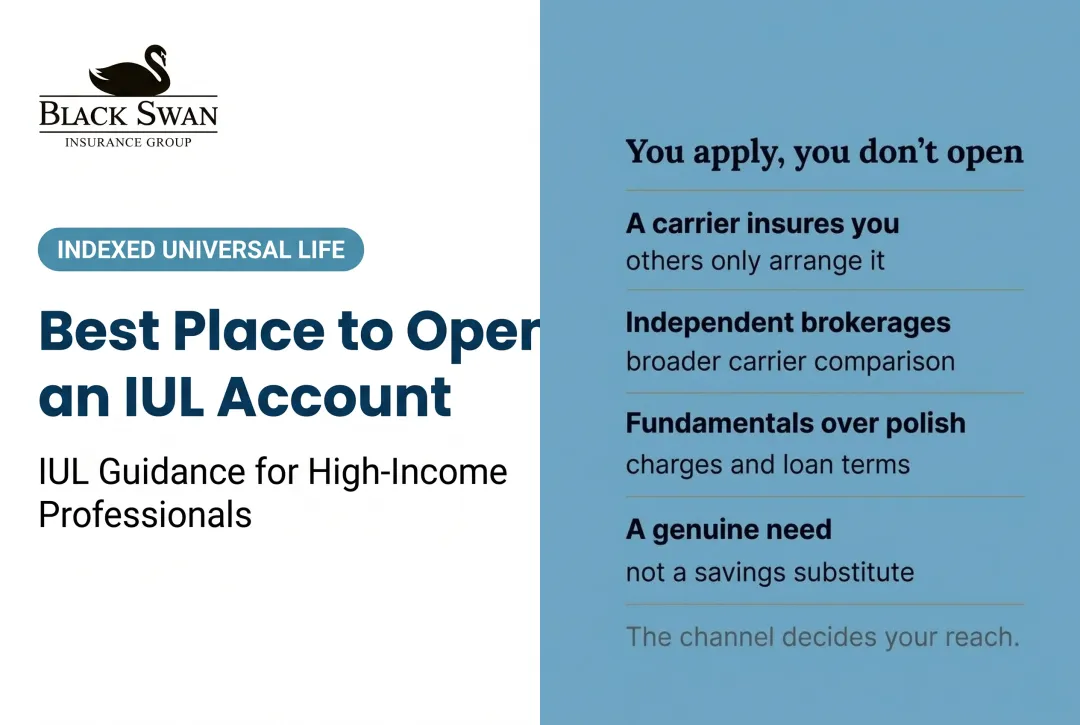
The carrier issues and administers the policy. A brokerage compares carriers, helps with underwriting and provides ongoing reviews. Ask any brokerage about licensing, carrier access and compensation.
How do I compare illustrations from different companies?
Use identical assumptions for age, health class, death benefit, premium and loan strategy across every proposal. Then compare the guaranteed column, a lower-crediting scenario and total fees — not the illustrated best case.
Sources
- NAIC — Actuarial Guideline 49-A
- SOA/LIMRA — 2024 universal life premium persistency experience study
- IRS — Revenue Procedure 2001-42 (seven-pay test)
Disclosure: This article is educational and is not personal tax, legal or investment advice. Indexed universal life is life insurance first. Carrier ratings, product features, riders and availability vary by insurer and state and change over time, and all guarantees are subject to the issuing insurer's claims-paying ability. Illustrated values are not guarantees; actual results depend on policy terms, crediting, costs and funding. Any potential tax-advantaged access depends on the policy being properly structured, funded and managed. Actual results depend on policy design, carrier, crediting options, caps, participation rates, expenses, funding and ongoing management. This strategy is not appropriate for everyone. Policy loans and withdrawals reduce cash value and the death benefit, and can create tax consequences if the policy lapses or becomes a modified endowment contract. Consult your own tax, legal and financial professionals for advice specific to your situation.
And remember, it's not what you earn, it's what you keep… enjoy the ride.