By Robert Balgac, Founder, Black Swan Insurance Group | October 9, 2026
The "where" in this question has a narrow answer: through a licensed life insurance producer authorised in your state, placing a contract with a carrier approved to sell that product there. There is no marketplace, no platform, no account. "Max-funded" is not a product at all — it is a design approach that directs as much premium as possible toward cash value while staying under the IRS limit that keeps the contract from becoming a Modified Endowment Contract.
That is worth saying plainly to anyone earning $150K+ who has maxed the 401(k), hit the Roth phase-outs and is now being shown screenshots of someone's policy. The venue matters far less than the licence, the carrier list and whether anyone will still be reviewing the contract in year nine.
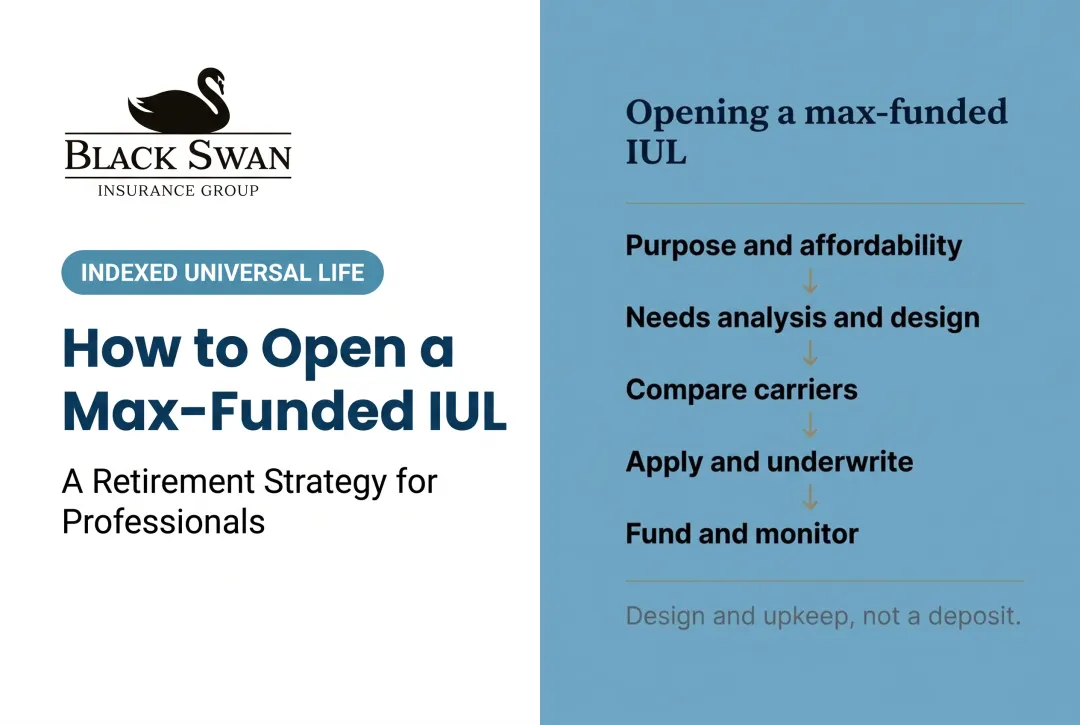
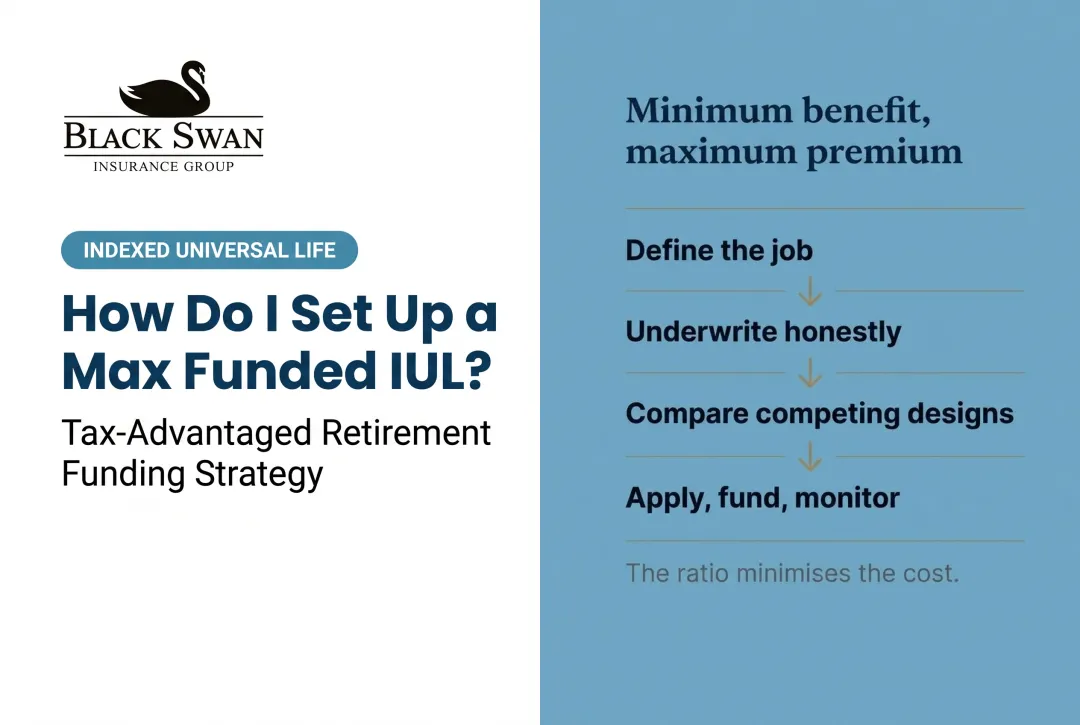
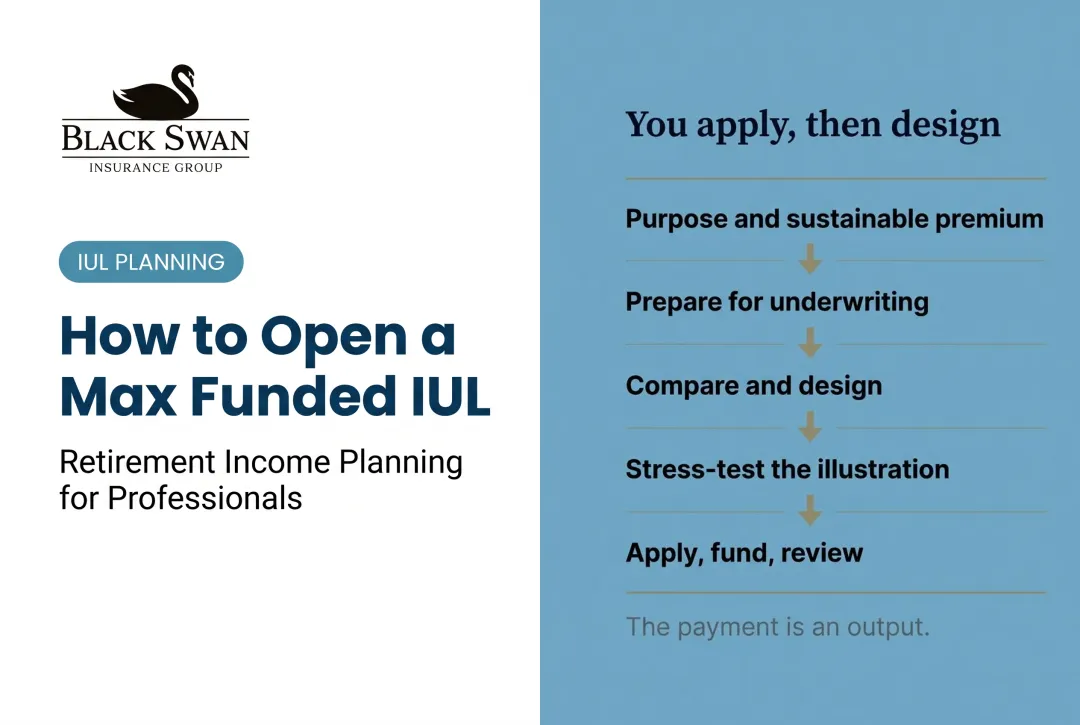
The short answer: You open one with a licensed producer in your state, not online and not through a bank. The real work is comparing designs across carriers on identical assumptions, choosing a premium you can sustain through a bad year rather than one that flatters the illustration, confirming remaining seven-pay capacity with the carrier before any unscheduled payment, and scheduling in-force reviews from day one. Licensing requirements do not relax because the meeting happened over video.
Key Takeaways
- Open one only through a licensed life insurance professional authorised in your state — a licence in one state does not travel
- Coordinate the funding target with the death benefit and the IRS seven-pay test or you will trigger MEC status by accident
- This is permanent life insurance first; cash value growth and loan access are secondary, performance-dependent features
- Compare guaranteed and non-guaranteed values, caps, participation rates and surrender schedules before signing
- Request an updated in-force illustration every year, not just at issue
Step 1: Purpose and a Premium You Can Survive
Before anyone runs an illustration, decide what the contract has to accomplish: permanent death-benefit protection for dependents or debts, supplemental retirement flexibility, tax diversification alongside a 401(k) or Roth account, estate or business-continuity planning, or a combination.
Then pick a premium you could still pay through a layoff, a slow business quarter or an unexpected expense — not the number that makes the future-value column look impressive. A max-funded policy that lapses in year eight because the funding was never realistic is simply a sunk cost with extra steps.
Confirm the basics are already handled first: emergency fund, any employer 401(k) match you would otherwise leave on the table, adequate coverage elsewhere, and high-interest debt under control.
Step 2: The Licensing Question, Answered Properly
An IUL must be sold through a licensed life insurance agent or broker authorised in your state. The NAIC requires anyone who sells, solicits or negotiates insurance to hold a producer licence, and a licence in one state does not automatically clear anyone to sell in another.
Much of this now happens virtually — video consultations, e-signed applications, electronic delivery. None of that changes the licensing position. Verify the producer's authority in your state and identify the actual issuing carrier before you share medical or financial records.
A brokerage holding appointments with multiple carriers can compare designs side by side, which matters because underwriting rules, pricing and product availability differ by company and by state. Black Swan Insurance Group reviews options across several carrier partners, works with clients across Ohio and, through its carrier relationships, in other states where its producers are licensed. Not every product is available in every state, and approval always comes down to individual underwriting.
Step 3: Build and Compare Designs
Request multiple illustrations using identical age, health class, premium budget, funding period, death-benefit option, riders and index strategy. Change more than one variable between illustrations and the comparison means nothing.
Compare a minimum-death-benefit design, which is more cash-value efficient but leaves less funding headroom, against a design carrying additional death-benefit protection, which creates more headroom at a higher insurance cost. Then put guaranteed values next to current non-guaranteed illustrated values.
Ask directly what the numbers do if caps, participation rates or crediting assumptions move lower. Under NAIC illustration regulation, insurers must label guaranteed figures separately from non-guaranteed ones, and that second column reflects current assumptions that can change.
An illustration is a model, not a guarantee.
The Ultimate IUL Blueprint
Before you choose a producer or a carrier, the Blueprint covers what the design has to survive: funding levels, caps and charges, the MEC line, loan timing, and exactly what to demand from an illustration.
Step 4: Application and Underwriting
Underwriting typically asks for income, net worth and the source of premium funds; existing coverage; medical history, medications and family health history; occupation and hobbies, some of which carry rating surcharges; and beneficiary designations.
Depending on the case this can include a paramedical exam, a medical records request, a prescription database check or financial documentation — though accelerated programmes skip the exam for some applicants. Before signing, check that owner, insured, beneficiaries, riders, premium schedule and any replacement disclosures match what was actually discussed.
Step 5: Check the Issued Contract, Then Monitor It
Compare the delivered policy against the illustration and application you approved. Death benefit, premium limits, surrender schedule, loan provisions, charges and crediting terms should all match. Confirm how premiums will be paid and what happens if one is missed.
Then put annual reviews on the calendar: funding progress, cash value, loan balances, and whether the death benefit still reflects your actual obligations.
This is not set-it-and-forget-it. It is design-it, fund-it, review-it.

What the Critics Get Right
The honest criticism of the "where do I open one" question is that it treats a decades-long insurance commitment as a shopping decision.
People arrive at this search having already concluded the strategy is right for them, usually because someone showed them a cash-value column. Critics are right that a licence is a minimum standard rather than a mark of design competence, right that distribution is compensated out of premium, and right that early cash value frequently disappoints compared with what buyers remember being shown.
A great IUL is engineered. A bad IUL is sold.
The useful response is to verify the licence, insist on more than one carrier design, and judge the professional by whether they will tell you no.
Who This Fits
Stronger Fit
- High-income professionals and executives with stable surplus cash flow
- Business and practice owners building assets outside a concentrated business
- Affluent families balancing protection needs against legacy goals
- Late-start high earners with a shorter runway but still-insurable health
Being on that list does not settle it. Insurability, liquidity and funding consistency decide the real answer — income alone does not.
Weaker Fit
Not everyone should buy this. It is usually the wrong call if you are saving for a goal in the next three to five years, have unpredictable cash flow or no emergency fund, need maximum near-term access to your money, or prefer fully guaranteed growth without index-linked variability.
Most people should fund simpler things first. A 401(k) or Roth IRA is usually first in line — simpler, cheaper, often matched. A taxable brokerage account offers more liquidity and no contribution rules. Term insurance buys cheaper pure protection for a fixed period. Whole life offers guaranteed, non-index-linked cash value at a different cost structure. An annuity solves for income, not death benefit. An IUL replaces none of these; it is normally the last piece added.
On taxes. Loans and withdrawals from a properly structured, non-MEC contract can be taken income-tax-free up to basis, provided the policy stays in force and never becomes a MEC. If a policy with an outstanding loan lapses, that balance can become taxable income. None of this substitutes for a CPA or estate attorney who can see your whole picture.
What to Prepare Before Applying
Financial and personal. Target premium budget and cash-flow picture; existing coverage and retirement contributions; debts, reserves and family obligations; business interests, retirement timeline and legacy objectives; health and lifestyle details including tobacco use, medications, occupation, hobbies and family medical history. A smoker or someone in a high-risk occupation prices differently from a healthy, low-risk applicant.
Policy documents. For every design under consideration, request the full illustration and the contract, the expense and charge schedules, surrender-charge details and loan provisions, and current crediting assumptions. Then ask for a side-by-side showing death benefit, cash value and premiums; guaranteed against non-guaranteed; break-even timing; and performance under less favourable assumptions.
Tax and compliance. The seven-pay test under IRC Sections 7702 and 7702A determines whether the contract keeps life insurance tax treatment or becomes a modified endowment contract. The IRS has confirmed that meeting Section 7702's guideline-premium test does not by itself establish non-MEC status — the 7702A calculation is a separate check.
There is no universal dollar figure. The limit is specific to each policy's age, death benefit and design, which is exactly why max funding has to be confirmed by the carrier rather than estimated from a rule of thumb.

Protection and ownership. Confirm the death benefit is genuinely sufficient for dependents, debts, estate obligations or business needs rather than minimised purely for cash-value efficiency. Review ownership and beneficiary designations, any trust or business ownership structure, and whether this replaces existing coverage. Involve a spouse, CPA or attorney where the decision touches shared finances or an estate plan.
The Variables That Decide the Outcome
Funding level and death-benefit design. Premiums must stay inside the policy's seven-pay limit. Adding an unscheduled lump sum without first checking remaining capacity with the carrier is among the fastest routes to accidental MEC status — carriers track the figure per contract, so ask before sending money, not after. The lowest permissible death benefit maximises cash-value efficiency but can leave dependents underinsured; a larger one creates legal funding room at higher insurance cost. Neither is automatically correct.
Crediting and charges. Caps, participation rates, spreads and floors determine how index performance becomes credited interest. A 0% floor only protects against negative crediting.
Zero is your hero in a down year — but the floor applies to the credit, not to the charges.
Cost of insurance, administrative fees and surrender charges can still reduce cash value in a year the index credits nothing.

Risks to Understand Before You Apply
- Early warning signs compound quietly: declining cash value, a growing loan balance, reduced crediting, or an in-force illustration worse than last year's. Contact the carrier at the first of them, not the fourth.
- Index returns and credited returns are different things, separated by caps, participation rates and spreads.
- Policy loans are not free money. Interest accrues, and an unmanaged balance erodes the death benefit.
- Max funding reduces lapse risk without eliminating it. Cost of insurance still rises with age.
- Exceeding the seven-pay limit triggers MEC status, generally permanently, changing how loans and withdrawals are taxed.
- A lapse with a loan outstanding can create taxable income with no cash received.
Find Out Where You Actually Stand
This starts with the Tax-Free Wealth Blueprint Fit Review. If you earn $150K+ and are trying to work out where and how to do this, we confirm licensing and carrier availability for your state, establish the protection need, model funding against your contract's own MEC limit, stress-test through lower-crediting and zero-credit years, and compare designs across carriers with charges and loan assumptions in plain numbers. If a Roth strategy and a term policy serve you better, we will say so. If IUL does not fit, we will tell you that too.
Frequently Asked Questions
Where can I open a max-funded IUL?
Through a licensed life insurance agent or broker authorised in your state, with a carrier approved to sell that product there. Much of the process can happen virtually, but licensing and state suitability rules still apply.
Can I open one entirely online?
Consultations and e-signatures can happen online, but you still need a licensed professional, carrier approval, underwriting and compliant policy delivery in your state. A fully self-serve purchase is generally not available.
How much money do I need?
There is no universal minimum or maximum. The sustainable premium depends on age, health, death-benefit design, underwriting results and what you can fund consistently without straining your budget.
Is a max-funded IUL a good idea?
It can fit if you need permanent protection, have reliable surplus cash flow and accept a decades-long commitment. It is not automatically right, so compare it against your other retirement and insurance options first.
Can a max-funded IUL become a MEC?
Yes. Exceeding the seven-pay limit triggers MEC status and changes how loans and withdrawals are taxed. Confirm remaining premium capacity with the carrier and a tax professional before adding extra funds.
Sources
- NAIC — Producer licensing
- NAIC — Life Insurance Illustrations Model Regulation
- IRS — Information letter on Section 7702 and 7702A testing
Disclosure: This article is educational and is not personal tax, legal or investment advice. Indexed universal life is life insurance first. Producer licensing, carrier appointments and product availability vary by state and must be verified independently. Illustrated values are not guarantees; actual results depend on policy design, carrier, crediting options, caps, participation rates, expenses, funding and ongoing management. This strategy is not appropriate for everyone. Policy loans and withdrawals reduce cash value and the death benefit, and can create tax consequences if the policy lapses or becomes a modified endowment contract. Consult your own tax, legal and financial professionals for advice specific to your situation.
And remember, it's not what you earn, it's what you keep… enjoy the ride.