By Robert Balgac, Founder, Black Swan Insurance Group | October 9, 2026
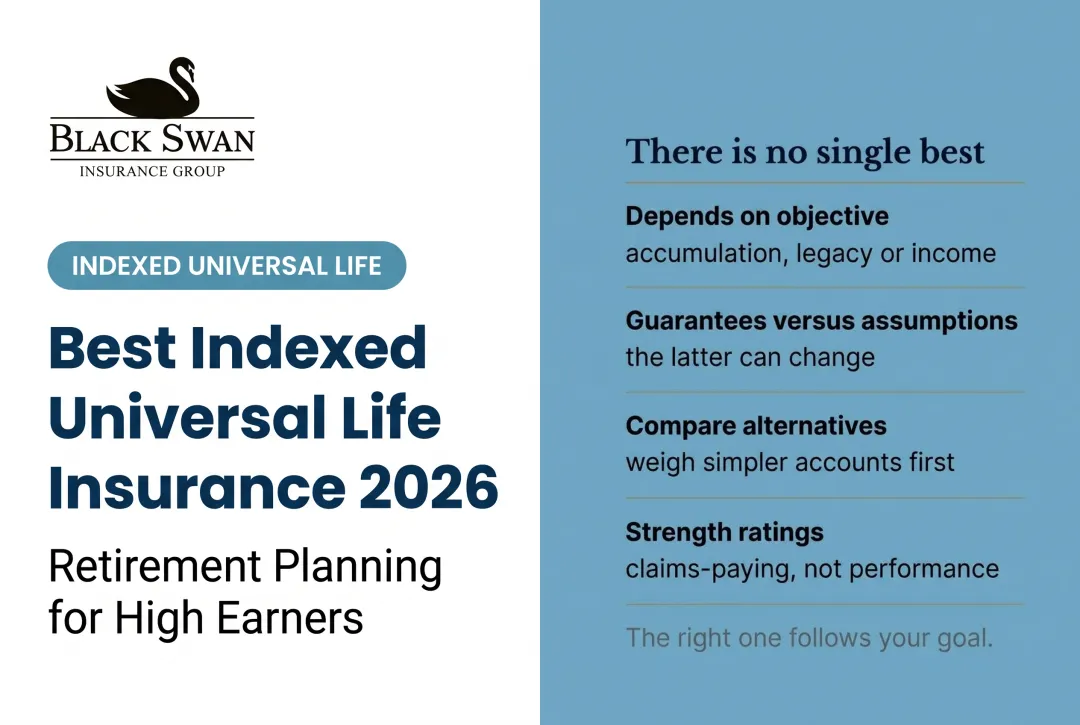
There is no single best indexed universal life policy, and anyone who hands you one is describing their contract rather than your situation. The strongest choice depends entirely on what you are solving for: lifelong protection, accumulation, retirement income, living benefits, estate planning, or underwriting flexibility for a particular health history.
The answer looks different for a 48-year-old physician catching up on retirement savings than for a business owner building assets outside a concentrated practice. IUL new premium reached $4.5 billion in 2025, up 17% year over year, per LIMRA's 2025 individual life sales data. Growth proves the category is established. It proves nothing about whether a given policy performs as illustrated.
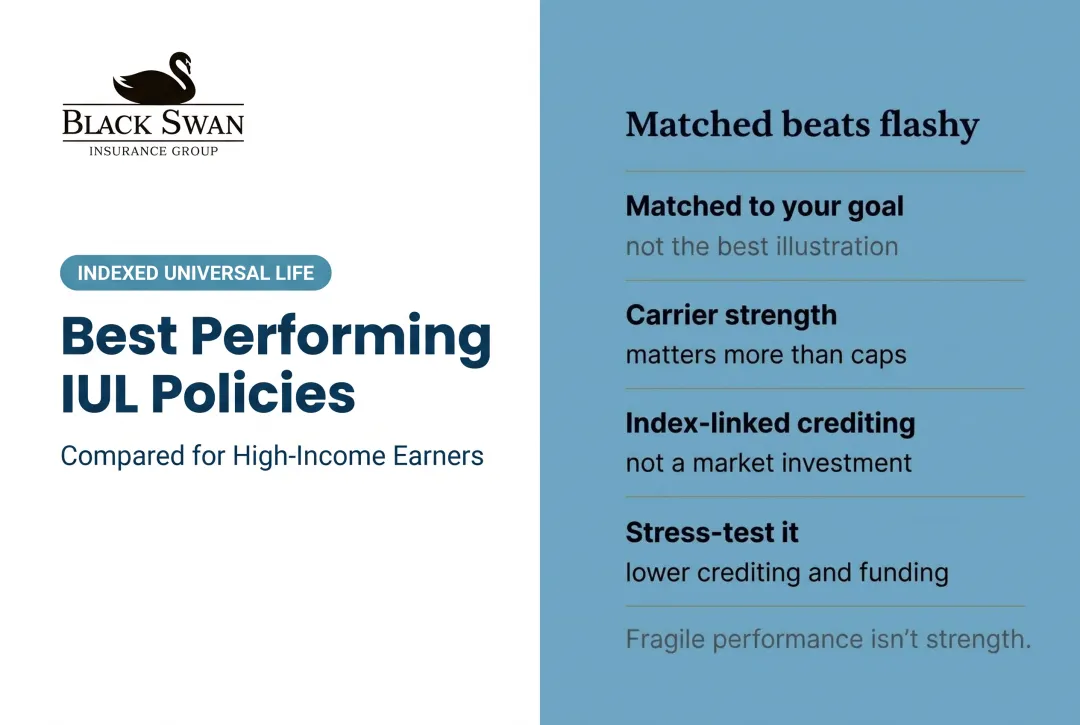
The short answer: Match the carrier to your objective, then judge on guaranteed values, loan provisions and financial strength — never on one illustrated return. The cap quoted today is a number the carrier can revise. The guaranteed column is the part that binds them.
Key Takeaways
- Index-linked cash value grows inside permanent life insurance, limited by caps, participation rates, spreads and charges
- Match the carrier to your goal: accumulation, income, legacy, living benefits or underwriting fit
- Weigh guaranteed values, loan provisions and financial strength — not one illustrated return
- Consider IUL only with a real insurance need, sustainable funding and adequate liquidity elsewhere
How the Market Works
Permanent life insurance with adjustable premiums, an adjustable death benefit and a cash-value account credited partly by reference to an external index. Your money is never invested in that index — the insurer applies a formula, and the formula is where the confusion lives.
Every premium dollar splits across cost of insurance (rising with age), administrative fees, rider costs, and whatever remains as cash value.
A 0% floor protects you from a negative index credit. It does not protect cash value from internal charges. As Guardian Life explains, total cash value can still decline in a year where the index credit is zero, because cost of insurance and fees keep deducting.
Zero is your hero in a down year — but the floor applies to the credit, not to the charges.
Four features decide what you can realistically earn: the floor (guaranteed minimum, often 0%), the cap (maximum credit in a segment), the participation rate (fraction of gain counted), and the spread (deduction before crediting).
Policy loans and withdrawals add another layer. Borrowing reduces performance, shrinks the death benefit, and — if the loan outgrows what the policy can support — triggers a lapse. A lapse with a loan outstanding creates a tax bill nobody planned for.

| Policy type | Duration | Cash-value risk | Typical use |
|---|---|---|---|
| Term Life | 10–30 years | None | Income replacement, mortgage protection |
| Whole Life | Lifelong | Low, fixed guarantees | Guaranteed legacy |
| Traditional UL | Lifelong, flexible | Moderate, fixed-rate crediting | Flexible permanent coverage |
| IUL | Lifelong, flexible | Moderate to high | Tax diversification, capped upside with a floor |
| Variable UL | Lifelong, flexible | High, direct market exposure | Experienced investors seeking growth |
The Ultimate IUL Blueprint
Before comparing carriers, the Blueprint covers what any design has to survive: funding levels, caps and charges, the MEC line, loan timing, and what to demand from an illustration.
Carriers, By Objective
A research-based shortlist, not a guarantee any of them suits you. Products, caps, riders and state approvals change — verify current terms before applying.
Allianz Life. The Accumulator replaced Pro+ Advantage as flagship in 2024, so any comparison using legacy Pro+ illustrations is outdated. Index Lock lets you secure an index value mid-period, with an Auto Lock triggering at a preset target. Best for policyholders who will actively manage crediting. The trade-off is real: locking can produce a lower credit than waiting, and the insurer will not tell you when. Classic (flat-bonus) and Select (multiplier-bonus) allocations typically carry lower caps or an added asset charge. AM Best A+, S&P AA, both affirmed 2026. Not a set-and-forget profile.
Nationwide. Indexed UL Accumulator III, Protector II 2020 and Survivorship Indexed UL 2020, with separate New York versions. Accumulator III offers capped and uncapped S&P 500 and Nasdaq-100 strategies. Worth knowing: the Overloan Lapse Protection Rider II requires the policy to be at least 15 years old and the insured at least 65 — it will not rescue early borrowing. AM Best A+, Moody's A1, affirmed late 2025.
Pacific Life. Horizon IUL 2 became flagship in 2024, with an age-90 no-lapse guarantee on eligible policies (extendable for life) for applicants issued at 79 or younger, plus a two-life Survivorship IUL 2. The catch: the guarantee depends on maintaining a required premium schedule — skip payments and it can terminate early. AM Best A+ (December 2025), Moody's Aa3 (August 2026).
Penn Mutual. Accumulation IUL, Protection IUL and Survivorship IUL. The Protection IUL account offers guaranteed 0% or 1% crediting floors — a contractual guarantee, not a marketing phrase. But note the loan asymmetry: indexed loan credits can run lower than the loan charge in Penn's own examples, which is exactly the scenario that breaks a retirement-income plan. Accumulation IUL is issued by Penn Insurance and Annuity Company; confirm ratings for that entity. AM Best A+, Moody's Aa3, S&P A+, Fitch AA− (2025–2026).
John Hancock. Protection IUL, Accumulation IUL and single- and two-life Survivorship versions. Vitality offers a free "GO" tier and a paid "PLUS" tier at $2–4 monthly with potential premium savings — requiring registration, a health review and subject to state eligibility. Model wellness savings separately from guaranteed values. S&P AA−, Moody's Aa3, AM Best A+, Fitch AA (September 2026).

What the Critics Get Right
Treat every "best IUL" list — including this one — with suspicion.
They are usually written by parties compensated when you buy. They rank on features that are current rather than contractual. And they imply a universal winner that does not exist. A cap quoted today can be cut next year without breaching your policy, and generous bonus structures almost always arrive paired with lower caps.
What a comparison can honestly do is narrow the field by objective and tell you which clauses to interrogate — Nationwide's age-65 rider threshold, Pacific Life's premium-dependent guarantee, Penn Mutual's loan asymmetry. Those details decide outcomes. Cap rates mostly do not.
How These Were Assessed
A strong insurer rating and a suitable policy are different things. You can pair a financially sound carrier with a design completely wrong for your funding capacity.
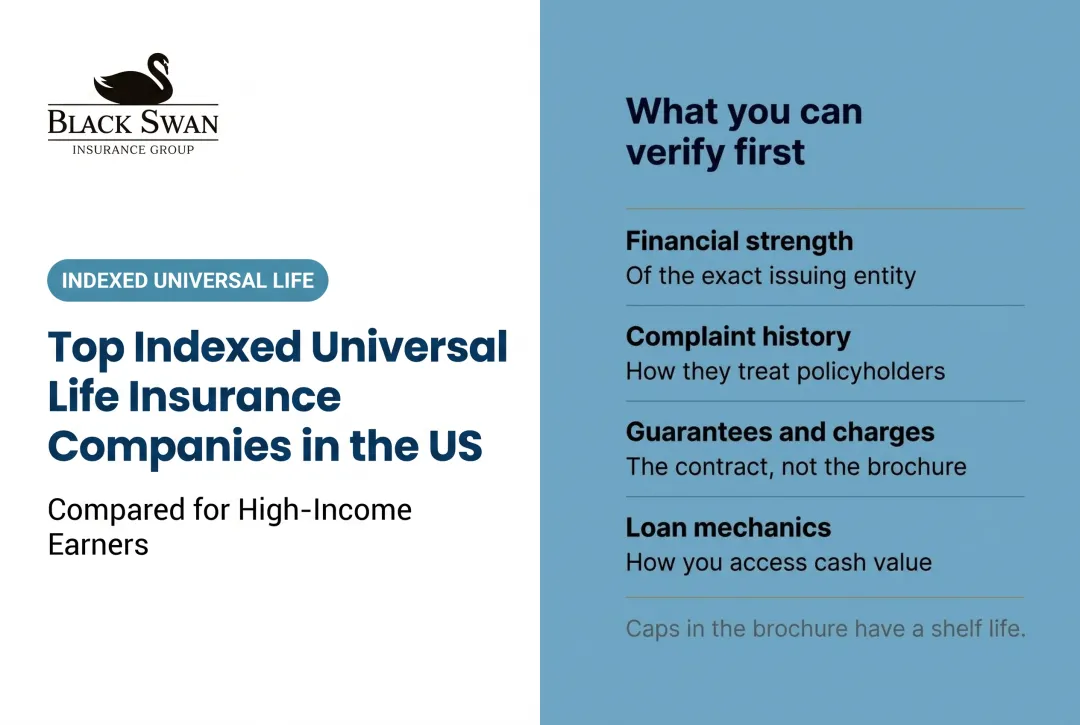
Six criteria: financial strength for the exact issuing entity; guaranteed against non-guaranteed values including no-lapse provisions and loan rates; total policy economics across cost of insurance, admin, riders, surrender charges and premium loads; index-crediting design; loan structure including overloan protection and lapse risk; and usability — whether you can realistically monitor it.
| Carrier | AM Best | Moody's | S&P | Fitch |
|---|---|---|---|---|
| Allianz Life | A+ | Aa3 | AA | — |
| Nationwide Life | A+ | A1 | A+ | — |
| Pacific Life | A+ | Aa3 | AA− | AA− |
| Penn Mutual | A+ | Aa3 | A+ | AA− |
| John Hancock | A+ | Aa3 | AA− | AA |
These agencies use different scales — identical letters across columns do not signal identical risk.
Stress-test every illustration for guaranteed-column values, lower-than-illustrated crediting, reduced or paused funding, rising charges with age, extended loans, and a premature lapse.
An illustration is a model, not a guarantee.
The NAIC's AG 49-A guidance already limits how favourably illustrations may present index credits, and new disclosure requirements from April 2026 require carriers to pair illustrations with a 25-year historical-index table. That improves transparency. It is still not a return guarantee.

Stronger Fit
- Earning $150K+ with surplus cash flow after reserves, debt and maxed retirement contributions
- A genuine permanent protection, business or legacy need
- Insurable at a reasonable rate, with a long funding horizon
- Willing to review the policy annually
Weaker Fit
Not everyone should buy one. Step back if you have an unclaimed employer match, thin reserves, near-term liquidity needs, or only need a death benefit for a defined period — term is cheaper and does that job completely.
Risks to Understand Before You Buy
The design errors that break otherwise sound policies:
- Chasing the highest current cap rate rather than the most sustainable design
- Treating an illustration as a forecast
- Ignoring surrender charges in the early years
- Overfunding into MEC status, which is generally permanent
- Using emergency reserves to cover premiums
- Substituting IUL for an employer match, IRA, diversified investments or adequate term coverage
This is not set-it-and-forget-it. It is design-it, fund-it, review-it.
Find Out Where You Actually Stand
This starts with the Tax-Free Wealth Blueprint Fit Review. If you earn $150K+ and are comparing carriers, we define the objective first, then run identical assumptions across designs, read guaranteed values against illustrated ones, and stress-test each through lower crediting, paused funding and extended loans. We explain compensation before anyone funds anything. If another strategy deserves priority, we will say so. If IUL does not fit, we will tell you that too.
Frequently Asked Questions
Is buying an IUL worth it?
It can be, with a genuine permanent insurance need, sustainable long-term funding and solid liquidity elsewhere. For many buyers, term insurance or other retirement vehicles make more sense first.
Where is the best place to get one?
Through a licensed agent or brokerage comparing multiple carriers, disclosing compensation clearly, and offering annual reviews. Avoid anyone presenting a single product as your only option.
What should I look for?
Financial strength, contractual guarantees, cost of insurance, crediting methodology, caps and participation rates, loan terms, and fit with your broader plan.
How do I compare companies?
Run identical applicant assumptions and premiums across several carriers, then compare guaranteed and non-guaranteed values, fees, cash surrender value, death benefit and loan scenarios side by side.
What are the biggest risks?
Changing caps and participation rates, rising fees, insufficient funding, loan interest, lapse risk and surrender charges. Tax trouble follows if the policy lapses with a loan outstanding or becomes a modified endowment contract.
Should I buy one before maxing my 401(k) or IRA?
Generally no. Capture any employer match and max tax-advantaged accounts first. Consider IUL afterwards if permanent insurance and tax diversification still make sense.
Sources
- LIMRA — U.S. individual life insurance new premium tops $17.5 billion in 2025
- Guardian — Indexed universal life insurance
- NAIC — Actuarial Guideline 49-A
Disclosure: This article is educational and is not personal tax, legal or investment advice. Indexed universal life is life insurance first. Carrier products, riders, rates, rider eligibility thresholds and state availability change frequently and must be confirmed against current policy forms before applying; ratings cited reflect an insurer's claims-paying ability, not the suitability of any contract. Illustrated values are not guarantees; actual results depend on policy terms, crediting, costs and funding. Any potential tax-advantaged access depends on the policy being properly structured, funded and managed. Actual results depend on policy design, carrier, crediting options, caps, participation rates, expenses, funding and ongoing management. This strategy is not appropriate for everyone. Policy loans and withdrawals reduce cash value and the death benefit, and can create tax consequences if the policy lapses or becomes a modified endowment contract. Consult your own tax, legal and financial professionals for advice specific to your situation.
And remember, it's not what you earn, it's what you keep… enjoy the ride.