By Robert Balgac, Founder, Black Swan Insurance Group | October 5, 2026
Almost every conversation about indexed universal life opens with the same question: what interest rate will I get?
Understandable, and incomplete in a way that costs people money years later. An IUL interest rate is not a guaranteed return. It is a policy-specific crediting result shaped by index performance, the crediting method, caps, participation rates and floors, fixed-account options, and the charges deducted before any of it applies.
Three numbers get conflated constantly: index performance, credited interest, and actual cash-value growth. They are not the same, they are rarely close, and the distance between them is where disappointment lives.
If you earn $150K+ and are comparing policies on their illustrated rate, this is the page that explains why that comparison tells you almost nothing.
The short answer: Interest is credited from an index formula; cash value is never invested in that index. Caps, participation rates, floors, spreads and bonuses vary by carrier and change the credited result, and carriers can adjust them where the contract allows. A 0% floor limits index losses — not insurance costs, fees or loans, which still reduce cash value. And credited interest is not your annualised return, because premium timing, deductions, loan interest and withdrawals all sit between the two.
Key Takeaways
- Interest is credited from an index formula; cash value is never invested in that index
- Caps, participation rates, floors, spreads and bonuses vary by carrier and change credited interest
- A 0% floor limits index losses, not insurance costs, fees or loans
- Illustrations are projections — compare guaranteed and non-guaranteed numbers side by side
- Credited interest is not the same thing as your policy's annualised return
How the Money Actually Moves
An IUL interest rate is the rate credited to your policy's eligible cash-value allocation, calculated under a specific formula over a defined crediting period, typically 12 months. It is not a deposit rate and not a market return.
- Premium is paid into the contract
- Charges come out — cost of insurance, administrative fees, rider costs
- Remaining value is allocated to a fixed account, an indexed account, or a mix
- Interest is credited to the indexed allocation under the contract's formula

Plenty of people assume the index is where their money sits. It is not. Your premium is never invested in stocks, bonds or anything tied to that index. Index performance is the reference point the insurer uses in a calculation.
What Shapes the Credited Rate
- Crediting method — how index change is measured over the period:
- Annual point-to-point: change from start to end of 12 months
- Monthly point-to-point: the sum of monthly changes, each capped
- Monthly average: the average of index values across the period
- No method wins in every market; results depend on how the index behaved
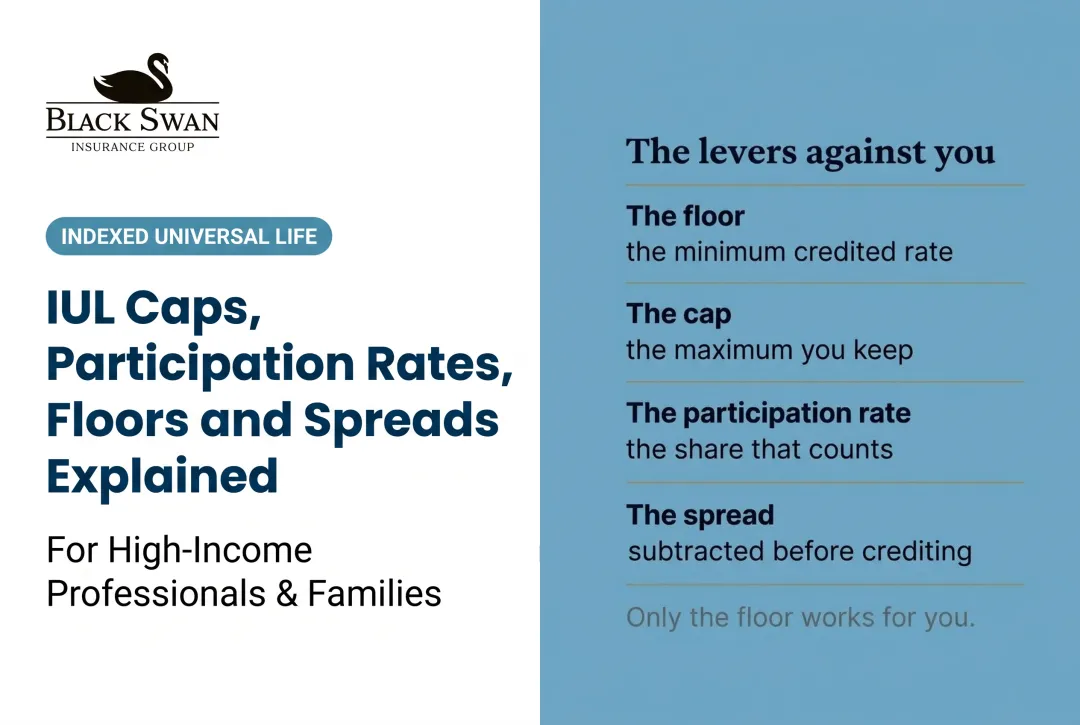
- Participation rate — the share of index gain used in the formula
- Cap — the maximum rate the formula will credit, however far the index rises
- Spread — a percentage subtracted from index performance before crediting
- Multipliers or bonuses — contract-specific enhancements in some policy years, not standard
Carriers can change caps, participation rates and fixed-account rates where the contract allows. As an illustration of the range, one insurer's published strategy guide lists caps from 10.50% to 25.00%, with participation rates from 100% up to 300% across strategies. Those are specific to that carrier's lineup at a point in time, not a market average.
Your policy's actual value also reflects charges, allocation choices, premium timing, loans and withdrawals. None of that appears in the index. Review the contract's definitions, allocation rules, crediting dates and change provisions before comparing two policies.
Turning Index Moves Into Credited Interest
There is no permanent average rate for an IUL. The credited rate in any period depends on the formula, how the index moved during that specific window, current carrier terms, and the assumptions in your illustration.
An index gains 12% during a 12-month period and your strategy has a 9% cap: credited interest is 9%. A participation rate of 80% with no cap on that same 12% gain credits 9.6%. Hypothetical and non-predictive, used to show the mechanics.
Now reverse it. The index drops 8%. With a 0% floor you are credited 0%, not −8%. That protects the crediting calculation. It does not protect the policy's overall value, because insurance costs and administrative charges come out regardless.

Zero is your hero in a down year — but the floor applies to the credit, not to the charges.
Guaranteed Versus Non-Guaranteed
- Guaranteed values — contractually protected minimums such as a guaranteed floor or a guaranteed maximum cost of insurance
- Current values — assumptions the insurer applies now and can adjust, including caps, participation rates and current charges
Surrender periods, loan terms and minimum premium requirements are policy-specific. Do not assume someone else's policy terms apply to yours. Pull the contract.
What the Critics Get Right
The criticism of how these rates get marketed is accurate, and conceding it makes the rest of this more useful.
Critics are right that quoting an illustrated rate as though it were a return is misleading, because the number sits above a stack of charges nobody mentions. They are right that carriers control the caps and can reduce them after you have committed. And they are right that comparing two policies on their illustrated rates is comparing two marketing assumptions, not two contracts.
Where the criticism runs out is in the conclusion that the numbers are therefore meaningless. They are not — they are just the wrong numbers. The guaranteed maximum cost of insurance, the guaranteed floor, the surrender schedule and the loan provisions are all contractual, and those are what a serious comparison uses.
Three Properties Worth Understanding
Stability and Variability
Credited interest recalculates each period. Caps, participation rates and carrier actions shift the result, so a rate that looked attractive at issue is not locked for life.
The sequence of returns matters too. Two policies with identical average returns over 20 years can end up with very different cash values depending on which years the gains and losses occurred, once ongoing charges are layered in.
Downside Protection and Upside Limits
The floor limits exposure to negative index performance during a crediting period. The trade is real: caps, participation limits and spreads constrain how much upside you capture when markets perform.
| Product | Growth mechanism | Predictability |
|---|---|---|
| Whole life | Fixed guarantees, insurer-declared dividends | High |
| Indexed universal life | Index-linked formula with floor and cap | Moderate |
| Variable universal life | Direct investment in separate accounts | Low, market-exposed |
| Term insurance | No cash value | Not applicable |
No product wins for every buyer. The fit depends on how much variability you will accept against how much guarantee you need.
Coupling With Everything Else
The credited rate interacts with age, health and underwriting class at issue; the death-benefit amount and design; premium level and funding schedule; loans, withdrawals and riders; and the contract's tax treatment.
One deserves particular attention. Modified endowment contract status: a policy funded too aggressively in its early years fails the seven-pay test, and MEC distributions are taxed income-first and can trigger an additional 10% tax unless an exception applies. If a MEC or heavily loaned policy later lapses or surrenders, the tax consequence can be substantial. Talk to a tax professional before locking in a funding strategy.
Any potential tax-advantaged access depends on the policy being properly structured, funded and managed.
The Ultimate IUL Blueprint
If you are comparing crediting strategies across carriers, the Blueprint covers what to pull from each: the guaranteed floor, the maximum cost of insurance, the surrender schedule, the loan provisions and the MEC line.
Funding Above the Minimum
A policy funded at the minimum premium leaves almost no room for error. If you are relying on it for future loans, supplemental income or a permanent death benefit, funding has to sit above that minimum.
Stress-test any illustration against lower credited rates than illustrated, rising cost of insurance, missed or reduced premiums, a longer-than-expected life expectancy, loan interest accumulating, and a later or earlier income start date.

Who It Fits
Stronger Fit
- A genuine permanent protection need standing on its own merits
- Household income of $150K+ with funding capacity above the minimum premium, sustainable through a bad year
- A long horizon, and liquidity held elsewhere
- Willingness to review credited rates, caps and funding annually
- Comfort with variability in exchange for crediting protection
Weaker Fit
Not everyone should buy an IUL. If the crediting rate is what attracted you, the charges below will change the picture.
- You need short-term liquidity
- You cannot commit to consistent long-term funding
- Basic protection needs are not yet covered — term insurance comes first and is far cheaper for a temporary need
- The numbers only work under best-case assumptions
- You want a predictable guaranteed rate, where whole life is the better structure
What to Request and How to Verify
Before buying or reviewing: the complete dated basic illustration with guaranteed and non-guaranteed ledgers; the policy contract and any endorsements; the current crediting-strategy rate sheet covering index, method, cap, participation and spread; the fee and expense schedule; and the loan provisions and surrender schedule.
Every illustration should label which numbers are guaranteed and which are current assumptions, and state the date the rates were pulled. If a document does not distinguish them, ask for one that does.
To interpret a credited rate for a segment, confirm the index starting and ending points, the participation rate, cap, spread and floor, and the crediting method applied.
And then the correction that matters: credited interest is still not your policy's annualised return. Premium timing, deductions, loan interest, withdrawals and death-benefit changes all sit between them.
An illustration is a model, not a guarantee. The rate on the cover is the least binding number in the document.
Risks to Understand Before You Compare Rates
- Credited interest is not your return, and treating it as one is the most common error in this category
- Charges continue in a 0% crediting year, so cash value can fall with the floor intact
- Caps, participation rates and spreads can be changed by the carrier where the contract allows
- Cost of insurance rises with age and is deducted regardless of crediting
- Sequence of returns matters, and two policies with the same average can end very differently
- Minimum funding leaves no margin, and it is the most common route to lapse
- Loans reduce cash value and death benefit, and a lapse with a loan outstanding and gain in the contract creates taxable income
- Crossing the seven-pay limit makes the contract a MEC, taxing distributions income-first with a possible 10% additional tax
- Multipliers and bonuses are contract-specific and frequently come with offsetting costs
Find Out Where You Actually Stand
This starts with the Tax-Free Wealth Blueprint Fit Review. If you earn $150K+ and are comparing crediting strategies, we read the contractual terms rather than the illustrated rates, model a stretch of below-assumption crediting, calculate what the design actually returns after charges, and price term plus your existing accounts on identical terms. If it does not fit, we will tell you that too.
Frequently Asked Questions
What is a typical IUL interest rate?
There is no typical rate, and any figure quoted as one should be treated sceptically. The credited result depends on the formula, the index's behaviour in that specific window, current carrier terms and your allocation.
Is the credited rate my return?
No. Premium timing, cost of insurance, administrative charges, loan interest and withdrawals all sit between the credited rate and your actual annualised result.
Can the carrier lower my cap?
Generally yes, where the contract allows it, subject to any guaranteed minimum. That is why the guaranteed terms matter more than the current ones when comparing policies.
Does the 0% floor protect my cash value?
No. It protects the crediting calculation. Insurance costs and administrative charges continue regardless, so total value can fall in a flat year.
Which crediting method is best?
None universally. Annual point-to-point, monthly point-to-point and monthly averaging each perform differently depending on how the index moved. Anyone claiming one always wins is selling.
Should I buy term insurance instead?
If the protection need has an end date, yes — term is cheaper and simpler, and the crediting conversation becomes irrelevant.
Sources
- Nationwide — indexed crediting strategy guide
- IRS Rev. Proc. 2001-42 — seven-pay test and MEC treatment
- NAIC — Life Insurance Illustrations
- NAIC — Life Insurance
- I.R.C. § 7702A (modified endowment contracts)
Disclosure: This article is educational and is not personal tax, legal or investment advice. Indexed universal life is life insurance first. Caps, participation rates and spreads referenced are carrier- and date-specific and are not market averages. Actual results depend on policy design, carrier, crediting options, caps, participation rates, expenses, funding and ongoing management. Policy loans and withdrawals may reduce cash value and death benefit and can create tax consequences if the policy lapses or becomes a modified endowment contract. This strategy is not appropriate for everyone. Illustrated values are not guarantees; actual results depend on policy terms, crediting, costs and funding. Consult your own tax, legal and financial professionals for advice specific to your situation.
And remember, it's not what you earn, it's what you keep… enjoy the ride.