By Robert Balgac, Founder, Black Swan Insurance Group | October 5, 2026
"Opening an IUL account" is a misnomer worth correcting before anything else. You are not opening a bank account, a savings account or a brokerage account.
You are applying for an indexed universal life insurance policy — a contract issued by a life insurance company, combining a death benefit with a cash-value component, subject to underwriting.
What you end up with does not depend mainly on how the market performs. It depends on your age, health, coverage amount, how you fund it, carrier charges and how the crediting formula works. Skip any of those and a well-marketed illustration will fall short of what actually happens.
If you earn $150K+ and have decided to go ahead, here is the process — and the step where most buyers lose money by hurrying.
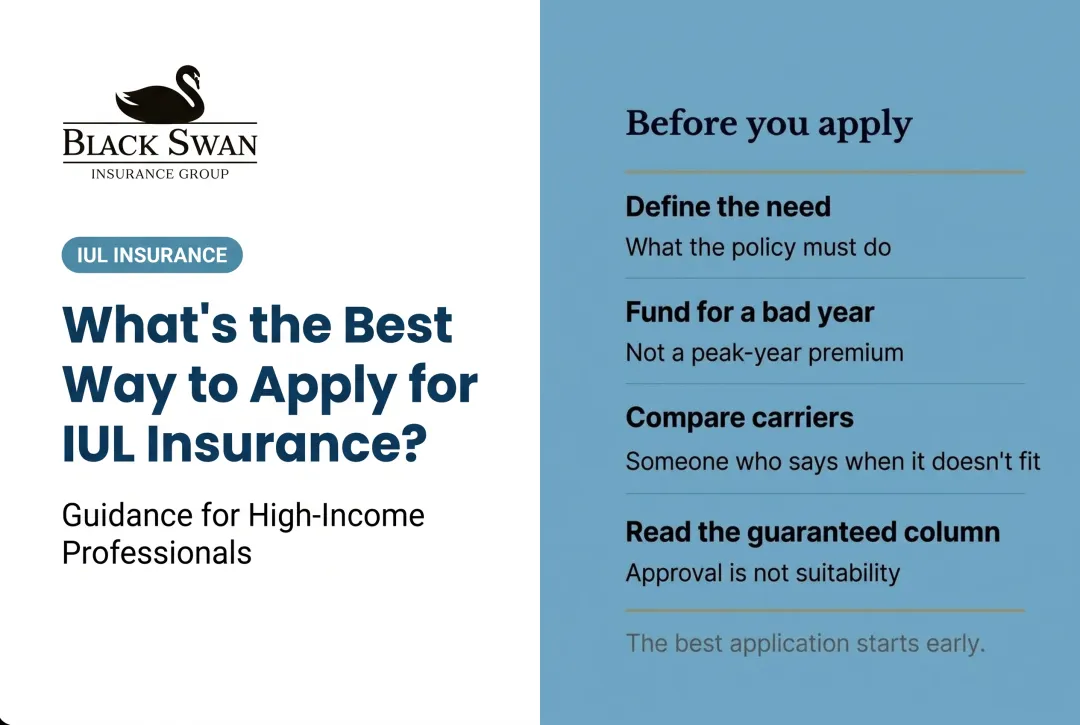
The short answer: This is permanent coverage with flexible premiums and cash value credited by an index formula, not by owning stocks. Confirm you need permanent coverage and can sustain the premium before applying. Compare carriers on caps, participation rates, surrender values and guaranteed versus non-guaranteed illustrations. Factor loans, withdrawals, MEC rules and annual reviews in from day one. And do not rush step five — reviewing the offer against the original illustration is where the real decision happens.
Key Takeaways
- Permanent coverage with flexible premiums and cash value credited by an index formula, not stocks
- Confirm you need permanent coverage and can sustain premiums before applying
- Compare carriers on caps, participation rates, surrender values and both illustration columns
- Factor loans, withdrawals, MEC rules and annual reviews into the decision from day one
- Coverage typically activates only after the policy is approved, delivered and funded
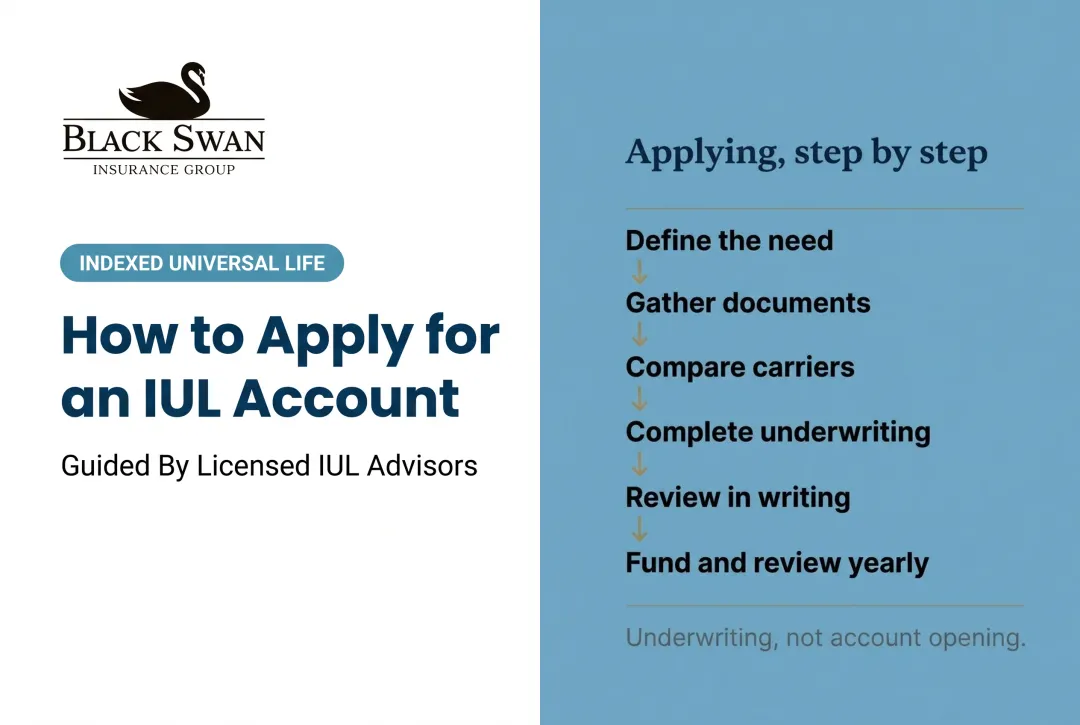
Step 1: Define the Purpose
Before comparing carriers, get specific about why. Protecting income for your family, planning a business transition, funding future college costs, or supplementing retirement income? The death-benefit need should drive the design, not an assumed rate of return.
Work out the coverage amount needed to replace income or cover obligations; your preferred policy duration and funding horizon; the premium you can commit to consistently; and your liquidity needs and beneficiaries.
Before allocating long-term dollars, confirm that emergency savings, employer retirement-plan contributions and high-interest debt are already handled. This complements those priorities; it does not replace them.
Step 2: Compare Carriers Properly
A captive representative offers products from one insurer. An independent broker can compare multiple carriers, subject to licensing and product availability in your state.
When comparing, look at financial-strength ratings for the exact legal entity issuing the policy; policy charges, underwriting approach and index-strategy options; historical cap and participation-rate behaviour; and surrender schedules and service expectations.
Carrier rate sheets change. North American Company's current-rate disclosure, for example, lists caps between 8.25% and 10.5% depending on product and crediting method — figures that shift with market conditions and are set by the carrier, not the index.
Step 3: Prepare the Application
Underwriting moves faster when the paperwork is complete first time.
- Identification and contact details — government ID, Social Security number, address
- Financial information — employment, income, net worth, existing coverage
- Beneficiary details and payment or banking information
- Health history — medications, diagnoses, surgeries, hospitalisations, tobacco or nicotine use
- Lifestyle factors — hazardous hobbies, family medical history, relevant records
Answer every question accurately and consistently. Omissions or inconsistencies between your application and your medical records do more than slow underwriting — they can create claim disputes years later, when nobody can correct them.
Step 4: Underwriting and the Offer
Depending on age, health and coverage amount, underwriting may include application and prescription review, medical-record pulls and financial underwriting, a paramedical exam, or accelerated data-driven underwriting.
Timelines vary by pathway. Per LIMRA's 2020 industry underwriting survey, accelerated programmes averaged 3 days from application to the medical questionnaire stage versus 8 days for traditional underwriting, with final decisions averaging 9 days versus 27. Industry averages, not a guarantee — missing records or a referral to full underwriting extends things.
When the offer arrives, compare it line by line against your original illustration: the approved risk class and resulting premium; the death benefit and any riders included or excluded; and any exclusions or amendments to the original assumptions.
A rated offer changes the economics of the whole plan. That is a moment to reassess, not to sign.
Step 5: Review, Accept, Fund — The Step People Rush
Review the illustration carefully: guaranteed values against current non-guaranteed assumptions; cash surrender value and death benefit at various policy years; charges deducted annually and break-even expectations; and outcomes if crediting rates drop or premiums are reduced.
Coverage typically activates only after the policy is approved, delivered and funded per the carrier's requirements. Confirm your free-look period and keep your delivery documents.
Then set up a sustainable payment method and document your planned premium schedule, index-account allocation and beneficiary designations.

This is not set-it-and-forget-it. It is design-it, fund-it, review-it. A policy nobody revisits drifts off course, and the lapse data shows exactly where it ends up.
What the Critics Get Right
Scepticism about the buying process here is warranted, and worth conceding directly.
Critics are right that "open an account" framing sets an expectation the product cannot meet, and that the language is chosen for a reason. They are right that the free-look period exists because regulators concluded buyers needed protection after delivery, and that almost nobody uses it to read the contract. And they are right that a buyer who accepts a rated offer without recalculating the whole plan has changed the economics without noticing.
Where the criticism stops is that a careful buyer can manage all of it. None of these are hidden. They are documented in the contract and the illustration, and the fix is reading them before signing rather than after.
Is This Right for You?
Four questions:
- Do you genuinely need permanent life insurance?
- Can you sustain premiums for the long haul, including a bad year?
- Are you willing to monitor the policy annually?
- Do you accept that cash-value results are not guaranteed by an index's past performance?
Stronger Fit
- Household income of $150K+ with a genuine permanent protection need
- High-income professionals and executives seeking permanent protection plus tax diversification
- Business owners building assets outside a concentrated business
- Families who have already maxed other retirement priorities and want additional flexibility
- Willingness to review funding, crediting and loan balances every year
Weaker Fit
Not everyone should buy an IUL. The five steps below include the point at which the honest answer is often to stop.
- Short-term coverage needs — term insurance is usually cheaper and simpler, and frequently the right answer
- Unstable cash flow or limited emergency reserves
- A preference for low-cost, simple investing
- An expectation of guaranteed, market-like returns
What to gather: a licensed insurance professional; a carrier-specific application and current illustration software; a secure way to share documents; and access to a tax or legal professional where your situation calls for it.
What you will need to provide: age, health, income, assets and liabilities; existing coverage and retirement contributions; business obligations and family needs; and when and how you expect to access cash value later.
Compliance and Risk
Illustrations are projections, not promises. Index crediting is not the same as owning the index, and any potential tax-advantaged access depends on the contract being properly structured, funded and managed, and on current law.
The NAIC recommends asking your agent which values are not guaranteed and whether guaranteed minimums apply before you commit. Review current IRS guidance on modified endowment contracts, loans, withdrawals and lapse before setting funding levels.

The Ultimate IUL Blueprint
Before you submit an application, the Blueprint covers the design decisions that determine the outcome: funding levels, the MEC line, index-strategy selection and loan timing.
The Parameters That Decide the Outcome
Not one advertised rate. How insurance costs, funding, crediting rules and time interact.
Funding falls into three levels: minimum funding keeps the policy in force; planned funding balances growth against long-term cost; accumulation-focused funding maximises cash value within legal limits. These produce very different policies from the same product, and confirming which one you were quoted is essential.
Age at issue changes everything. The cost of insurance component of each premium is far smaller at 25 than at 65, which is why the same premium produces entirely different cash-value trajectories at different ages — and why a late start needs conservative assumptions rather than optimistic ones.

Risks to Understand Before You Apply
- Inaccurate or inconsistent application answers can create claim disputes years later
- A rated offer changes the economics, and accepting one without recalculating is a common error
- Coverage does not exist until the policy is approved, delivered and funded
- Charges continue in a 0% crediting year, so cash value can fall with the floor intact
- Cost of insurance rises with age and is deducted regardless of index performance
- Caps and participation rates are set by the carrier and can change after issue
- Minimum funding is fragile, and it is the most common route to lapse
- Loans reduce cash value and death benefit, and a lapse with a loan outstanding and gain creates taxable income
- Crossing the seven-pay limit makes the contract a MEC and changes distribution taxation permanently
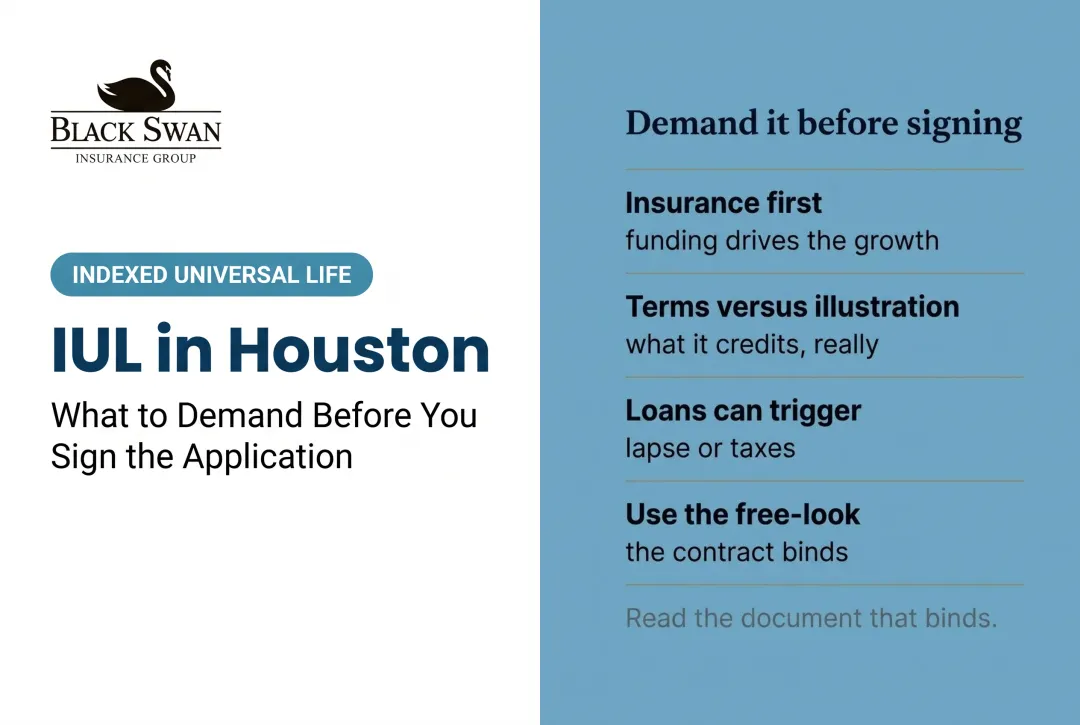
- The free-look period is short — use it to read the contract, not the illustration
Find Out Where You Actually Stand
This starts with the Tax-Free Wealth Blueprint Fit Review. If you earn $150K+ and are preparing to apply, we confirm the permanent need first, compare carriers on guaranteed terms rather than illustrated rates, model the funding through a bad stretch, and read any offer against the original illustration before you accept it. If it does not fit, we will tell you that too.
Frequently Asked Questions
Is an IUL an account I open?
No. You are applying for a life insurance policy, subject to underwriting, and the name causes real confusion about what you are buying and what protections apply.
How long does the process take?
It varies by underwriting pathway. Accelerated programmes have averaged around 9 days to a decision against 27 for traditional underwriting, though missing records or a referral extends that considerably.
What if I am offered a worse rate class than illustrated?
The premium and the economics change, sometimes substantially. Recalculate the whole plan against the new offer rather than accepting it because the application is already in.
When does coverage actually start?
Typically only after the policy is approved, delivered and funded per the carrier's requirements. Assuming you are covered from the application date is a dangerous mistake.
What is the free-look period for?
Reviewing the actual contract after delivery, with the right to cancel for a refund. Use it to read the policy rather than the illustration — they are different documents and only one of them binds.
Should I buy term insurance instead?
If the protection need has an end date, yes. Term is cheaper and simpler, and it deserves pricing before you begin an application for permanent coverage.
Sources
- LIMRA — Life insurers look to make the underwriting process easier for customers
- NAIC — What type of life insurance is right for you?
- NAIC — Life Insurance Illustrations
- NAIC — Life Insurance
- I.R.C. § 7702A and Rev. Proc. 2008-39 (modified endowment contracts and the seven-pay test)
Disclosure: This article is educational and is not personal tax, legal or investment advice. Indexed universal life is life insurance first and is not a deposit account. Carrier caps, participation rates and product availability change and vary by state. Actual results depend on policy design, carrier, crediting options, caps, participation rates, expenses, funding and ongoing management. Policy loans and withdrawals may reduce cash value and death benefit and can create tax consequences if the policy lapses or becomes a modified endowment contract. This strategy is not appropriate for everyone. Illustrated values are not guarantees; actual results depend on policy terms, crediting, costs and funding. Consult your own tax, legal and financial professionals for advice specific to your situation.
And remember, it's not what you earn, it's what you keep… enjoy the ride.