By Robert Balgac, Founder, Black Swan Insurance Group | October 7, 2026
Term, whole life and indexed universal life all pay a death benefit. Past that they have almost nothing in common — not how long they last, not how they are funded, not how much of your attention they will demand for the next thirty years.
U.S. individual life insurance new premium reached $17.5 billion in 2025, with IUL accounting for 25% of that and growing 17% year over year, according to LIMRA's 2025 sales report. More people are buying these contracts than ever. Rather fewer can explain what they bought.
The short answer: Start with one question — is the need temporary or permanent? If it ends, buy term; it is the cheapest honest answer and nothing else competes. If it genuinely outlives a term, the choice is between whole life's guarantees and IUL's flexibility, and that trade is really about whether you will manage a policy or just pay a bill.
If you earn $150K+ and someone has put all three in front of you, be aware they fail in different ways. Term fails by expiring while you still need it. Whole life fails by costing more than you wanted for decades. IUL fails by lapsing in year 22 because nobody watched the funding.
Key Takeaways
- Term handles temporary needs — income replacement, mortgage, child-rearing years — at the lowest cost per dollar of coverage
- Whole life prioritises guarantees and fixed premiums; IUL trades predictability for flexible funding and index-linked potential
- Fit depends on insurability, sustainable funding, liquidity and your existing retirement strategy — not a single "best" product
- Always separate guaranteed from non-guaranteed values before comparing anything
- Permanent coverage only stays permanent if it is adequately funded
What Each One Actually Is
Term Life
Coverage for a set period, typically 10 to 30 years, with no cash value in most policies. It is built for obligations with an end date: a 20-year mortgage, income replacement through your working years, the stretch until the children are independent.
With no savings component to fund, premiums stay low relative to the death benefit. Many term policies include a conversion option letting you move to permanent coverage later without new medical underwriting — an underrated feature worth confirming before you buy.
Whole Life
Permanent coverage with scheduled, fixed premiums and cash value accumulating under guaranteed provisions.
A participating policy may also pay dividends, but dividends are never guaranteed, as Northwestern Mutual states plainly. Actual payouts depend on the insurer's investment returns, mortality experience and expenses each year.
Indexed Universal Life
Permanent coverage with flexible premiums and a death benefit that can sometimes be adjusted. Cash value is credited by reference to an external index such as the S&P 500, but the cash value is never invested in that index.
Crediting depends on the participation rate, the cap, the floor (often 0%) and policy charges — cost of insurance, administrative fees and rider costs deducted regardless of index performance.
Zero is your hero in a down year — but the floor applies to the credit, not to the charges.
That gap between a protected credit and continuing charges is precisely where underfunded policies begin to fail. Permanent coverage of either kind only stays permanent if it is funded. Skipped premiums, rising insurance costs, loans and withdrawals all erode cash value and move the contract toward lapse.

Side by Side
| Feature | Term | Whole Life | IUL |
|---|---|---|---|
| Duration | Fixed period (10–30 years) | Lifetime, if funded | Lifetime, if funded |
| Premium structure | Low, fixed for term | Fixed, scheduled | Flexible, must cover rising costs |
| Cash value | None (typically) | Guaranteed accumulation | Index-linked, variable |
| Guarantees | Death benefit only | Death benefit + cash value | Death benefit only; cash value not guaranteed |
| Flexibility | Low | Low | Moderate to high |
| Complexity | Low | Moderate | High |
| Common uses | Income replacement, debt coverage | Legacy, predictable growth | Retirement supplement, flexible legacy |
| Primary risk | Coverage ends at term | Low early cash value, non-guaranteed dividends | Illustration risk, lapse, rising charges |
Term needs almost no maintenance once bought. Whole life is predictable but benefits from periodic review. IUL demands ongoing attention — funding levels, loan balances, and whether current caps and charges still support the original objective.
That is not a criticism of IUL. It is a different kind of commitment, closer to managing an account than paying a bill, and buyers should be told that before they sign rather than after.
The Ultimate IUL Blueprint
If a permanent policy is on the table, the Blueprint sets out what the design has to survive: funding levels, charges, the MEC line, loan timing, and what to demand from an illustration.
What the Critics Get Right
The standard criticism — buy term and invest the difference — is correct far more often than the insurance industry likes to admit.
For most households, for most of their lives, the need genuinely is temporary. Term plus a disciplined investment habit is cheaper, simpler and harder to break. Permanent coverage sold to someone with a twenty-year need is an expensive solution to a problem term already solved.
The honest caveat is the word disciplined. The strategy assumes you actually invest the difference, keep investing it through a downturn, and have no need for coverage at 70. Where those assumptions hold, the critics are right. Where they do not, "buy term and invest the difference" quietly becomes "buy term and spend the difference".
What Each One Costs
Pricing depends on age, health, tobacco use, coverage amount, term length, underwriting class, riders, state and the insurer's own design. No two applicants get the same quote.
Term premiums vary too widely to quote a reliable single figure. Tobacco users can pay two to three times what non-smokers pay for comparable coverage. A personalised quote on your actual health profile is the only meaningful number.
Whole life, illustratively: a 2025 Policygenius analysis of $100,000 policies for healthy nonsmokers found estimated monthly premiums of $75 at 30, $110 at 40, $175 at 50 and $290 at 60, from Policygenius's internal rate data. Actual pricing still turns on carrier, structure and underwriting.

And the cost that rarely appears on an illustration: opportunity cost. A larger permanent premium competes with emergency reserves, debt reduction, 401(k) and IRA contributions, and taxable investing. Before committing, ask what else that money could do.
The Risks, By Product
Term: coverage ends unless you renew or convert, often at a far higher rate; no cash value if you outlive it; renewal can become expensive or restricted by health changes.
Whole life: early cash value is often below premiums paid for several years; dividends are never guaranteed; loans reduce death benefit and cash value and can trigger tax if the policy lapses before repayment.
IUL: illustrations are assumptions, and caps and participation rates can change; cost of insurance rises with age and can be increased within contractual limits; underfunding, withdrawals or outstanding loans all contribute to lapse; failing the seven-pay test creates a modified endowment contract, where loans and withdrawals can be taxable with a possible 10% additional tax before 59½.
How to Choose Without Being Sold
Start with a needs analysis: income replacement (years of support and amount), debts and obligations (mortgage, business loans, tuition), and genuinely permanent needs (estate liquidity, legacy, coverage that must outlast retirement).
Then stress-test affordability against a worse year, not today's budget. A policy that only survives ideal conditions is not a plan.
Compare honestly across term plus disciplined investing, qualified retirement accounts and Roth strategies, brokerage assets, whole life, IUL, guaranteed UL, and employer group coverage.
And read the illustration properly. Per the NAIC's illustration guidance, every basic illustration separates guaranteed elements from non-guaranteed ones. Check guaranteed against illustrated values, the assumed crediting rate with caps and participation rates, charges and cost of insurance over time, surrender values and break-even timing, and outcomes under a lower-crediting scenario rather than the best case.
An illustration is a model, not a guarantee.
If you hold convertible term, confirm the conversion deadline, which products qualify and how pricing is set at conversion. Those details vary by carrier and they expire.

Stronger Fit
Permanent coverage is worth examining if you:
- Earn $150K+ with surplus cash flow after reserves, debt and maxed retirement contributions
- Have a protection, estate or business need that genuinely outlives a 20-year term
- Are insurable at a reasonable rate with a long funding horizon
- Will review the policy annually if you choose IUL
Weaker Fit
Buy term instead if you:
- Need substantial coverage on a limited budget
- Have obligations that decline and end — mortgage, dependants, working years
- Cannot sustain a permanent premium through an income interruption
- Have not yet captured an employer match or built emergency reserves
- Want to buy coverage once and never think about it again
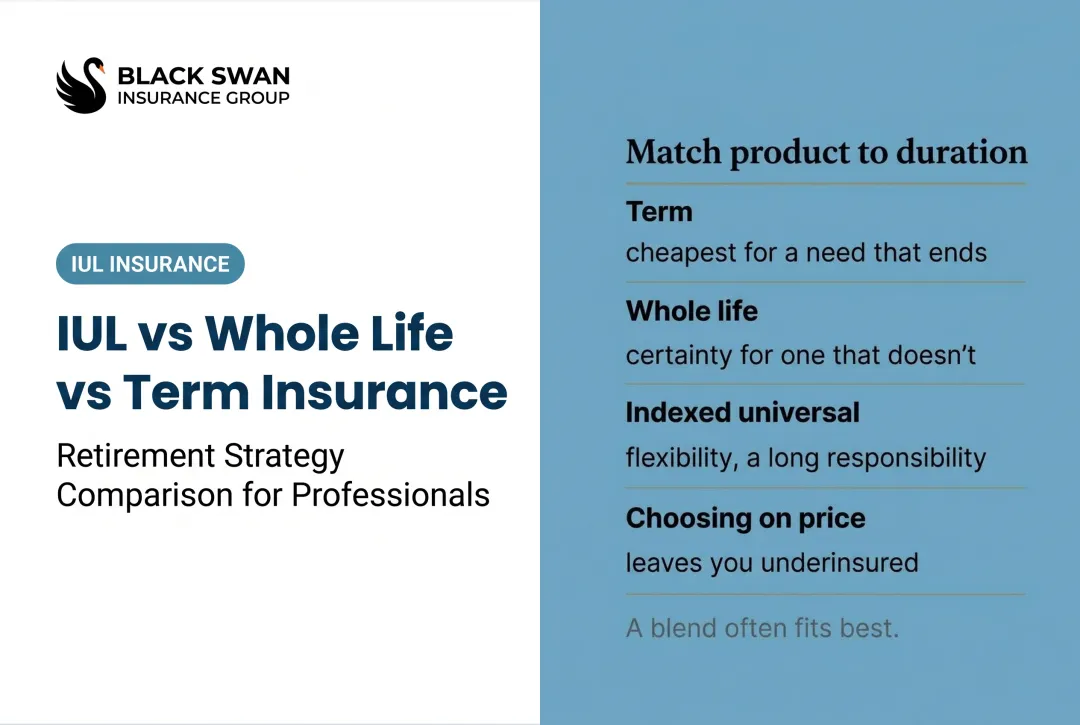
For late-start high earners aged 45 to 55, suitability turns on more than income: remaining funding runway, liquidity you must keep outside the policy, succession and concentration risk for business owners, and whether qualified plans should be funded first. Where the need is mixed, a blended approach — term for the temporary piece, permanent for the lasting one — usually beats either alone.
Risks to Understand Before You Apply
- Replacing existing coverage triggers new underwriting, possible surrender charges and a fresh contestability period. Never cancel first.
- Health changes are permanent. Insurability is a perishable asset; a term conversion option is worth more than it looks.
- Caps and participation rates can fall, subject to contract minimums.
- Cost of insurance rises with age on flexible-premium designs.
- Loans are the sharp edge. The loan is not the problem; the unmanaged loan is the problem.
- Lapsing with a loan outstanding can create taxable income with no cash received.
Find Out Where You Actually Stand
This starts with the Tax-Free Wealth Blueprint Fit Review. If you earn $150K+ and you are weighing term against whole life against IUL, we define the actual need and duration first, then compare designs and carriers against the alternatives — including maxing the plan and buying term — and stress-test any permanent design through lower-crediting and zero-credit years. If term solves your problem, we will say so and you will have spent nothing. If IUL does not fit, we will tell you that too.
Frequently Asked Questions
What is the difference between term, whole life and IUL?
Term covers a fixed period at the lowest cost with no cash value. Whole life is permanent with guaranteed cash value and fixed premiums. IUL is permanent with flexible premiums and index-linked cash value subject to caps, floors and charges.
Is IUL or whole life better?
Whole life prioritises guarantees and predictable fixed premiums; IUL offers flexible funding and index-linked potential with considerably more to manage. The better fit depends on your permanent need, budget, horizon and appetite for monitoring a contract.
Should I just buy term and invest the difference?
Often, yes — if the need is temporary, and if you genuinely invest the difference and keep doing so. It is a strong strategy that fails only on discipline or on a need that outlives the term.
How much does a $100,000 term policy cost per month?
It depends heavily on age, health, tobacco use, term length and underwriting class. No single figure applies; get a personalised quote.
Can I hold term and permanent coverage at the same time?
Yes, and layering them is common — term for the temporary need, permanent for the lasting one. Evaluate total premiums, underwriting and affordability together before adding the second policy.
What should I look for in an IUL illustration?
Guaranteed against non-guaranteed values, crediting assumptions, caps and participation rates, policy charges, surrender values, and how the design performs under a lower-crediting scenario rather than the illustrated best case. Compare it with a plain sales illustration for the same funding.
Sources
- LIMRA — U.S. individual life insurance new premium tops $17.5 billion in 2025
- Northwestern Mutual — Dividend-paying whole life insurance
- Northwestern Mutual — Modified endowment contracts
- Policygenius — Whole life insurance policy cost
- NAIC — Life Insurance Buyer's Guide
Disclosure: This article is educational and is not personal tax, legal or investment advice. Indexed universal life is life insurance first. Product features, pricing, guarantees and availability vary by carrier and state, and all guarantees are subject to the issuing insurer's claims-paying ability. Premium figures cited are illustrative third-party estimates, not quotes. Illustrated values are not guarantees; actual results depend on policy terms, crediting, costs and funding. Any potential tax-advantaged access depends on the policy being properly structured, funded and managed. Actual results depend on policy design, carrier, crediting options, caps, participation rates, expenses, funding and ongoing management. This strategy is not appropriate for everyone. Policy loans and withdrawals reduce cash value and the death benefit, and can create tax consequences if the policy lapses or becomes a modified endowment contract. Consult your own tax, legal and financial professionals for advice specific to your situation.
And remember, it's not what you earn, it's what you keep… enjoy the ride.