By Robert Balgac, Founder, Black Swan Insurance Group | October 7, 2026
For a high earner, the 401(k) is where retirement planning starts, not where it finishes. Once it is maxed and the Roth phase-out has closed, the search begins for tax diversification, protection and a legacy structure — and that search reliably arrives at indexed universal life.
IUL is also one of the most misrepresented products in financial services. It gets sold as a retirement vehicle with the costs glossed over, then attacked as a scam by people describing badly designed policies. Both camps are arguing about the same product and neither is describing yours.
The short answer: IUL is permanent life insurance whose cash value is credited by reference to a market index — you are never invested in the index itself. A 0% floor protects the credit in a down year; a cap limits what you keep in a good one. Properly structured, it offers tax-deferred growth and potentially tax-advantaged access through loans. Improperly funded, it lapses and takes a tax bill with it.
Key Takeaways
- IUL combines a death benefit with index-linked cash value, without direct market investment
- Growth is protected by a floor and limited by a cap or participation rate the insurer sets
- Structured correctly it offers tax-deferred growth, loan access and an income-tax-free death benefit
- It is a long-horizon tool with significant costs — not a savings account and not a 401(k) replacement
- Suitability is the whole question: permanent need, long horizon, stable surplus income
What It Is
Permanent life insurance with two components: a death benefit paid to beneficiaries, generally free of federal income tax, and a cash value account accumulating on a tax-deferred basis.
What distinguishes IUL is how that cash value earns. Not a fixed rate as in whole life, not direct investment as in variable UL, but interest credited by reference to an index such as the S&P 500.
Your money is not in the market. The insurer holds cash value in its general account and uses index performance as a benchmark — index crediting — to calculate what it credits. You capture some of the upside without owning the downside, and you pay for that arrangement in capped gains and policy charges.
Where the Premium Goes
Premium first covers the policy's internal costs: cost of insurance (the death-benefit charge, which rises with age), administrative charges, a premium load taken as a percentage of each payment, and rider expenses for optional benefits. What survives reaches the cash value account.
Because cost of insurance climbs with age, the policy needs enough early funding to build value that can absorb higher charges later. Underfund the first decade and the last two are in trouble.

How Crediting Is Measured
Interest references a chosen index, and the calculation usually excludes dividends paid by the underlying stocks — a detail rarely volunteered and worth several percentage points of long-run return.
Carriers measure the change by annual point-to-point (comparing the index at segment start and one year on, the most common method) or by monthly or daily averaging, which smooths volatility but can reduce credit after a late-year rally.
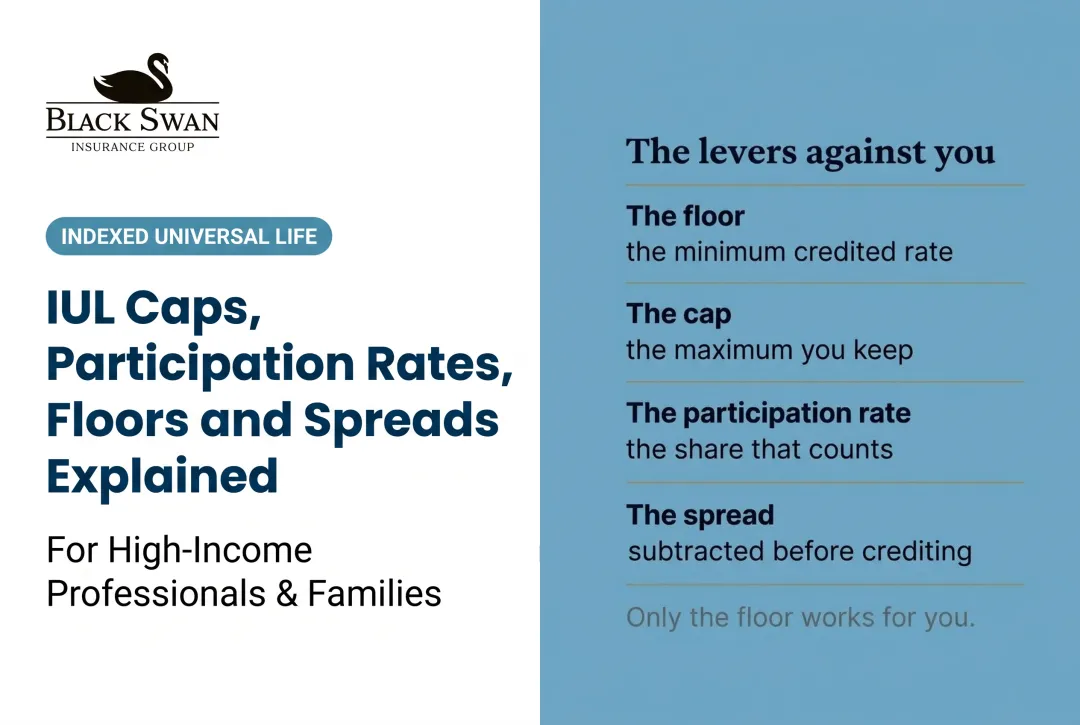
Three levers then shape the result. The floor is your downside protection, typically 0% or 1%, meaning no negative credit from a market fall — though charges still come out. The cap is the ceiling: index up 15% against a 9% cap credits 9%. The participation rate sets what share of the gain counts: a 10% gain at 80% participation credits 8% before any cap.
Put together, with a 9% cap, 0% floor and 100% participation: a 14% index year credits 9%; a −12% year credits 0%, with charges still deducted; a 7% year credits the full 7%.
The Ultimate IUL Blueprint
If you are evaluating a policy, the Blueprint sets out what the design has to survive: funding levels, caps and charges, the MEC line, loan timing, and what to demand from an illustration.
What It Offers
Flexible premiums and death benefit. Unlike whole life's fixed schedule, you can pay more in strong years and less in tight ones, provided the policy holds enough value to cover its costs. The death benefit can often be adjusted as needs change.
Tax treatment. Under IRC §7702, life insurance receives favourable treatment: tax-deferred growth on cash value, potentially tax-advantaged access through policy loans while the contract stays in force and non-MEC, and an income-tax-free death benefit.
Supplemental retirement flexibility. For earners who have exhausted the 401(k) and IRA, access to cash value through loans can provide a differently-taxed source of retirement cash flow — useful for managing overall tax exposure. Business owners use the same feature to build liquid capital outside a concentrated company.
Every one of those depends on design, funding and management. None of them is automatic.
What the Critics Get Right
The criticism of IUL is largely aimed at how it is sold, and on that ground it lands.
Illustrations get presented as projections. Caps get quoted as though contractual. Policies get recommended to people who have not captured an employer match. And "tax-free retirement" is a phrase doing far more work than the tax code supports — loans are only tax-advantaged while the policy survives, and a lapse with debt outstanding converts the whole arrangement into a taxable event.
Where the criticism overreaches is in treating a badly designed policy as proof the structure cannot work. Two people can own the same product and hold completely different assets, because one was engineered and one was sold.
A great IUL is engineered. A bad IUL is sold.
The Risks, Stated Plainly
Lapse. The 0% floor protects cash value from negative index returns; it does not guarantee the policy stays in force. Every month the insurer deducts cost of insurance and fees. If credited interest fails to outpace those rising internal costs, value erodes — and at zero, coverage ends.
Non-guaranteed elements. Illustrations project from current caps and costs, which the insurer can later change. Per the NAIC, illustrations include non-guaranteed elements: a carrier may lower cap rates or raise internal fees, and either slows growth or threatens viability in an underfunded contract.
MEC. Fund above the seven-pay limit and the contract becomes a Modified Endowment Contract. Loans and withdrawals then tax income-first, with a possible 10% penalty on gains taken before 59½. Design funding to stay inside the limit from day one — the status is generally permanent.

How It Compares
| Feature | IUL | Whole Life | Variable UL |
|---|---|---|---|
| Premiums | Flexible | Fixed and required | Flexible |
| Cash value growth | Index-linked with cap and floor | Guaranteed minimum plus non-guaranteed dividends | Direct investment in market sub-accounts |
| Market risk | Buffered by the floor; upside capped | Very low; steady and guaranteed | Full exposure to gains and losses |
As FINRA notes, VUL is a security carrying direct investment risk, while IUL references an index without ownership. Whole life offers the most certainty; IUL occupies the middle ground.
| Factor | IUL | 401(k) / IRA |
|---|---|---|
| Primary purpose | Death benefit, with secondary cash value | Retirement saving and investment |
| Contribution limits | No IRS dollar cap; funding limited by MEC rules | Strict annual limits (2026 401(k) deferral: $24,500) |
| Access | Policy loans at any age if cash value supports them | Withdrawals before 59½ usually taxed plus 10% penalty |
| Costs | Insurance charges, fees, commissions | Typically lower; mainly investment management fees |
Max out employer matching and core qualified contributions first. Only then weigh IUL for permanent protection, tax diversification or access those accounts cannot provide.
Stronger Fit
- Earning $150K+ with stable surplus cash flow after maxing retirement accounts
- A permanent need — legacy planning, estate liquidity, a lifelong dependant
- A 15-to-20-year horizon, since costs are front-loaded and value builds slowly
- Good health, because underwriting drives cost of insurance and long-run performance
Weaker Fit
Not everyone should own one. Walk away if you:
- Need access to the money in the short term
- Primarily want low-cost death-benefit protection — term is better and cheaper
- Cannot comfortably fund the policy for decades
- Have no clear, permanent insurance need
At Black Swan Insurance Group the suitability review runs five steps: a full review of goals and permanent protection needs, custom design matched to budget and horizon, stress-testing under conservative assumptions, transparent enrolment and funding plan, and annual reviews.

Risks to Understand Before You Fund
- Charges continue in a zero year. The floor applies to the credit, not to the cost of insurance.
- Caps and participation rates can fall, subject to contract minimums.
- Dividends are excluded from most crediting calculations, which materially affects long-run comparison with an index fund.
- Cost of insurance rises with age and can overtake crediting in a thin policy.
- MEC status is generally permanent and removes the access advantage.
- Lapse with loans exceeding basis converts the excess into taxable income with no cash received.
This is not set-it-and-forget-it. It is design-it, fund-it, review-it.
Find Out Where You Actually Stand
This starts with the Tax-Free Wealth Blueprint Fit Review. If you earn $150K+ and are weighing an IUL, we establish the protection need first, model the funding against the MEC limit, stress-test the design through lower-crediting and zero-credit years, and show the charges and loan assumptions in plain numbers. Our job is to help you decide whether this is the right tool — and to be straight with you when it is not. If IUL does not fit, we will tell you that too.
Frequently Asked Questions
What is indexed universal life insurance?
Permanent life insurance providing a lifelong death benefit plus a cash value component, where credited interest is linked to a market index with downside protected by a floor and upside limited by a cap.
Is IUL a good investment?
It is life insurance first, not a pure investment. It offers tax-advantaged growth potential, but returns are capped and it carries internal costs that traditional investment vehicles do not.
Is IUL better than a 401(k)?
No. A 401(k) is a dedicated retirement vehicle; IUL is insurance that can supplement retirement through loans and a death benefit. Treat it as a complement, and capture any employer match first.
Can you lose money in an IUL?
Cash value will not fall from negative index returns because of the floor, but total cash value can still decline. When monthly charges exceed credited interest, value drops — and the policy can eventually lapse.
How do withdrawals and loans work?
You can withdraw or borrow against cash value, often with favourable tax treatment when properly structured. Withdrawals reduce cash value and death benefit; loans accrue interest, and any unpaid balance at death reduces what beneficiaries receive.
What happens if the policy lapses?
Coverage ends. If outstanding loans exceed your cost basis, the excess can be treated as taxable income — an unexpected bill arriving at the worst possible moment.
Does the index include dividends?
Usually not. Most crediting calculations use price return rather than total return, which is one of the larger and least-discussed differences between an IUL credit and owning an index fund.
Sources
Disclosure: This article is educational and is not personal tax, legal or investment advice. Indexed universal life is life insurance first. Product features, charges, caps, participation rates and availability vary by carrier and state, and guarantees are subject to the issuing insurer's claims-paying ability. Contribution limits change annually and should be confirmed with the IRS. Illustrated values are not guarantees; actual results depend on policy terms, crediting, costs and funding. Actual results depend on policy design, carrier, crediting options, caps, participation rates, expenses, funding and ongoing management. This strategy is not appropriate for everyone. Policy loans and withdrawals reduce cash value and the death benefit, and can create tax consequences if the policy lapses or becomes a modified endowment contract. Consult your own tax, legal and financial professionals for advice specific to your situation.
And remember, it's not what you earn, it's what you keep… enjoy the ride.