By Robert Balgac, Founder, Black Swan Insurance Group | October 5, 2026
If you are a physician, business owner or executive already maxing the 401(k) and the IRA, you have hit the wall that starts this conversation. There is only so much you can shelter each year, and the next dollar has nowhere obvious to go.
That is the moment indexed universal life enters the picture, and the moment the framing usually goes wrong. An IUL is permanent life insurance with a cash-value component tied to an index-crediting formula. It is not a fund, not a 401(k) substitute, and not a market position. Retirement plans go sideways precisely where that distinction gets blurred.
Used properly it is a supporting player. The lead roles belong to your qualified accounts, and the employer match is the single highest-certainty return available to you anywhere.
The short answer: Outcomes depend on design, funding discipline, crediting assumptions, charges and staying in force — not on the illustration. A 0% floor blocks negative index years while insurance costs and fees still erode cash value. Treat this as a complement to a 401(k), IRA or brokerage account for the right buyer, never a replacement. Compare guaranteed against non-guaranteed values and stress-test low-crediting and interrupted-funding years before building any income assumption on it.
Key Takeaways
- Outcomes hinge on design, funding discipline, crediting assumptions, charges and staying in force
- A 0% floor blocks negative index years; insurance costs and fees can still erode cash value
- It complements a 401(k), IRA or brokerage account for the right buyer — it does not replace them
- Compare guaranteed against non-guaranteed values, and stress-test low crediting and interrupted funding
- A policy that looks well-funded at 45 can look very different at 70
How the Policy Works
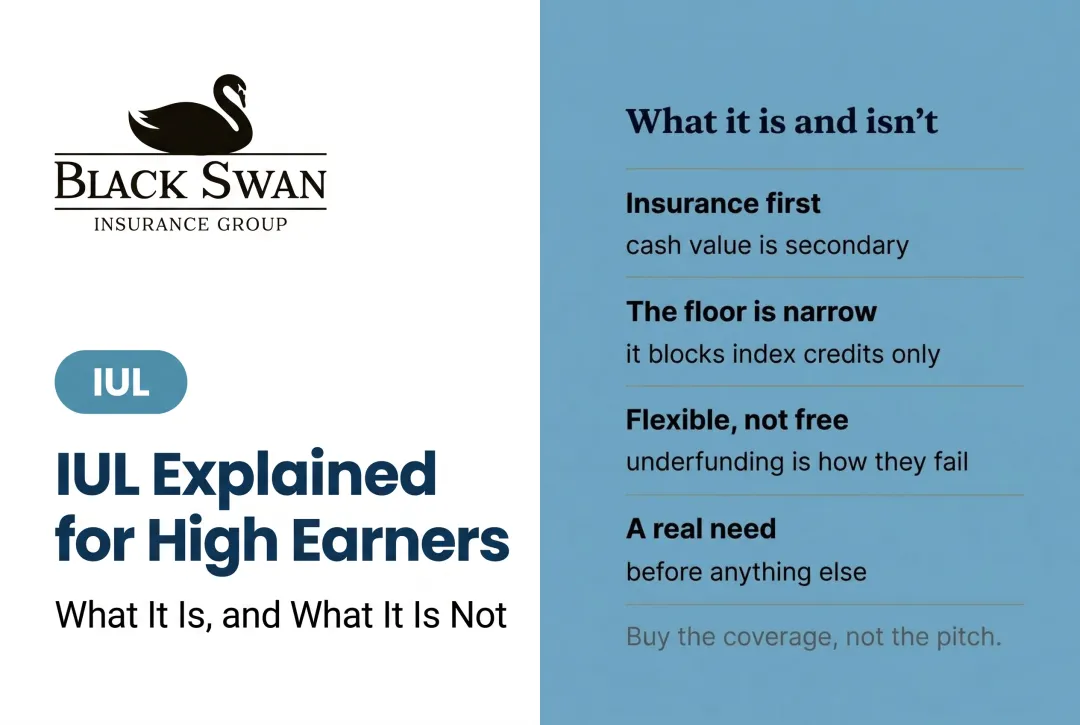
Two components: a death benefit for beneficiaries, and a cash-value account that can grow over time. The death benefit is the core purpose. Cash value is a secondary feature.
Each premium splits. Part covers the cost of insurance based on age, health and coverage amount. Part pays administrative fees and rider charges. What remains goes toward cash value. The split varies by insurer, design and riders — there is no universal formula.
Crediting
Your cash value is not invested in the S&P 500 or any index. The insurer calculates a crediting rate from a formula tied to that index's performance.
- Floor — the minimum credited rate, often 0%, protecting against negative index years
- Cap — the maximum credited rate, however well the index performed
- Participation rate — the percentage of index gains counted
- Spread or asset-based charge — a fee some products deduct before crediting
A policy with a 9% cap, 100% participation and a 0% floor: the index gains 12%, you are credited 9%. The index drops 15%, you are credited 0%. Simplified mechanics, not a projection.

The floor matters, and it is not a guarantee that total account value will not drop. Cost of insurance, administrative fees and rider costs are deducted regardless. A 0% crediting year combined with high internal charges still means cash value declines.
Zero is your hero in a down year — but the floor applies to the credit, not to the charges.
Flexibility and Access
Premiums are marketed as flexible and technically are, within policy limits. Flexible does not mean optional. Skip too many payments, or underfund relative to the cost structure, and you risk lapse.
Once cash value builds, withdrawals or loans may give you access:
- Withdrawals reduce the death benefit dollar-for-dollar, or more
- Loans accrue interest and increase lapse risk if unmanaged
- A lapse with an outstanding loan balance can trigger a taxable event
Loan provisions, crediting methods and guarantees differ by contract. Read the policy documents and current illustration, not a summary.
Where It Can Actually Help
- Permanent income protection for a spouse or dependents
- Supplemental cash value growing tax-deferred alongside other savings
- Tax diversification, since qualified plan withdrawals are taxable while policy loans generally are not treated as income while the contract is in force
- Liquidity before or during retirement without the early-withdrawal penalties tied to IRAs before 59½
- A death benefit supporting legacy or estate goals
A permanent death benefit becomes more relevant with a mortgage, children, a business carrying ongoing obligations, or a need to equalise an inheritance. Term insurance covers a window of years and does that job cheaply. Permanent coverage runs as long as the policy stays funded and in force.
Loans and withdrawals can supplement retirement income. Treat any income projection sceptically until you have accounted for loan interest that keeps accruing, cost of insurance continuing into retirement, and crediting assumptions from an illustration that may not hold for 20 or 30 years.
On tax: death proceeds are generally not taxable income to beneficiaries, and policy loans are typically not treated as taxable distributions while the policy stays in force and is not a modified endowment contract. That is potential tax-advantaged access, conditional on the contract being properly structured, funded and managed.
Surrendering or lapsing with an outstanding loan can create taxable income. The rules around basis, MEC status and lapses are specific, and they belong with a tax professional before you build income assumptions on them.

What the Critics Get Right
The case against using life insurance as a retirement vehicle is strong, and meeting it head-on is the only way this page earns trust.
Critics are right that the internal cost structure makes this a poor accumulation vehicle compared with a low-cost index fund, and that no illustration adjusts for that honestly. They are right that the retirement-income language used to sell these policies describes a loan against your own death benefit, which is a very different thing from a Roth distribution. And they are right that the lapse data is damning: policies that fail deliver the worst possible outcome, having consumed decades of premium.
Where the criticism runs out is the protection need. If you need permanent coverage regardless, the cash value inside it is not competing with your 401(k) — it is a feature of insurance you were buying anyway. The error is treating the retirement story as the reason to buy, rather than as a secondary benefit of a policy justified on protection alone.
The Costs and Risks
Internal costs reduce cash value regardless of index performance: cost of insurance rising with age; premium loads and administrative fees; rider charges; surrender charges if you cancel in the early years; and loan interest if you borrow. These are disclosed in the contract and the current illustration. Ask for both.
Illustrations show possibilities. Guaranteed values assume the worst contractually allowed performance. Non-guaranteed values assume today's caps, participation rates and charges hold for decades.
The NAIC's life insurance illustration model regulation prohibits insurers from presenting non-guaranteed elements as guaranteed or using assumptions more favourable than their own recent experience. Caps and participation rates can still change within contract limits.
Ask for three versions: guaranteed values; a reduced-crediting scenario; and one assuming you miss or lower several premium payments.
Lapse risk is documented. A joint LIMRA and Society of Actuaries study covering 34 million universal life policy exposures from 2015 to 2021 found IUL lapse rates rose across nearly every policy year and stayed consistently higher than other universal life products throughout.
Liquidity and concentration. Funding a policy with money you might need soon — emergency savings, a house deposit, near-term tuition — creates a problem when you need it early. Surrender charges and loan mechanics are not built for short notice. Be especially careful with premium financing or aggressive funding sold as a hands-off strategy; those deserve specialised independent review.

The Ultimate IUL Blueprint
If a permanent need genuinely exists and you are past the framing question, the Blueprint covers the design decisions that determine whether it survives to do a retirement job: funding levels, the MEC line, loan timing and index-strategy selection.
How It Compares
Against a 401(k) or IRA
| Feature | 401(k)/IRA | IUL |
|---|---|---|
| Primary purpose | Retirement savings | Life insurance protection |
| Employer match | Possible | None |
| 2026 contribution limit | $24,500 (401k); $7,500 (IRA) | No IRS cap; underwriting and affordability set the ceiling |
| Investment choice | Employer-selected funds or brokerage options | Index-crediting formula; no direct market exposure |
| Required minimum distributions | Generally from age 73 | None |
| Death benefit | None | Yes |
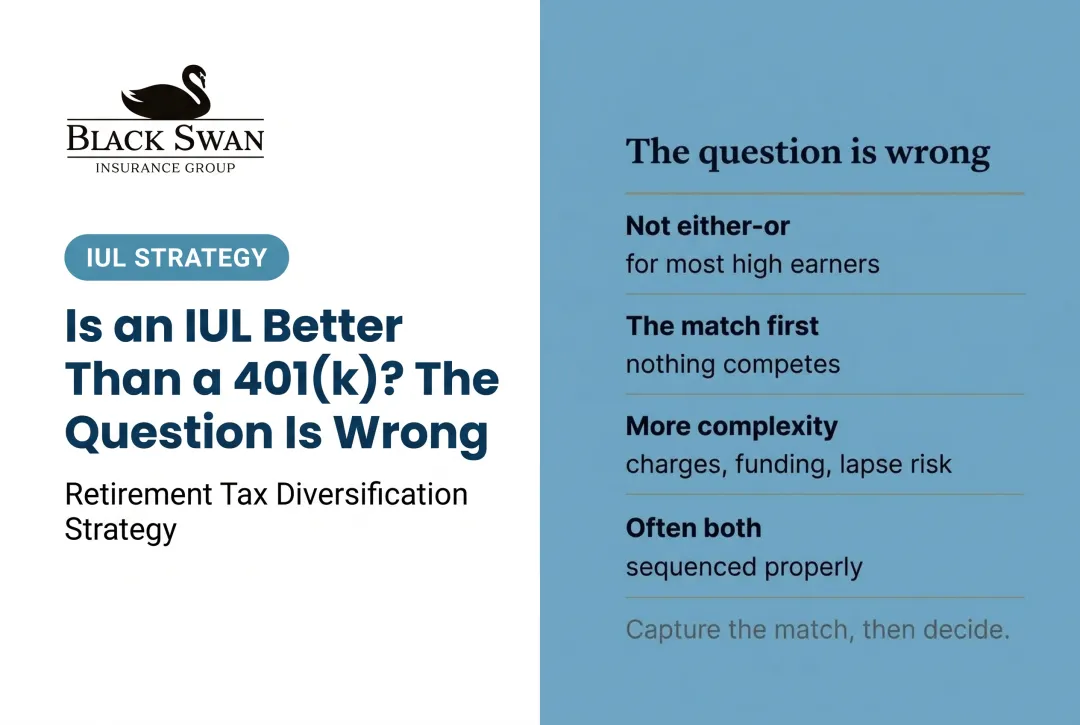
For tax year 2026 the IRS set the 401(k) elective deferral limit at $24,500, with combined IRA contributions capped at $7,500. If your employer matches, capture that match before funding a policy. A 401(k) is not the enemy — depending on it as the only bucket is the part worth examining, and skipping a match to fund a premium is indefensible.
Against Whole Life and Other Designs
Whole life typically has fixed premiums and guaranteed cash-value growth backed by the insurer's general account. An IUL trades some of that predictability for flexible premiums and index-linked crediting that could outperform or underperform it.
- Variable universal life puts cash value directly into investment subaccounts, with full market gains and losses and no floor
- Term insurance provides temporary coverage with no cash value, and is usually the least expensive way to get pure protection
Guarantees on any of these depend on the issuing insurer and the specific contract.

Against Taxable Investing
Direct index funds and brokerage accounts offer what a policy cannot: full transparency and daily liquidity. You see exactly what you own and can sell whenever you want, subject to capital gains tax. What they do not offer is a contractual death benefit or the loan-based access structure of life insurance.
Use taxable accounts for flexible, liquid growth. Consider a policy only when you also need permanent protection and can fund it long term without starving the match, your reserves or other core goals.
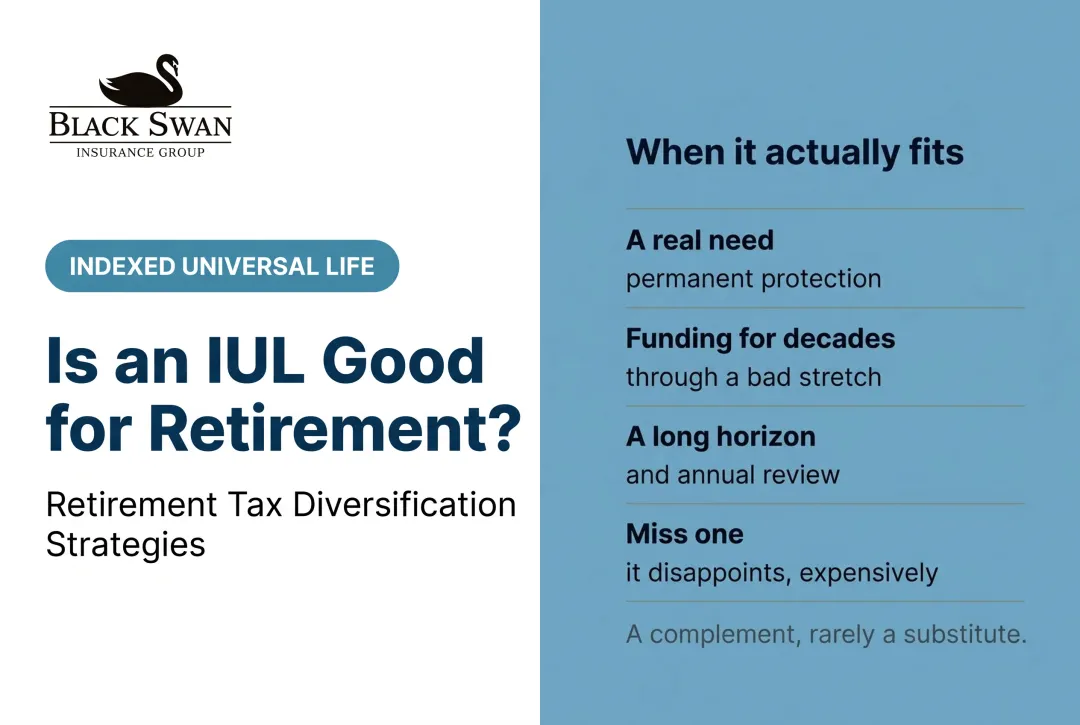
Who It Fits
Stronger Fit
- A genuine, lasting need for permanent life insurance
- Household income of $150K+ with stable surplus cash flow after emergency reserves and maxed tax-advantaged accounts
- A long horizon, ideally 15 to 20 years or more
- Insurability at reasonable rates
- Ability to fund consistently, including through a rough year
- Willingness to review the contract annually
Weaker Fit
Not everyone should buy an IUL. As a supporting player it can earn its place; as the lead it almost never does.
- The employer match is not yet captured
- Emergency reserves are thin, or high-interest debt is running
- Money may be needed before the contract builds accessible value
- The need is temporary protection — term insurance is the cheaper and correct answer
- The retirement story is the only reason the policy is being considered
Due Diligence Before You Sign
Request the full contract and the current dated illustration. Read the guaranteed column first. Get the three scenarios. Confirm the surrender schedule, loan provisions and where your funding sits relative to the MEC line. Then have it reviewed by someone who is not compensated on the sale.

If the illustration only works when everything goes right, it is not a plan. It is a wish with a binder.
Risks to Understand Before You Build Income On It
- Treating it as a retirement account rather than insurance with a feature is the root error
- Charges continue in a 0% crediting year, so cash value can fall with the floor intact
- Cost of insurance rises with age and continues into retirement, exactly when income is being drawn
- Caps and participation rates can change within contract limits after you commit
- IUL lapse rates ran higher than other universal life designs across the 2015–2021 study period
- Loans accrue interest and raise lapse risk, and a lapse with a loan outstanding and gain in the contract creates taxable income
- Crossing the seven-pay limit makes the contract a MEC and changes distribution taxation permanently
- Surrender charges and loan mechanics are not built for short notice
- Premium financing adds leverage, lender terms and collateral risk, and deserves independent review
Find Out Where You Actually Stand
This starts with the Tax-Free Wealth Blueprint Fit Review. If you earn $150K+ and have genuinely run out of qualified room, we map what tax-advantaged capacity remains, test whether a permanent protection need exists independently, model the policy at reduced crediting and interrupted funding, and compare a taxable brokerage account on identical terms. If it does not fit, we will tell you that too.
Frequently Asked Questions
Can an IUL replace my 401(k)?
No, and it should not be presented that way. A 401(k) carries an employer match and dedicated retirement tax treatment. A policy is insurance with a cash-value feature. Capture the match first, always.
Is the retirement income from a policy tax-free?
It is generally a loan against your own cash value, not taxed while the policy stays in force and is not a MEC. A lapse or surrender with a loan outstanding and gain in the contract can create taxable income, so "tax-free" is conditional on the policy surviving.
What happens if I stop paying premiums?
Charges continue to be deducted from cash value. Once that runs out the policy lapses, and any outstanding loan can become taxable. Options exist short of stopping — ask for an in-force illustration before making a change.
Does the 0% floor protect my cash value?
No. It protects the credited interest. Cost of insurance, administrative fees and rider charges are deducted regardless, so value can fall in a flat year.
How long does this need to run to work?
Generally 15 to 20 years or more. Anything shorter and the early-year charges dominate, which is why surrender in the first decade is where people lose money.
Should I buy term and invest the difference instead?
If there is no permanent protection need, frequently yes, and it deserves pricing. It works when the difference genuinely gets invested every year, including through a bad market.
Sources
- IRS — COLA increases for dollar limitations on benefits and contributions
- NAIC — Life Insurance Illustrations Model Regulation (Model 582)
- LIMRA and Society of Actuaries — 2015–2021 UL lapse rate study
- NAIC — Life Insurance
- I.R.C. § 7702A and Rev. Proc. 2008-39 (modified endowment contracts and the seven-pay test)
Disclosure: This article is educational and is not personal tax, legal or investment advice. Indexed universal life is life insurance first. Contribution limits change annually. Actual results depend on policy design, carrier, crediting options, caps, participation rates, expenses, funding and ongoing management. Policy loans and withdrawals may reduce cash value and death benefit and can create tax consequences if the policy lapses or becomes a modified endowment contract. This strategy is not appropriate for everyone. Illustrated values are not guarantees; actual results depend on policy terms, crediting, costs and funding. Consult your own tax, legal and financial professionals for advice specific to your situation.
And remember, it's not what you earn, it's what you keep… enjoy the ride.