By Robert Balgac, Founder, Black Swan Insurance Group | October 5, 2026
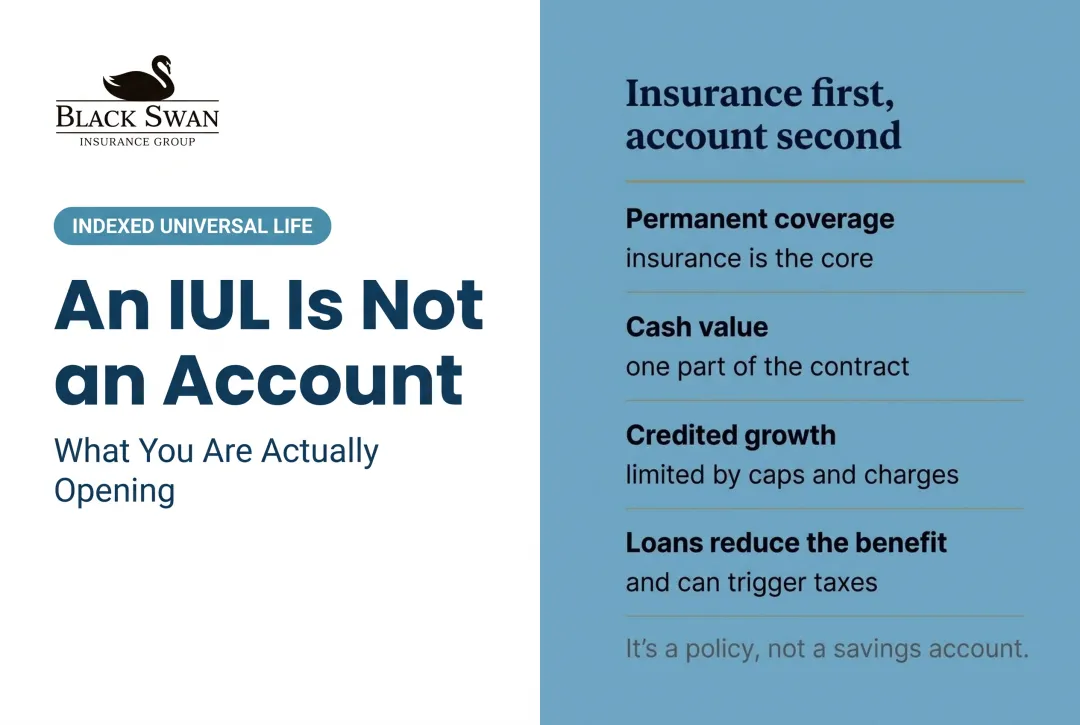
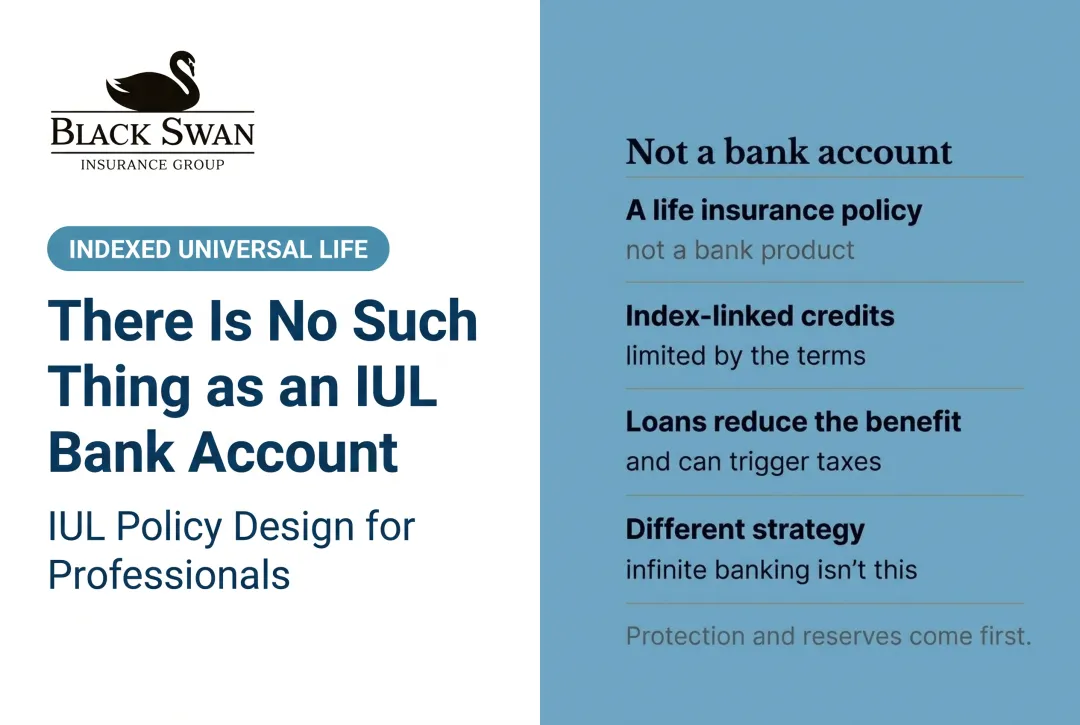
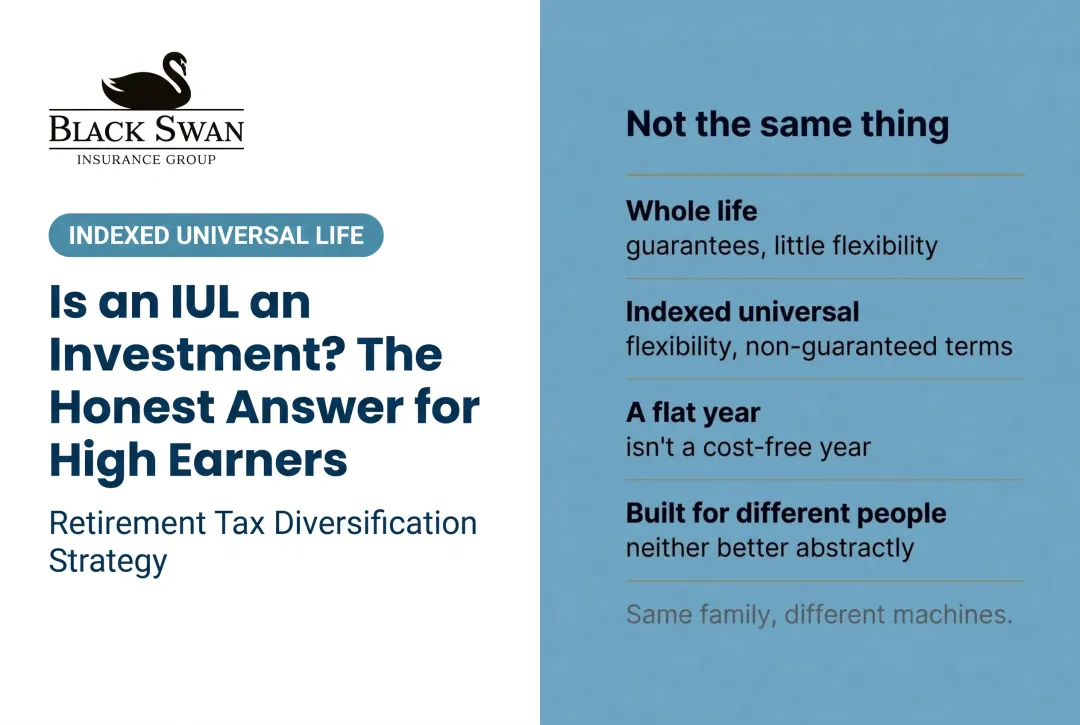
If you searched "IUL investment," the correction comes first: an IUL is not an investment. It is indexed universal life insurance — a permanent life insurance policy that builds cash value credited on a formula referencing a market index.
That is not pedantry. It changes the regulation, the expectations and the way you should evaluate what is being shown to you.
Most high earners hear about this from a colleague or a social media ad promising retirement income the IRS cannot touch. The pitch is compelling. The mechanics are considerably more nuanced, and caps, participation rates, policy charges and underwriting all shape what a contract actually delivers.
The short answer: An IUL blends permanent life insurance with cash value credited through an index-linked formula, not through market ownership. Caps, participation rates, spreads and policy charges shape real results far more than headline index returns. Loans, withdrawals, underfunding and lapse risk can undo the tax advantages and reduce the death benefit. It fits people with a genuine permanent insurance need, stable cash flow and a long horizon. Always request guaranteed and non-guaranteed illustrations before comparing it against anything else.
Key Takeaways
- It blends permanent life insurance with cash value credited on an index-linked formula, not direct market ownership
- Caps, participation rates, spreads and policy charges shape real results more than headline index returns
- Loans, withdrawals, underfunding and lapse risk can undo tax advantages and reduce the death benefit
- It fits people with a genuine permanent insurance need, stable cash flow and a long time horizon
- Always request guaranteed and non-guaranteed illustrations before comparing strategies
What the Name Actually Means
Break it apart. Indexed describes how interest credits are calculated. Universal means premiums and death benefit can flex over time. Life insurance means the core purpose is a death benefit for your beneficiaries.
It sits in the universal life category — permanent coverage designed to stay in force for your entire life, provided you meet the funding requirements. That contrasts with term insurance, which pays only if you die within a set period, usually 10 to 30 years, and costs a fraction as much for doing exactly that.
Where the Premium Goes
Not into a single bucket. It typically covers cost of insurance charges for the death benefit; administrative and premium load fees built into the contract; and cash-value accumulation, the remainder available for index-linked crediting. The split depends on your contract, age, health class and design.
How It Differs From a Brokerage Account
This is where people get confused. With a brokerage account, mutual fund or ETF, you own shares and receive the market's actual return including dividends.
With an IUL you own an insurance contract. The insurer uses an index such as the S&P 500 as a reference point to calculate interest credits, and your cash value is never invested in the market.
FINRA confirms IUL is generally not considered a security, unlike variable universal life, which invests cash value in registered securities subaccounts.
That distinction matters for regulation and for expectations. Your death benefit and cash value depend on funding, charges, credited interest and whether the policy stays in force — not on what the index did.
How the Crediting Works
Once premium is allocated to cash value, most carriers let you choose a fixed account, one or more indexed strategies, or a mix.
- Floor — a guaranteed minimum index credit, often 0%. It stops negative index credits, and fees and charges can still reduce total policy value
- Cap — the maximum rate creditable in a period. Gains above it are not credited
- Participation rate — the share of index gains used in the formula. Some strategies use a spread or asset fee instead of, or alongside, a cap
Per Guardian Life, IUL funds are not actually invested in the market; the index is a reference for calculating interest, and dividends are typically excluded from that calculation depending on carrier and strategy.
A Worked Example
Assume a 0% floor, a 10% cap and a 100% participation rate on an S&P 500-linked strategy, price return only. Hypothetical, not a projection for any real product:
| Index performance | Credited to policy |
|---|---|
| Index rises 18% | 10%, capped |
| Index rises 7% | 7%, within the cap |
| Index falls 12% | 0%, floor blocks the negative credit |
Cost of insurance and administrative charges apply in every scenario. A 0% index credit does not mean a 0% change in total policy value.

Zero is your hero in a down year — but the floor applies to the credit, not to the charges.
Caps and participation rates are not locked forever. Carriers can change them within contractual limits, and charges continue whether the index is up or down. Request current product-specific terms before relying on any illustration. One IUL does not behave like every other IUL.
What the Critics Get Right
The people who object to this being called an investment are correct, and that objection is the premise of this page rather than something to argue with.
Critics are right that judged as an accumulation vehicle it loses to a low-cost index fund across most long stretches, because dividends are excluded, the credit is capped and the cost of insurance never stops. They are right that the "investment" framing sets an expectation the contract cannot meet, and that the framing is chosen deliberately. And they are right that most people arriving at this search term should be funding a Roth or a brokerage account instead.
Where the criticism runs out is the death benefit. If you need permanent coverage regardless, the cash value is a feature of insurance you were buying anyway, not a competitor to your portfolio. The error is buying the insurance because of the feature.
Benefits and Risks
What it offers: a permanent death benefit while the policy stays in force; tax-deferred cash-value growth with potential tax-advantaged access through loans or withdrawals when the policy is properly structured, funded and managed; premium flexibility within contractual and tax-law limits; downside protection on index credits via the floor; and supplemental use for retirement income, business liquidity or legacy goals alongside the rest of your plan.
Death benefit proceeds paid to a beneficiary are generally excluded from gross income, per the IRS — a genuine factor in legacy and estate planning, and the most robust advantage the product has.
The trade-offs:
- Capped upside — caps, participation rates and spreads limit how much index gain you receive
- Ongoing charges — cost of insurance and administrative fees reduce cash value even in low-crediting years
- Funding pressure — "flexible" premiums are not optional forever, and underfunding raises lapse risk
- Loan and withdrawal drag — both cut cash value and death benefit, accrue interest, and can trigger taxes if the policy lapses or is surrendered
- Limited liquidity — surrender charges and underwriting make it a poor fit for short-term goals
Overfund past IRS limits and the contract becomes a modified endowment contract. Loans and withdrawals are then taxed gains-first, with a possible 10% penalty before 59½. Review aggressive funding with a CPA or attorney first — MEC status changes the tax outcome in ways illustrations rarely emphasise, and it is permanent.

The Ultimate IUL Blueprint
If a permanent protection need genuinely exists, the Blueprint covers what determines the outcome: funding levels, the MEC line, index-strategy selection and loan timing.
Is It a Fit?
Fit depends on goals, health, age, cash-flow stability, liquidity needs and willingness to review the policy over time — not on how strong the illustration looks on day one.
Stronger Fit
- High-income professionals and executives with foundational protection already in place, wanting permanent coverage plus cash-value potential
- Household income of $150K+ with premiums sustainable through changing circumstances
- Business and practice owners seeking protection or liquidity outside the business, coordinated with a CPA, attorney and succession plan
- Affluent families with a real permanent death-benefit need
- Late-start high earners, roughly 45 to 55, who have confirmed a compressed timeline still leaves room for the policy to work
Weaker Fit
- You need the lowest-cost death benefit available — term insurance wins that outright
- Limited emergency reserves or uncertain income
- A short time horizon, or a need for quick access to funds
- A preference for simple, fully guaranteed products
- No willingness to check in on the policy periodically
Not everyone should buy an IUL, and most people who land on this page from that search term should not. It belongs weighed alongside employer plans, IRAs, Roth strategies, brokerage accounts, term insurance, whole life and annuities — never as a replacement for all of them.

One decision rule sits above everything else: a real permanent insurance need and sustainable funding come before tax treatment or projected cash-value growth. Reverse that order and the rest of the analysis does not matter.
Risks to Understand Before You Fund One
- Evaluating it purely on accumulation is the framing error that produces most of the disappointment
- Dividends are excluded from index crediting, so it is not comparable to a total-return benchmark
- Charges continue in a 0% crediting year, so cash value can fall with the floor intact
- Cost of insurance rises with age and is deducted regardless of index performance
- Caps and participation rates can be changed within contractual limits after you commit
- Underfunding raises lapse risk, and flexible premiums make drifting easy
- Surrender charges and underwriting make this unsuitable for short-term goals
- Loans and withdrawals reduce cash value and death benefit, and a lapse with a loan outstanding and gain creates taxable income
- Crossing the seven-pay limit makes the contract a MEC permanently and taxes distributions gains-first
Find Out Where You Actually Stand
This starts with the Tax-Free Wealth Blueprint Fit Review. If you earn $150K+ and arrived here looking for an investment, we start by identifying what job actually needs doing — accumulation, protection, tax diversification — and price the right tool for it. If it does not fit, we will tell you that too, and "fund the Roth and buy term" is a conclusion we reach regularly.
Frequently Asked Questions
Is an IUL an investment?
No. It is a life insurance contract whose cash value is credited using an index as a reference. FINRA generally does not treat it as a security, unlike variable universal life.
Why does my policy credit less than the index returned?
Caps, participation rates and spreads each reduce the credit, and dividends paid by companies in the index are typically excluded from the calculation entirely.
Does the 0% floor protect my policy value?
No. It blocks a negative index credit. Cost of insurance and administrative charges are deducted regardless, so total policy value can fall in a flat year.
Can the carrier change my cap?
Yes, within contractual limits. That is why the guaranteed terms matter more than the current ones when you compare policies.
Who should actually consider one?
Someone with a genuine permanent insurance need, stable cash flow, a long horizon and the willingness to review the contract annually. That is a narrower group than the marketing suggests.
Should I buy term and invest the difference?
If there is no permanent protection need, frequently yes — and it deserves pricing first. It works when the difference genuinely gets invested every year, through a bad market.
Sources
- FINRA — Insurance products
- Guardian Life — Indexed universal life
- IRS — Life insurance and disability insurance proceeds
- NAIC — Life Insurance Illustrations
- I.R.C. § 7702A and Rev. Proc. 2008-39 (modified endowment contracts and the seven-pay test)
Disclosure: This article is educational and is not personal tax, legal or investment advice. Indexed universal life is life insurance first and is not a security or an investment product. The worked example uses hypothetical figures and is not a projection for any real product. Actual results depend on policy design, carrier, crediting options, caps, participation rates, expenses, funding and ongoing management. Policy loans and withdrawals may reduce cash value and death benefit and can create tax consequences if the policy lapses or becomes a modified endowment contract. This strategy is not appropriate for everyone. Illustrated values are not guarantees; actual results depend on policy terms, crediting, costs and funding. Consult your own tax, legal and financial professionals for advice specific to your situation.
And remember, it's not what you earn, it's what you keep… enjoy the ride.