By Robert Balgac, Founder, Black Swan Insurance Group | October 5, 2026
Two people can buy the identical product from the identical carrier with the identical premium and end up in completely different places. The difference is not the index. It is the design.
Proper structure coordinates permanent protection, cash-value goals, premium capacity, policy costs and long-term objectives into one working plan. It is not a search for the index with the best historical run.
Most $150K+ buyers get this backwards — typically the ones who maxed the 401(k), hit the Roth income limits, and arrived at a policy conversation already primed to think in projected returns. They start from an illustration with an impressive projected number, then shape the policy around that figure rather than around the insurance need, the funding capacity and the time horizon they actually have. An illustration is not a guarantee. Real results hinge on death-benefit design, funding consistency, ongoing charges, crediting terms that can change, and how loans are managed across decades.
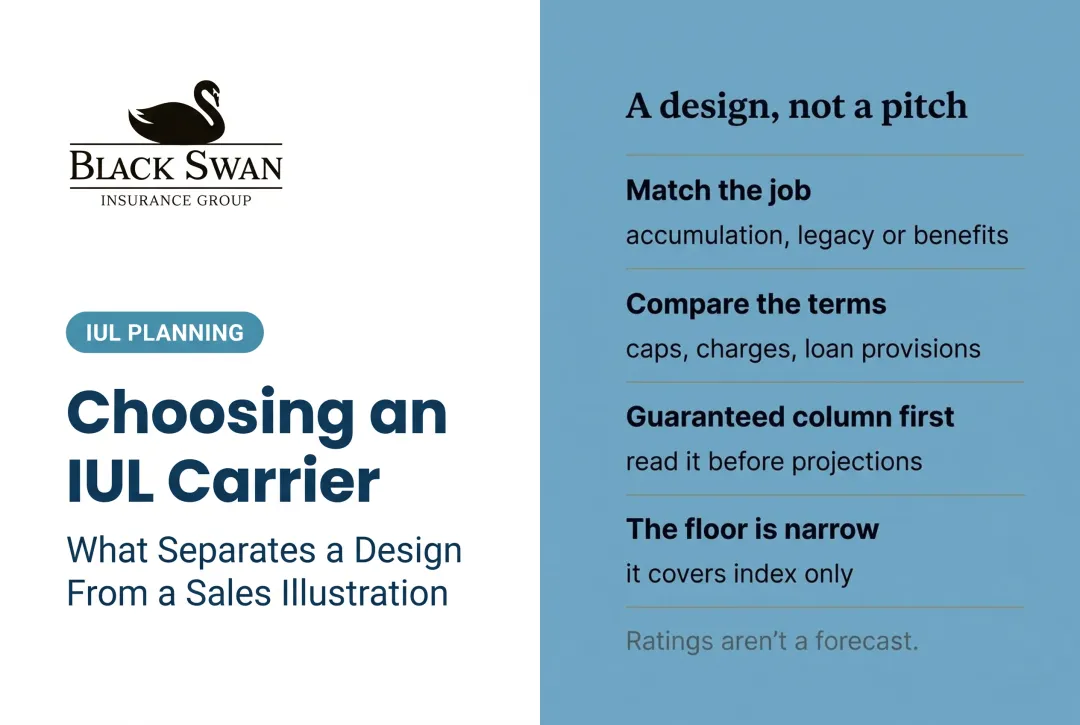
The short answer: Anchor the design to one primary objective — protection, cash value, retirement income, or a deliberate mix. Compare guaranteed against non-guaranteed values on caps, participation rates, floors, spreads and loan provisions. Fund at a sustainable level and check the seven-pay rule to avoid MEC treatment. Treat loans and index crediting as conditional tools rather than promised liquidity. And identify the premium required to avoid lapse in the worst case, not the best.
Key Takeaways
- Anchor the design to one primary objective; trying to maximise everything maximises nothing
- Compare guaranteed against non-guaranteed values: caps, participation rates, floors, spreads and loans
- Fund at a sustainable level and check the seven-pay rule to avoid MEC treatment
- Treat loans and index crediting as conditional tools, not promised liquidity
- Planned premium is not guaranteed premium, and the difference decides whether the policy survives
Step 1: Define the Purpose and Horizon
Before touching a single design variable:
- The required death benefit amount and intended policy duration
- Your planned retirement or liquidity date, plus any legacy objectives
- Whether this supplements existing coverage and retirement accounts
Separate protection needs from accumulation goals early. A policy designed purely around an attractive illustration can leave a family underinsured, because the death benefit was minimised to boost projected cash value. That is a design decision with a victim.
Confirm the basics too: adequate emergency reserves, sustainable surplus cash flow, and a horizon long enough to absorb early surrender charges and limited initial cash value. This is not a short-term savings vehicle.
Step 2: Choose the Design Type
Protection-focused uses a larger death benefit and additional riders, prioritising family protection, estate planning or business continuity over early cash value.
Accumulation-focused sets a lower death benefit relative to premium, directing more dollars toward cash value. This requires careful testing against MEC limits and funding rules from day one.
Hybrid balances death benefit, cash value, liquidity and riders. Every hybrid involves trade-offs — nothing maximises death benefit, cash value and liquidity simultaneously, and any design claiming to is mis-specified.
Step 3: Set the Premium and Death-Benefit Relationship
Run three funding scenarios: minimum, planned, and maximum non-MEC. Underfunding matters because insurance charges and administrative costs do not pause during weak crediting years — if the policy is not sufficiently funded, those charges erode cash value faster than expected.
The death-benefit option you select also affects cash-value potential and cost of insurance, corridor requirements under the tax code, and future premium capacity and flexibility.
Planned premium is not guaranteed premium. Reduce, skip or increase payments and the trajectory changes, sometimes dramatically. That single distinction explains most of the policies that fail.

Step 4: Select Crediting Strategies and Vet the Carrier
- Caps limit how much index gain gets credited
- Participation rates determine what percentage of index movement counts
- Spreads are deducted before crediting is calculated
- Floors protect against negative index years, typically at 0%
Compare current terms against guaranteed minimums, not just the current numbers. Carriers can adjust crediting parameters for existing policyholders over time, per NAIC in-force illustration materials.
A full carrier review covers financial-strength ratings from A.M. Best, Moody's, S&P and Fitch; policy charges, service standards and surrender schedules; and loan provisions and state-specific availability.
Zero is your hero in a down year — but the floor applies to the credit, not to the charges, and a design that ignores that is not a design.
Step 5: Stress-Test It
Compare guaranteed values against illustrated values side by side. Projected index credits are assumptions.
Under NAIC Actuarial Guideline 49-A, illustrated indexed-credit rates are capped relative to historical index performance and net investment earnings, precisely to prevent overly optimistic projections. A guardrail, not a guarantee.
Run conservative scenarios testing:
- Lower and prolonged low-crediting periods
- Changing caps or participation rates
- Increased policy charges
- Reduced premium payments
- Planned policy loans
Check whether the policy stays in force through the intended insured age under each scenario. Then identify exactly what premium is required to avoid lapse under a worst-case run — that number, not the planned premium, is what you are actually committing to.
Step 6: Ownership, Beneficiaries and Reviews
Confirm policy ownership, primary and contingent beneficiaries, and the premium payer, coordinating with any broader estate or business planning documents already in place.
Understand how withdrawals, loans, loan interest and unpaid balances affect cash value, death benefit and tax treatment. These are not abstract — an unpaid loan balance exceeding cash surrender value triggers a lapse.
Schedule regular reviews. Compare actual statements against the original illustration every year, and update whenever income, health, family or business circumstances shift.

What the Critics Get Right
The criticism that design quality varies wildly in this product is not just accurate — it is the entire argument of this page.
Critics are right that a policy designed to maximise an illustration frequently minimises the death benefit, which is an odd outcome for a life insurance purchase. They are right that "max-funded" gets used without reference to the MEC line that makes max-funding work or fail. And they are right that the planned premium on an illustration is a projection, while the premium needed to prevent lapse is a different and rarely quoted figure.
Where the criticism runs out is in concluding the product cannot be built well. It can. The failures are design failures and funding failures, and both are visible in advance to anyone who reads the guaranteed column and runs the scenarios.
Who Should Be Structuring One At All
Stronger Fit
- A genuine permanent insurance need standing on its own
- Household income of $150K+ with stable surplus cash flow
- Willingness to monitor the policy long term and review it annually
- A multi-decade objective, not a savings horizon
- Existing 401(k), Roth, brokerage and emergency reserves already handled
Weaker Fit
- Short-term savings or emergency liquidity is the actual goal
- The need is temporary protection — term insurance is the better answer and far cheaper
- Income is irregular in a way that makes consistent funding unrealistic
- Nobody intends to review the contract after issue
- Not everyone should buy an IUL, and a good designer says so before drawing anything
What to Gather First
Age, health status and tobacco use; desired death benefit and existing coverage; dependents, income-replacement needs and debts; business obligations, estate goals and insurability considerations.
Then review what is already in place so this stays supplemental: existing 401(k), IRA and Roth balances; brokerage assets and emergency savings; and disability coverage and other protection in force.
Request the full paper trail before applying: the current illustration and product guide, the consumer brochure and charge schedule, the surrender schedule and loan provisions, and the index-crediting descriptions with guaranteed-versus-current assumptions. Compare more than one design or carrier where possible.
The Ultimate IUL Blueprint
This whole process, in one document — funding levels, the MEC line, index-strategy selection, loan timing and the scenarios a design has to survive.
The Parameters That Decide Results
A high cap or an appealing index name tells you nothing on its own about sustainability.
Death-benefit amount and option. These influence insurance costs, corridor requirements, cash-value efficiency and future funding flexibility. Compare level and increasing structures using both current and guaranteed values.
Premium funding and consistency. Sustainable funding matters even though premiums are technically flexible, because insurance charges, administrative costs and rider charges still have to be covered. Planned premium reductions, missed payments and irregular business-owner income all raise lapse risk over time.
Crediting method and non-guaranteed assumptions. What gets credited differs from raw index performance. Caps, participation rates, spreads, floors, index allocation and fixed-account options all interact, and any potential tax-advantaged access later depends on the contract being properly structured, funded and managed throughout.

Same premium. Different design. Completely different outcome. That is the whole point of structuring this properly.
Risks to Understand Before You Finalise a Design
- Minimising the death benefit to boost the illustration can leave a family underinsured
- Planned premium is not the lapse-avoidance premium, and only one of those is a real commitment
- Charges continue in a 0% crediting year, so cash value can fall with the floor intact
- Cost of insurance rises with age and is deducted regardless of crediting
- Caps and participation rates can be adjusted for existing policyholders over time
- Crossing the seven-pay limit makes the contract a MEC permanently and changes distribution taxation
- An unpaid loan exceeding cash surrender value triggers a lapse, and a lapse with gain creates taxable income
- Surrender charges make an early exit expensive, which matters most in the years cash value is thinnest
- Illustrated rates are capped by AG 49-A as a guardrail, and a guardrail is not a forecast
Find Out Where You Actually Stand
This starts with the Tax-Free Wealth Blueprint Fit Review. If you earn $150K+ and are designing a policy, we anchor it to one objective, run the three funding scenarios, read the guaranteed column, and identify the premium that actually prevents lapse under a bad decade. If it does not fit, we will tell you that too.
Frequently Asked Questions
What does "properly structured" actually mean?
A design anchored to one clear objective, funded at a sustainable level, tested against the guaranteed column, kept clear of the MEC line, and reviewed every year. Not a design optimised to produce the best-looking illustration.
Should I minimise the death benefit to maximise cash value?
Only if you have confirmed the reduced death benefit still meets your protection need. Minimising it purely to improve a projection is how families end up underinsured.
What is the difference between planned and guaranteed premium?
Planned premium is what the illustration assumes you will pay. The lapse-avoidance premium is what the contract actually requires in a poor scenario. Ask for both figures.
Can the carrier change my cap?
Generally yes, within contract limits, and for existing policyholders as well as new ones. That is why guaranteed minimums matter more than current rates when comparing designs.
What is AG 49-A?
An NAIC actuarial guideline capping illustrated indexed-credit rates relative to historical performance and net investment earnings, to limit over-optimistic projections. It restrains illustrations; it does not guarantee results.
Should I just buy term insurance?
If the protection need has an end date, yes — term is cheaper and simpler, and no structuring exercise is required.
Sources
- NAIC — Life Insurance (A) Committee in-force illustration materials
- NAIC — Actuarial Guideline 49-A materials
- NAIC — Life Insurance Illustrations
- NAIC — Life Insurance
- I.R.C. § 7702A and Rev. Proc. 2008-39 (modified endowment contracts and the seven-pay test)
Disclosure: This article is educational and is not personal tax, legal or investment advice. Indexed universal life is life insurance first. Illustrated values are projections subject to regulatory constraints and are not guarantees. Actual results depend on policy design, carrier, crediting options, caps, participation rates, expenses, funding and ongoing management. Policy loans and withdrawals may reduce cash value and death benefit and can create tax consequences if the policy lapses or becomes a modified endowment contract. This strategy is not appropriate for everyone. Consult your own tax, legal and financial professionals for advice specific to your situation.
And remember, it's not what you earn, it's what you keep… enjoy the ride.