By Robert Balgac, Founder, Black Swan Insurance Group | October 9, 2026
There is a specific document request that separates a serious indexed universal life conversation from a sales conversation, and almost nobody makes it. If you earn $150K+, have maxed the 401(k) and are past the Roth phase-out, this is the one thing to take from this page:
Ask for four separately labelled premium figures on your illustration. Initial premium. Planned premium. No-lapse guarantee premium. Target premium. Four numbers, four meanings, four different implications for whether your policy survives the next thirty years — and they are routinely blended into one headline figure that answers none of your questions.
The short answer: There is no universal minimum. What there is, on every illustration, is a set of distinct premium figures that get collapsed into one by convention. The minimum keeps coverage guaranteed for a defined period. The planned premium is what you intend to pay. The target premium, on some older illustrations, is a commission threshold rather than a funding goal. Until those are separated on paper, you do not know what you are being quoted.
Key Takeaways
- No universal minimum exists across carriers — get a carrier-specific illustration first
- A policy's minimum premium is often far below what real cash value growth requires
- Age, health, tobacco use, death benefit and underwriting class all change the required premium
- "Target premium" can mean a commission threshold, not a funding target — confirm which
- Fund emergency savings, employer matches and other tax-advantaged accounts before IUL
- Pick a premium you can sustain for decades, not one built on best-case projections
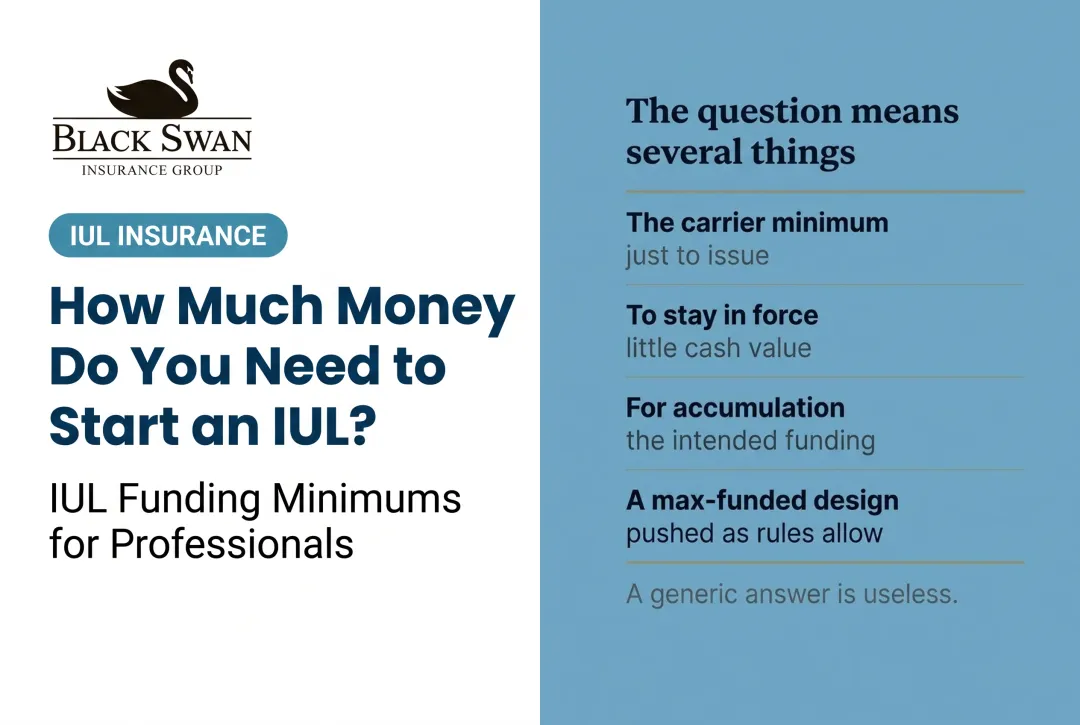
Three Things "Starting an IUL" Can Mean
- The initial premium required to issue the policy
- The minimum planned premium needed to keep coverage active under the policy's terms
- A larger target contribution designed to actually build cash value
These are not interchangeable, and treating them as one number is where most buyers are tripped.
Labelled Carrier Examples
Mutual of Omaha's IUL Express guide defines a minimum initial premium tied to its no-lapse guarantee. Paying that amount keeps the death benefit guaranteed for 20 years at issue ages 18 to 60, or until age 80 for issue ages 61 and above. Planned premiums can change starting in year two, according to Mutual of Omaha's IUL Express guide.
That same guide shows an $80-per-month hypothetical for $150,000 of coverage. It is an "Easy Solve" cash-accumulation projection, not a stated minimum, and it assumes no riders and no premium changes.
A separate Mutual of Omaha comparison shows $10,300 to $10,770 annually for a $1 million level death benefit on a preferred-nontobacco male aged 54 to 55.
| Example | Age/Class | Coverage | Premium | Context |
|---|---|---|---|---|
| Mutual of Omaha IUL Express | 18–60 | $150,000 | ~$80/month | Easy Solve projection, not a minimum |
| Mutual of Omaha Life Protection Advantage | 54–55, preferred-nontobacco male | $1,000,000 | $10,300–$10,770/year | Protection-focused design |

Never treat one carrier's sample as a market average. And remember that a low entry premium misleads in a particular way: an underfunded policy can stay in force for years while building almost nothing. It has not failed. It has succeeded at the wrong objective.
What Determines the Amount
The premium you need is not a monthly budget decision. It is a calculation built on two inputs: how much insurance you need, and what you want the cash value to do.
Age, Health and Underwriting
Cost of insurance is driven by age, sex, health history, tobacco use, occupation and underwriting class. A preferred-nontobacco classification at 40 can cost significantly less than a standard classification at the same age, sometimes by a wide margin for identical coverage.
Underwriting class is not guaranteed until the carrier reviews your file. Quotes built on an assumed best-case class are unreliable. Ask what premium applies at your approved class, not the one hoped for.
Death Benefit and Design
The desired death benefit, the benefit option (level versus increasing), riders and crediting strategy all change the math. Pacific Life's client guide notes that a level option may see insurance charges decline as accumulated value grows, while an increasing option — face amount plus accumulated value — behaves differently over time.
Cash Value Goals and Horizon
Someone wanting only permanent protection can often fund closer to the minimum. Someone pursuing supplemental retirement income, tax diversification or business liquidity needs a deliberate funding schedule, and a longer runway helps.
This matters most for late-start high earners. In your late 40s or early 50s at peak income, a compressed timeline may require higher sustainable contributions to make the strategy worthwhile. That does not guarantee a better outcome. It reflects less time for cash value to build before you would want to use it.
Carrier Rules and the Tax Ceiling
Carriers set contractual premium guidelines; the IRS sets limits. Under Section 7702, a policy must meet either a cash value accumulation test or guideline-premium and corridor requirements to qualify as life insurance for tax purposes.
Separately, the seven-pay test under Section 7702A determines whether a policy becomes a Modified Endowment Contract — if cumulative premiums in the first seven contract years exceed a calculated limit, according to IRS guidance on Sections 7702 and 7702A.

There is no single dollar ceiling applying to every IUL. The limit is calculated for your contract, and it resets if you make a material change later.
On top of that, several charges reduce cash value regardless of index performance: cost of insurance deducted monthly and tied to age and health; administrative fees; premium loads taken before money reaches cash value; rider charges; surrender charges, often on a 10-year schedule; and loan interest if you borrow.
Pacific Life's own client guide states plainly that policy charges, loans and withdrawals can still reduce cash value even when the index segment credits zero.
Zero is your hero in a down year — but the floor applies to the credit, not to the charges.
The Ultimate IUL Blueprint
Before you accept a premium figure, the Blueprint covers what the design has to survive: funding levels, caps and charges, the MEC line, loan timing, and what to demand from an illustration before you sign.
What the Critics Get Right
The fair criticism is pointed at exactly the thing this article is about: the labels. When "target premium" on an older illustration means a commission threshold rather than a funding goal, the document the buyer relies on to make a thirty-year decision is partly a compensation artefact. That is a real conflict and pretending otherwise insults your intelligence.
The second fair point: a minimum premium tied to a no-lapse guarantee can create the impression of safety while building nothing. The guarantee is real. The accumulation someone pictured is not.
What the criticism misses is that the four figures are all available. They are not secret. They are simply not volunteered, and a buyer who asks for them labelled separately changes the conversation completely.
A great IUL is engineered. A bad IUL is sold.
Low Funding Versus Higher Funding
Lower funding makes coverage accessible upfront and leaves less cushion if index crediting underperforms, charges increase over time, or you need to reduce or pause premiums later. It tends to fit people whose primary goal is permanent protection — and the design still has to be tested for long-term sustainability, not just affordability today.
Higher funding allocates a larger share of each premium toward cash value relative to insurance cost. It still has to match actual surplus cash flow rather than hoped-for income, an ongoing protection need, your willingness to maintain the premium for decades, and the MEC limit.
| Option | Best for | Trade-off |
|---|---|---|
| Employer 401(k) match | Free money, tax-deferred growth | Limited investment control |
| Roth IRA / 401(k) | Tax-free growth, income limits permitting | Annual contribution caps |
| Emergency reserves | Short-term liquidity | No growth potential |
| Term life insurance | Low-cost pure protection | No cash value |
| Taxable brokerage | Flexibility, no withdrawal restrictions | No tax-deferred growth |
| IUL | Permanent protection + potential tax-advantaged access | Requires sustained, long-term funding |
For high-income professionals, executives and business owners the practical sequence runs: cover essential protection, keep adequate liquidity, capture any employer match you are leaving on the table, and then evaluate whether remaining surplus genuinely supports an IUL.

How to Estimate Your Budget
- Calculate true surplus cash flow after essential expenses, high-interest debt, emergency savings and priority retirement contributions. Do not use money you might need in the next few years.
- Define the policy's primary purpose — permanent protection, supplemental retirement income, tax diversification, legacy planning or business liquidity. The purpose drives the death benefit and the design.
- Request multiple illustrations. Compare guaranteed versus non-guaranteed values, premium schedules, surrender values, charges, caps and loan provisions side by side.
- Stress-test everything. Lower-than-illustrated crediting, reduced income, a missed premium, an outstanding loan. If the policy only works under best-case assumptions, that is your answer.
- Loop in your tax or legal adviser on MEC exposure, ownership structure and beneficiary designations before you sign.
This is not set-it-and-forget-it. It is design-it, fund-it, review-it.
Stronger Fit
- Can sustain the planned premium for the full time horizon, tested against a weak year
- A genuine, lasting need for permanent life insurance
- Emergency reserves and short-term liquidity already covered
- Lower-cost tax-advantaged accounts already maxed
- The policy still looks reasonable under conservative assumptions
Weaker Fit
This strategy is not appropriate for everyone. Walk away if:
- Your surplus depends on income you have not yet earned
- You might need the money for a home, business, education or emergency inside the surrender period
- The protection need is temporary — buy term
- You would not request the four labelled premium figures, because then you will not know what you bought
- You have no appetite for an annual review
Risks to Understand Before You Commit
- Focusing only on the first premium. The real question is whether you can sustain funding if income changes.
- Assuming the 0% floor means the account holds its value. Charges, loan interest and surrender fees keep deducting in flat and negative index years.
- Treating illustrated caps and returns as guarantees. An illustration is a model, not a guarantee, and the guaranteed and non-guaranteed columns tell different stories.
- Ignoring liquidity needs. Money needed within the surrender-charge period does not belong here.
- Misreading loan mechanics. Policy loans are real debt, accruing interest, reducing cash value and death benefit, and capable of triggering a taxable event if the policy lapses with a balance outstanding. The loan is not the problem; the unmanaged loan is the problem.
Find Out Where You Actually Stand
This starts with the Tax-Free Wealth Blueprint Fit Review. If you earn $150K+ and want to know what you actually need to start, we begin with a needs assessment rather than a premium target, pull the initial, planned, no-lapse and target figures out separately so you can see what each one means, compare multiple funding scenarios against your goals, and show you how the design holds up before you commit to a long-term obligation. If IUL does not fit, we will tell you that too.
Frequently Asked Questions
How much money is needed to start an IUL?
It varies by carrier and design, and there is no universal figure. Minimum premiums to issue are often far below what sustains meaningful cash value growth, so request a personalised illustration for your age and health.
What is the difference between a minimum premium and a target premium?
A minimum premium keeps the death benefit guaranteed for a defined period. A target premium is typically an illustrated funding goal — and on some older contracts it is tied to agent commission structure rather than your funding needs. Ask which definition is in use.
Can I lose money in an IUL even with a 0% floor?
Yes. The floor only protects against negative index crediting. Cost of insurance, administrative fees and surrender charges continue to deduct regardless of index performance.
What happens if I stop paying premiums?
Depending on accumulated cash value and charges, the policy may continue for a period using existing value, or it may lapse. Reduced or skipped premiums should be stress-tested in advance, not improvised.
How do I know if I am overfunding into MEC territory?
Your carrier calculates a seven-pay limit specific to your contract. Exceeding it in the first seven years triggers MEC status and permanently changes how loans and withdrawals are taxed.
Which of the four premium figures should I actually plan around?
The planned premium, tested against your worst likely income year — with the no-lapse figure as your floor and the MEC limit as your ceiling. The target premium is the one to treat with the most suspicion.
Sources
- Mutual of Omaha — IUL Express guide
- IRS — guidance on Sections 7702 and 7702A (24-0008)
- NAIC — Life Insurance Illustrations
Disclosure: This article is educational and is not personal tax, legal or investment advice. Indexed universal life is life insurance first. Premium figures shown are documented carrier illustrations for specific profiles, not quotes; underwriting class is not determined until the carrier reviews your file. Illustrated values are not guarantees; actual results depend on policy terms, crediting, costs and funding. Any potential tax-advantaged access depends on the policy being properly structured, funded and managed. Actual results depend on policy design, carrier, crediting options, caps, participation rates, expenses, funding and ongoing management. This strategy is not appropriate for everyone. Policy loans and withdrawals reduce cash value and the death benefit, and can create tax consequences if the policy lapses or becomes a modified endowment contract. Consult your own tax, legal and financial professionals for advice specific to your situation.
And remember, it's not what you earn, it's what you keep… enjoy the ride.