By Robert Balgac, Founder, Black Swan Insurance Group | October 5, 2026
Arizona professionals and business owners usually arrive at indexed universal life for the same reason: a term policy that expires does not solve a problem that does not.
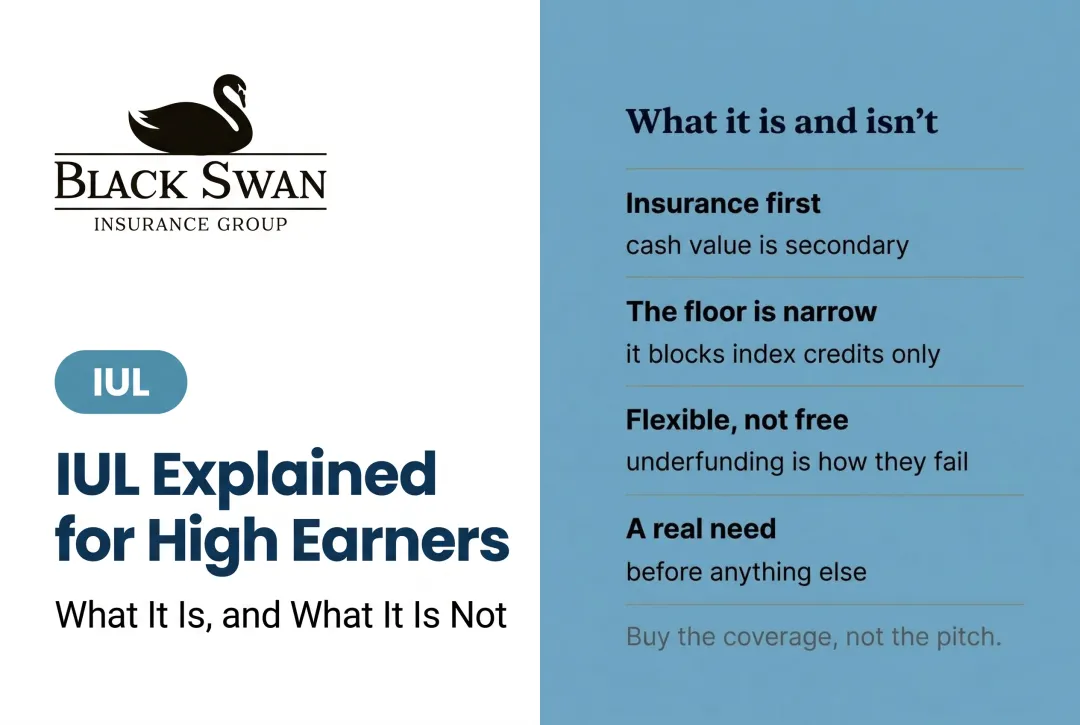
The distinction that matters most before anything else: an IUL is life insurance first. Cash value may receive interest credits tied to an external index such as the S&P 500, and you are not buying stock or ETF shares. There is no guarantee the policy matches market-level returns, and the crediting terms belong to the contract rather than to the market.
Here is the part worth internalising if you earn $150K+ and are weighing this. Policies in this category do not usually fail because the index had a bad decade. They fail because they were underfunded, and nobody checked until the carrier sent a letter.
The short answer: An IUL pairs permanent death-benefit protection with index-linked cash value — not direct market investment. Caps, participation rates and floors set your credited interest and can change over time. There is no single Arizona premium; cost depends on age, health, coverage and funding. Underfunding causes most lapses, not weak index performance. Compare guaranteed and non-guaranteed illustration values before you buy, and verify the insurer and disclosures with Arizona DIFI.
Key Takeaways
- Permanent death-benefit protection plus index-linked cash value — not a direct market investment
- Caps, participation rates and floors set your credited interest and can change over time
- Arizona cost depends on age, health, coverage and funding; no statewide premium applies
- Underfunding causes most policy lapses, not weak index performance
- Compare guaranteed and non-guaranteed illustration values before buying
How the Policy Works
Permanent life insurance with a death benefit, a cash-value account, and flexible premium and death-benefit options that vary by contract. Policies sold to Arizona residents come from licensed carriers regulated under Arizona insurance rules, while the indexed-crediting design works much as it does nationwide.
The NAIC describes IUL as blending fixed and indexed features, with credited interest linked to an external index and contracts typically including a guaranteed minimum interest rate, even as premiums and death benefit change on the owner's decisions.
Where the Premium Goes
- Cost of insurance — covering the mortality risk the insurer takes on
- Policy charges — administrative fees, premium loads, rider costs
- Cash value — what remains, which may then receive indexed interest
Because charges come out first, net cash value can look very different from total premiums paid, particularly in the early years.
A Worked Crediting Example
A policy with a 10% cap, a 0% floor and a 100% participation rate: if the tracked index rises 14%, the policy credits 10%. If the index falls 8%, the floor typically prevents a negative credit. Illustrative, not a promise found in every contract.

Your actual contract may use spreads instead of participation rates, different indices, or monthly averaging rather than point-to-point. Request the specific formula in writing.
You do not own the underlying index securities. Fees, loan provisions and shifting caps or participation rates can change the outcome even in years the index performs well.
Zero is your hero in a down year — but the floor applies to the credit, not to the charges.
Flexibility Carries Lapse Risk
Many contracts let you skip or reduce a premium when cash value can cover the charges. That can backfire: if charges keep drawing down an underfunded account, the policy lapses.
Before choosing a carrier, review the contract language on index options and crediting methods, cap and participation-rate adjustments, guaranteed elements, and surrender charges and loan provisions.
The Risk That Actually Matters
Underfunding is the biggest threat here, not a single bad market year.
Wisconsin's Office of the Commissioner of Insurance has warned that rising cost-of-insurance charges and shifting crediting assumptions can deplete cash value, with some universal life policies lapsing at little or no value or demanding large additional payments simply to stay in force. That warning was not about Arizona specifically, and the mechanics are identical everywhere.
The rest of the risk list: cost of insurance increasing with age; caps or participation rates decreasing at renewal; surrender charges in the early years; poor long-term performance under conservative assumptions; and lapse, which can create adverse tax consequences.
Read Both Ledgers
Every illustration should show guaranteed values — the contractual floor — and current-assumption values built on today's caps, charges and crediting rates. Ask how the numbers shift if credited rates drop, charges rise, funding is reduced, or you take an early withdrawal. A policy that only looks good under optimistic assumptions is not a policy you can rely on.

What the Critics Get Right
The criticism this product attracts is largely deserved, and engaging it directly is more useful than deflecting.
Critics are right that state regulators have had to issue warnings about universal life lapses, which is not a signal of a well-distributed product. They are right that the flexibility marketed as a benefit is the same mechanism that lets a policy quietly starve. And they are right that a buyer choosing on the lowest quoted premium is being set up, because the cheapest quote usually means the thinnest funding.
Where the criticism stops is the protection need. If your coverage requirement genuinely outlasts a term — estate liquidity, a business obligation, a dependent who will always need support — then term insurance stops being an answer at some point. The question becomes which permanent structure survives, and that is a funding question, which is exactly what the critics are right about.
What It Offers
- Lifelong death-benefit protection rather than a policy that expires
- Tax-deferred cash-value growth under applicable rules
- Premium flexibility as income changes
- Access to accumulated cash value
- Optional living-benefit or accelerated-benefit riders, where available
Any potential tax-advantaged access is conditional on the policy being properly structured, funded and managed.
On loans and liquidity: policy loans and withdrawals can provide liquidity for retirement income, education costs, emergencies or business needs. A policy loan is real debt. It accrues interest, and an unpaid balance reduces both cash value and the death benefit your beneficiaries receive.
High-income households generally look at this after maxing an employer match, building reserves and diversifying investments. It works as a complement to those foundations, not a replacement.
What It Costs in Arizona
No universal monthly premium exists. Pricing depends on age, health and tobacco use; underwriting class; coverage amount and death-benefit design; policy type and riders; the planned funding schedule; and carrier-specific charges.
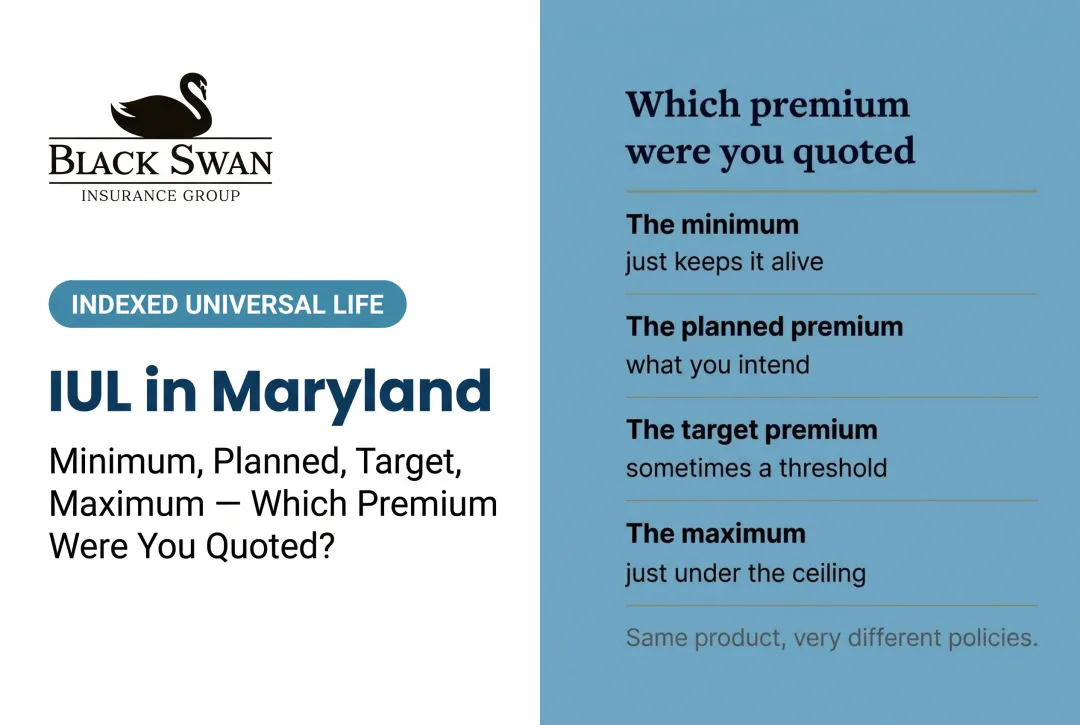
When requesting quotes, insist each example is labelled by applicant profile, coverage amount, underwriting assumptions, funding schedule and issue date. And confirm whether the figure is a minimum premium to keep the policy in force or a planned premium meant to build meaningful cash value. Those are different numbers and the gap between them is where lapses come from.
A Lower Premium Is Not a Better Policy
A cheaper quote usually means less cash-value funding, higher long-term lapse risk, or weaker guarantees. Compare instead: guaranteed versus illustrated values; cash surrender value at several durations; death-benefit durability under conservative assumptions; caps, participation rates and charges; loan terms and interest treatment; and the funding level actually required to keep coverage in force.
Arizona compliance: before applying, verify current state requirements, insurer authorisation and policy disclosures with the Arizona Department of Insurance and Financial Institutions. DIFI's Consumer Protection Division can also help where a dispute with an insurer cannot be resolved directly.
The Ultimate IUL Blueprint
If a permanent need genuinely exists, the Blueprint covers the funding decisions that determine whether the policy survives: funding levels, the MEC line, index-strategy selection and loan timing.
How It Compares
| Policy type | Cash value | Flexibility | Best fit for |
|---|---|---|---|
| Term insurance | None | Low | Affordable, temporary protection |
| Whole life | Guaranteed, steady growth | Low | Predictability over flexibility |
| IUL | Index-linked, variable | High | Long horizon with active monitoring |
| Variable UL | Investment-linked, direct market exposure | High | Higher risk tolerance |
Term versus IUL. Term insurance focuses on affordable temporary protection and builds no cash value. That is a feature when the need is temporary, and it usually wins that comparison outright.
Whole life versus IUL. Whole life delivers more predictable guarantees and fixed cash-value mechanics. An IUL trades some of that predictability for index-linked potential and premium flexibility, with more variables to monitor.
Traditional UL and VUL. Traditional universal life credits a fixed rate set by the insurer. Variable universal life ties cash value directly to subaccounts, so you carry the investment risk. An IUL sits between: index-linked crediting without direct ownership, still subject to caps and charges that can shift.

Against retirement accounts. 401(k)s, IRAs, Roth accounts, brokerage assets and annuities each carry their own rules, tax treatment and liquidity terms, and none is life insurance. This does not replace a plan's employer match or an IRA's simplicity. It complements them once core protection and tax-advantaged saving are handled.
Who It Fits
Stronger Fit
- A genuine need for permanent coverage standing on its own merits
- Household income of $150K+ with stable surplus cash flow
- Favourable insurability
- A long time horizon and genuine willingness to monitor the policy
- Lower-cost tax-advantaged accounts already maxed
Weaker Fit
Not everyone should buy an IUL. If the premium is a stretch in a normal year, underfunding is close to certain and the policy will not survive the decade.
- Inexpensive temporary coverage is the real need — term insurance is the answer
- Unstable income or insufficient emergency reserves
- A short time horizon
- Low tolerance for ongoing complexity
- Tax-advantaged accounts not yet maxed
Evaluating a Policy
- Guaranteed versus non-guaranteed elements — know exactly which numbers the insurer promises
- Premium schedule and death-benefit option — confirm what is required to keep coverage in force
- Index accounts and crediting method — floor, cap, participation rate, and crediting frequency
- Charges and surrender schedule — cost of insurance, admin fees, and how long surrender penalties run
- Loan provisions — rates, how interest accrues, and the effect on death benefit
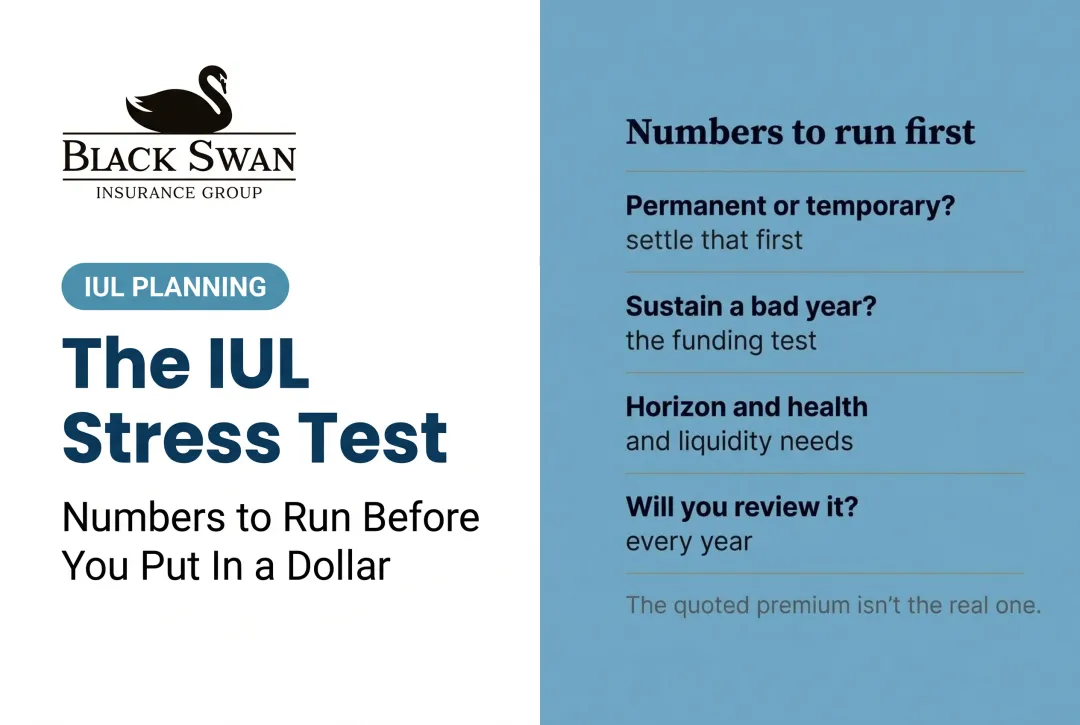
- Stress scenarios — lower crediting, reduced funding, an early withdrawal, an unrepaid loan

Do not buy the highlight reel. Watch the game film. The guaranteed ledger is already in the envelope.
Risks to Understand Before You Apply
- Underfunding is the leading cause of failure, and a low quoted premium is often the first step toward it
- Charges continue in a 0% crediting year, so cash value can fall with the floor intact
- Cost of insurance rises with age and is deducted regardless of index performance
- Caps and participation rates can be reduced at renewal after you have committed
- Surrender charges apply in the early years
- Loans are real debt, reduce the death benefit, and a lapse with a loan outstanding and gain in the contract creates taxable income with no cash received
- Crossing the seven-pay limit makes the contract a MEC and changes distribution taxation permanently
- A lapse can trigger adverse tax consequences at an age when replacing coverage may be impossible
- Illustrated values are projections, and only the guaranteed column is a commitment
Find Out Where You Actually Stand
This starts with the Tax-Free Wealth Blueprint Fit Review. If you earn $150K+ in Arizona, we compare the guaranteed and current ledgers, identify the real funding level required rather than the minimum quoted, model reduced funding and an unrepaid loan, and price term plus your existing accounts on identical terms. If it does not fit, we will tell you that too.
Frequently Asked Questions
How much does an IUL cost in Arizona?
There is no statewide figure. Cost depends on age, health, tobacco use, underwriting class, coverage amount, design, riders and funding level. Insist any quote is labelled with the assumptions behind it.
What actually causes these policies to lapse?
Underfunding, in most cases — compounded by rising cost of insurance and, sometimes, reduced caps. A single weak index year rarely does it on its own.
What is the difference between minimum and planned premium?
Minimum keeps the policy technically in force. Planned is intended to build meaningful cash value. Confirm which number you are being quoted, because the difference is usually the difference between a policy that works and one that does not.
Where do I verify a carrier or agent in Arizona?
Through the Arizona Department of Insurance and Financial Institutions, which also runs a Consumer Protection Division for disputes that cannot be resolved with the insurer directly.
Does the 0% floor protect my total policy value?
No. The floor prevents a negative index credit. Cost of insurance, administrative charges and loan interest continue regardless, and cash value can fall in a flat year.
Should I buy term insurance instead?
If the protection need has an end date, yes — term is cheaper and simpler, and it deserves pricing before anyone designs a permanent policy.
Sources
- NAIC — Life Insurance
- Wisconsin OCI — consumer alert on universal life insurance
- Arizona Department of Insurance and Financial Institutions — consumer resources
- NAIC — Life Insurance Illustrations
- I.R.C. § 7702A and Rev. Proc. 2008-39 (modified endowment contracts and the seven-pay test)
Disclosure: This article is educational and is not personal tax, legal or investment advice. Indexed universal life is life insurance first. State rules, carrier product availability and licensing requirements change; confirm current details before applying. Actual results depend on policy design, carrier, crediting options, caps, participation rates, expenses, funding and ongoing management. Policy loans and withdrawals may reduce cash value and death benefit and can create tax consequences if the policy lapses or becomes a modified endowment contract. This strategy is not appropriate for everyone. Illustrated values are not guarantees; actual results depend on policy terms, crediting, costs and funding. Consult your own tax, legal and financial professionals for advice specific to your situation.
And remember, it's not what you earn, it's what you keep… enjoy the ride.