By Robert Balgac, Founder, Black Swan Insurance Group | October 9, 2026
Anyone hunting for the best accumulation-focused IUL ends up buried in glossy illustrations built around peak cap rates. What actually holds up is a policy you can stress-test on costs, guarantees and funding until it still works twenty years out — not just in the sales projection.
IUL pairs a permanent death benefit with cash value credited partly by reference to an index such as the S&P 500. It is a contract, not a brokerage account. You own no index shares, and your result depends on crediting formulas rather than market performance alone.
IUL sales reached $4.5 billion in new annualised premium in 2025, up 17% on 2024, roughly a quarter of all individual life premium sold. More carriers, more products, more confusing illustrations.
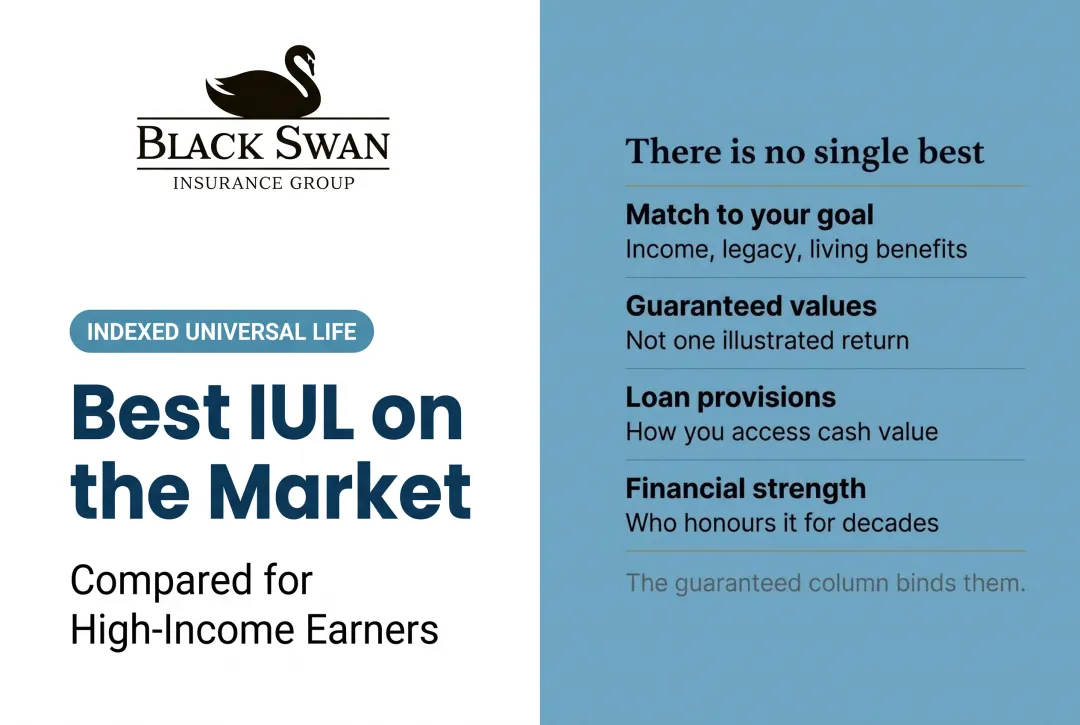
The short answer: Fit depends on insurance need, funding capacity, horizon and liquidity — not brand. Caps, participation rates, floors, loan provisions and cost of insurance have to be weighed together, never in isolation. And a brokerage can compare carriers, but only the issuing carrier backs the guarantees.
Key Takeaways
- Best fit depends on insurance need, funding capacity, time horizon and liquidity — not brand name
- Caps, participation rates, floors, loan provisions and cost of insurance must be weighed together
- Illustrations are projections — review them under conservative, reduced-funding and loan scenarios
- Only the issuing carrier backs the contractual guarantees
- Accumulation is the secondary benefit; this is life insurance first
How Accumulation Actually Works
Permanent life insurance with two moving parts: a death benefit, and a cash value account receiving credits tied to an index. The policy never buys index shares — you earn a credit calculated by formula.
Where the premium goes. Part covers cost of insurance and policy expenses; the rest goes to cash value. In early years expenses take a larger share, which is why accumulation is slow at first and accelerates later — assuming the policy stays funded and charges do not spike.
Four terms control the credit: the floor (minimum, often 0%), the cap (maximum regardless of index gain), the participation rate (share of gain used), and the spread (deduction before crediting).
Nationwide's own educational materials give a useful example: at 100% participation, a 9% cap and a 0% floor, index moves of +15%, +6% and −12% generate credits of 9%, 6% and 0% respectively, before policy charges. Hypothetical, not a quoted rate.
Zero is your hero in a down year — but the floor applies to the credit, not to the charges.

Accessing it. Cash value can be tapped through withdrawals or policy loans, which accrue interest while outstanding, reduce the death benefit until repaid, and can trigger a taxable event if the policy lapses with a balance owed. NAIC guidance distinguishes guaranteed values from non-guaranteed illustrated ones — a distinction that matters most when you are relying on loans for income decades from now.
The Ultimate IUL Blueprint
If accumulation is the objective, the Blueprint covers what the design has to survive: funding levels, caps and charges, the MEC line, loan timing, and what to demand from an illustration.
Carriers, By Accumulation Feature
No carrier wins on every metric. A shortlist, not a rank order — your illustration, health class, premium schedule and loan plans decide the real fit.
Black Swan Insurance Group is a Springboro, Ohio brokerage, not a carrier. It does not issue policies; it compares designs across carriers and matches funding to protection and retirement goals, covering goals review, design, index-strategy alignment, application support and annual reviews. Caps and participation rates change, so a policy that fit at issue drifts without check-ins. Confirm the current carrier lineup, state licensing and availability where you live.
Penn Mutual. Accumulation IUL (form ICC22-PI-IFL), issued through The Penn Insurance and Annuity Company, offers six indexed accounts including capped and uncapped options with varying floors, plus a 0% floor-with-spread design. Loan terms are a genuine strength: traditional loans at a current net cost of 1% in years 1–5, then 0%, with a guaranteed maximum of 1% in years 1–10, then 0.25%; indexed loans carry a guaranteed fixed 5% charge while loaned value can still receive index credits. Public materials do not publish a full itemised monthly charge schedule, so rely on a personalised illustration. Parent ratings are strong (AM Best A+, S&P A+) — confirm how they apply to the issuing subsidiary.
Allianz Life. The Accumulator mixes fixed and indexed allocations. Index Lock can capture a positive index change mid-period, but only on annual point-to-point strategies using a participation rate — not every account in the policy. A 2024 guide showed a Classic option at a 1% flat bonus and a Select option at a 40% multiplier bonus with a 1% annual asset charge. Bonused accounts usually offset that upside with lower caps or participation rates, and the figures change by product version — match every number to the illustration date.
Nationwide. Indexed UL Accumulator III emphasises strategy choice: S&P 500, Nasdaq-100, Multi-Index Monthly Average, BNPP Global H-Factor and a fixed account, all with a guaranteed 0% floor. Current premium charges run 8% in year 1, 6% thereafter against a guaranteed maximum of 10%, with surrender charges for 10 years from issue. Loans come as declared-rate or indexed, the latter still earning credits on collateral. The optional Overloan Lapse Protection Rider II can keep a heavily loaned policy from lapsing later — neither automatic nor free.
Pacific Life. Horizon ECV IUL targets affluent professionals and business owners wanting earlier access. An optional term rider can raise early cash surrender value across roughly the first seven to ten years. Index choices include BlackRock Endura-linked strategies alongside familiar benchmarks. Expect a 10-year surrender schedule and ongoing monthly charges. A weaker match if your priority is lowest early cost, because ECV features carry trade-offs visible only in a side-by-side illustration.

What the Critics Get Right
Pitched as an accumulation vehicle against a low-cost index fund, IUL loses on returns and it is not close. Capped upside, dividends excluded from most crediting calculations, and charges that compound against you from day one.
That criticism is correct, and anyone showing you an illustration that appears to beat the market is showing you assumptions. The honest case for accumulation inside a policy is not higher returns — it is a differently-taxed bucket attached to a death benefit you actually need, for someone who has already filled the cheaper buckets.
If you have not filled them, the critics are simply right.
How These Were Assessed
A research starting point, not individualised advice. Terms shift by state, age, health class and carrier update.
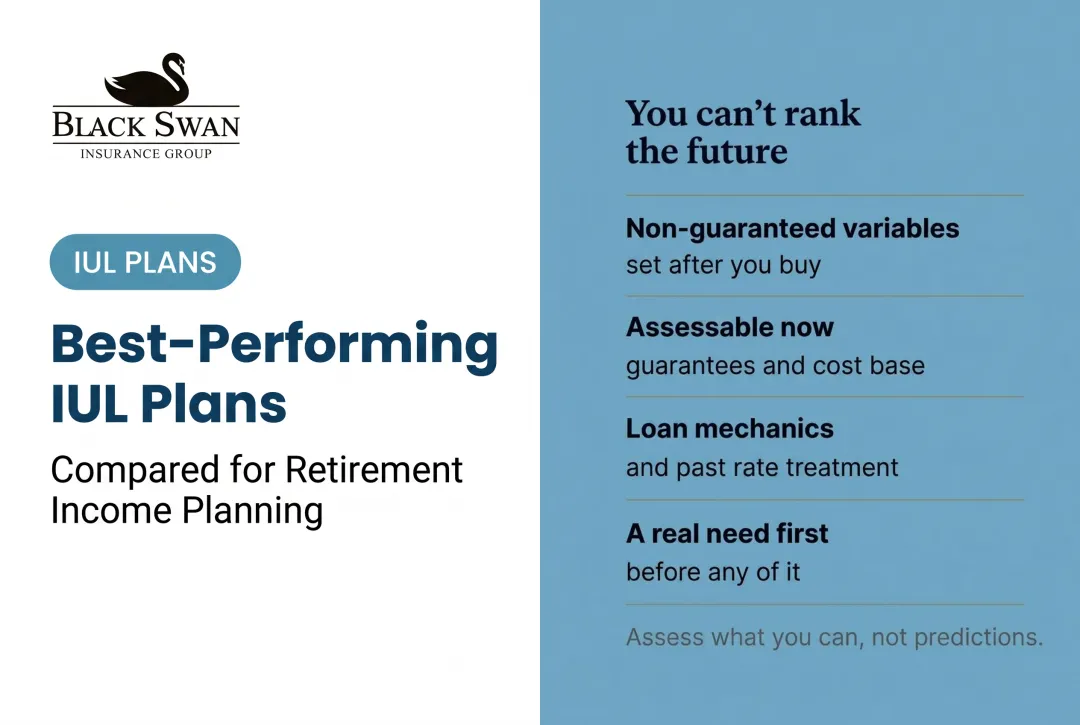
Separate guaranteed from non-guaranteed. Caps, participation rates and bonuses are current, not promised. Only contractual guarantees survive a bad decade.
Review the full cost picture — cost of insurance, premium loads, administrative charges, rider costs and surrender charges all compound.
Stress-test under pressure — lower crediting, interrupted premiums, rising loan balances, shifting caps. Each scenario reveals something different about lapse risk.
Check the order of operations first. Emergency savings, high-interest debt, the employer match, and Roth or IRA contributions generally belong ahead of IUL funding. 2026 IRS limits allow $24,500 in 401(k) elective deferrals plus catch-up contributions at 50 and older. Most buyers should exhaust that space first.

Stronger Fit
- Earning $150K+ with a genuine, lasting need for permanent death-benefit protection
- Stable surplus cash flow committable for 15+ years
- Emergency reserves already in place
- A broader plan already accounting for the 401(k), IRA and other vehicles
Weaker Fit
If any of those are missing, the conversation should wait. It is not right for everyone — particularly anyone needing liquidity soon, carrying high-interest debt, or wanting only a death benefit for a defined period, where term is cheaper and sufficient.
Risks to Understand Before You Fund
- Chasing the highest illustrated cash value rather than the most sustainable design
- Mistaking a 0% floor for protection against all losses — it does not cover charges
- Ignoring loan interest until it compounds into a real problem
- Overfunding into MEC status without understanding the tax trade-off, which is generally permanent
- Committing more premium than the household can realistically sustain for decades
- Early surrender, which means steep charges and minimal cash value
This is not set-it-and-forget-it. It is design-it, fund-it, review-it.
Find Out Where You Actually Stand
This starts with the Tax-Free Wealth Blueprint Fit Review. If you earn $150K+ and accumulation is the goal, we compare illustrations on identical assumptions, read the contract rather than the brochure, model the funding against the MEC limit, and stress-test through lower crediting and a reduced-premium decade. No promises about approval, tax outcomes or performance — just an honest look at whether this belongs in your plan. If IUL does not fit, we will tell you that too.
Frequently Asked Questions
What makes a policy good for long-term accumulation?
Sustainable funding, manageable costs, credible guarantees and a genuine permanent insurance need — all of which matter more than any single index feature. A holding period measured in decades is non-negotiable.
Is IUL a good choice for retirement savings?
It can complement qualified accounts but should not replace them. Funding capacity, ongoing monitoring and fees all determine whether it adds real value alongside a 401(k) or Roth.
Can I lose money in one?
The floor protects against negative index crediting, not against policy charges, cost of insurance or loan interest. Underfunding, excessive loans or lapse can still reduce cash value or trigger tax consequences.
How do I compare policies across carriers?
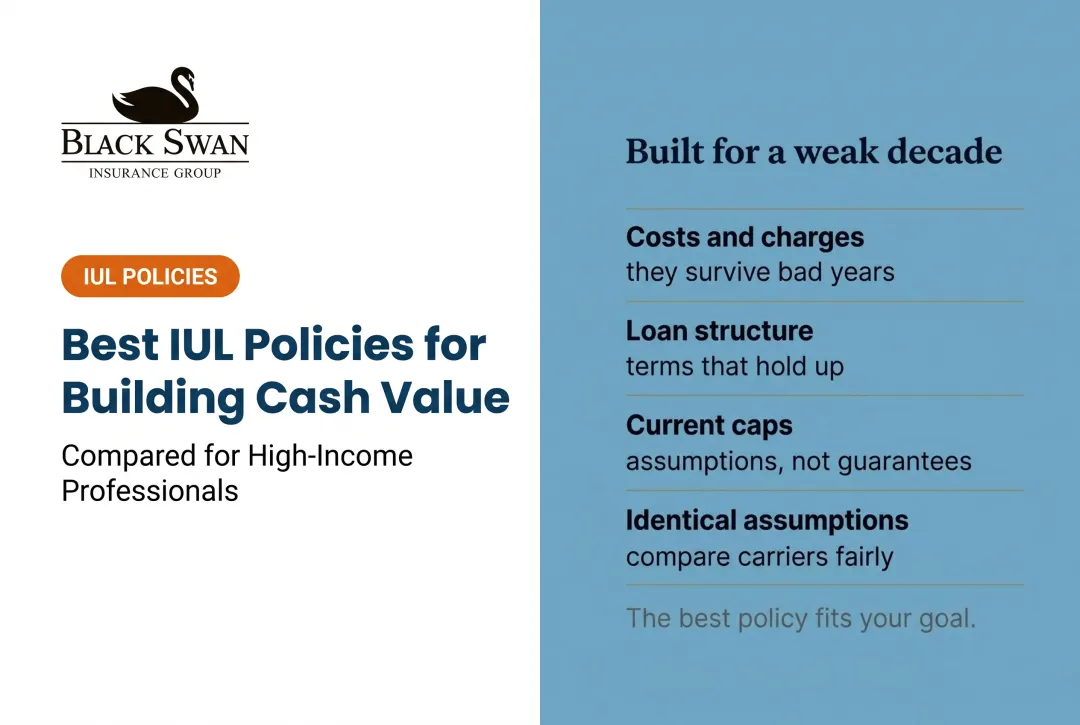
Use identical funding and coverage assumptions. Then compare guaranteed against illustrated values, all charges, caps, participation rates, loan terms, surrender schedules and financial strength.
Should I prioritise a 401(k) or IRA first?
Generally yes. Review employer matches, available qualified-plan contributions and emergency reserves before evaluating whether IUL adds something your existing accounts do not.
How long should I hold it?
It is built for long-term ownership. Early surrender means steep charges, minimal cash value and lost coverage. The right duration depends on the specific design and your overall plan.
Sources
- LIMRA — U.S. individual life insurance new premium tops $17.5 billion in 2025
- IRS — 401(k) limit increases to $24,500 for 2026
- NAIC — Life Insurance Illustrations
Disclosure: This article is educational and is not personal tax, legal or investment advice. Indexed universal life is life insurance first. Carrier products, loan terms, bonus structures, index options and state availability change frequently and must be confirmed against current policy forms and a personalised illustration before applying; ratings reflect an insurer's claims-paying ability, not the suitability of any contract, and parent-company ratings may differ from the issuing subsidiary's. Contribution limits change annually and should be confirmed with the IRS. Illustrated values are not guarantees; actual results depend on policy terms, crediting, costs and funding. Any potential tax-advantaged access depends on the policy being properly structured, funded and managed. Actual results depend on policy design, carrier, crediting options, caps, participation rates, expenses, funding and ongoing management. This strategy is not appropriate for everyone. Policy loans and withdrawals reduce cash value and the death benefit, and can create tax consequences if the policy lapses or becomes a modified endowment contract. Consult your own tax, legal and financial professionals for advice specific to your situation.
And remember, it's not what you earn, it's what you keep… enjoy the ride.