By Robert Balgac, Founder, Black Swan Insurance Group | October 9, 2026
Permanent life insurance with cash value tied to a market index sounds like a retirement hack. It is not one. It is a contract with charges, caps, underwriting and a funding obligation that runs for decades, and the people who do well with it are the ones who treat it as an operating commitment rather than a purchase.
That is worth saying plainly to the reader who usually arrives here: a $150K+ earner who has maxed the 401(k), run past the Roth phase-out, and now wants somewhere else for retirement dollars. The National Association of Insurance Commissioners describes IUL interest crediting as tied to an external index, typically with a guaranteed minimum rate attached. Caps, participation rates, ongoing insurance costs and flexible-premium rules demand real attention. Skip the upkeep and you end up with an underfunded policy or an unwanted lapse.
The short answer: An IUL can supplement retirement income when there is a genuine permanent insurance need, funding you can sustain through a bad decade, and a loan strategy you actively manage. The mechanics are a sequence — define the objective, design the contract, fund it consistently, monitor it annually, then coordinate distributions with everything else you own. Most failures happen at the funding and monitoring steps, long after the sale.
Key Takeaways
- Confirm a genuine permanent life insurance need before considering an IUL for retirement income
- Separate guaranteed values from non-guaranteed illustrations before committing premiums
- Fund consistently enough to support the strategy while protecting emergency reserves
- Treat policy loans as real debt that can cut the death benefit and trigger taxes on lapse
- Schedule annual reviews and stress tests to confirm the policy still fits
When This Is Worth Evaluating At All
An IUL is not a universal retirement fix. Knowing whether you are in one of the narrow situations where it works matters more than any illustration someone hands you.
Stronger Fit
- A genuine need for permanent life insurance, not just a reason to invest
- Stable surplus cash flow after essentials, debt and existing retirement contributions
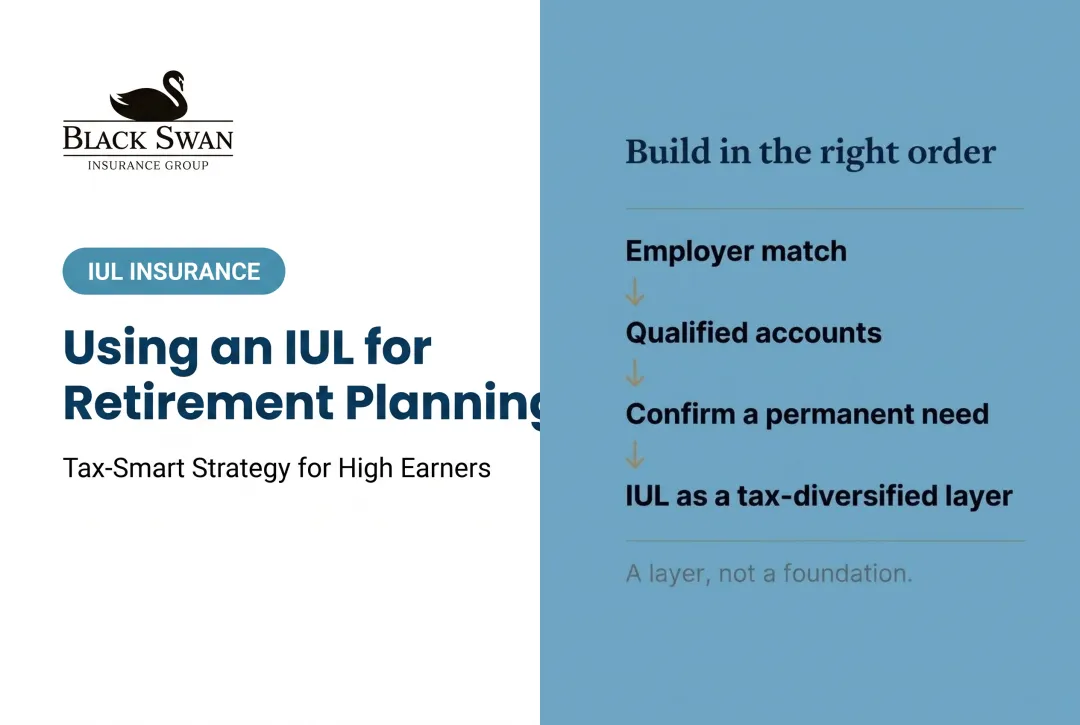
- Earning $150K+ with the employer match captured and tax-advantaged accounts maxed
- A commitment to funding the policy for years rather than a season
- A long horizon before you rely on the cash value
- A desire to diversify future income beyond tax-deferred accounts
High-income professionals, executives and business owners often fit because savings capacity already exists. So do late-start earners in their mid-40s to mid-50s who reached peak income later and face a compressed runway. Even then, insurability, affordability and alternatives deserve a hard look first.
Weaker Fit
Not everyone should use one. This is the wrong move if you have not captured an available employer 401(k) match, are using it as a substitute for emergency savings, plan to fund it with money needed for near-term expenses, have unstable income, or simply prefer transparent vehicles over a contract with moving parts.
Limited liquidity, no real insurance need, or an inability to commit to long-term funding are each sufficient reason to stop. No IUL is universally superior, and none produces guaranteed outcomes. What a properly structured, funded and managed contract can offer is potential tax-advantaged access — conditional, not promised.
What You Need Before Requesting an Illustration
Three things, locked down before anyone models anything.
Define the Insurance Need
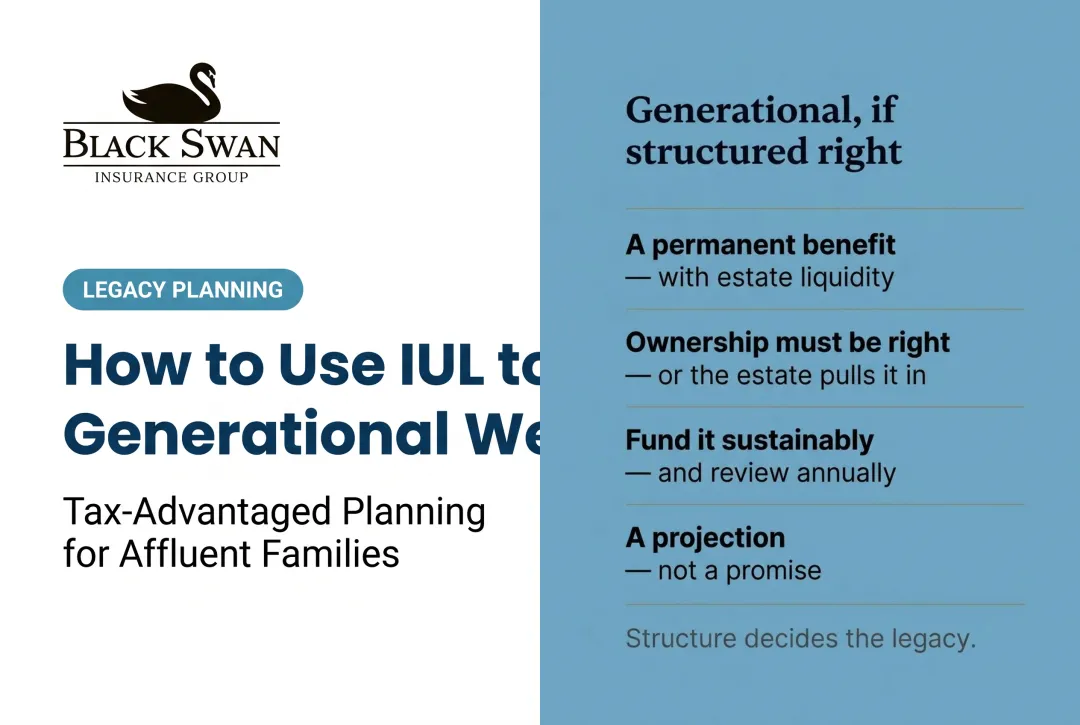
Start with the death benefit's purpose. Who are the intended beneficiaries and how long do they need protection? Are there estate or business obligations it should cover? Would term insurance, or a different permanent policy, meet the need more efficiently and more cheaply?
If you cannot answer the third question with a reason to say no, you have your answer.
Inventory the Full Picture
Current 401(k), IRA and Roth balances. Brokerage accounts and annuities. Social Security projections. Business assets and outstanding debt. Emergency reserves and planned retirement-income sources. An IUL only makes sense once you know exactly where it fits among what you already hold.
Get It in Writing
Request the actual carrier illustration and the full policy contract, then review guaranteed values kept separate from non-guaranteed projections, premium requirements and the index-crediting method, cap rates, participation rates and the crediting floor, and the policy charges, surrender schedule, riders and death-benefit options.
Then map the funding: the planned premium you intend to pay, the minimum premium required to keep the policy in force, and whether contributions stay affordable in a lower-income year. Bring in licensed insurance and financial professionals, and a tax professional for anything tax-dependent.

The Ultimate IUL Blueprint
Before you design anything, the Blueprint covers what the policy has to survive: funding levels, caps and charges, the MEC line, loan timing, and what to demand from an illustration.
The Sequence, Step by Step
1. Define the objective
Permanent family protection, supplemental retirement flexibility, legacy planning, business continuity, or a combination. Then lock in retirement age, income needs, liquidity requirements, beneficiaries, and how much complexity you are willing to manage. A policy built mainly for a death benefit carries different funding and cost priorities than one built for accumulation, and trying to do both at once usually does neither well.
2. Design and review
Compare death-benefit options, premium patterns, index-crediting strategies, fixed-account allocations, riders and charges using the actual carrier illustration. Review guaranteed values first, then non-guaranteed scenarios under conservative assumptions.
Index performance and policy performance are not the same thing. Cash value is not directly invested in the index; fees, insurance costs, caps, participation rates and the crediting method all shape the result.
An illustration is a model, not a guarantee.
Check whether proposed funding could create a Modified Endowment Contract. Under IRC Section 7702A a policy becomes a MEC if cumulative premiums during the first seven contract years exceed statutory seven-pay limits. That test is calculated on a contract-specific basis, not a single dollar figure applying to every policy. Get professional tax review before funding past that line, because the status is generally permanent.
3. Fund consistently
Each premium covers policy expenses, cost of insurance and cash value. Paying only the minimum may keep the policy alive without supporting a retirement strategy at all.
Set up automatic funding only after confirming the premium remains affordable alongside retirement contributions, reserves, debt payments and family or business obligations. "Flexible premium" does not mean funding indefinitely without consequence.
A household that pauses premiums for two years during a career transition can see projected cash value fall well short of its original trajectory even after resuming payments, because charges and cost of insurance kept drawing down the account throughout.
Zero is your hero in a down year — but the floor applies to the credit, not to the charges.
4. Monitor during accumulation
Review annual statements and in-force illustrations for cash value, premiums paid and policy charges; cost of insurance and surrender value; death benefit and any loan balance; and time remaining on the surrender schedule.
Compare actual performance against your original assumptions and check whether caps or participation rates have shifted — they can, and the carrier is not obliged to call you. Stress-test against lower crediting, extended stretches of weak crediting, rising charges or reduced premiums, and possible future loans.
This is not set-it-and-forget-it. It is design-it, fund-it, review-it.
5. Access cash value in retirement
Withdrawals and policy loans are not interchangeable. Withdrawals reduce cash value and basis directly. Loans create debt against the policy that accrues interest and can shrink the death benefit over time.
Build a distribution sequence coordinating IUL access with taxable accounts, Roth assets, brokerage funds, annuities and Social Security. Before taking any loan, have a repayment and monitoring plan. An unpaid balance with accumulating interest raises the chance the policy lapses — and a lapse with loans outstanding can create a tax bill while removing the protection you were counting on.
The loan is not the problem. The unmanaged loan is the problem.

What the Critics Get Right
The sharpest criticism of using IUL for retirement is about sequencing risk in reverse. The strategy depends on borrowing against cash value for decades, and the loan charge is contractual while the index credit funding it is not. If credits run below the loan rate for a sustained stretch — entirely possible, and documented in some carriers' own examples — the loan balance compounds faster than the policy can support it. The policy lapses, and the tax code treats the entire loan as income received.
That is a real failure mode, it has happened to real people, and anyone selling this as retirement income who does not describe it is not being straight with you.
The second fair criticism: cost. Cost of insurance rises with age exactly when you are drawing down the policy, which is the worst possible interaction. Front-loaded charges mean the strategy only works over long horizons.
What the criticism misses is that both problems are management problems, not product problems. A policy funded conservatively, borrowed against modestly, and reviewed annually behaves very differently from one funded to the minimum and borrowed against aggressively. The product does not decide which of those you get. Your discipline does.
A great IUL is engineered. A bad IUL is sold.
Where It Sits Alongside Everything Else
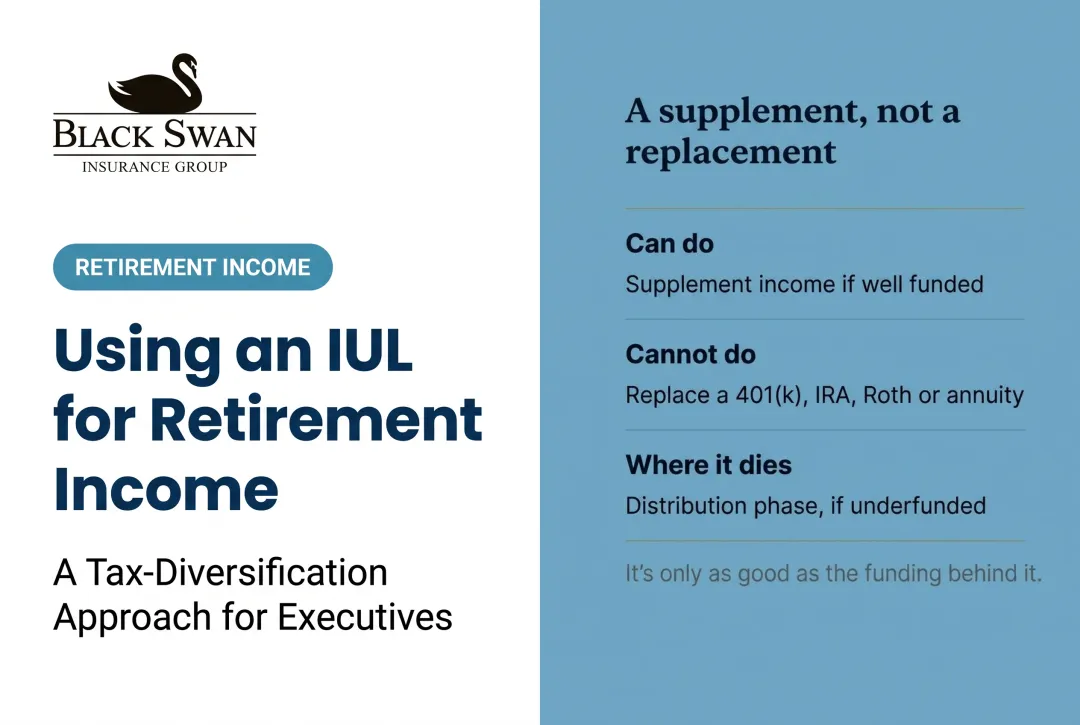
An IUL works alongside, not instead of, employer-sponsored plans, IRAs, Roth accounts, taxable investments, annuities and Social Security.
| Tool | Primary Role |
|---|---|
| 401(k) or IRA | Tax-advantaged retirement savings and investment access |
| Roth IRA / Roth 401(k) | Qualified, tax-free distributions in retirement |
| Annuities | Contractual income features |
| IUL | Permanent insurance plus policy-based cash value access |
For 2026 the IRS caps employee 401(k) contributions at $24,500 ($8,000 catch-up) and combined IRA contributions at $7,500, according to IRS guidance on 2026 retirement plan limits. The Roth phase-out begins at $153,000 for single filers and $242,000 for joint filers.
An IUL has no IRS contribution ceiling. Practical limits come from the MEC seven-pay test and your own funding capacity. Employer matches, contribution limits, fees, underwriting and tax treatment differ by product — verify current rules before assuming one tool can substitute for another.

Risks to Understand Before You Rely on This
Treat the death benefit as a core design feature, and confirm it still meets your protection goals after any withdrawal, loan or death-benefit change.
The habits that separate well-managed policies from problem ones:
- Use conservative assumptions — compare guaranteed values against multiple non-guaranteed scenarios, and read net cash value after charges rather than the best-case column
- Preserve liquidity — keep emergency reserves intact, avoid committing money needed soon, and reassess affordability after career, health or family changes
- Review annually — in-force values, premium history, crediting assumptions, charges, loan balances and surrender periods
- Coordinate your team — insurance, financial, tax and legal professionals, with answers in writing
The specific risks: caps and participation rates can be reduced after issue; cost of insurance rises with age; underfunding is the leading cause of failure; MEC status is generally permanent; and a lapse with loans outstanding can produce taxable income with no cash received.
Find Out Where You Actually Stand
This starts with the Tax-Free Wealth Blueprint Fit Review. If you earn $150K+ and are considering an IUL for retirement, we confirm the permanent insurance need first, establish a premium sustainable in a bad year, compare designs across carriers under identical assumptions, read guaranteed values against illustrated ones, model the distribution phase with the loan charge at its guaranteed maximum rather than its current rate, and stress-test through lower crediting and paused funding. We explain compensation before anyone funds anything. No review guarantees a particular outcome. If IUL does not fit, we will tell you that too.
Frequently Asked Questions
Can you use an IUL for retirement?
It can supplement retirement income where there is a genuine permanent insurance need, sustainable funding and ongoing monitoring. It is not an automatic replacement for a 401(k), IRA, Roth IRA or diversified portfolio.
Is an IUL a replacement for a 401(k) or IRA?
No. They serve different purposes and should be compared on employer matching, contribution limits, investment options, insurance need, fees, access and tax treatment before deciding how they fit together. Capture the match first, always.
What should I review before buying one for retirement?
The insurance need, guaranteed and non-guaranteed values, premiums, caps, participation rates, floors and charges — plus the surrender schedule, loan provisions, lapse scenarios and reasonable alternatives.
How do policy loans affect retirement income?
They provide access to cash value but accrue interest and reduce the death benefit. They raise lapse and tax risk if the policy becomes unsustainable with a balance outstanding. Model the guaranteed maximum loan charge, not the current one.
What happens if the policy lapses during retirement?
A lapse eliminates the death benefit and disrupts your income plan. Outstanding loans and taxable gain at lapse can also create an unexpected tax liability, depending on your contract and applicable law.
How often should it be reviewed?
At least annually — funding, policy values, charges, crediting assumptions, loans and death benefit — plus an additional review after any major financial or family change.
Sources
- NAIC — Life insurance
- IRS — Revenue Ruling 2007-38
- IRS — 401(k) limit increases to $24,500 for 2026; IRA limit increases to $7,500
Disclosure: This article is educational and is not personal tax, legal or investment advice. Indexed universal life is life insurance first. Contribution limits and tax rules change annually and must be confirmed against current IRS guidance; carrier caps, participation rates, charges and availability change frequently and must be confirmed against current policy forms. Illustrated values are not guarantees; actual results depend on policy terms, crediting, costs and funding. Actual results depend on policy design, carrier, crediting options, caps, participation rates, expenses, funding and ongoing management. This strategy is not appropriate for everyone. Policy loans and withdrawals reduce cash value and the death benefit, and can create tax consequences if the policy lapses or becomes a modified endowment contract. Consult your own tax, legal and financial professionals for advice specific to your situation.
And remember, it's not what you earn, it's what you keep… enjoy the ride.