By Robert Balgac, Founder, Black Swan Insurance Group | October 7, 2026
Every pitch for indexed universal life eventually arrives at the tax treatment. Tax-deferred growth. Basis-first withdrawals. Loans that are not taxable events. All of it is real, and none of it is automatic.
It is conditional on a piece of 1988 legislation most buyers have never heard of, and on a funding limit calculated specifically for your contract. Fund past that limit — often by doing something that feels responsible, like putting a bonus to work — and the protections you were sold quietly change shape. The policy does not fail. It just stops doing the job you bought it for.
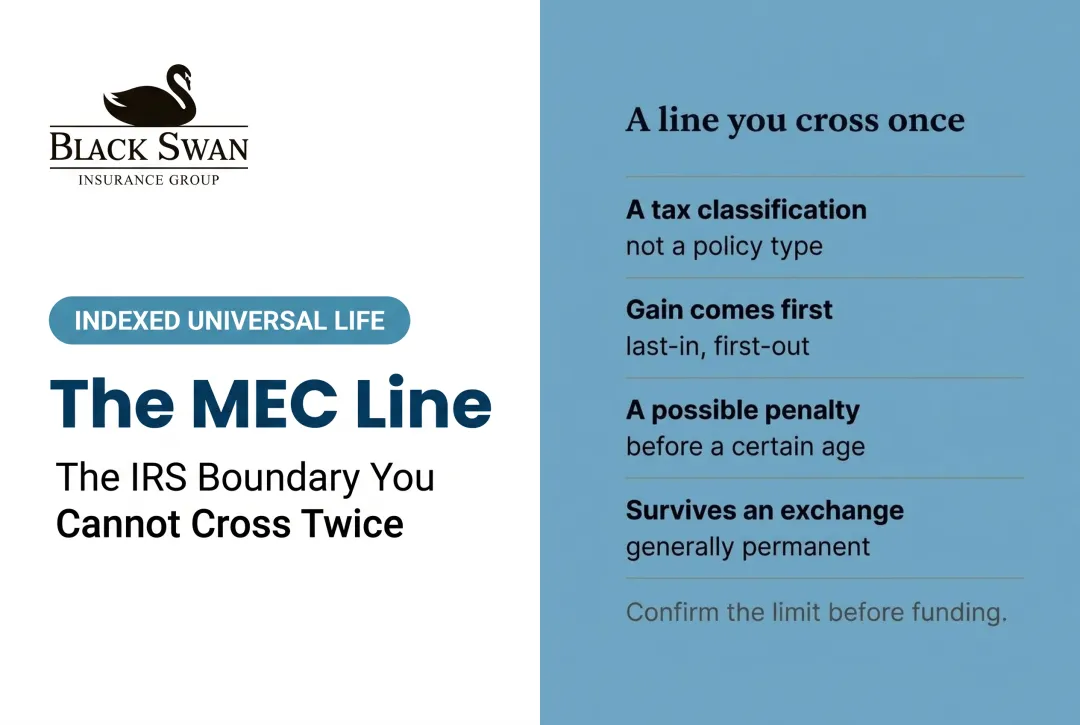
The short answer: TAMRA, the Technical and Miscellaneous Revenue Act of 1988, created the 7-Pay Test in IRC §7702A. Pay more into a policy during its first seven years than seven level premiums would have funded, and the contract becomes a Modified Endowment Contract. It keeps its death benefit and its tax-deferred growth. What it loses is favourable treatment of lifetime access — loans and withdrawals flip to gain-first, with a possible 10% additional tax before age 59½.
This matters to a specific person: the $150K+ earner who has maxed the 401(k), run into the Roth phase-outs, and is looking at a policy as a second bucket for tax-diversified retirement access. If that is you, the funding limit is not administrative trivia. It is the difference between the strategy working and the strategy being an expensive way to own life insurance.
Key Takeaways
- TAMRA (1988) added IRC §7702A and the 7-Pay Test that caps how fast a policy can be funded
- Exceeding the limit converts the contract into a Modified Endowment Contract (MEC)
- MEC status does not cancel the policy — it changes how loans and withdrawals are taxed
- The test is cumulative and contract-specific, so a single large payment years in can still trip it
- Judge an IUL on protection need, funding capacity and alternatives — not on tax treatment alone
What TAMRA Actually Did
TAMRA is federal legislation, Pub. L. 100-647, enacted November 1988. It added IRC §7702A, which defines a Modified Endowment Contract as a life insurance policy that fails the 7-Pay Test. The rules generally apply to contracts entered into on or after 21 June 1988.
TEFRA, DEFRA and TAMRA Are Not the Same Checkpoint
These three get used interchangeably by people who should know better. They answer different questions, in sequence:
| Law | Year | What it actually governs |
|---|---|---|
| TEFRA | 1982 | Rules for death proceeds on certain flexible-premium contracts issued before 1985 |
| DEFRA | 1984 | Added IRC §7702 — whether a contract qualifies as life insurance at all |
| TAMRA | 1988 | Added IRC §7702A — whether a qualifying policy becomes a MEC |
A contract has to clear §7702 first. Only then does the 7-Pay Test decide whether it keeps the most favourable treatment. Three gates, not one gate mentioned three times.
Why IUL Is Exposed to This
An IUL is universal life with flexible premiums. You can raise, lower or pause payments as cash flow moves — that flexibility is most of the appeal for business owners and anyone with variable income.
The same flexibility is the exposure. A fixed-premium whole life contract cannot drift past its limit, because the premium is not yours to change. An IUL can, and the mechanism is usually a single well-intentioned deposit.
The product is not the strategy. The design is the strategy.
What a Non-MEC Contract Preserves
Stay under the limit and you generally keep:
- Tax-deferred cash value growth inside the policy
- Basis-first withdrawal treatment, subject to contract terms
- Policy loan access without current income taxation while the contract is in force
- An income-tax-free death benefit under IRC §101(a)(1), subject to its stated exceptions
Each of those depends on your contract and on current law — confirm with your carrier and tax advisor. And note what non-MEC status does not buy you: the policy still needs adequate funding, realistic crediting assumptions, and monitoring for charges and lapse risk. Avoiding MEC status is necessary, not sufficient.
How the 7-Pay Test Works
It is not a flat dollar cap. It is a cumulative, contract-specific comparison of premiums paid against the net level premiums that would fund the policy over seven years — an actuarial calculation, not a number you can look up.
What Moves Your Limit
- The insured's age and underwriting class
- The death benefit amount
- Policy design and contract terms
- Actuarial assumptions written into the contract
Because all four vary, any specific figure quoted to you should come from your carrier's illustration. A number from a forum post is worth what you paid for it.
Why a Lump Sum Can Break a Compliant Policy
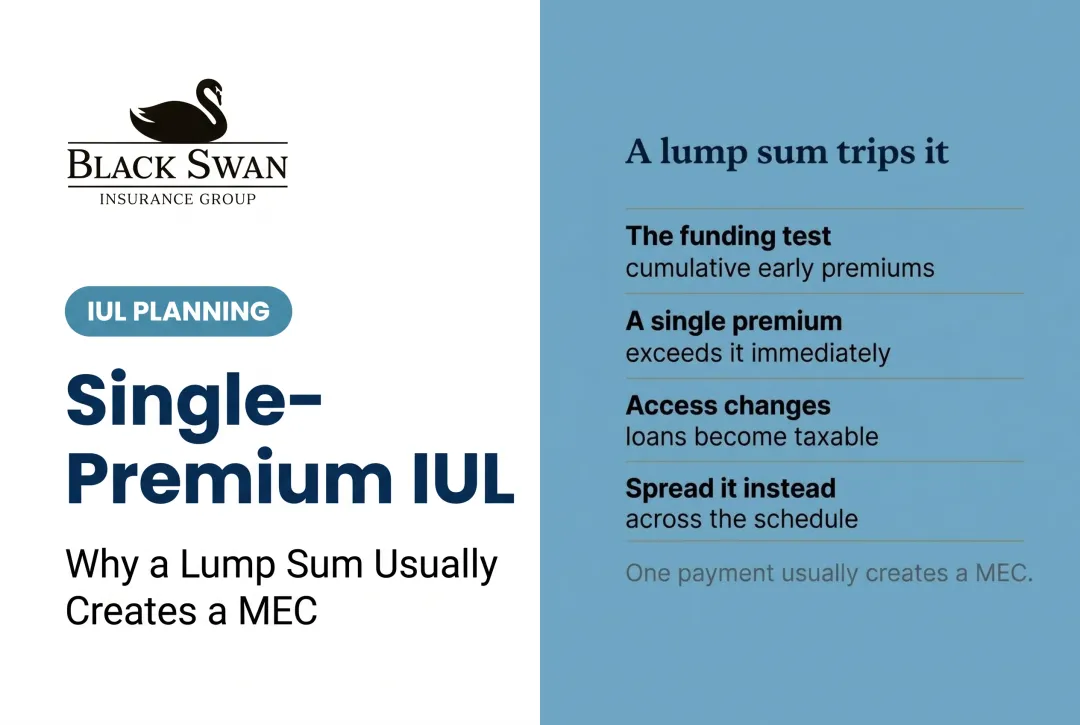
This is the part that catches people. The test is cumulative, not annual. A policy can sit comfortably inside the limit for years, and then one large contribution — the bonus, the distribution, the inheritance — pushes cumulative premiums over. Prior compliance is not a shield.

What Triggers a Retest
- A material change not already factored into testing
- A death benefit reduction during the first seven contract years
- An exchange into another contract
- Structural modification of the contract
An exchange does not launder existing MEC status, either. §7702A carries the classification into the replacement contract.
If You Catch It Early
If a payment might exceed the limit, call the carrier immediately. Two correction paths may be available:
- Premium return rule — amounts returned with interest within 60 days after the end of the contract year may be excluded from premiums paid.
- IRS closing agreement — under Rev. Proc. 2008-39, carriers can seek an IRS-approved correction for eligible, inadvertent, non-egregious failures.
Neither is automatic. Confirm timing, interest treatment and eligibility with the carrier. Miss the windows and the status is generally permanent.
The Ultimate IUL Blueprint
If you are deciding how hard to fund a contract, the Blueprint covers what the design has to survive: funding levels, the MEC line, loan timing, and what to demand from an illustration before you commit.
What Changes Under MEC Status
Neither classification is inherently good or bad. What changes is the order distributions are taxed in, and what that costs you.
| Feature | Non-MEC IUL | MEC |
|---|---|---|
| Withdrawal order | Basis first (FIFO) | Gain first (LIFO) |
| Policy loans | Generally not taxable on receipt while in force | Generally treated as distributions, taxable to the extent of gain |
| Assignments / pledges | Generally not immediately taxable | Generally treated as distributions |
Taxable amounts are generally ordinary income. Confirm the specifics with a qualified tax professional before relying on either column.
The Additional 10% Tax
IRC §72(v) adds a 10% tax on the taxable portion of a MEC distribution — not on the full amount received. Statutory exceptions apply where the distribution occurs:
- On or after age 59½
- Because of the taxpayer's disability
- As part of a qualifying series of substantially equal periodic payments
Death is not listed, but only because death benefits are handled separately under the general exclusion in §101(a)(1).
What MEC Status Does Not Do
It does not automatically impose annual income tax on undistributed growth, eliminate the death benefit's income-tax-free treatment, or terminate the policy. Those survive, subject to contract terms, ownership structure and current law.
What it does do is dismantle the living-access case. So if anyone has promised you retirement income that is both tax-free and guaranteed, you now know enough to push back: loans accrue interest, that interest compounds against cash value, crediting is not guaranteed, and charges continue whatever the index does. Potential tax-advantaged access is real. It is also conditional, and the conditions are the whole subject of this article.

What the Critics Get Right
The common criticism — that IUL is sold on tax treatment that most buyers do not understand and cannot verify — is largely fair.
The funding limit is contract-specific and invisible unless someone runs it. The consequence of breaching it is effectively permanent. And the person encouraging maximum funding is frequently compensated on that premium. None of that is a reason to dismiss the product, but all of it is a reason to demand the 7-Pay schedule in writing before the first payment, and to treat anyone who cannot produce it as unqualified to advise you.
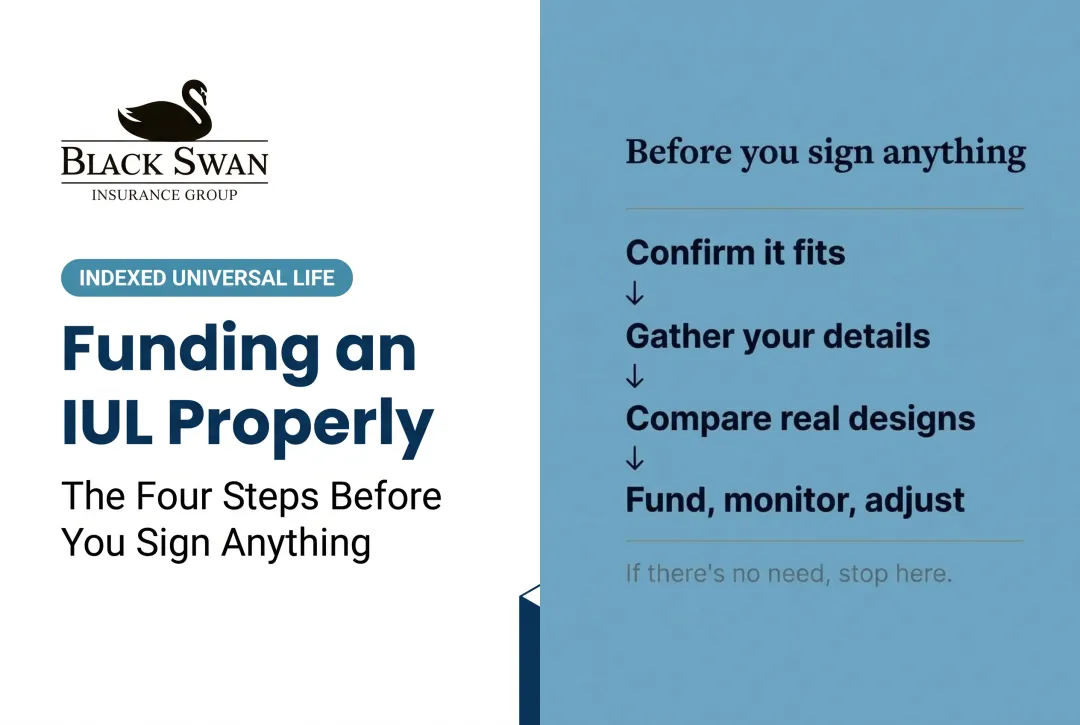
Funding It Without Losing Sight of Suitability
A great IUL is engineered. A bad IUL is sold.
Design starts with the objective — permanent protection, estate planning, supplemental retirement income, cash value accumulation — not with the largest contribution the contract will accept. Maximising premium without a defined purpose is how people walk into MEC territory, or overfund a policy that was never matched to their actual need.
Before committing, be honest about the planned premium and how long you can sustain it, your emergency reserves outside the policy, whether the funding survives a downturn or a business interruption, and how this sits beside existing retirement accounts, brokerage assets, debt and other coverage.
Then ask the carrier for the policy's 7-Pay position, guaranteed and non-guaranteed illustrations, expense assumptions and surrender schedules, index-crediting caps, participation rates and floors, and loan provisions with lapse-risk projections. An illustration is a model, not a promise. A floor limits negative crediting; it does not remove charges or guarantee cash value cannot fall.
Talk to the carrier and your advisor before you make an unusually large payment, skip a planned one, change the death benefit, take a substantial loan or withdrawal, exchange the policy, or change ownership. Every one of those can move your 7-Pay position or force a retest.

Black Swan Insurance Group, based in Springboro, Ohio, works with professionals, business owners and families on whether a sustainably funded IUL belongs in the plan at all — policy design, funding levels, MEC limits, realistic crediting assumptions, and honest comparison against whole life, term, the 401(k) and Roth alternatives. The process includes an annual review built to catch funding and MEC problems while they are still correctable. Tax and legal questions specific to your situation still belong with your own CPA or attorney.
Stronger Fit
Paying close attention to TAMRA limits is worth it if you:
- Earn $150K+ and are funding for living access, not only a death benefit
- Are funding at or near the maximum the design allows
- Have lumpy income — bonuses, distributions, commissions — that invites off-schedule payments
- Will commit to an annual review and an illustration before each material change
Weaker Fit
This is the wrong conversation for you right now if you:
- Have no emergency reserve, or high-interest debt that should be cleared first
- Cannot sustain the premium across the full funding period
- Need only a death benefit — term is cheaper and simpler, and you should buy term
- Want something you can fund once and ignore
Risks to Understand Before You Fund
- MEC status is generally permanent once the correction windows close. Stopping premiums or exchanging the contract does not reverse it.
- The floor applies to crediting, not to charges. Cost of insurance, surrender charges and administrative expenses continue in a zero year.
- Loans in a MEC are taxable to the extent of gain. The loan is not the problem. The unmanaged loan is the problem.
- Underfunding is the mirror risk. Backing off premiums to stay clear of the line can leave the contract too thin to carry rising insurance costs later.
- Caps and participation rates can change. They are not contractual constants, which is exactly why the annual review exists.
Find Out Where You Actually Stand
This starts with the Tax-Free Wealth Blueprint Fit Review. If you earn $150K+ and you are funding a policy, or weighing one, we model the premium schedule against the 7-Pay limit, show the remaining room, stress-test the funding through lower-return and zero-credit years, and put the loan assumptions in plain numbers. If the design needs changing, we will say so. If IUL does not fit your situation at all, we will tell you that too.
Frequently Asked Questions
What does TAMRA stand for?
The Technical and Miscellaneous Revenue Act of 1988. It introduced the 7-Pay Test and the MEC classification that still govern life insurance funding.
Is an IUL a type of cash value life insurance?
Yes. It is permanent life insurance with flexible premiums and a cash value component credited by reference to an external index, subject to caps, participation rates, charges and contract terms.
What happens if an IUL fails the 7-Pay Test?
It generally becomes a Modified Endowment Contract. It stays in force and keeps its death benefit, but loans and withdrawals receive less favourable tax treatment.
Can MEC status be reversed?
Generally no, once the correction periods have passed. If you suspect an overpayment, contact the carrier and a qualified tax professional immediately — the 60-day return window is short.
Does becoming a MEC cancel the policy?
No. The policy remains in force and the death benefit is intact. Only the tax treatment of lifetime loans and withdrawals changes.
How do I avoid creating one accidentally?
Confirm your 7-Pay position before any extra contribution or policy change, and review the contract annually with your carrier, your insurance professional and your tax advisor.
Is term insurance a better answer for me?
If your need is pure death-benefit protection for a defined period, very possibly yes. Term solves that problem cheaply and without any of the machinery in this article. IUL earns its complexity only when you need permanent coverage and want a tax-diversified place to build accessible value.
Sources
- 26 U.S.C. § 7702A — Modified endowment contract defined
- 26 U.S.C. § 72 — Annuities; certain proceeds of endowment and life insurance contracts
- IRS Revenue Procedure 2008-39
- NAIC — Life Insurance
- NAIC — Life Insurance Illustrations
Disclosure: This article is educational and is not personal tax, legal or investment advice. Indexed universal life is life insurance first. MEC determination is contract-specific and governed by IRC Sections 7702A and 72; review your own circumstances with your CPA or tax attorney before changing premiums or coverage. Any potential tax-advantaged access depends on the policy being properly structured, funded and managed. Actual results depend on policy design, carrier, crediting options, caps, participation rates, expenses, funding and ongoing management. This strategy is not appropriate for everyone. Policy loans and withdrawals reduce cash value and the death benefit, and can create tax consequences if the policy lapses or becomes a modified endowment contract. Illustrated values are not guarantees; actual results depend on policy terms, crediting, costs and funding. Consult your own tax, legal and financial professionals for advice specific to your situation.
And remember, it's not what you earn, it's what you keep… enjoy the ride.