By Robert Balgac, Founder, Black Swan Insurance Group | October 5, 2026
Most pages answering this question describe who can buy an indexed universal life policy. That is a low bar — if you are insurable and can pay a premium, you can buy one. The question worth answering is who should, and the honest version of that answer excludes most people who ask it.
If you earn $150K+ and are trying to work out whether you are in the narrow group this suits, the tests below are the ones that actually matter.
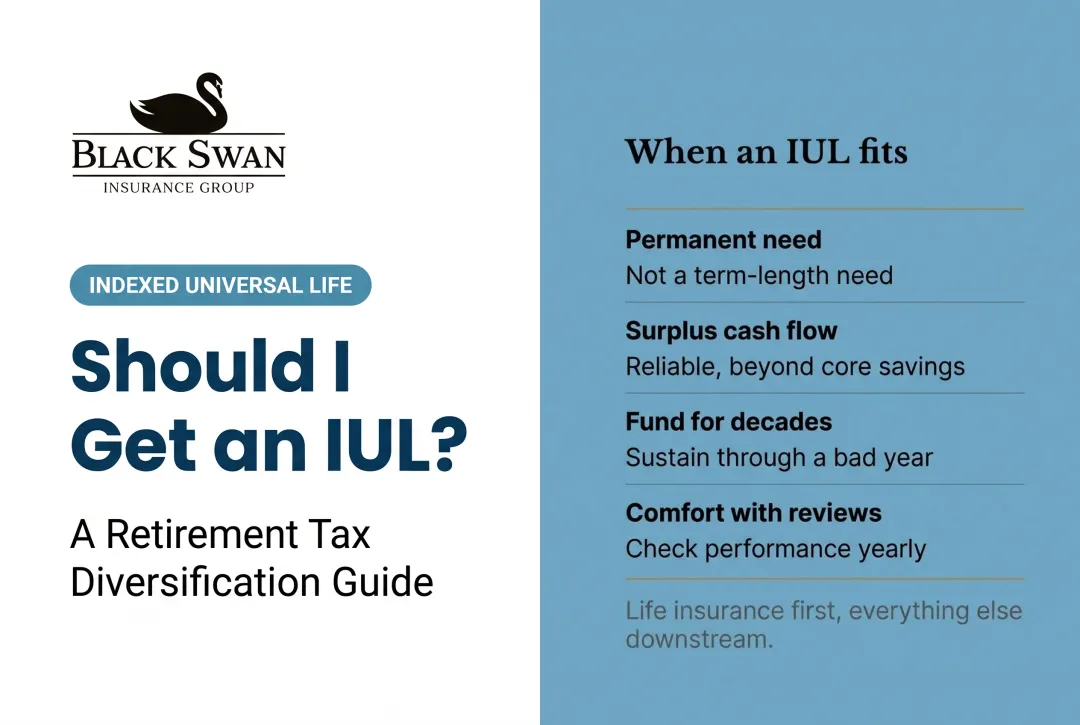
The short answer: An IUL suits a high earner with stable income, a genuine permanent protection or legacy need, sustainable funding capacity of roughly $500 to $2,500 a month without touching reserves, a twenty-year-plus horizon, existing retirement accounts already being funded, and the willingness to review the contract annually. Fail any of those and the answer is usually no. Term insurance and a brokerage account serve most households better.
Key Takeaways
- Insurability and affordability get you in the door; suitability is a different and much narrower test
- A permanent protection need has to exist independently of the cash value, or you are paying insurance costs for nothing
- Funding capacity must survive a bad year, not just a good one — flexible premium is how underfunded policies happen
- The employer match and available tax-advantaged accounts come first, every time
- If your horizon is under fifteen years, the charges rarely get a chance to be outrun
The Requirements, in Order
An IUL is permanent life insurance first, potential cash value second, and potential tax-advantaged optionality third — and that third part depends on the policy being properly structured, funded and managed. Work through them in that order and the suitability question usually answers itself.
One: Insurability
Underwriting assesses age, health, medical history, tobacco use, occupation, avocations and sometimes driving and financial records. Rate class materially changes cost of insurance, which is the largest ongoing charge. A substandard rating does not automatically rule the policy out, but it changes the arithmetic enough that the projection you were shown before underwriting is no longer the projection.
Two: A Real Protection Need
Ask what the death benefit is for. Acceptable answers include replacing income for dependants, clearing a mortgage, funding a buy-sell agreement, providing estate liquidity, or supporting a special-needs dependant for life. If the honest answer is "I do not really need it, I want the cash value," the structure is wrong and a brokerage account is the better vehicle.

Three: Sustainable Funding Capacity
Not what you can afford this month. What you can maintain through a slow year, after the emergency reserve is funded and high-interest debt is cleared. A policy funded near the maximum is a different contract from the same policy funded at the minimum.
If the illustration only works when everything goes right, it is not a plan. It is a wish with a binder.
Four: The Accounts That Come First
Capture the full employer match — nothing else in your financial life pays back that reliably. For 2026 the elective deferral limit is $24,500 and the IRA limit is $7,500. If a Roth is still available to you, it is cheaper and simpler than this; the phase-out begins at $153,000 single and $242,000 married filing jointly for 2026, which is usually why this conversation starts at all.
Five: Horizon and Temperament
Twenty years or more, and a willingness to look at an in-force illustration every year. This is not set-it-and-forget-it. It is design-it, fund-it, review-it.

What the Critics Get Right
Critics are right that IUL is sold far more widely than it suits, and that the suitability conversation is often replaced with an affordability conversation. They are right that a buyer who can make the premium is not the same as a buyer who should. And they are right that the product is frequently recommended before the qualified accounts are full, which inverts the sensible order.
Where the criticism overreaches is in concluding nobody should hold one. Segments exist where it genuinely fits — business owners with continuity obligations, families above the Roth phase-out with real protection needs, people with estate liquidity problems.
The Segments Where It Genuinely Fits
Abstract suitability tests are easier to apply against concrete situations. These are the profiles where the answer is most often yes.
The W-2 high earner with retirement overflow. Maxing the 401(k), locked out of a Roth, holding a large fully taxable retirement balance and uncomfortable with how much of the future depends on unknown tax rates. The protection need is real but modest; the tax-diversification argument does the work.
The business or practice owner. A continuity obligation, a buy-sell to fund, income that arrives unevenly, and a balance sheet already concentrated in one asset. Here the death benefit is doing genuine work and the flexible premium matches the cash flow.
The existing policy owner. Someone who already holds a contract, suspects it was designed badly, and needs an audit rather than a new purchase. Frequently the right outcome is to fix the funding on what they have.
The late-start high earner between 42 and 55. Strong income, compressed runway, often catching up after education or a business build. The funding analysis matters more here than anywhere else, because there are fewer years to absorb the early charges.
The spouse-led protector. Often the person who raises coverage in the first place, focused on what happens to the household rather than on crediting rates. The conversation should be about protection first and accumulation second.
Notice what these have in common: a real protection need, sustainable income and a long horizon. Where those three are absent, no segment label makes the policy suitable.
The Ultimate IUL Blueprint
A plain-English walkthrough of the suitability tests, funding requirements and the questions that separate a design from a sales illustration.
Who It May Fit, and Who Should Walk Away
Stronger Fit
- $150K+ stable income with $500–$2,500 a month available for long-term funding without touching reserves
- A genuine permanent protection, legacy or business-continuity need
- Already capturing the full employer match and funding available retirement accounts
- Tax-frustrated, Roth-limited, or holding too much in fully taxable retirement buckets
- Twenty-year-plus horizon and willingness to review annually
- Understands this is not a stock-market replacement
- Insurable at a reasonable rate class
Weaker Fit
Not everyone should buy an IUL, and most people who reach this page should not. Walking away is a legitimate outcome and often the right one.
- Unstable or highly variable income
- No emergency fund yet
- High-interest debt needing triage
- Liquidity needed inside the next five to ten years
- Only wants the cheapest death benefit — term insurance is the direct answer
- Uninsurable or heavily rated
- Unwilling to review the contract annually

Risks to Understand Before You Commit
- Underfunding leading to lapse is the dominant failure mode and often surfaces fifteen or more years in.
- Cost of insurance generally rises with age, so today's affordability is not tomorrow's.
- Non-guaranteed elements can be adjusted within contract limits, including caps and current charges.
- Surrender charges can apply for ten to fifteen years, making early exit expensive.
- A zero-credit year is a net negative year because charges continue.
- Policy loans and withdrawals reduce cash value and the death benefit, and a lapse with gain and an outstanding loan can create taxable income with no cash received to pay it.
Find Out Where You Actually Stand
This is a fit/no-fit review, not a recommendation. It is called the Tax-Free Wealth Blueprint Fit Review. If you earn $150K+ and want the suitability tests applied to your own numbers — including being told plainly if you fail one — that is exactly what it is for. If IUL does not fit, we will tell you that too.
Frequently Asked Questions
What are the requirements to qualify for an IUL?
Insurability through underwriting and the ability to pay premium. Those are the entry requirements. Suitability is a separate and much narrower test.
What income do you need for an IUL to make sense?
There is no rule, but the structure generally starts making sense above roughly $150K where retirement accounts are already being funded and Roth access is limited or gone.
Can I get an IUL with health issues?
Often yes, at a higher rate class, which increases cost of insurance and changes the projection. Some conditions will result in a decline.
Is there an age limit?
Carriers issue across a wide age range, but a shorter horizon means less time to outrun the early charges, so late-start buyers need the funding analysis done carefully.
Should I buy an IUL before maxing my 401(k)?
Generally no. Capture the employer match and use available tax-advantaged accounts first. They are cheaper and simpler.
When should I walk away?
If there is no real protection need, if the premium would strain a bad year, if you need the money within a decade, or if the policy on offer is minimum-funded with a large round death benefit.
Do I need a medical exam?
Often yes, though some carriers offer accelerated underwriting with no exam for certain ages and coverage amounts. The trade is usually a slightly higher rate class.
Can I be declined for an IUL?
Yes. Underwriting can decline based on health, occupation or financial factors, just as it can for any life insurance application.
How long does approval take?
Typically several weeks with full underwriting, less with an accelerated programme. Timelines vary by carrier and by how quickly medical records arrive.
Sources
- NAIC — Life Insurance — product definitions and buyer guidance
- IRS — Retirement plans — 2026 contribution limits and Roth phase-out ranges
- FINRA — Emergency fund guidance — reserves before long-term commitments
- NAIC, Life Insurance Illustrations Model Regulation (Model #582) — non-guaranteed element disclosure
- I.R.C. § 7702A — Modified Endowment Contract and the seven-pay test
- I.R.C. § 72 — additional tax on early distributions
Disclosure: The information on this page is educational in nature and does not constitute personalized financial, tax, or legal advice. Actual results depend on policy design, carrier, crediting options, caps, participation rates, expenses, funding, loans, and ongoing management. Policy loans and withdrawals reduce cash value and the death benefit, and can create tax consequences if the policy lapses or becomes a modified endowment contract. Consult a licensed insurance professional and, where appropriate, a tax or financial advisor before making any insurance or financial decision. Indexed universal life is life insurance first. Illustrated values are not guarantees; actual results depend on policy terms, crediting, costs and funding. This strategy is not appropriate for everyone.
And remember, it's not what you earn, it's what you keep… enjoy the ride.