By Robert Balgac, Founder, Black Swan Insurance Group | October 9, 2026
High earners hit the same wall. You make too much to contribute directly to a Roth IRA, you have already maxed the 401(k) at $24,500, and you are looking for another way to build tax-diversified retirement income. An IUL shows up in that search within about thirty seconds.
Here is what the pitch leaves out: a Roth IRA asks whether you have earned income. An IUL asks whether a carrier is willing to insure your life. Money does not qualify you. Insurability does — plus a genuine need for permanent coverage, funding capacity that survives a bad year, and enough runway for the design to work.
The short answer: Qualifying has two tests, and income is neither of them. First, are you reasonably insurable for the coverage you want, judged on age, health, family history, occupation and lifestyle? Second, are you financially suited to a long-term, carefully funded policy with a real protection need behind it? A Roth IRA is a retirement account. An IUL is a life insurance contract that happens to build cash value. They are not the same instrument wearing different labels.
Key Takeaways
- Evaluate this as life insurance first and a supplemental retirement strategy second
- Approval and pricing hinge on age, health history, lifestyle and each insurer's underwriting rules
- Strong candidates have a real protection need, stable surplus cash flow, liquidity elsewhere and a long funding horizon
- Compare guaranteed values against illustrated projections, not against a promised income figure
- A Roth IRA, employer plan, brokerage account or term policy may simply fit better
Step 1: Confirm Permanent Insurance Is Actually Needed
Identify the protection objective before anything else. Replacing income for a family? Covering a business obligation? Creating estate liquidity? Building a legacy?
Cash-value accumulation alone is not a sufficient reason to buy permanent insurance. This is permanent protection first, with potential cash value through index-based crediting second — not the reverse.
Ask what death benefit genuinely matches your beneficiaries' needs, how long you need coverage, and whether term insurance would accomplish the same protection goal for materially less money. Insurance suitability and retirement-account suitability are separate questions, and one decision should not be allowed to answer both.
Step 2: Review Your Insurability Before Designing Anything
Underwriters look at considerably more than your bank balance. New York's Department of Financial Services notes insurers typically evaluate age, health and smoking habits, family health history, occupation and hobbies when determining eligibility and pricing.
Assemble current age and detailed medical history; medications and ongoing treatments; family health history, particularly early cardiac or cancer events; tobacco or nicotine use including vaping; occupation and hazardous hobbies such as flying, diving or racing; and your driving record.
These shape your underwriting class, which drives your premium, the available face amount and sometimes the design itself. Carrier guidelines differ enough that generic approval predictions are worthless.
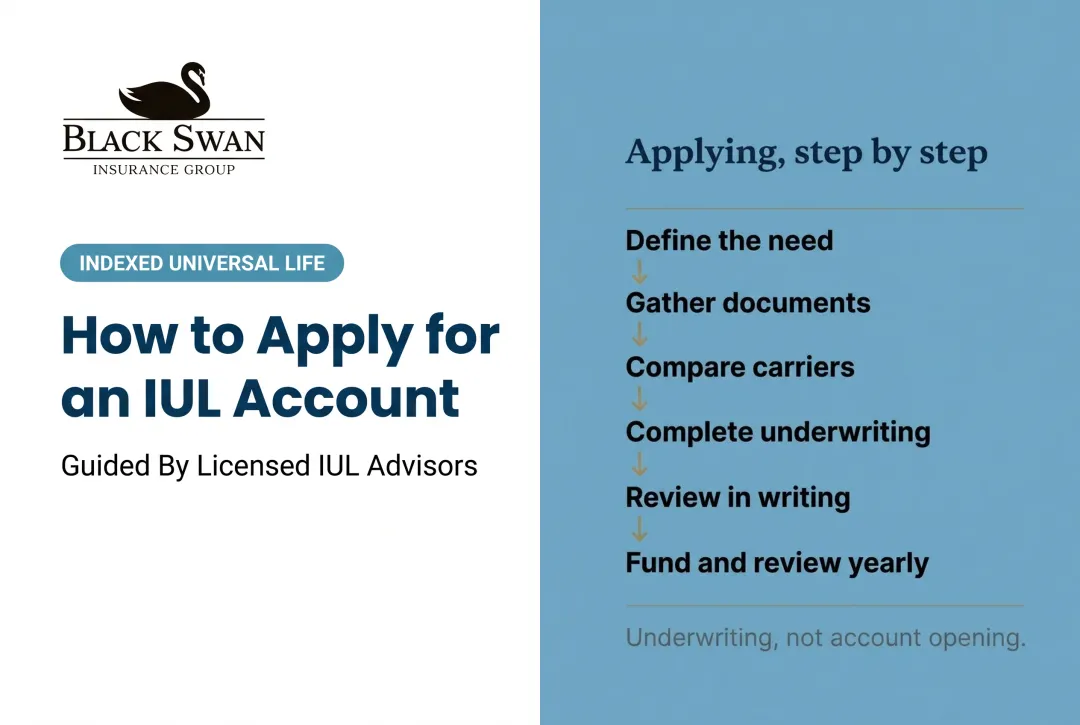
If your medical history is complex or your retirement timeline is short, request an informal underwriting review before any formal application. Black Swan builds this into a five-step process that starts with a financial goals review before any policy customisation.

Step 3: Establish Sustainable Funding Capacity
"No annual contribution limit" is the headline selling point and the most common source of trouble. Unlimited funding potential is not unlimited affordable funding.
Calculate true surplus cash flow — what remains after emergency reserves, debt obligations, employer-plan contributions and Roth strategies, business funding needs and other insurance premiums.
Funding is also constrained by tax law. Under IRS Revenue Ruling 2007-38, a contract becomes a Modified Endowment Contract if cumulative premiums within the first seven contract years exceed specific limits. MEC status changes how loans and distributions are taxed — generally income-first treatment plus a potential 10% additional tax on early distributions.
Stress-test the plan before committing: reduced contributions in a tight year; interrupted income from job loss or a business downturn; lower-than-illustrated crediting across a multi-year stretch; rising policy charges as you age; and unexpected liquidity needs outside the policy.
This is not set-it-and-forget-it. It is design-it, fund-it, review-it.
The Ultimate IUL Blueprint
Before you apply, the Blueprint covers what the design has to survive: funding levels, caps and charges, the MEC line, loan timing, and exactly what to demand from an illustration.
Step 4: Compare It Against the Roth, Honestly
This is where the decision is actually made. Line up contribution eligibility, investment control, fees, access rules, death benefits and tax treatment side by side.
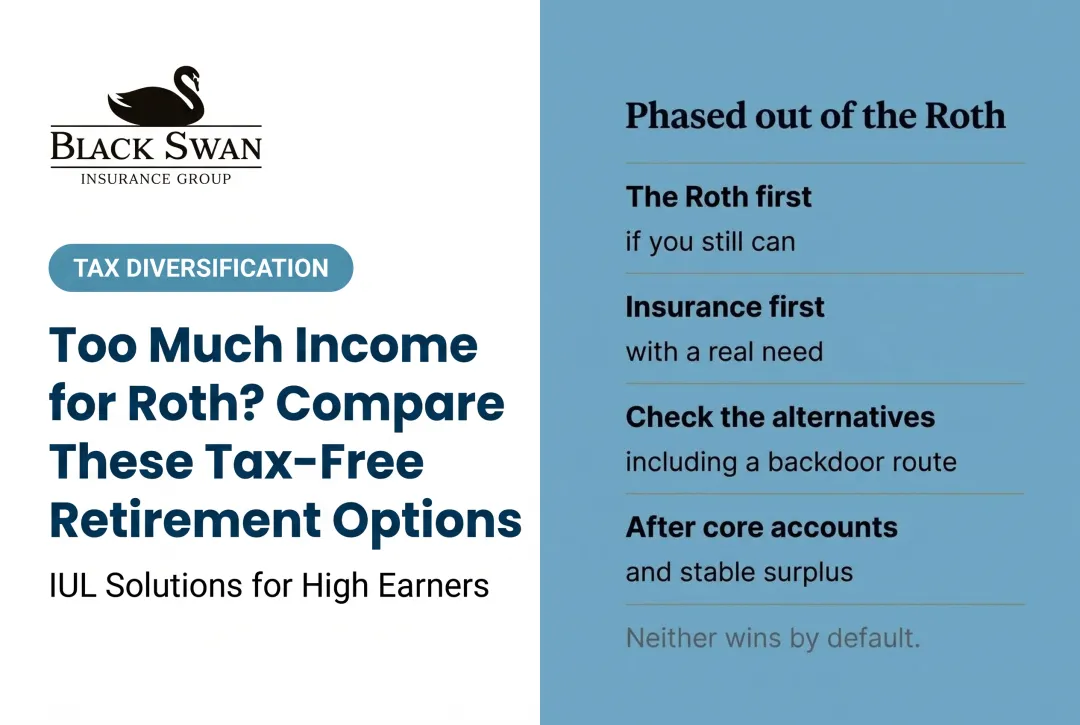
Roth IRA eligibility phases out on income. For 2026 the IRS sets direct Roth IRA contribution phase-outs at $153,000–$168,000 MAGI for single filers and $242,000–$252,000 for married filing jointly, with the IRA contribution limit at $7,500 and the 401(k) deferral limit at $24,500.
Above those thresholds a backdoor Roth conversion may still be available — a separate calculation involving pro-rata rules on existing traditional IRA balances, and one worth exhausting before an insurance premium enters the conversation.
On the IUL side, pull the actual illustration and read the guaranteed column against the non-guaranteed current-assumption column; the index-crediting assumptions, caps, participation rates and spreads; loan provisions and their effect on cash value over time; and surrender values and lapse scenarios under reduced crediting.
The NAIC's illustration guidance (AG 49-A) restricts how aggressively insurers may illustrate indexed crediting, but illustrated values remain projections, not guarantees.
An illustration is a model, not a guarantee.
Policy loans and withdrawals reduce cash value and death benefit, and can create taxable income if the policy lapses or is surrendered while a loan is outstanding.

What the Critics Get Right
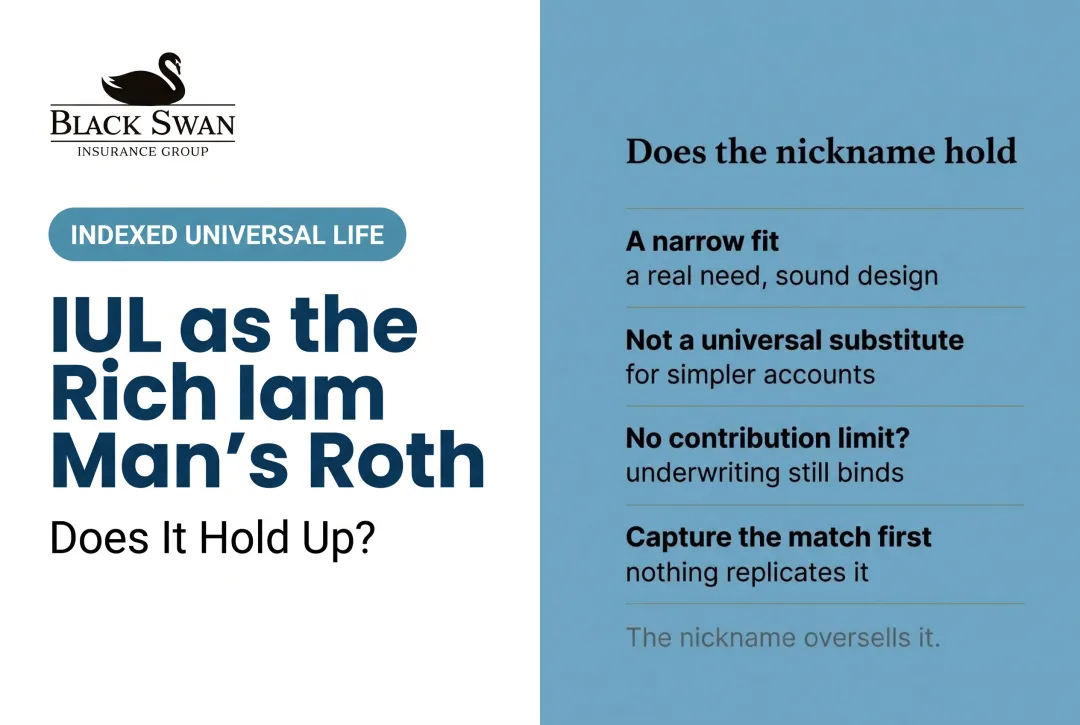
The strongest criticism of the "IUL as Roth alternative" framing is that it is a category error dressed as a solution.
A Roth IRA has no mortality charges, no cost of insurance rising with age, no surrender schedule, no underwriting and no exposure to lapse. Comparing the two on projected after-tax income alone hides every structural difference that matters. Critics are right that being phased out of a Roth is not, by itself, a reason to buy life insurance; right that the backdoor conversion is frequently the better and vastly simpler answer; and right that the person running the comparison is usually paid only if the insurance wins it.
A great IUL is engineered. A bad IUL is sold.
The defensible version is narrow: you have a permanent protection need that exists independently of the tax conversation, and the cash value is a second job the contract happens to do well. That is a real situation. It is just much rarer than the search volume suggests.
Who This Fits
Stronger Fit
- A genuine permanent protection need, independent of the Roth phase-out
- Adequate, stable cash flow after other obligations are met
- Strong insurability at a reasonable underwriting class
- A long accumulation horizon, typically 15 years or more
Weaker Fit
Not everyone should buy this. It is a weaker fit with limited emergency savings or unstable income, a near-term need for the money, premiums that would strain the budget, significant existing debt, no actual permanent death-benefit need, poor health pricing that makes the cost prohibitive, or plans to retire before the policy has time to build usable value.
Even when the profile fits, check Roth eligibility properly first. Direct contribution limits, backdoor conversion rules and compensation requirements change by tax year. None of this substitutes for an employer match, a low-cost Roth strategy, adequate term coverage or diversified investments.
What You Need Before Applying
Carriers want a complete picture: personal identification and income documentation; net worth, debts and existing insurance in force; dependents and beneficiary designations; business interests where applicable; desired coverage amount and intended premium budget; and medical records, medications and lifestyle details.
Carriers normally require financial justification for the requested death benefit. Income, assets and the stated purpose for coverage all influence how large a policy you can qualify for.
Where the strategy involves business ownership, trusts, large death benefits or complex beneficiary structures, involve a tax professional and estate-planning attorney early. That is not paperwork; it shapes the design.
Design variables matter as much as underwriting: death-benefit amount and premium pattern, the face-amount-to-cash-value ratio, index options and riders, loan provisions and the planned funding schedule. Review guaranteed values, current-assumption values, surrender values, break-even timing and lapse sensitivity side by side before signing.
Liquidity. Keep an emergency reserve entirely separate from the policy. This should never be the account you tap for a car repair or a slow month of revenue. Premiums are paid with after-tax dollars, and favourable loan treatment depends on keeping the contract in force and following applicable tax rules.

Qualification Mistakes, and How to Fix Them
Most qualification problems come from design choices rather than forms.
- Treating it as an investment account. Define death-benefit purpose, coverage duration and beneficiaries before any accumulation discussion.
- Designing around an optimistic illustration. Compare guaranteed values with multiple non-guaranteed scenarios including lower crediting, higher charges, missed premiums and early surrender.
- Funding beyond sustainable cash flow. If the planned premium fails a stress test, reduce it, delay the application, or prioritise employer-plan and Roth strategies first.
- Assuming a 0% floor removes downside. Floors limit negative index crediting; charges, loan interest, withdrawals and surrender fees still erode cash value.
Zero is your hero in a down year — but the floor applies to the credit, not to the charges.
If underwriting comes back poorly: request additional medical records to clarify a flagged condition, ask for reconsideration with updated information, compare outcomes across carriers, adjust the death benefit to an affordable level, or take term coverage if permanent insurance is not approvable at reasonable cost. Never omit or misrepresent information to improve a class — that risks denial of a future claim.
If Roth access looks closed: separate direct contributions from conversions, and verify current income limits, filing status and pro-rata rules with a tax professional before concluding anything.
The Alternatives
A Roth IRA or conversion strategy wins when the goal is direct market exposure, simpler administration and lower insurance-related cost. Employer plans come first wherever a match exists. Term insurance plus retirement investing separates protection from accumulation with clearer costs. Other permanent insurance or annuities — whole life, fixed and indexed annuities — differ in guarantees, liquidity and fees, and none substitutes without its own suitability review.
Combining strategies is usually the realistic answer: keep funding qualified plans and Roth accounts, and layer permanent insurance in only when its protection role justifies the cost on its own merits.
Risks to Understand Before You Apply
- Underwriting can come back worse than quoted, and a design built on an assumed health class may no longer work at the offered one.
- Cost of insurance rises with age — a cost a Roth IRA simply does not have.
- Caps and participation rates can be lowered after issue, within contract minimums.
- Crossing the seven-pay line is generally permanent and changes the taxation of loans and withdrawals.
- Surrender charges restrict access for years, so this is not a liquid alternative to anything.
- Lapsing or surrendering with a loan outstanding can create taxable income with no cash received.
Find Out Where You Actually Stand
This starts with the Tax-Free Wealth Blueprint Fit Review. If you earn $150K+ and have been phased out of the Roth, we check the backdoor conversion first, establish whether a permanent protection need genuinely exists, run an informal underwriting review where health is complex, model funding against the MEC limit, and stress-test the design through lower-crediting and zero-credit years against what a Roth and a term policy would do instead. If the Roth route wins, we will say so. If IUL does not fit, we will tell you that too.
Frequently Asked Questions
How much money do I need to qualify?
There is no universal minimum, and money is not what qualifies you — insurability is. Required premium depends on age, health, death-benefit amount, carrier rules and funding goals, and a carrier's minimum to issue differs from what a cash-value strategy needs.
Can I contribute to a Roth if I make $300,000?
Direct eligibility depends on filing status, modified adjusted gross income and tax year. At $300,000 MAGI most filers exceed the direct contribution limits, though a backdoor conversion may still be available. Check current IRS guidance with a tax adviser.
Is it better to have an IUL or a Roth IRA?
Neither is universally better. A Roth is built for straightforward retirement investing; an IUL combines permanent life insurance with cash value. Compare cost, complexity, market exposure, contribution rules and whether a death-benefit need actually exists.
What health conditions affect qualification?
Insurers weigh diagnoses, treatment history, medications, family health history, tobacco use and overall health. Outcomes vary by carrier, so disclose fully and request a preliminary underwriting review where available.
Can I use both together?
Yes, where each serves a distinct role — a Roth for retirement investing, an IUL for permanent protection or legacy needs. Confirm both are affordable together and review annually.
Sources
- IRS — Revenue Ruling 2007-38
- IRS — 401(k) limit increases to $24,500 for 2026; IRA limit increases to $7,500
- NAIC — Life Insurance Illustrations
Disclosure: This article is educational and is not personal tax, legal or investment advice. Indexed universal life is life insurance first. Contribution limits, Roth phase-out thresholds and pro-rata conversion rules change by tax year and must be verified against current IRS guidance. Illustrated values are not guarantees; actual results depend on policy design, carrier, crediting options, caps, participation rates, expenses, funding and ongoing management. This strategy is not appropriate for everyone. Policy loans and withdrawals reduce cash value and the death benefit, and can create tax consequences if the policy lapses or becomes a modified endowment contract. Consult your own tax, legal and financial professionals for advice specific to your situation. Any potential tax-advantaged access depends on the policy being properly structured, funded and managed.
And remember, it's not what you earn, it's what you keep… enjoy the ride.