By Robert Balgac, Founder, Black Swan Insurance Group | October 5, 2026
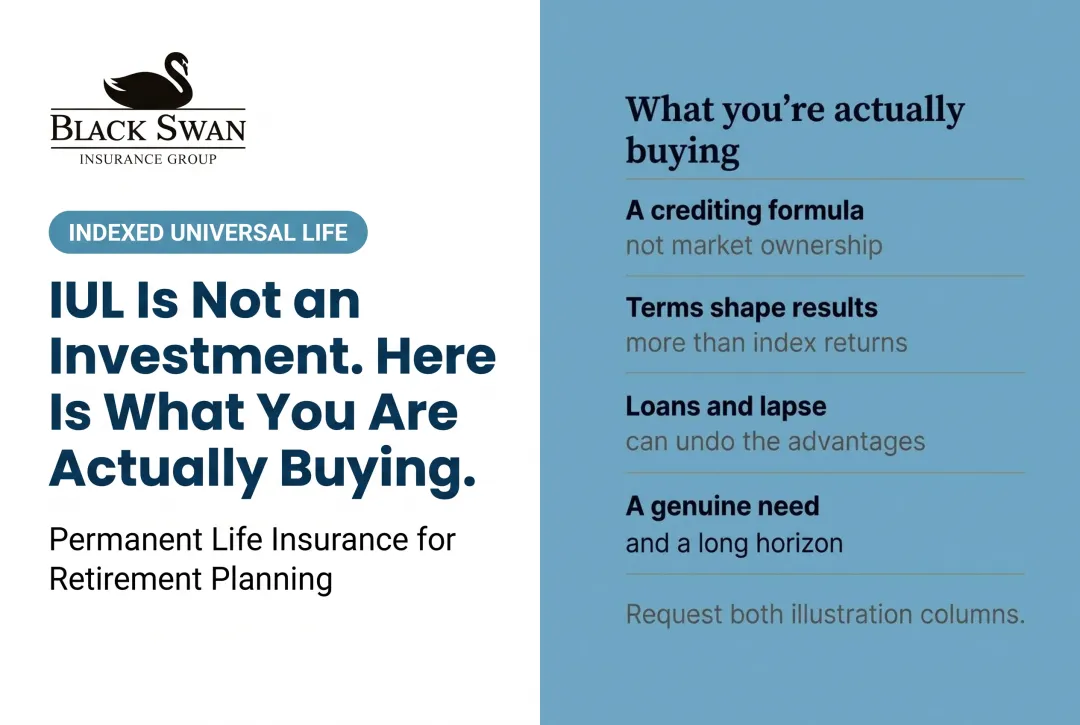
Most explanations of indexed universal life stop at "your cash value grows with the market." That sentence is wrong in a way that costs people money.
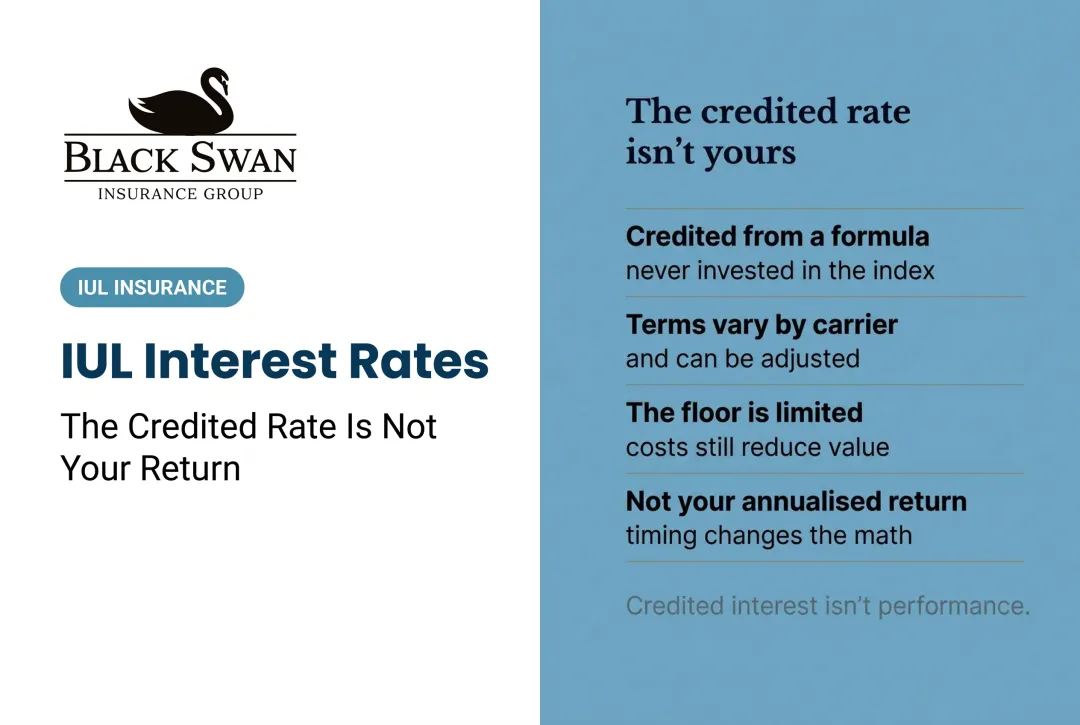
Your cash value does not buy shares. It does not receive dividends. What happens is that the insurer runs a crediting formula — shaped by a cap, a floor, a participation rate, sometimes a spread — using the index as a reference point, and adds the result to an account that has already had the cost of insurance and administrative charges taken out of it.
Understand that sequence and everything else about this product becomes legible: why the early years look disappointing, why a 0% floor does not stop your value falling, and why two people with identical policies end up in completely different places.
This matters most to the people being shown these illustrations — $150K+ earners who have maxed the 401(k), run into the Roth income limits, and are being told a policy is the natural next bucket. It might be. But not on the strength of a projection nobody walked you through.
The short answer: An IUL is permanent life insurance with a cash-value account. Premium goes in, the insurer deducts cost of insurance, administrative fees, rider charges and premium expenses, and the remainder is allocated to indexed or fixed accounts. Interest is then credited on a formula referencing an external index — limited by a cap, scaled by a participation rate, sometimes reduced by a spread, and floored at typically 0%. The charges continue in a 0% year, so total value can still fall. Caps and participation rates are non-guaranteed and can be reset at renewal.
Key Takeaways
- An IUL pairs a death benefit with cash value funded by flexible but contractually limited premiums
- Index-linked crediting is a formula, not market ownership — the index's full performance is rarely credited
- Caps, participation rates, spreads, floors and rising insurance costs all shape the real result
- Loans and withdrawals unlock cash value but reduce the death benefit and can cause a lapse
- This is one piece of a plan, not a replacement for a 401(k), an IRA or an emergency fund
What an IUL Is
Permanent life insurance, in force for life while adequately funded, with two moving parts:
- Death benefit protection — the payout beneficiaries receive
- Cash value — an accumulating component credited through an index-linked formula
"Indexed" describes how interest is calculated. The insurer tracks an external index and uses it as a reference. You never own shares, and dividends are usually excluded. Pacific Life notes that its indexed accounts based partly on the S&P 500 exclude dividends from the crediting math — a detail most buyers never hear.

What It Is Not
- Not a mutual fund or a brokerage account
- Not direct market participation
- Not a guarantee of high, or even average, returns
- Not a vehicle where the index's full performance flows into your policy
How It Sits Against the Alternatives
| Product | Cash-value growth | Built for |
|---|---|---|
| Term life | None — pure protection | Temporary income replacement, at the lowest cost |
| Whole life | Fixed, guaranteed | Predictable, locked-in cash value |
| IUL | Index-linked formula, capped and floored | Flexible funding with crediting protection and limited upside |
| Variable universal life | Direct subaccount exposure | Owners comfortable carrying market losses |
Death benefits are generally received income tax-free, and cash value grows tax-deferred inside the policy. Actual treatment depends on structure, MEC status and current law.
The Sequence: Premium In, Credit Out
Funding
Premiums are flexible within contract limits, and flexible does not mean optional forever. Enough value or premium has to be present to cover the cost of insurance and ongoing charges, or the contract lapses.
- Minimum funding keeps the death benefit active without prioritising cash value
- Higher funding builds cash value faster, subject to policy rules and federal limits
Cost depends on age, health class, death benefit, riders, design and the carrier's pricing. There is no universal monthly premium for a given coverage amount.
Funding too aggressively pushes the contract into modified endowment contract status. Under the seven-pay test in IRC Section 7702A, the IRS compares premiums paid in the first seven contract years against a prescribed benchmark. Cross it and you lose the favourable loan and withdrawal treatment that motivated the design in the first place.
Charges, Then Allocation
Before anything reaches cash value, the insurer typically deducts cost of insurance, administrative fees, rider charges, premium expenses and — in early years — surrender charges. What survives is allocated among indexed accounts and, where offered, a fixed account.
Here is the part most buyers miss: the charges continue when the index credits 0%. A floor protects against negative index performance. It does not protect against monthly deductions. Total cash value can fall in a flat year.
Zero is your hero in a down year — but only in the sense that the credit did not follow the market off the cliff. The policy still bills you.
The Crediting Methods
- Annual point-to-point — index change from the start to the end of a 12-month period
- Monthly point-to-point — each month's change, summed over the year, subject to a monthly cap
- Averaging — an average index value across a period rather than a single point
A simplified, hypothetical example of one formula:
If the index rises 10% during the crediting period, a 60% participation rate produces a 6% raw result. A 5% cap then limits the actual credit to 5%. Illustrative only, and not a forecast.
The definitions worth locking down:
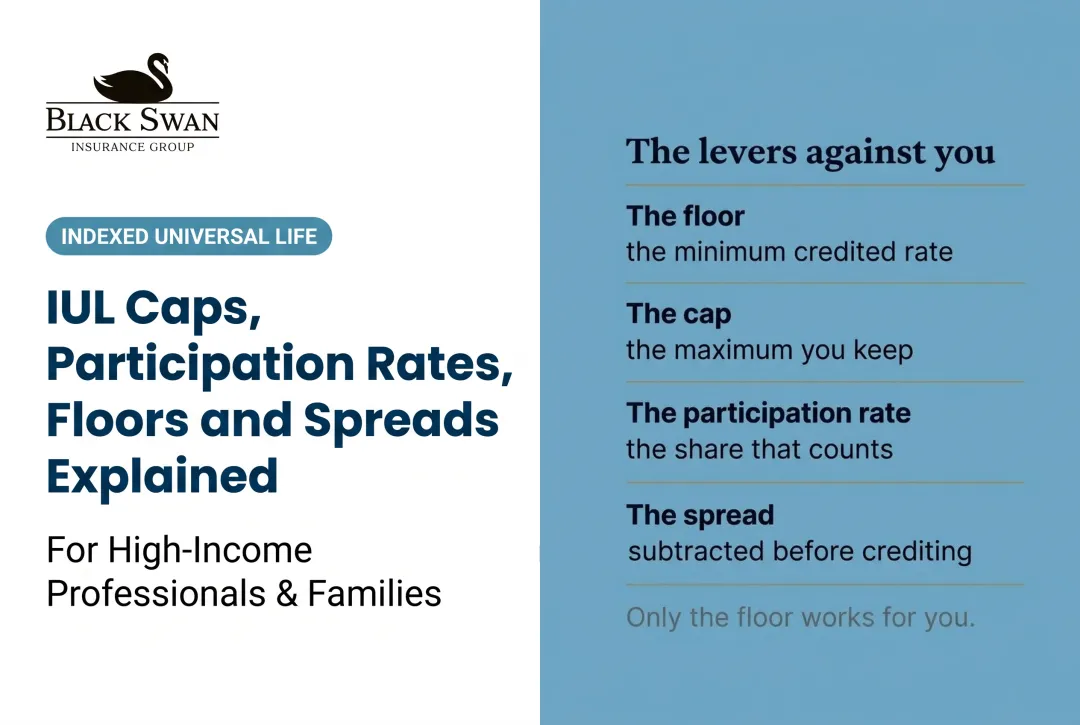
- Cap — the maximum credited interest for that period
- Participation rate — how much of the index-linked gain the policy can credit
- Spread — an amount subtracted from index growth before crediting, used instead of or alongside a cap
- Floor — the minimum credit, often 0%, preventing negative index performance from directly reducing credited interest
None of these are guaranteed for life. Caps, participation rates, spreads and bonus features are typically non-guaranteed and can change at renewal, subject only to a contractual minimum. The NAIC notes that basic illustrations must separate guaranteed elements locked in at issue from non-guaranteed elements carriers can adjust. Verify each feature in the contract, not the sales illustration.

Getting the Money Out
- Policy loans — borrow against cash value, subject to available value and interest
- Withdrawals — take money directly, reducing cash value and death benefit
- Surrender — cancel for the cash surrender value, usually reduced by surrender charges
A loan is not costless. Interest accrues, and if the balance grows large relative to policy value, lapse risk rises sharply. An unpaid loan at lapse with gain in the contract can create a taxable event with no cash received to pay it.
Withdrawals reduce cash value and death benefit and may carry tax consequences depending on your basis and whether the contract remains properly structured, funded and managed as a non-MEC.
At death, beneficiaries receive the death benefit minus any outstanding loan and accrued interest.
Before borrowing, withdrawing or surrendering, review the loan provisions and how interest is calculated, withdrawal limits and fees, the surrender charge schedule, and the lapse and grace-period rules.
What the Critics Get Right
The people who say this product is too complicated for most buyers have a point, and dodging it would be dishonest.
They are right that the crediting formula is opaque enough that most owners could not explain it to a spouse — and if you cannot explain it at the kitchen table, it is not ready for your household. They are right that non-guaranteed caps mean the carrier holds a lever it can pull after you are committed. And they are right that the "market-linked growth" framing oversells what a capped, dividend-excluded, charge-reduced credit actually delivers.
Where the criticism runs out is in treating complexity as automatic disqualification. A mortgage is complicated. The question is whether the mechanics were explained honestly and whether the design survives a bad decade. Complexity is a reason to demand a proper explanation, not a reason to assume fraud.
Where It Fits in a Plan
An IUL makes sense for households with a genuine, ongoing permanent insurance need and stable cash flow — not because an illustration shows an attractive number thirty years out.
Common contexts: family protection paired with long-term accumulation, estate and legacy planning, business-owner protection and succession, supplemental retirement income alongside other accounts, and occasionally education funding through cash value.
Six Questions Before You Apply
- Time horizon — enough years to fund the policy and let cash value build past the early charges?
- Health and insurability — will underwriting classify you favourably?
- Emergency reserves — is a cash-flow disruption already covered elsewhere?
- Existing contributions — are you capturing the full employer match and funding tax-advantaged accounts first?
- Liquidity and debt — will you need this money sooner than the design assumes?
- Willingness to monitor — are you prepared for an annual review, every year?
The Ultimate IUL Blueprint
If you want the framework behind the design decisions — funding levels, the minimum death benefit, the MEC line, index-strategy selection and loan timing — that is what the Blueprint covers.
Who This Actually Fits
Stronger Fit
- Household income of $150K+ with stable or growing surplus cash flow
- A real permanent protection, legacy or business-continuity need standing on its own merits
- Roughly $500–$2,500 a month of funding capacity that does not touch reserves
- Already funding retirement accounts and deliberately seeking a second tax-advantaged bucket
- A long horizon and genuine willingness to review the contract annually
- Insurable, and clear that any potential tax-advantaged access is conditional on the policy being properly structured, funded and managed
Weaker Fit
Not everyone should buy an IUL. Understanding the formula is not the same as needing the contract it sits inside.
- Foundational coverage is missing — term insurance comes first, and often it is the whole answer
- An employer match is going uncaptured
- Emergency reserves are thin or retirement contributions are behind
- Money is likely needed before the contract builds accessible value
- No appetite for monitoring caps, funding and loan balances year to year

If you cannot explain the strategy to your spouse in plain English, it is not ready for your household.
Risks to Understand Before You Apply
- Charges continue in a 0% crediting year, so total cash value can fall even with the floor intact
- Cost of insurance rises with age, and it is deducted whether or not the index credits anything
- Caps, participation rates and spreads are non-guaranteed and can be reset at renewal
- Dividends are excluded from index crediting, so the reference is not total market return
- Surrender charges apply in the early years, exactly when a buyer is most likely to want out
- Underfunding is the most common failure mode, and flexible premiums make it easy
- Loan interest compounds, reduces the death benefit, and an unpaid loan at lapse or surrender with gain can create taxable income
- Crossing the seven-pay limit makes the contract a MEC under I.R.C. § 7702A and changes distribution taxation permanently
- Illustrated values are not guarantees — read the guaranteed column first
Find Out Where You Actually Stand
This starts with the Tax-Free Wealth Blueprint Fit Review. If you earn $150K+ and are trying to work out whether an IUL belongs in your plan, we run your numbers, stress-test the funding, show the fees, the caps and the loan assumptions, and compare it honestly against term insurance plus diversified savings. If it does not fit, we will tell you that too.
Frequently Asked Questions
How much does a $1,000,000 policy cost per month?
It depends on age, health class, underwriting results, death benefit structure, riders, funding design and the carrier's pricing. There is no universal figure; a personalised quote is the only real answer.
How does an IUL pay out, and can I borrow against it?
At death, beneficiaries receive the death benefit less any unpaid loan and interest. You can generally borrow against cash value while alive, but unpaid loans accrue interest, reduce the death benefit and raise lapse risk if left unmanaged.
What is the average rate of return?
There is no reliable average. Cash value grows through index-linked crediting limited by caps, participation rates, floors and spreads, then reduced by ongoing charges. Illustrated rates are assumptions.
Is an IUL a good idea?
It depends on whether a genuine permanent insurance need exists, whether you can fund it long term, whether liquidity is covered elsewhere, and whether your objectives are clear. It is not right for everyone, and that is not a hedge.
Is it better than a 401(k)?
They serve different purposes. A 401(k) often carries an employer match and contribution limits; an IUL provides protection with flexible, tax-deferred cash value. Capture the match first, then decide what the next dollar should do.
Should I buy term instead?
If the need is temporary and the goal is the most death benefit for the lowest premium, yes, and that is worth saying plainly. Permanent coverage earns its place when the protection need genuinely outlasts a term.
Sources
- Pacific Life — Indexed universal life insurance
- IRS guidance on the Section 7702A seven-pay test
- NAIC — Life Insurance Illustrations
- NAIC — Life Insurance
- I.R.C. § 7702A and Rev. Proc. 2008-39 (modified endowment contracts and the seven-pay test)
Disclosure: This article is educational and is not personal tax, legal or investment advice. Indexed universal life is life insurance first. Actual results depend on policy design, carrier, crediting options, caps, participation rates, expenses, funding and ongoing management. Policy loans and withdrawals may reduce cash value and death benefit and can create tax consequences if the policy lapses or becomes a modified endowment contract. This strategy is not appropriate for everyone. Illustrated values are not guarantees; actual results depend on policy terms, crediting, costs and funding. Consult your own tax, legal and financial professionals for advice specific to your situation.
And remember, it's not what you earn, it's what you keep… enjoy the ride.