By Robert Balgac, Founder, Black Swan Insurance Group | October 9, 2026
Indexed universal life and whole life both promise something most financial products cannot: coverage that lasts your entire life, plus cash value you can reach while you are still around to use it. Treating them as interchangeable is an expensive mistake, and it is the default one.
Plenty of high earners buy whichever policy their adviser mentioned first. A Texas Department of Insurance consumer guide states the distinction that matters: whole life premiums and cash values are guaranteed under the contract, while IUL premiums are adjustable — and insufficient funding can draw down cash value fast enough to cause a lapse. That is a regulator, not a competitor, describing the failure mode.
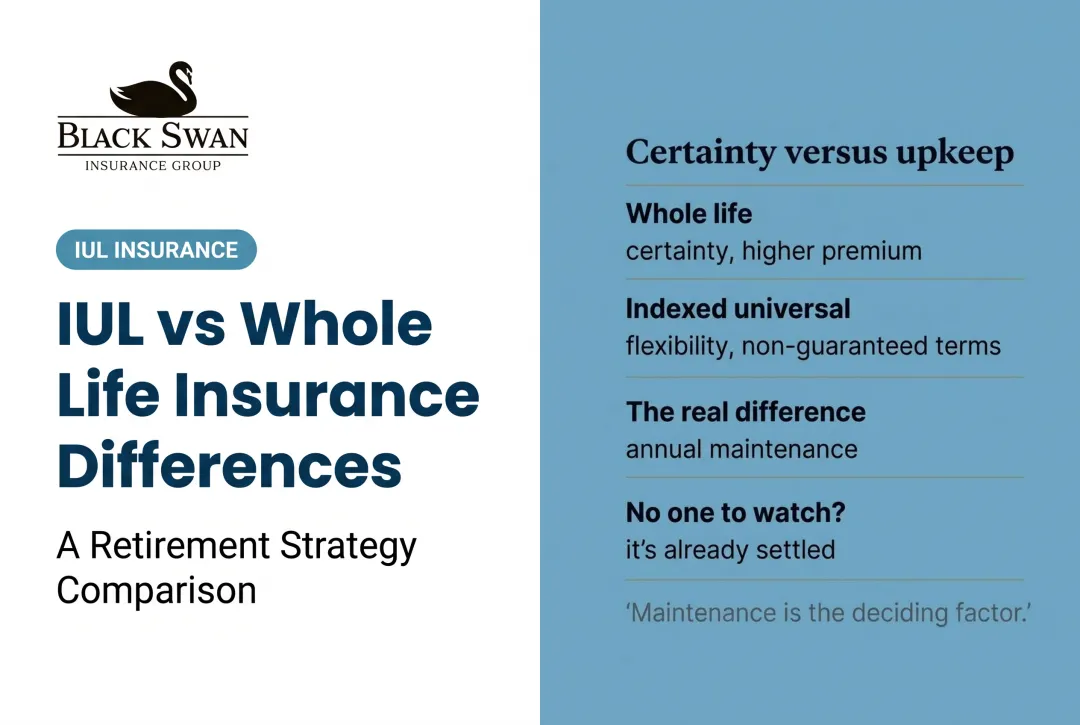
The short answer: whole life is a contract. IUL is a contract plus a plan, and the plan is yours to maintain. If you earn $150K+, have maxed the 401(k) and hit the Roth phase-out, the choice is between paying more for certainty and paying less now in exchange for an obligation that lasts as long as the policy does.
For families juggling mortgages, education costs and retirement timelines, picking the wrong structure means overpaying for flexibility you never used, or underfunding a policy that depended on you not to.
Key Takeaways
- IUL ties cash value to a market index with flexible premiums; whole life locks fixed premiums and guarantees
- IUL floors block negative index credits, but fees and insurance costs can still shrink cash value
- Whole life builds cash value steadily, usually at a higher premium with slower early growth
- Compare guarantees to illustrations — caps, participation rates and surrender terms — before buying
- Choose on budget, risk tolerance, time horizon and how closely you will monitor the contract
The Full Comparison
| Factor | IUL | Whole Life |
|---|---|---|
| Premiums | Adjustable within policy limits; underfunding raises lapse risk | Fixed and predictable for the life of the policy |
| Cash value growth | Index-linked crediting shaped by caps, participation rates, and floors | Guaranteed growth, plus potential non-guaranteed dividends |
| Death benefit | Adjustable, subject to underwriting and sufficient funding | Fixed and guaranteed when contractual requirements are met |
| Predictability | Illustrated values above the guaranteed floor aren't promised | Guaranteed values are stable; dividends fluctuate |
| Complexity | Requires regular review of charges, caps, and funding | Generally simpler, but loans and withdrawals still need attention |
Premiums
IUL premiums flex up or down within policy limits, which sounds appealing until a few payments are missed. When premium falls below the policy's internal charges, the shortfall comes out of cash value — and exhausted cash value triggers a lapse.
Whole life premiums are generally fixed for the life of the contract. Less flexibility, far fewer surprises.
Cash value growth
IUL crediting depends on the index selected, the cap (maximum credited return), the participation rate (how much of the index movement counts), and the floor (minimum credited rate, often 0%).
A Pacific Life policy guide lists current caps and participation rates that vary by account and change over time, because they are not guaranteed figures. Read that sentence twice before you build a retirement projection on one of them.
Whole life cash value grows at a guaranteed rate specified in the contract. Participating policies may also pay dividends, never guaranteed.
Death benefit and predictability
IUL death benefits can often be adjusted up or down, subject to underwriting and adequate funding. Useful if coverage needs shift; it also means the benefit is not locked the way whole life's is.
IUL illustrations show projected growth above the guaranteed floor. Those numbers are not promises — internal charges, cost of insurance and changing caps all move real performance away from them. Whole life trades upside potential for stability, though dividends, where applicable, still depend on insurer performance.

An illustration is a model, not a guarantee.
Complexity and management
IUL requires ongoing attention: funding levels, crediting assumptions, caps and lapse risk all shift. Whole life is easier to monitor, though loans, withdrawals and beneficiary designations deserve periodic review.
What Each Product Is
Indexed universal life
Permanent life insurance pairing a death benefit with cash value credited based on an external index's performance, such as the S&P 500. You do not own the index — caps, participation rates, spreads, floors and fees shape what actually reaches your account.
A floor typically limits negative index crediting. It is not a blanket guarantee against losing value, because insurance costs and policy charges accrue regardless of what the index did.
Zero is your hero in a down year — but the floor applies to the credit, not to the charges.
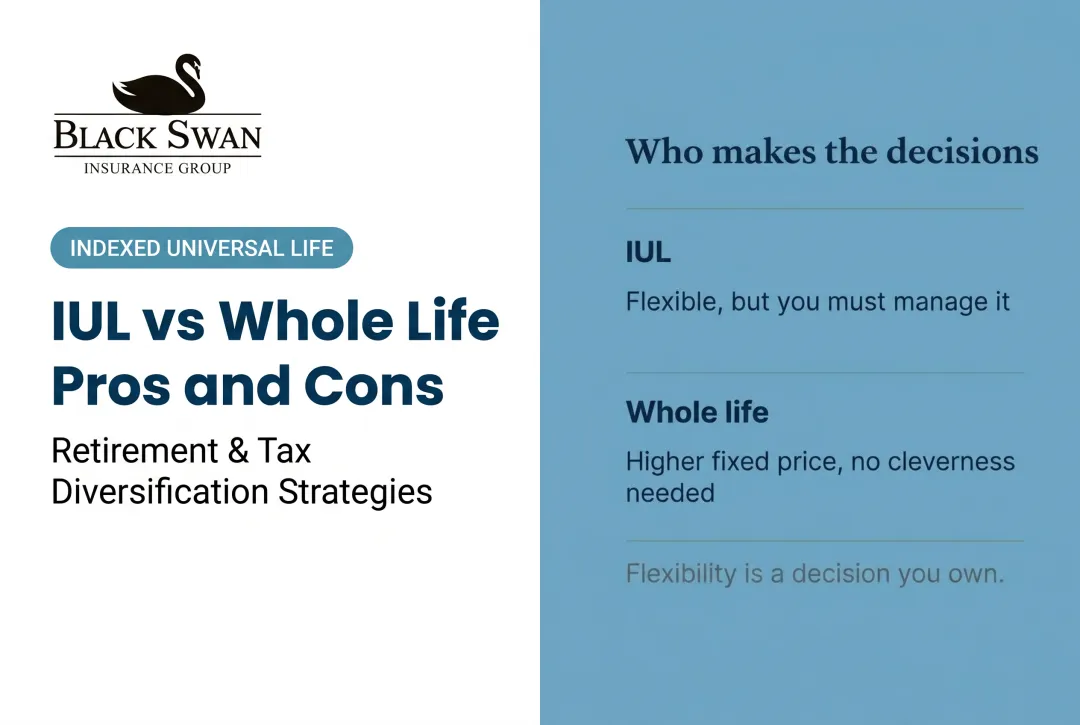
Flexibility cuts both ways. Adjustable premiums and death-benefit options can fit a changing income, and they put the funding responsibility squarely on you. Before buying, ask specifically about rising cost of insurance as you age, caps or participation rates that can change, surrender charges in early policy years, how loans are treated and taxed, and what underfunding does to lapse risk.
Whole life
Permanent coverage with a fixed premium structure and cash value that includes contractually guaranteed elements. Participating whole life may also pay dividends — not guaranteed, and not to be confused with the guaranteed cash value.
That mix often suits buyers who want simpler long-term management for estate or legacy planning. Participating policies can add dividends on top: MassMutual projected more than $2.5 billion in dividends for eligible policyholders in 2025. Impressive, and still set annually and still not guaranteed. A dividend scale is a forecast of the insurer's experience, not a term of your contract.
Common trade-offs: higher premiums than term insurance, less flexibility than IUL, surrender charges in early years, and slower cash-value growth early on. Loans and withdrawals reduce available cash value or the death benefit, with possible tax consequences depending on how the policy is managed.

The Ultimate IUL Blueprint
If you are comparing these two seriously, the Blueprint covers what an IUL design has to survive: funding levels, caps and charges, the MEC line, loan timing, and what to demand from an illustration.
Which Fits Which Goal
The better question is what job the policy must do. Permanent protection, legacy planning, supplemental retirement flexibility, business liquidity and cash-value accumulation point in different directions.
Whole life when predictability is the priority — fixed premiums with no funding surprises, contractual guarantees on cash value and death benefit, a stable benefit independent of index performance, simpler long-term management. Business owners and affluent families use it for permanent protection and liquidity planning, as a complement to other tools rather than a replacement.
IUL when flexibility and index-linked potential matter — variable income or changing coverage needs, a long horizon with surplus cash flow, and a willingness to review performance annually. Never choose IUL because an illustration shows an attractive projected value. Compare guaranteed and conservative assumptions side by side.
Compare against the alternatives first
Permanent insurance should not be the first stop. Weigh it against term insurance for straightforward income replacement, qualified retirement plans such as a 401(k), Roth strategies where you are eligible, taxable brokerage accounts, disability coverage and emergency reserves, and business succession or buy-sell planning.
A "no-fit" conclusion is often the right one.
What the Critics Get Right
The honest criticism of this comparison is that it is usually conducted between two products when it should first be conducted between permanent insurance and nothing at all.
Most buyers who think they need permanent coverage need term insurance and a higher savings rate. The permanent sale is made easier by illustrations that make the cash value look like a savings account with a free death benefit attached, when it is a death benefit with a constrained savings feature attached. That framing error is on the industry, and it is worth saying out loud.
The criticism loses force only in a specific case: a high earner with full tax-advantaged buckets, a permanent estate or business-continuity need, and the cash flow to fund a contract properly for decades. If that is not you, the critics are describing your situation accurately and you should take the advice.
A great IUL is engineered. A bad IUL is sold.
Three Situations, Three Reads
Predictable legacy protection. Two working parents, a mortgage, and a clear goal: guarantee a death benefit for their children regardless of markets. Fixed budgeting beats growth potential here, which points to whole life's contractual guarantees over IUL's index-dependent projections.
Variable income and long-term accumulation. A business owner with fluctuating income and a long horizon might evaluate IUL for premium flexibility and index-linked crediting. Before committing, stress-test lower crediting years, rising insurance costs, reduced premium payments, and the resulting lapse risk. Do not rely on the best-case illustration alone.
The late-start high earner. A 45-to-55-year-old high earner with a compressed retirement runway must prioritise insurability, sustainable funding and liquidity, and compare permanent insurance honestly against retirement accounts and other investments. IUL is not automatically right here. Time horizon and funding capacity matter more than the pitch — a shortened funding window leaves too little time for cash value to absorb early charges before income is needed from it.
Policy review checklist
Whichever product you are evaluating, request the policy illustration in both guaranteed and current ledgers, expense and cost-of-insurance breakdowns, cap and participation-rate history where available, the surrender charge schedule, and loan provisions with lapse assumptions. Then review annually, comparing actual funding and performance against the original assumptions.
This is not set-it-and-forget-it. It is design-it, fund-it, review-it.

Black Swan Insurance Group's process follows that pattern — needs assessment, tailored coverage exploration, transparent sign-up, and continued guidance through annual reviews. We have used this approach with more than 20,000 families and businesses since 2017 and hold an A+ Better Business Bureau rating.
Stronger Fit
Permanent coverage of either kind deserves consideration if you:
- Earn $150K+ with dependable surplus after reserves, debt and maxed retirement contributions
- Have a genuine lifelong protection, estate or business need
- Are insurable at a reasonable rate with a long horizon
- Will read an annual statement and act on it, if you choose IUL
Weaker Fit
Not everyone should buy either. Step back if you cannot sustain the funding commitment, need near-term liquidity, lack a genuine permanent insurance need, carry higher-priority debt, or have unfilled tax-advantaged retirement space. Assess age, health and insurability, dependents, debt and business obligations, desired death benefit and retirement timeline, cash-flow stability and tax position, and your real comfort with policy complexity — then involve a licensed professional and your tax or legal adviser.
Risks to Understand Before You Choose
- Underfunding is IUL's defining risk, and the Texas regulator describes exactly how it ends.
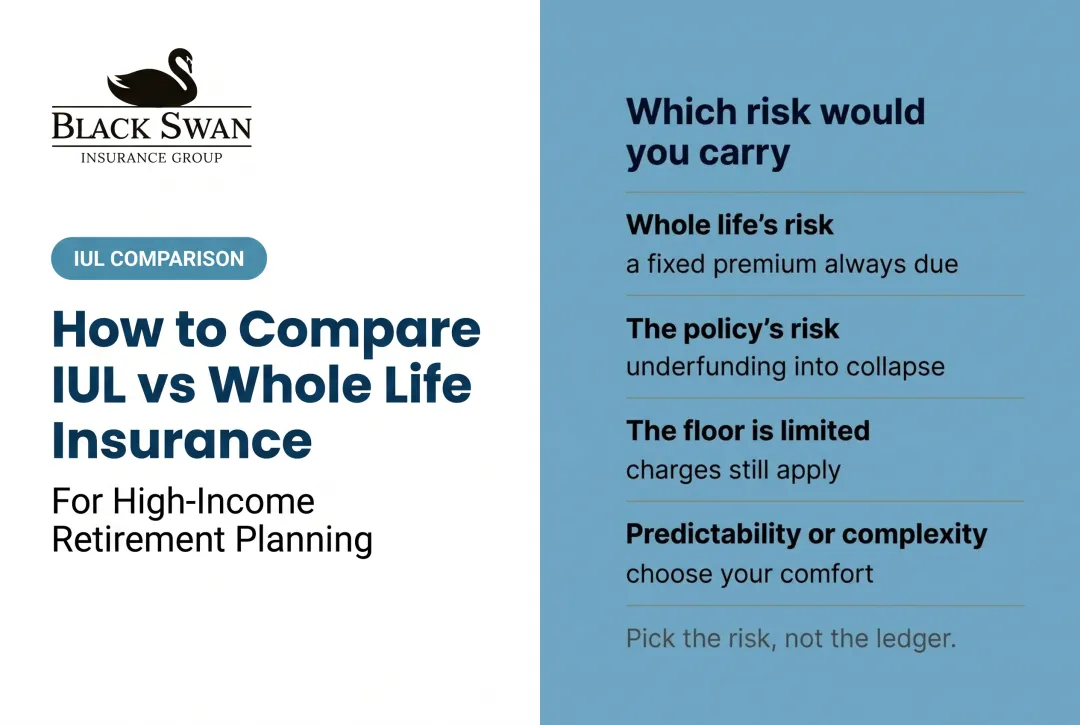
- Whole life's defining risk is cost — a fixed premium owed in every year, suitable or not.
- Caps and participation rates change, subject to contract minimums, and your illustration does not.
- Cost of insurance rises with age, which is why late-year charges break thinly funded designs.
- Dividends are never guaranteed, including a record-setting scale.
- Loans and withdrawals reduce cash value and death benefit; an unpaid loan at lapse can be taxable with no cash received.
- Replacement or a 1035 exchange brings new underwriting, surrender charges and fresh contestability.
Find Out Where You Actually Stand
This starts with the Tax-Free Wealth Blueprint Fit Review. If you earn $150K+ and want a comparison built around your numbers rather than a product sheet, we define the job the coverage has to do, read guaranteed against illustrated values side by side, compare loan and access mechanics, and stress-test both designs through lower crediting and a reduced-income year. If term solves your problem, we will say so and you will have spent nothing. If IUL does not fit, we will tell you that too.
Frequently Asked Questions
What is the difference between IUL and whole life insurance?
IUL links cash value crediting to a market index with adjustable premiums and death benefit; whole life offers fixed premiums, guaranteed cash value and a predictable death benefit. Exact terms vary by carrier and policy.
Is IUL or whole life better for retirement income?
Neither automatically. Compare funding capacity, time horizon, policy charges, guaranteed versus illustrated assumptions, and alternatives like a 401(k) or Roth IRA with a qualified professional.
Which is more affordable?
IUL may have lower or more flexible initial funding requirements; whole life is more predictable long-term. Compare total funding needed over the life of the policy, not the first premium.
Can you lose money in an IUL?
A floor limits negative index crediting but does not eliminate insurance costs, fees, loan effects or lapse risk. Review the guaranteed ledger and the policy charges, not just index performance.
Does whole life have guaranteed cash value?
Yes, whole life contracts generally guarantee cash value growth when required premiums are paid. Dividends and other non-guaranteed elements are not part of that guarantee.
Can you switch from whole life to IUL?
Replacing coverage usually requires a new application and underwriting. Factor in surrender charges on the old policy, loss of existing benefits and tax considerations before comparing a replacement against simply keeping what you have.
Sources
- Texas Department of Insurance — life insurance consumer guide
- Pacific Life — Horizon IUL 2 policy guide
- MassMutual — record dividend announcement
Disclosure: This article is educational and is not personal tax, legal or investment advice. Indexed universal life is life insurance first. Product features, guarantees, dividends and availability vary by carrier and state, and all guarantees are subject to the issuing insurer's claims-paying ability; dividends on participating policies are never guaranteed and historical dividend performance does not predict future results. Illustrated values are not guarantees; actual results depend on policy terms, crediting, costs and funding. Any potential tax-advantaged access depends on the policy being properly structured, funded and managed. Actual results depend on policy design, carrier, crediting options, caps, participation rates, expenses, funding and ongoing management. This strategy is not appropriate for everyone. Policy loans and withdrawals reduce cash value and the death benefit, and can create tax consequences if the policy lapses or becomes a modified endowment contract. Consult your own tax, legal and financial professionals for advice specific to your situation.
And remember, it's not what you earn, it's what you keep… enjoy the ride.