By Robert Balgac, Founder, Black Swan Insurance Group | October 5, 2026
If you earn $150K+ and someone has shown you an IUL illustration with a smooth upward curve, you have probably been told the cash value "compounds." The curve is real arithmetic. The word is doing more work than it should.
Compounding, in the ordinary sense, means your balance earns a return and next year's return is calculated on the larger balance. That does happen inside an indexed universal life policy. What also happens, every single month, is that the policy deducts the cost of insurance, administrative charges and any rider costs. The growth is gross. What you keep is net. A compound-interest account has no such deduction, and that difference is the entire subject of this page.
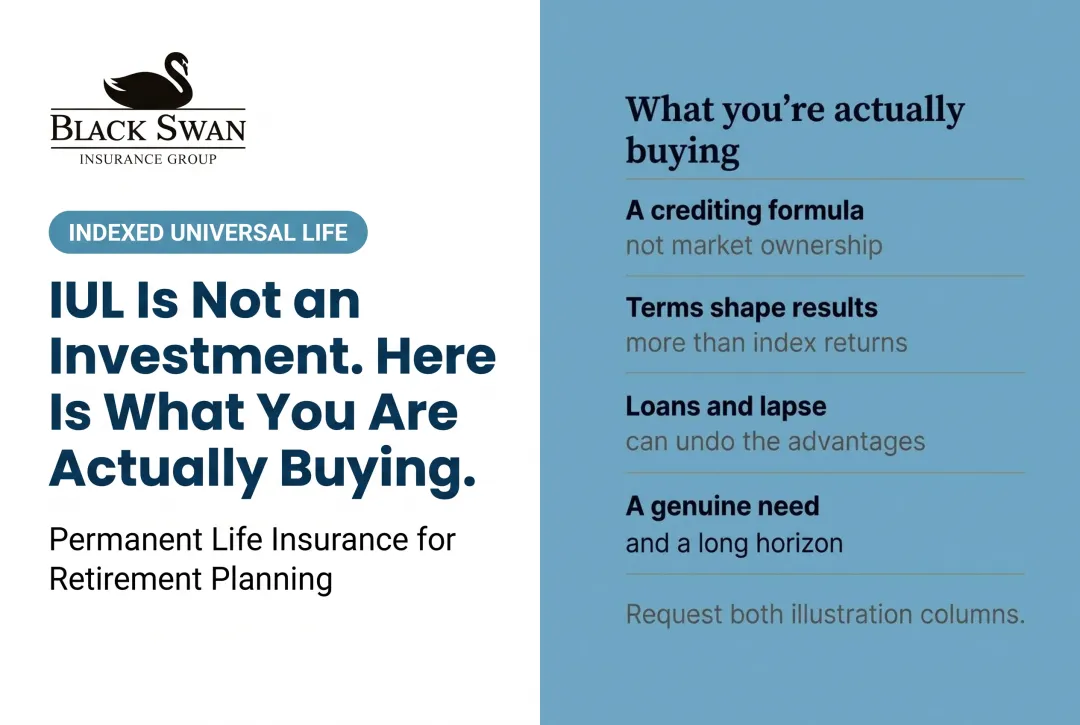
The short answer: Cash value inside an IUL can grow on a compounding basis, because credited interest is applied to an increasing account value. But an IUL is not a compound-interest account. Policy charges are deducted monthly regardless of crediting, caps and participation rates limit the credited rate, and a 0% floor stops a negative index credit without stopping the charges. The honest description is compounding net of costs, not compounding.
Key Takeaways
- Credited interest does compound inside the policy, but it compounds on the account value that remains after monthly charges are taken
- A 0% floor protects the credit, not the account — in a flat year the index credits nothing and charges still run, so cash value can fall
- Caps and participation rates mean the credited rate is rarely the index return, and the gap compounds too
- The first several years are the slowest, because early charges and any surrender schedule work against a small account value
- Compare the net result against a taxable brokerage account, a 401(k) and a Roth before deciding the structure is worth its cost
What "Compounding" Actually Means Inside an IUL
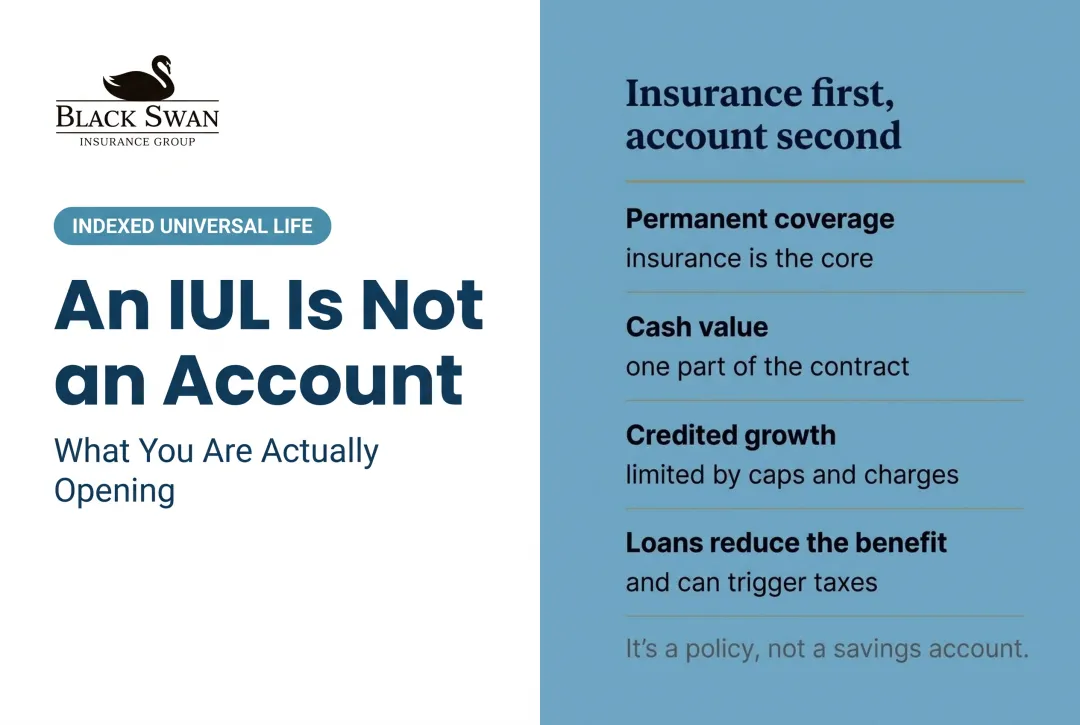
An IUL is permanent life insurance first. The cash value is a component of that contract, not a savings account sitting alongside it. Any potential tax-advantaged access later depends on the policy being properly structured, funded and managed.
Here is the sequence that runs each month and each crediting period:
- You pay premium; a premium load is deducted before anything reaches the account
- Monthly charges come out: cost of insurance, administrative fees, rider charges
- At the end of the crediting period, an index-linked formula determines the credited rate
- That rate is applied to the account value that survived steps 1 and 2
- Next period repeats, on the new balance
Step 4 is genuine compounding. Steps 1 and 2 are why the word alone is misleading.

The illustration is a model, not a promise. A smooth curve is a series of assumptions wearing a suit.
The Floor Applies to the Credit, Not the Policy
This is the single most misunderstood mechanic in the product. A 0% floor means the index-linked credit will not be negative. It does not mean the account value cannot fall. In a year where the index finishes flat or down, you are credited zero and still billed cost of insurance and administrative charges. Net movement for that year is negative.
Zero is your hero in a down year — not because the policy has no costs, but because the index crediting did not follow the market off the cliff. Those are different claims and only the second one is true.
Caps, Participation Rates and Spreads
The credited rate is not the index return. Three levers sit between them:
- Cap — the maximum credited rate for that period, regardless of how far the index rose
- Participation rate — the share of the index movement the policy credits
- Spread — an amount subtracted from the index movement before crediting
These are generally non-guaranteed within contract limits, which means a carrier can adjust them. A policy that looked attractive at a 10% cap behaves differently at 7%, and because the shortfall compounds, a small change early costs more than the same change late.
Where the Compounding Story Breaks Down
What the Critics Get Right
Critics of IUL are right about a specific thing, and pretending otherwise damages trust. When a policy is sold on an illustration that shows a steady credited rate every year for thirty years, the buyer is being shown arithmetic that has never once described a real index. Real sequences include flat years and down years, and the order they arrive in matters. Critics are also right that early-year charges are heavy relative to a small account, so the first years look nothing like the curve.
Where the criticism overreaches is in treating every policy as identical. A properly designed contract, funded near the MEC limit with a death benefit sized for cash value rather than for the largest illustration, behaves differently from a minimum-funded policy sold on a big face amount. The product is not the strategy. The design is the strategy.

The First Years Are the Slowest
Premium loads, the cost of insurance on a young policy and any surrender charge schedule all press hardest when the account value is smallest. Compounding needs a base to work on. This is why a policy evaluated at year three tells you almost nothing, and why surrendering early is usually the most expensive decision available.
Run the Comparison Honestly
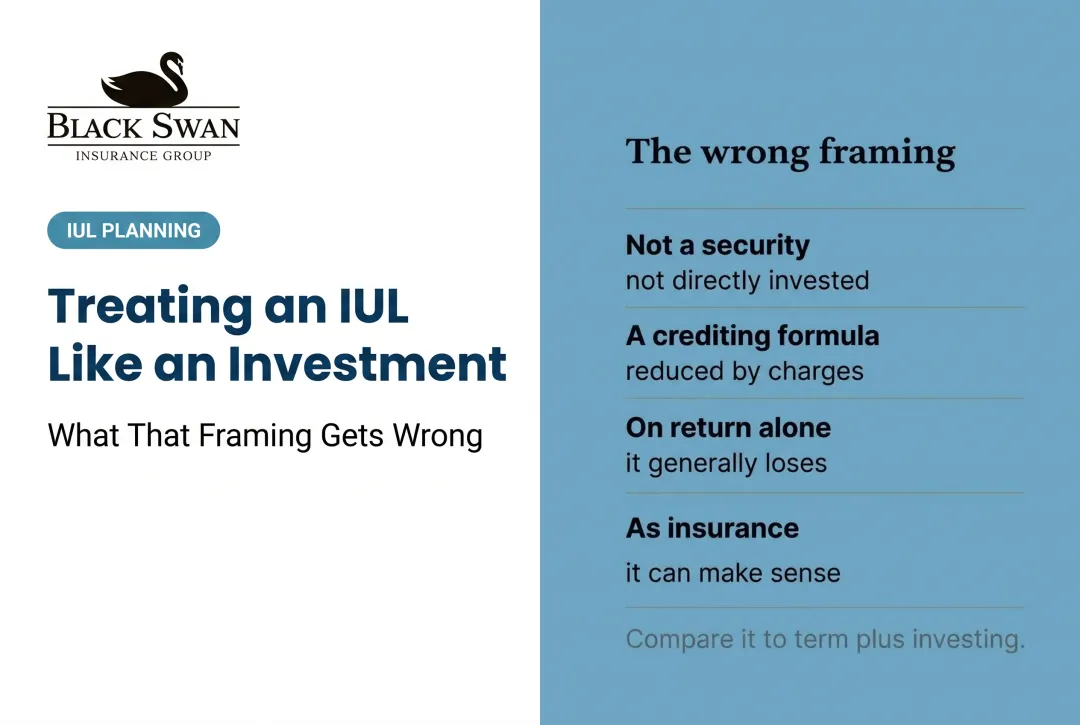
Against a taxable brokerage account, the IUL trades some upside for downside crediting protection and a death benefit, and adds insurance costs the brokerage account does not have. Against a 401(k), the 401(k) generally wins on cost and on the employer match, and the IUL offers a different tax treatment later. Against term insurance plus investing the difference, the term route is cheaper for protection and leaves the investing to accounts built for it — which is the right answer for most households.
The Ultimate IUL Blueprint
A plain-English walkthrough of how funding, design, charges and crediting interact — including how to read a projection and what to ask before you accept one.
Who This Structure May Fit
Stronger Fit
- $150K+ stable income with $500–$2,500 a month available for long-term funding without touching reserves
- A genuine permanent protection, legacy or business-continuity need alongside the cash value goal
- Already capturing the full employer match and funding available retirement accounts
- A twenty-year-plus horizon, so compounding has time to work past the early charges
- Willingness to review the policy annually rather than set it and forget it
Weaker Fit
Not everyone should buy an IUL. If you are here because the word "compounding" sounded like a savings account with better numbers, the honest answer is that it is not one.
- No emergency fund, or high-interest debt still outstanding
- Income that would make the premium a strain in a slow year
- A need for liquidity inside the first several years
- Only a temporary protection need — term insurance is the direct answer and costs a fraction as much

Risks to Understand Before You Fund
- Charges are deducted whether or not interest is credited. A zero-credit year is a net negative year for cash value.
- Caps, participation rates and spreads are generally non-guaranteed within contract limits and can be adjusted by the carrier.
- Underfunding is the most common failure. A policy funded at the minimum premium can lapse decades later, and the illustration that sold it will not have shown that path.
- Surrender charges apply for years. Exiting early usually returns less than was paid in.
- Policy loans and withdrawals reduce cash value and the death benefit, and a lapse with an outstanding loan and gain in the contract can create taxable income with no cash attached.
- MEC risk. Funding above the seven-pay limit under I.R.C. § 7702A changes distribution taxation permanently for that contract.
Find Out Where You Actually Stand
This starts with a fit/no-fit review, not a product recommendation. It is called the Tax-Free Wealth Blueprint Fit Review. If you earn $150K+ and want to know what the net compounding actually looks like on your numbers, we model the charges, the crediting assumptions, a flat decade and the funding required to survive it. If IUL does not fit, we will tell you that too.
Frequently Asked Questions
Does IUL cash value really compound?
Credited interest is applied to the existing account value, so yes, mathematically it compounds. It compounds on the balance remaining after monthly charges, which is why net growth is slower than a gross crediting rate suggests.
Is an IUL the same as a compound-interest savings account?
No. A savings account has no cost of insurance, no caps and no surrender schedule. An IUL is permanent life insurance with a cash value component whose growth is limited by crediting terms and reduced by charges.
What happens to compounding in a flat market year?
The index credit is typically zero under the floor. Charges are still deducted, so the account value usually falls slightly. The floor prevents a negative credit, not a negative year.
Why does the illustration look so smooth?
Because it applies one assumed rate repeatedly. Ask for the guaranteed column and for a version modelling two or three zero-credit years. If the projection only works when everything goes right, it is not a plan.
How long before compounding outruns the charges?
It depends on funding level, design and crediting, and no honest answer exists without your numbers. In general, well-funded policies take many years, and minimum-funded policies may never get there.
Is term insurance plus investing the difference better?
For most households, yes — if you genuinely invest the difference and stay disciplined. Term is not the enemy. Cheap coverage solves a real problem. It just does not solve every problem.
Sources
- NAIC — Life Insurance — universal life and indexed crediting definitions
- NAIC, Life Insurance Illustrations Model Regulation (Model #582) — non-guaranteed element disclosure
- I.R.C. § 7702A — Modified Endowment Contract and the seven-pay test
- I.R.C. § 72 — additional tax on early distributions
- IRS — Retirement topics: contribution limits — 2026 401(k) and IRA limits
Disclosure: The information on this page is educational in nature and does not constitute personalized financial, tax, or legal advice. Actual results depend on policy design, carrier, crediting options, caps, participation rates, expenses, funding, loans, and ongoing management. Policy loans and withdrawals reduce cash value and the death benefit, and can create tax consequences if the policy lapses or becomes a modified endowment contract. Consult a licensed insurance professional and, where appropriate, a tax or financial advisor before making any insurance or financial decision. Indexed universal life is life insurance first. Illustrated values are not guarantees; actual results depend on policy terms, crediting, costs and funding. This strategy is not appropriate for everyone.
And remember, it's not what you earn, it's what you keep… enjoy the ride.