By Robert Balgac, Founder, Black Swan Insurance Group | October 9, 2026
Where to buy indexed universal life is not really a shopping question. It is a decision about which company will carry your policy obligations for the next forty years, and who will help you design, fund and monitor it along the way.
Buyers usually start by comparing quoted premiums, then get caught later by caps, charges or funding gaps nobody raised. Independent distribution now accounts for more than 90% of IUL sales per LIMRA's 2025 data — most buyers are already choosing brokers over single-carrier agents.
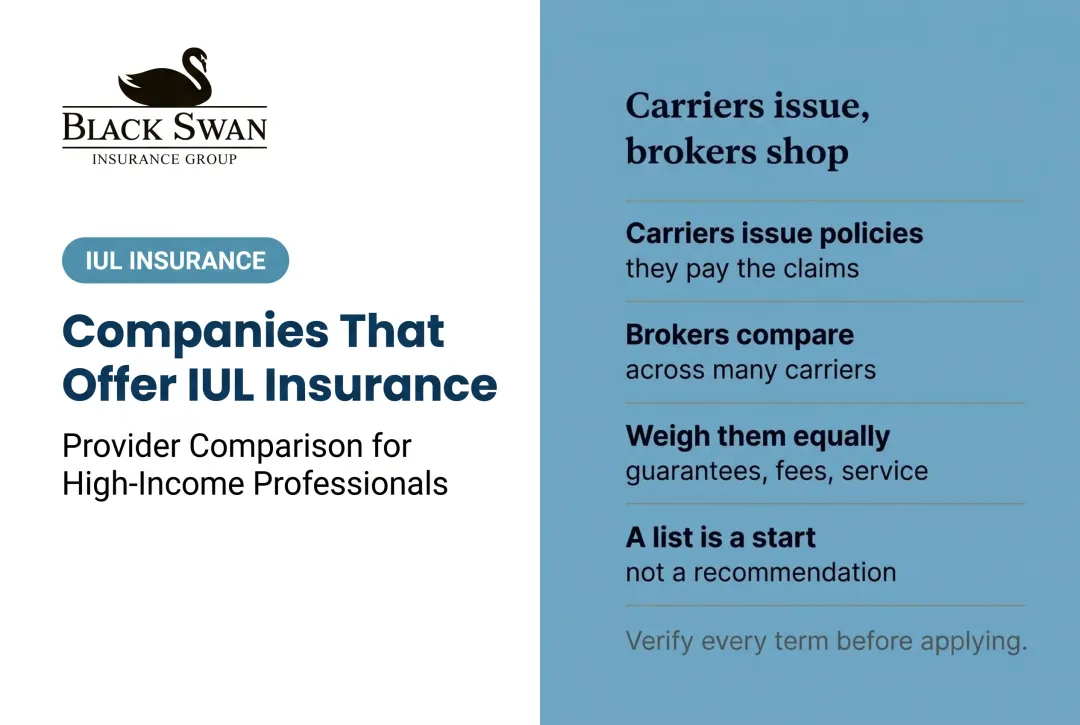
The short answer: You are choosing two things at once, and most people only notice one. The issuing carrier is legally obligated to pay claims and honour guarantees. The intermediary helps you select, apply and service the policy. Channel matters less than the depth of analysis you get and whether anyone is still there in year ten.
Key Takeaways
- Independent brokers enable multi-carrier comparison; direct and online channels trade choice for a simpler application
- Verify the carrier's financial strength, charges, caps, participation rates and loan provisions before signing
- Compare against term, whole life, the 401(k), Roth accounts and taxable investing — this is not an automatic fit
- Seek professional guidance for business succession, estate planning, retirement income or late-start funding
- A quote is not an offer; this is an underwriting process
The Channels
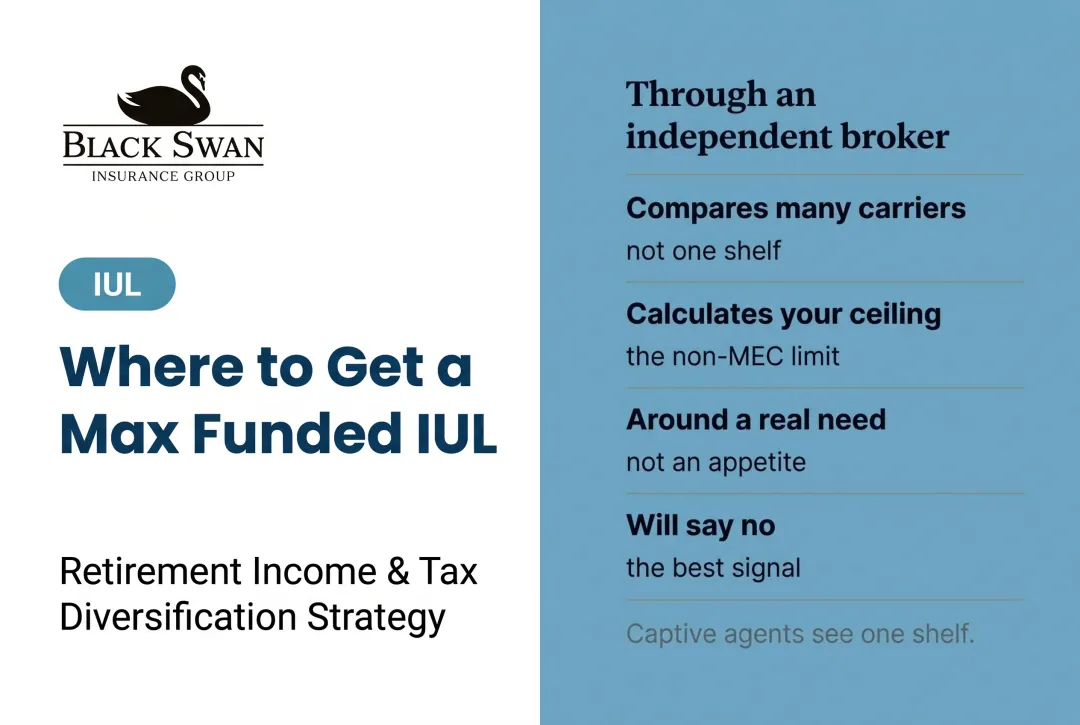
Independent broker. Holds contracts with multiple carriers, allowing comparison of crediting structures, riders and underwriting niches across companies. Ask how many carriers they actually access and which specialise in IUL; how they are compensated and whether that varies by carrier; whether the recommendation would replace an existing policy, and why; and whether annual reviews come after the sale.
Captive agent. Represents one insurer, often with genuinely granular product knowledge. What they cannot do is show you how a competitor's cap or loan provision compares. Ask directly whether the recommendation is limited to one carrier and how alternatives were evaluated.
Direct from the carrier. Removes an intermediary layer and gives direct access to underwriting and policy materials. The trade-off is one product shelf, and digital tools do not replace a person walking you through funding assumptions, lapse risk, or what happens if caps fall.
Online marketplace. Fast quoting and applications. LIMRA found 32% of consumers preferred buying life insurance online in 2023 against 29% preferring in person — a fairly even split, and that data covers life insurance broadly rather than IUL specifically. Confirm who the actual issuing carrier is, what human support exists past the application, and how underwriting and licensing are disclosed.

Black Swan Insurance Group, founded in Ohio in 2017, works through the independent-broker model, specialising in IUL guidance for high-income professionals, business owners and families, partnering with Equis Financial and supporting more than 20,000 families and businesses. Expect a needs assessment and a fit-or-no-fit conversation before any illustration — from any brokerage, not only this one.
The Ultimate IUL Blueprint
Before choosing where to buy, the Blueprint covers what the design has to survive: funding levels, caps and charges, the MEC line, loan timing, and what to demand from an illustration.
How to Judge Whoever You Are Talking To
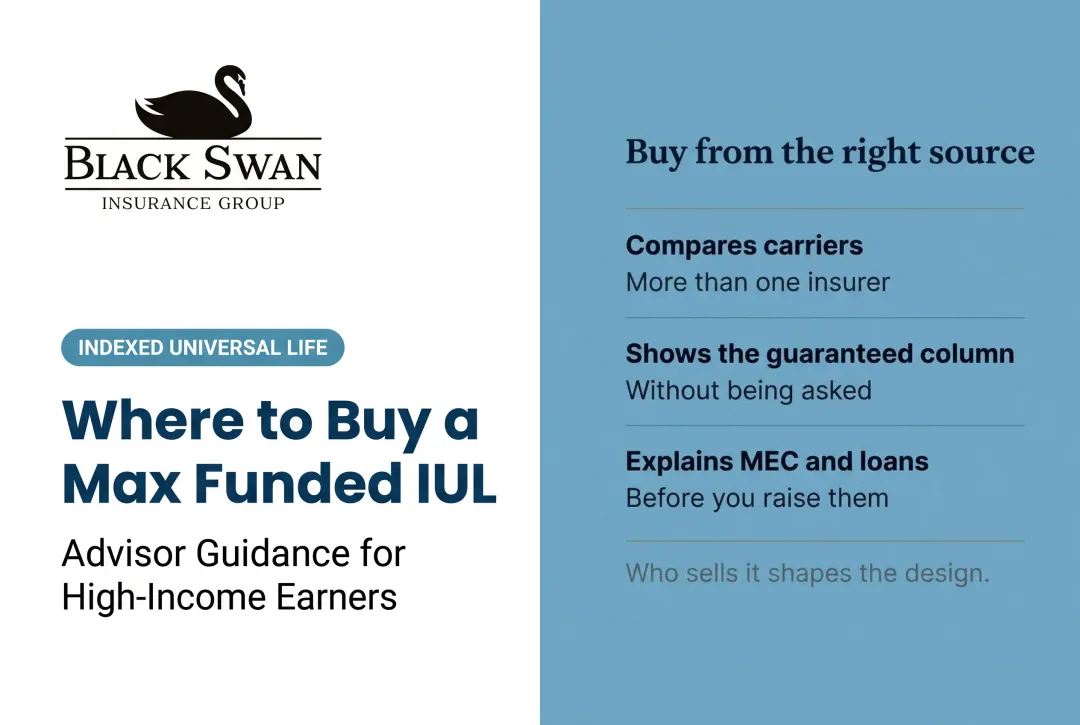
Access and comparison. Can they compare multiple suitable carriers and explain why one design beat term, whole life or guaranteed UL? A vague answer is the answer. Pin down the actual objective too — death-benefit protection, accumulation, retirement-income supplementation, or estate and business liquidity.
Carrier strength. A broker's reputation does not substitute for the insurer's. AM Best, S&P, Moody's and Fitch rate claims-paying ability, and those ratings apply to the company, not your policy. AM Best's categories run from Superior (A++/A+) down through Good (B++/B+). Check closed, confirmed complaints on the NAIC's Consumer Insurance Search for the past three years, and make sure a strong broker reputation is not masking a thin or deteriorating insurer rating.
Illustration transparency. Projections, not promises. The NAIC's Actuarial Guideline 49-A, revised in 2025, caps how aggressively insurers may illustrate index-crediting rates and loan benefits.
An illustration is a model, not a guarantee.

Request guaranteed against non-guaranteed values, planned premium against minimum required funding, the charges, caps, participation rates and floor provisions, and what happens if performance comes in lower than projected.
Compensation. Ask plainly how your adviser is paid, whether commissions shift by carrier, and whether the recommendation involves replacing something you already own. A written explanation of trade-offs and a cooling-off period before signing are reasonable expectations for a decades-long contract.
Ongoing service. Ask whether they provide annual reviews, send statements, track premium sufficiency, and flag changes when caps or crediting terms shift.
What the Critics Get Right
The honest criticism of every channel on this page is that none of them is paid to talk you out of it.
An independent broker earns more by placing a larger premium. A captive agent earns by placing their own carrier's product. A marketplace earns on volume. None of that makes anyone dishonest, but it does mean the question "should I buy this at all?" has no natural advocate in the room — which is why you have to ask it yourself, early, and judge the answer you get.
The best signal of a good adviser is not how well they describe the product. It is whether they will describe the circumstances in which you should walk away.
The Process
Define the objective first — death benefit, beneficiaries, horizon and purpose. Late-start high earners should prioritise insurability and funding runway over projected cash value.
Complete a broader review. Confirm emergency savings, needed term coverage, high-interest debt and qualified retirement contributions are handled. This complements the 401(k), IRA and Roth; it does not replace them.
Compare preliminary designs showing death-benefit options, premium schedules, crediting methods, caps, participation rates and surrender values. Ask what minimum premium keeps the policy in force and what triggers lapse.
Complete underwriting and read the final contract. Age, health, tobacco use, occupation and finances affect approval and pricing. Compare the issued policy against your illustration, confirm beneficiaries, and note the free-look window — in New York, at least 10 days, and up to 30 for mail-delivered policies.
Fund and monitor it. Flexible premiums still have limits, and underfunding lets charges erode cash value faster than it builds.

Overfund too quickly and the contract becomes a Modified Endowment Contract under IRS Section 7702A's seven-pay test, changing how loans and withdrawals are taxed. Build the funding schedule around that limit from day one.
| Channel | What it may offer | What to verify |
|---|---|---|
| Independent broker | Broad carrier comparison, personalised design | Carrier access, compensation, ongoing service |
| Captive agent | Deep knowledge of one insurer's lineup | Whether alternatives were genuinely considered |
| Direct carrier | Direct access to the issuer, simpler process | Product choice, design help, human support |
| Online marketplace | Fast quotes, digital convenience | The actual issuing carrier, underwriting support |
| Financial planner | Integration with retirement and tax planning | Insurance licensing and compensation structure |
Not every planner holds an insurance licence — confirm they are licensed to sell what they recommend.
Stronger Fit
- Earning $150K+ with a genuine permanent protection need and a long horizon
- Sustainable surplus cash flow after reserves, debt and maxed retirement contributions
- Insurable at a reasonable class
- Willing to engage with annual reviews
Weaker Fit
Not everyone should buy one. Step back if you want the cheapest coverage, need guaranteed accumulation, require short-term liquidity, have an unclaimed employer match, or cannot sustain the premium through a weak year — term solves a defined-period need far more cheaply.
Risks to Understand Before You Buy
- Caps and participation rates can be lowered after issue, within contract limits.
- Cost of insurance rises with age, and underfunding is the leading cause of failure.
- Replacing an existing policy triggers new underwriting, surrender charges and fresh contestability.
- MEC status is generally permanent and changes loan and withdrawal taxation.
- Lapsing with a loan outstanding can create taxable income with no cash received.
- The platform is not the payer — ratings and obligations rest with the issuing carrier.
Find Out Where You Actually Stand
This starts with the Tax-Free Wealth Blueprint Fit Review. If you earn $150K+ and are working out where to buy, we begin with whether you should — then verify carrier financial strength, separate guaranteed values from projected ones, model the funding against the MEC limit, and stress-test through lower crediting and a reduced-premium year. Trusts, business ownership and replacements need your own tax and legal advisers, and we will say so. If IUL does not fit, we will tell you that too.
Frequently Asked Questions
How much does it cost?
Premiums vary by age, health, tobacco use, coverage amount, design and carrier. There is no reliable average — compare guaranteed and planned funding scenarios for your own situation.
How do I actually buy one?
Define the coverage need, compare suitable carriers and alternatives, review illustrations and charges carefully, complete underwriting, examine the issued contract, and set up ongoing reviews.
Is buying an IUL worth it?
It can suit someone with a permanent protection need, a long horizon and sustainable surplus cash flow. It is typically wrong for buyers wanting the cheapest coverage, guaranteed accumulation or short-term liquidity.
Where can I buy one?
Independent brokers, captive agents, direct insurers, online marketplaces and financial professionals. An independent adviser can compare carriers side by side — confirm the issuing carrier, licensing and service support either way.
Direct from the insurer or through an agent?
Direct can be convenient; an independent agent may compare carriers and design options. Focus on suitability, transparency and compensation rather than channel.
How do I check a carrier is sound?
Review AM Best, S&P, Moody's or Fitch ratings for the issuing entity, and check closed confirmed complaints through the NAIC's consumer search for the past three years.
Sources
- LIMRA — U.S. individual life insurance premium sets new sales record in 2024
- LIMRA — 2024 Insurance Barometer, modernizing life insurance
- NAIC — Consumer Insurance Search
- NAIC — Actuarial Guideline 49-A
- New York DFS — life insurance consumer guidance
- IRS Revenue Ruling 2007-38 — modified endowment contracts
Disclosure: This article is educational and is not personal tax, legal or investment advice. Indexed universal life is life insurance first. Distribution channels, carrier availability, underwriting requirements, free-look periods and product terms vary by state and insurer and must be confirmed before purchase; ratings reflect an insurer's claims-paying ability, not the suitability of any contract. Illustrated values are not guarantees; actual results depend on policy terms, crediting, costs and funding. Any potential tax-advantaged access depends on the policy being properly structured, funded and managed. Actual results depend on policy design, carrier, crediting options, caps, participation rates, expenses, funding and ongoing management. This strategy is not appropriate for everyone. Policy loans and withdrawals reduce cash value and the death benefit, and can create tax consequences if the policy lapses or becomes a modified endowment contract. Consult your own tax, legal and financial professionals for advice specific to your situation.
And remember, it's not what you earn, it's what you keep… enjoy the ride.