By Robert Balgac, Founder, Black Swan Insurance Group | October 5, 2026
Almost everyone shopping an indexed universal life policy for accumulation opens with the same question: which carrier has the highest cap right now?
It is the wrong question, and the reason is simple. Caps and participation rates change — some carriers reset them annually. What does not change is the contract's cost structure, its guarantee provisions, its loan mechanics, and how the design behaves when the market underperforms for three years running. Those decide the outcome. This year's headline number does not.
If you earn $150K+ and are looking at permanent protection paired with a long-term cash-value strategy, the comparison worth running is about durability, not projections. Here is how to do it, which carriers are built for which job, and where something other than an IUL is the better answer.
The short answer: Cash accumulation inside an IUL depends on policy design, premium level, underwriting class, fees, crediting elections, loan provisions and ongoing monitoring — not on which carrier posts the highest cap. Compare identical illustrations across carriers using the same insured profile, funding schedule and death benefit, read the guaranteed column first, and stress-test lower crediting and a multi-year funding pause. Evaluate the whole thing alongside a 401(k), Roth accounts, whole life, term insurance and annuities rather than instead of them.
Key Takeaways
- Cash value tracks index performance through floors, caps, participation rates and policy charges — it is not direct market investment
- The right carrier depends on the job: accumulation, retirement income, legacy planning, living benefits or underwriting fit
- Compare identical illustrations, read guaranteed values, and model lower-crediting scenarios before choosing
- Current caps, participation rates and bonuses are not contractual guarantees; only the guaranteed columns and the contract bind
- Evaluate an IUL alongside qualified accounts and term insurance, never as a replacement for them
Where Your Premium Actually Goes
An IUL is permanent life insurance first. It combines a death benefit with a cash-value account that may earn interest linked partly to an external index such as the S&P 500. Premium dollars do not buy index shares; the insurer credits interest on a formula tied to index movement.
Every premium dollar splits before anything reaches cash value:
- Cost of insurance — the mortality charge, which rises with age
- Administrative and policy fees — flat or percentage-based
- Rider costs — living benefits, no-lapse guarantees, enhanced cash-value features
- Cash value allocation — whatever remains, credited to fixed or indexed accounts
Because premiums are flexible, underfunding is a genuine lapse risk. Skip enough payments, or fund at the bare minimum, and rising insurance charges erode cash value.
The Crediting Mechanics
| Mechanism | What it does |
|---|---|
| Floor | Sets the minimum indexed credit, commonly 0% — it does not stop policy charges from reducing total value |
| Cap | Limits the credited rate even when the index climbs higher |
| Participation rate | Multiplies the index change before the credit is applied |
| Spread or margin | Subtracts a stated amount from the credit after participation is calculated |
According to LIMRA's 2026 sales report, U.S. IUL new premium reached a record $4.5 billion in 2025, up 17% year over year and representing 25% of the individual life market. That is sales volume. It is not evidence that any individual policy will perform as illustrated.

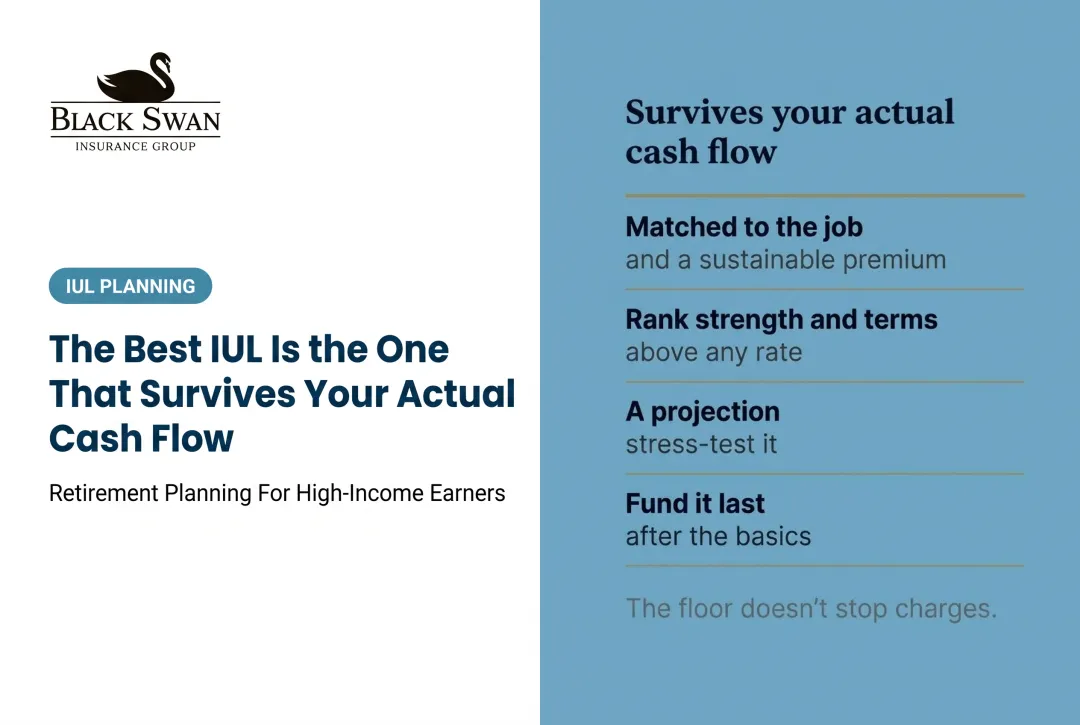
Zero is your hero in a down year — but the floor applies to the credit, not to the charges. A policy can credit 0% and still lose ground.
Any potential tax-advantaged access later, through loans and withdrawals, is conditional on the contract being properly structured, funded and managed, staying in force, and remaining outside MEC status.
Carriers, by the Job They Are Built For
Six practical filters: designs actually built for cash-value growth, financial strength, cost and fee transparency, the indexed crediting menu, loan treatment and flexibility, and fit for high-income, business-owner and family goals.
Caps, participation rates, bonuses and product availability change often. Confirm time-sensitive details against current illustrations, carrier filings and independent rating agencies.
Pacific Life
Pacific Horizon IUL 2 offers three design paths: stronger early cash surrender value, long-term accumulation, or a balanced build. Crediting includes one-year, multi-year and volatility-control indexed accounts plus a fixed account. A no-lapse guarantee can run to age 90, or for life with an option.
Pacific Horizon Survivorship IUL adds a flexible-premium last-survivor design tied to major indices, including a BlackRock Endura-linked option. As of August 2025, Pacific Life held AM Best A+ (Superior) and S&P AA− (Very Strong).
Best fit: accumulation, early cash value or survivorship coverage. Confirm: current caps and loan charges in a live illustration; larger or complex cases may need deeper underwriting review.
Nationwide
Indexed UL Accumulator III and YourLife Indexed UL Accumulator emphasise strategy choice: four indices and 11 approaches including S&P 500, Nasdaq-100, multi-index and volatility-control options. Riders cover chronic, critical and terminal illness, with long-term care and overloan-lapse-protection also available.
Nationwide Life Insurance Company held AM Best A+ as of November 2025, and ranked third for overall customer satisfaction in J.D. Power's 2025 individual life study — a company-wide result, not IUL-specific.
Best fit: buyers wanting a broad indexed-strategy menu with living-benefit riders. Confirm: the 10-year surrender schedule on the flagship product, and that caps, fixed rates and rider costs vary by state.
Penn Mutual
Accumulation IUL, issued through The Penn Insurance and Annuity Company, offers six indexed accounts — capped and uncapped — plus a guaranteed policy-value enhancement from year one. A no-lapse guarantee of up to 30 years is included automatically.
A mutual company since 1847, Penn Mutual held AM Best A+ (Superior, affirmed April 2026) and S&P A+ (affirmed December 2025).
Best fit: buyers who want permanent protection and strong guarantees over the highest illustrated figure. Confirm: policy loans suspend the no-lapse guarantee until repaid, so model any borrowing before relying on that protection. Fewer indexed-strategy choices than some competitors.
Lincoln Financial
The suite spans protection- and accumulation-oriented designs: WealthProtector, WealthAccelerate, WealthBuilder, WealthBuilder ECV, and WealthPreserve 2 SIUL for survivorship. WealthProtector, from The Lincoln National Life Insurance Company, pairs a protection-first build with a guaranteed Policy Value Bonus and an optional Extended No-Lapse Rider II that can extend guarantees to age 100.
Lincoln National Life held AM Best A (stable) as of March 2026.
Best fit: estate planning, business-owner protection and survivorship goals. Confirm: loans and withdrawals reduce cash surrender value and death benefit and can lapse the policy if funding is not managed; surrender charges vary by product and the multiple tiers add complexity.

This is a starting framework, not a pick list. Underwriting, state availability, budget and goals can point somewhere else entirely.
What the Critics Get Right
The objection to using life insurance as an accumulation vehicle is a serious one and deserves a straight answer rather than a deflection.
Critics are right that early-year acquisition costs and insurance charges mean the accumulation story is slow to become true, and that a buyer who exits in year five will almost certainly regret it. They are right that capped crediting will trail a straightforward index fund across a long bull market. And they are right that the tax advantages get presented as the headline when they are conditional on the policy surviving for decades.
Where the argument stops short is in assuming accumulation is the only reason anyone would hold the contract. If there is no permanent protection need, the criticism is decisive — fund the qualified accounts and buy term. The question only becomes live for someone who needs the death benefit anyway and is deciding what the cash value should do alongside it.
How to Compare Properly
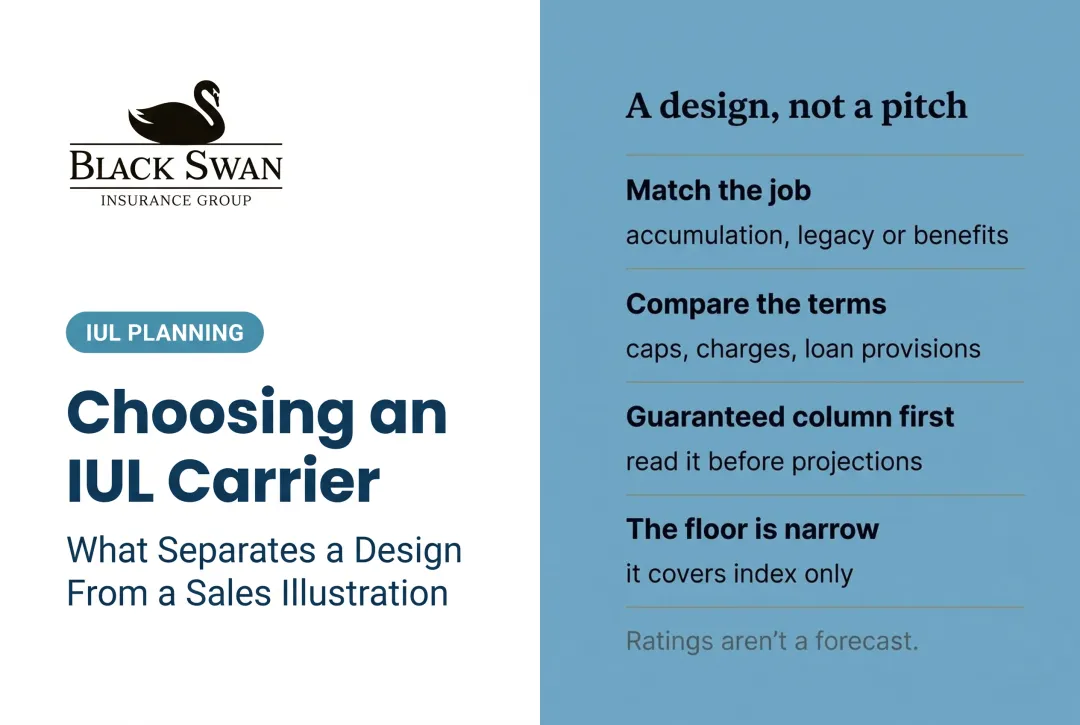
Ranking carriers on illustrated cash value is the common and costly mistake. So is chasing the highest current cap, ignoring cost of insurance, underfunding, or treating a projection as a forecast.
What actually matters:
- Financial strength. Review current AM Best ratings for each issuing carrier, alongside NAIC complaint data and claims-service history. AM Best's rating guide defines A++ and A+ as Superior and A/A− as Excellent — applying to claims-paying ability, not to any policy's expected performance.
- Policy economics. Cost of insurance, administrative charges, surrender schedules, premium flexibility and rider costs all determine how much premium reaches cash value.
- Apples-to-apples illustrations. The comparison only works with the same insured profile, death benefit, premium, funding schedule and underwriting class across every quote.
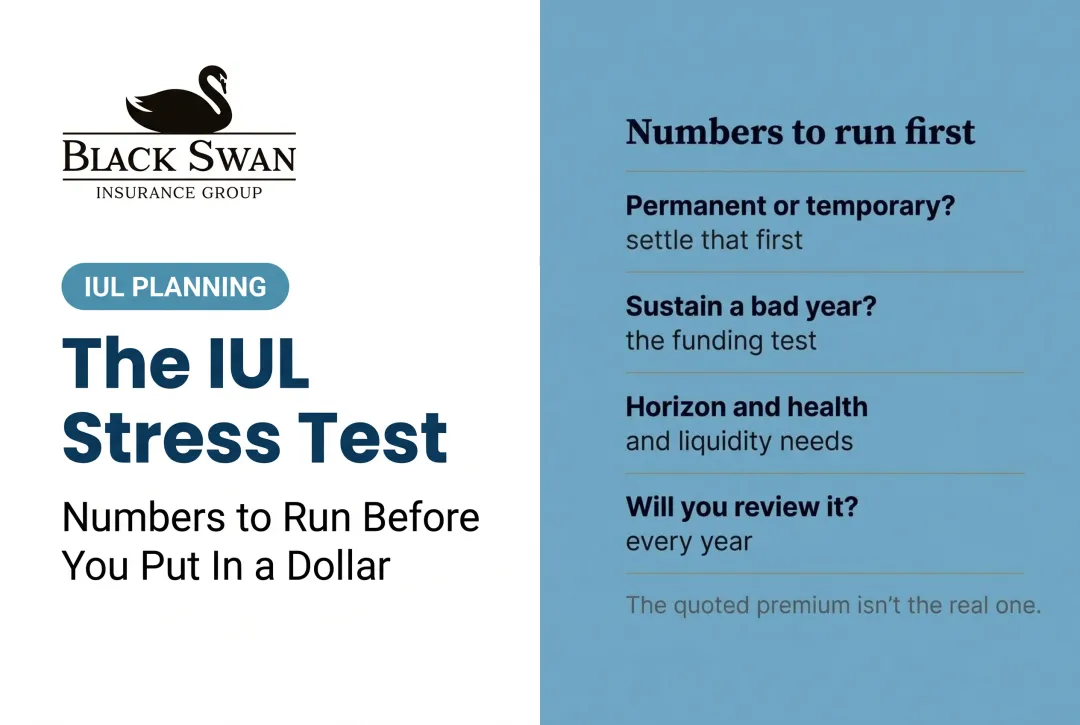
- Stress-testing. Model lower crediting assumptions, reduced premiums, skipped payments and extended loans during retirement.
- Ongoing service. Whether the carrier and adviser provide regular reviews and clear documentation. A contract nobody monitors drifts.
The NAIC illustration guidance is explicit: every basic illustration contains guaranteed and non-guaranteed columns, and the non-guaranteed side is not locked in at issue.
A realistic stress test: a policy funded at $12,000 a year looks strong under current assumptions, then loses years of accumulation if caps fall or premiums pause for even three years. That scenario is common enough that it should be run before anyone signs.

Do not buy the highlight reel. Watch the game film. Ask what happens in the three years you cannot pay the full premium, because that is the scenario that actually shows up.
The Ultimate IUL Blueprint
If accumulation is the goal, the Blueprint covers the design decisions that determine whether it works: funding levels, minimum death benefit, the MEC line, loan timing and index-strategy selection.
Who This Actually Fits
Stronger Fit
- Household income of $150K+ with stable or growing surplus cash flow
- A genuine permanent insurance need that stands on its own merits
- Funding capacity of roughly $500–$2,500 a month, sustainable across a downturn, without touching reserves
- Already funding retirement accounts and deliberately building a second tax-advantaged bucket
- A long horizon, adequate liquidity elsewhere, and comfort with policy complexity
- Willing to review the contract annually
Weaker Fit
Not everyone should buy an IUL for accumulation. If the horizon is under fifteen years, the charges rarely get a chance to be outrun.
- Unstable income, or funding that only works when nothing goes wrong
- Thin emergency reserves or high-interest debt needing triage
- Money likely needed before the contract builds accessible value
- No permanent protection need — in which case term insurance plus qualified accounts is the stronger and cheaper plan, and it is worth saying outright
- Wanting guaranteed growth, where whole life offers more certainty with less complexity
Risks to Understand Before You Fund for Accumulation
- Early cash value is reduced by acquisition costs, insurance charges and surrender schedules — the accumulation story takes years to become true
- Cost of insurance rises with age and is charged in flat crediting years
- Caps, participation rates and bonuses are not guaranteed and can be reset by the carrier
- Underfunding, or a multi-year premium pause, can cost years of accumulation and raise lapse risk
- Loans reduce cash value and death benefit, can suspend a no-lapse guarantee, and an outstanding loan at lapse or surrender with gain can create taxable income with no cash received
- Crossing the seven-pay limit makes the contract a MEC under I.R.C. § 7702A and changes distribution taxation permanently
- Surrender charges commonly run a decade on accumulation-focused designs
- State availability and rider pricing vary, and products are withdrawn from sale
- Ratings reflect claims-paying ability, not policy performance
Find Out Where You Actually Stand
This starts with the Tax-Free Wealth Blueprint Fit Review. If you earn $150K+ and are weighing an accumulation-focused design, we compare carrier illustrations on matched assumptions, read the guaranteed columns, model a funding pause and lower crediting, and price the alternatives including term plus qualified accounts. If it does not fit, we will tell you that too.
Frequently Asked Questions
How much does it cost to start an IUL?
Minimum premiums vary by age, health, coverage amount, underwriting class, carrier and design. A sustainable accumulation-focused premium is normally well above the bare minimum, which is one reason the minimum is a poor planning number.
Is an IUL a good choice for cash accumulation?
It can offer tax-deferred growth and index-linked crediting, but fees, caps, flexible-premium risk and loan risk all weigh against it. Core protection and retirement accounts come first; this is evaluated afterwards as a complement.
How quickly does cash value build compared with other policies?
Early value is reduced by acquisition costs, insurance charges and surrender schedules. Results vary widely by design and funding level relative to term, which builds none, or whole life, which is typically slower but more guaranteed.
Who should consider one?
Someone with a genuine permanent insurance need, long-term funding capacity, liquidity elsewhere and comfort with complexity. A fit-or-no-fit review before purchase is not optional.
What are the alternatives?
401(k)s, Roth and traditional IRAs, taxable brokerage accounts, high-yield savings or bonds, annuities, whole life, and term insurance paired with separate investing. The right one depends on your tax position, liquidity needs, risk tolerance and protection goals.
Should I just buy term and invest the difference?
If there is no permanent protection need, that is frequently the better plan and deserves to be said plainly. It depends on actually investing the difference, every year, through a bad market.
Sources
- LIMRA — U.S. individual life insurance new premium tops $17.5 billion in 2025
- AM Best — Guide to Best's Credit Ratings
- NAIC — Life Insurance Illustrations
- NAIC — Life Insurance
- I.R.C. § 7702A and Rev. Proc. 2008-39 (modified endowment contracts and the seven-pay test)
Disclosure: This article is educational and is not personal tax, legal or investment advice. Indexed universal life is life insurance first. Carrier products, ratings, caps and participation rates change; confirm current terms and state availability directly. Actual results depend on policy design, carrier, crediting options, caps, participation rates, expenses, funding and ongoing management. Policy loans and withdrawals may reduce cash value and death benefit and can create tax consequences if the policy lapses or becomes a modified endowment contract. This strategy is not appropriate for everyone. Illustrated values are not guarantees; actual results depend on policy terms, crediting, costs and funding. Consult your own tax, legal and financial professionals for advice specific to your situation.
And remember, it's not what you earn, it's what you keep… enjoy the ride.