By Robert Balgac, Founder, Black Swan Insurance Group | October 5, 2026
Indexed universal life gets pitched as market upside with none of the downside. That framing oversimplifies a genuinely useful and genuinely complicated contract, and it sets up the disappointment that follows.
Here is the direct version. An IUL can be a smart move for a specific kind of buyer — primarily as a permanent life insurance strategy with a tax-diversification benefit attached. It is not a replacement for your 401(k), and an attractive illustration is not evidence of anything.
If you earn $150K+ and someone has put a proposal in front of you, the productive move is not to argue about whether the product is good. It is to run five numbers against your own situation and see whether the design survives them.
The short answer: Before funding anything, establish whether you need permanent rather than temporary coverage; whether you can sustain the premium through a bad year; how long your horizon and how good your health are today; whether you need liquidity within a few years; and whether you will actually review the policy annually. Interest credits track an index but premiums are never invested in it. Floors limit index losses while fees, insurance charges and loans still draw down cash value. Fund foundational accounts and appropriate protection first, then decide whether this fills a specific gap better than something simpler.
Key Takeaways
- Interest credits track an index such as the S&P 500; premiums are never invested directly in stocks
- Floors can limit index losses, but fees, insurance charges and loans still draw down cash value
- Best fit: established buyers wanting permanent protection and tax diversification — not the cheapest coverage or simple market exposure
- Caps, participation rates and spreads can be adjusted by the carrier after you commit
- The premium that keeps a policy in force is a different number from the premium you were quoted
The Five Questions That Decide It
- Do you actually need permanent rather than temporary life insurance? If the need has an end date, term insurance answers it better and for a fraction of the cost. This question disqualifies more buyers than the other four combined.
- Can you fund the policy consistently, including in a bad year? Not the good year. The year revenue drops or the job changes.
- What is your horizon, and how is your health today? Both decide whether the contract has time to work and what it will cost to own.
- Will you need this money within a few years? Surrender charges make an early exit expensive, and the early years are exactly when cash value is thinnest.
- Will you review it every year? Not intend to. Actually do it.
How the Crediting Works
An IUL is permanent life insurance: a death benefit, flexible premiums, and a cash-value account. Evaluate the insurance before the accumulation, because the insurance is what you are buying.
Where the premium goes: cost of insurance, administrative charges, optional riders where elected, and cash value — whatever remains. Carriers allocate differently. Ask for a current sample illustration from the specific policy, not generic figures.
Index-linked is not index-owned. The policy references an index, often the S&P 500, and you own no shares. The insurer calculates a crediting rate from that index's performance and applies it to your cash value.
- Floor — the minimum crediting rate, often though not always 0%
- Cap — the maximum crediting rate in a strong index year
- Participation rate — the percentage of index gains used in the credit
- Spread — a deduction some carriers subtract from index growth before crediting
If the index gains 12% and your cap is 9%, you are credited 9%. If the index drops 15% and your floor is 0%, you are credited 0%. That is the trade, stated plainly.
The catch most buyers miss: the floor protects the crediting rate, not the policy balance. Cost of insurance, administrative fees and loan interest keep coming out in a 0% year. Cash value can still decline.

Funding strategy matters as much as crediting. Paying the bare minimum keeps the policy alive and does almost nothing for cash value. A properly structured, funded and managed design balances an adequate death benefit against meaningful funding while staying under the threshold that would trigger modified endowment contract status.
The Benefits, Stated Accurately
Permanent protection for specific jobs. A death benefit that does not expire while the policy stays funded solves problems term cannot touch: estate liquidity, business succession, legacy planning around a family business. These are protection goals and should not be confused with accumulation goals.
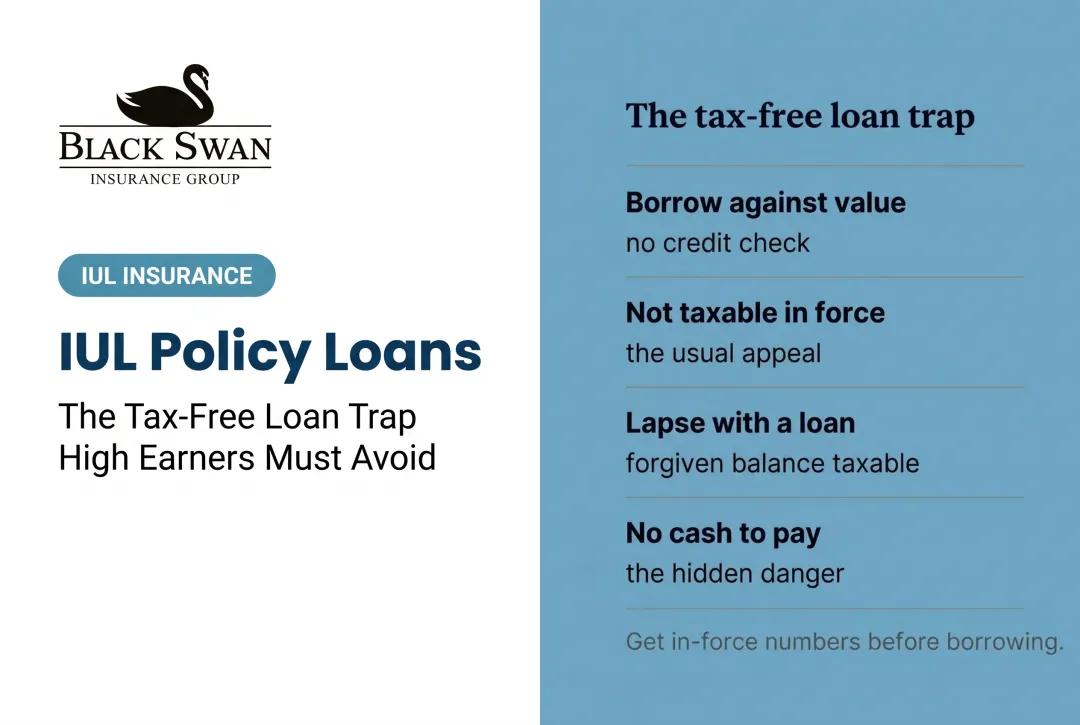
Tax-deferred growth and conditional access. Cash value grows tax-deferred, and per IRS Publication 525 death benefits are generally not taxable income to beneficiaries. Policy loans can offer potential tax-advantaged access while the policy remains in force. That clause carries the weight — a lapse with an outstanding loan and gain in the contract produces a tax bill nobody planned for.
Flexibility, with an obligation attached. Premiums adjust as income changes, useful for business owners and commissioned professionals. The catch is that you have to monitor it. Skipping payments in lean years without checking the impact is how policies quietly slide toward lapse.
A complement, not a replacement. It can add a permanent insurance layer and another potential source of retirement liquidity alongside a 401(k), Roth IRA or brokerage account. It does not replace any of them.
Downside protection, with an asterisk. Index losses do not reduce credited interest below the floor. Policy value can still fall when charges outpace crediting, or when loans and withdrawals go unmanaged. Protection from index losses is not protection from all losses.
What the Critics Get Right
The critics of this product are correct about the things that matter most, and the honest response is to agree rather than deflect.
They are right that the cost structure is opaque and stacked: cost of insurance, premium loads, administrative charges, rider fees, index strategy charges, surrender charges and loan interest, varying widely by carrier and design. They are right that caps and participation rates can be adjusted within the contract's guaranteed minimums, so a generous cap today may shrink in five years and take your income projection with it. And they are right that the premium someone quotes you is not the same as the premium required to keep the policy in force.
Where the criticism stops is the protection question. None of those objections tell you anything about whether you need permanent coverage. They tell you to be sceptical about design and funding, which is correct, and which is a reason to run the stress test rather than to skip the conversation.
Lapse Risk, and What Triggers It
The NAIC's Life Insurance Buyer's Guide advises buyers to ask what premium is needed to keep coverage in force, not just what premium is planned. That is the single most useful question on this page.
A policy lapses when remaining value can no longer cover charges. The common triggers: premiums consistently below what rising insurance charges require, several years of weak crediting, withdrawals drawing cash value down, and loan balances compounding faster than the contract supports.

The Ultimate IUL Blueprint
If you clear the five questions and want the design detail — funding levels, the MEC line, index-strategy selection and loan timing — that is what the Blueprint covers.
Who It Fits
Stronger Fit
- A genuine permanent life insurance need standing on its own merits
- Household income of $150K+ with long-term funding capacity that survives a downturn
- Tax diversification goals after the foundational accounts are funded
- Comfort with non-guaranteed policy elements, understood rather than glossed over
- Willingness to review the contract every year
If you are reaching peak earnings in your late 40s or 50s, the arithmetic changes. Less time to fund the policy, and health and insurability matter more. Compare directly against catching up on retirement accounts, adjusting the retirement timeline, and using term insurance for a shorter protection window. A shorter runway means less room for error.
Weaker Fit
Not everyone should buy an IUL. If the stress test below fails on any single line, that is a complete answer.
- No emergency reserve yet
- An employer 401(k) match going uncaptured
- Maximum death benefit at the lowest cost is what you need — term insurance wins that comparison outright
- The money may be needed in the next few years
- No appetite for monitoring the contract over decades
A high income or significant net worth does not make this suitable. Fit depends on how protection needs, cash flow, tax position and risk tolerance interact — not on the balance sheet alone.

Against the Alternatives
| Option | Best for | Key trade-off |
|---|---|---|
| Term insurance | Affordable, temporary protection | No cash value, coverage ends |
| Whole life | Guaranteed growth, fixed premiums | Less flexibility, typically lower ceiling |
| IUL | Permanent protection plus tax diversification | Higher complexity, non-guaranteed upside |
| 401(k) | Tax-advantaged retirement savings | Contribution limits, no death benefit |
| Roth IRA | Tax-free qualified withdrawals | Income limits, contribution caps |
| Brokerage account | Full market exposure, liquidity | Fully taxable, no protection element |
Term versus IUL. Term is built for affordable temporary protection; an IUL for permanent coverage with cash value at higher cost and complexity. They often do different jobs in the same plan rather than competing.
Whole life versus IUL. Whole life offers a simpler structure and stronger guarantees with fixed premiums. An IUL trades some certainty for flexible premiums and index-linked potential. Outcomes depend heavily on design and carrier.
Qualified accounts and brokerage versus IUL. Those come with clear contribution rules and transparent investment choices and no death benefit. An IUL brings permanent protection with less transparency around fees and crediting terms.
Match the tool to the job — protection, accumulation, tax diversification or legacy — rather than ranking a policy against raw market returns. Fund foundational accounts and appropriate protection first.
What to Review Before You Sign
Request and read:
- Guaranteed and non-guaranteed values, side by side
- Current and guaranteed caps, participation rates, floors and spreads
- Insurance charges, the surrender schedule and rider costs
- Loan provisions and how they affect the death benefit
- What happens to the policy if crediting rates drop
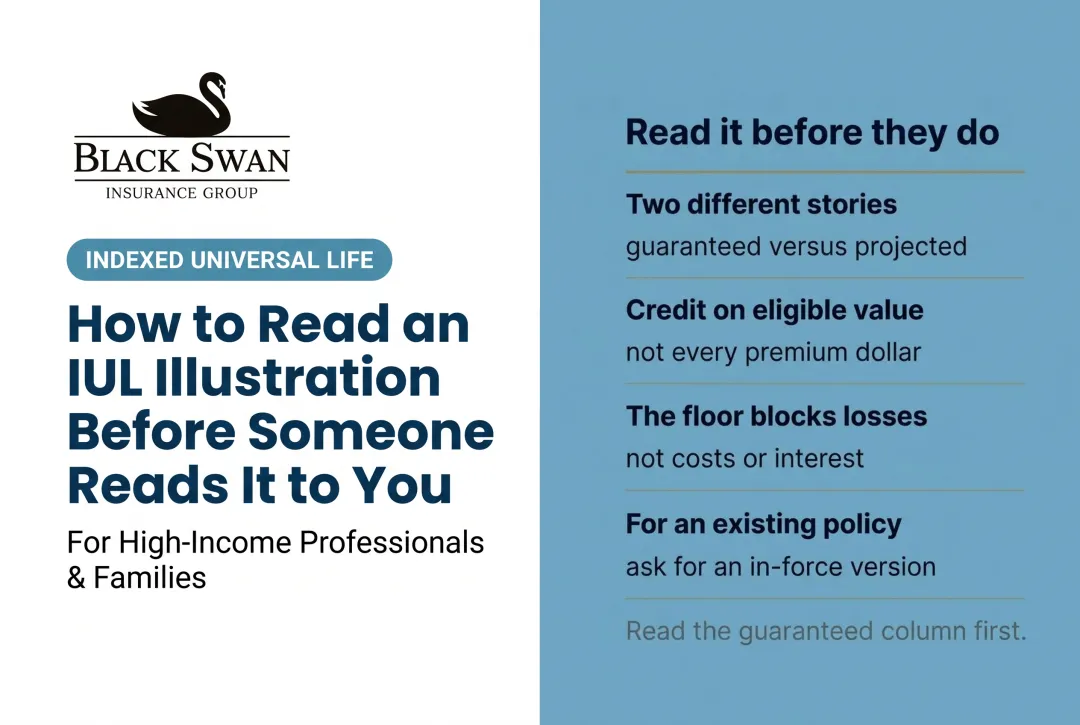
Ask for illustrations under conservative, current and adverse assumptions. Then ask specifically how much premium keeps the policy in force if performance disappoints or circumstances change.
Compare carriers on financial strength ratings, contract guarantees, historical crediting performance, policy expenses and flexibility, and overall suitability — not on the highest projected cash value.
Coordinate with your insurance advisor, tax professional and attorney. Confirm MEC rules, ownership structure, beneficiary designations and how the policy fits any estate or business planning.
An illustration without a risk section is a restaurant menu with no prices. Everything looks delicious until the check shows up.
Risks to Understand Before You Fund One
- The floor protects the credit, not the balance — charges continue in a 0% crediting year
- Cost of insurance rises with age and is deducted every month regardless of performance
- Caps, participation rates and spreads can be reduced within the contract's guaranteed minimums after you commit
- The quoted premium may not be the premium that keeps it in force — ask for both numbers
- Surrender charges make the early years expensive to exit, which is when most disappointed buyers want to
- Underfunding is the leading cause of lapse, and premium flexibility makes drifting easy
- Loans reduce cash value and death benefit, and a lapse with a loan outstanding and gain in the contract creates taxable income with no cash received
- Crossing the seven-pay limit makes the contract a MEC under I.R.C. § 7702A and changes distribution taxation permanently
- Premium dollars spent here are unavailable elsewhere, and that opportunity cost belongs in the comparison
Find Out Where You Actually Stand
This starts with the Tax-Free Wealth Blueprint Fit Review. If you earn $150K+, we run the five questions against your real numbers, stress-test the funding through a bad year, read the guaranteed column, and price term plus qualified accounts on identical terms. If it does not fit, we will tell you that too.
Frequently Asked Questions
How does an IUL actually produce value?
Through cash-value growth credited on an index-linked formula, potential tax-advantaged loan access while the policy is in force, and the death benefit. Fees, charges, caps, loan balances and lapse risk all shape what you keep.
Do affluent households use these?
Some do, for permanent protection, estate or business planning, and supplemental tax diversification. Wealth alone does not make it the right fit, and the same funding and risk checks apply.
Can you lose money in an IUL?
Index losses do not directly reduce credited interest below the floor. Declining policy value from charges, inadequate funding, withdrawals, loans or lapse is a real and common risk.
Is $1,000,000 enough coverage?
It depends on income replacement needs, debts, dependents, education or business obligations, existing assets and legacy goals. A needs-based calculation beats any rule of thumb.
What is the single most important question to ask?
What premium keeps this policy in force if performance disappoints. The planned premium is a projection; that number is closer to a commitment.
Should I buy term instead?
If the protection need has an end date, yes, and it deserves saying before anyone designs a permanent policy. Permanent coverage earns its place when the need genuinely outlasts a term.
Sources
- IRS Publication 525 — Taxable and Nontaxable Income
- NAIC — Life Insurance Buyer's Guide
- Insurance Information Institute — How much life insurance do I need?
- NAIC — Life Insurance Illustrations
- I.R.C. § 7702A and Rev. Proc. 2008-39 (modified endowment contracts and the seven-pay test)
Disclosure: This article is educational and general in nature, and is not personal tax, legal or investment advice. Indexed universal life is life insurance first. Policy terms, tax treatment, guarantees and availability vary by carrier and individual circumstances. Actual results depend on policy design, carrier, crediting options, caps, participation rates, expenses, funding and ongoing management. Policy loans and withdrawals may reduce cash value and death benefit and can create tax consequences if the policy lapses or becomes a modified endowment contract. Review an actual contract and consult qualified professionals before purchasing. Illustrated values are not guarantees; actual results depend on policy terms, crediting, costs and funding. This strategy is not appropriate for everyone.
And remember, it's not what you earn, it's what you keep… enjoy the ride.