By Robert Balgac, Founder, Black Swan Insurance Group | October 5, 2026
Putting a large lump sum into a permanent policy sounds like the obvious move. More money in, more cash value growing tax-deferred. Not always.
Overfund the wrong policy and the IRS reclassifies it as a modified endowment contract, changing how every future withdrawal and loan is taxed. A MEC is not a different product. It is a tax label that attaches when a cash-value policy fails a specific test tied to how much premium arrived in its early years.
Once that label sticks, it does not come off. Reducing future premiums will not reverse it. Exchanging the policy will not reverse it. This is the one line in policy design where a well-intentioned decision produces a permanent consequence.
The short answer: MEC status is a tax classification, not a policy type, triggered when premiums exceed the IRS seven-pay limit. Distributions from a MEC follow last-in-first-out rules, so taxable gain comes out before basis. A 10% additional tax may apply to taxable distributions before age 59½. The classification is generally permanent and survives a 1035 exchange. Confirm your seven-pay limit with the insurer before making any large payment.
Key Takeaways
- MEC status is a tax classification, not a policy type, triggered when premiums exceed IRS seven-pay limits
- Distributions follow LIFO rules — taxable gain comes out before basis
- A 10% additional tax may apply to taxable MEC distributions before age 59½
- Reducing future premiums will not reverse it — the classification is generally permanent
- Confirm your seven-pay limit with your insurer before any large payment
What a MEC Actually Is
A permanent life insurance policy that has received premiums exceeding the limits under Internal Revenue Code Section 7702A. A contract becomes a MEC when it meets all three conditions: it qualifies as life insurance under IRC 7702, it was entered into on or after June 21, 1988, and it fails the seven-pay test.
Why the Rule Exists
Congress created these limits through the Technical and Miscellaneous Revenue Act of 1988. Before TAMRA, buyers used heavily funded policies as shelters — a large single premium, then borrowing against the cash value without tax. TAMRA tied favourable treatment to a slower, more insurance-like funding pattern.
That history matters, because it explains the rule. The tax advantages exist for insurance. Fund a contract so aggressively that it stops looking like insurance and the advantages go away.
Which Policies Can Trigger It
Any cash-value permanent policy: whole life, universal life, indexed universal life and variable life.
Term insurance generally does not raise the issue, since most term policies carry no cash value for the test to measure — one more respect in which term is simpler.
What MEC Status Does Not Do
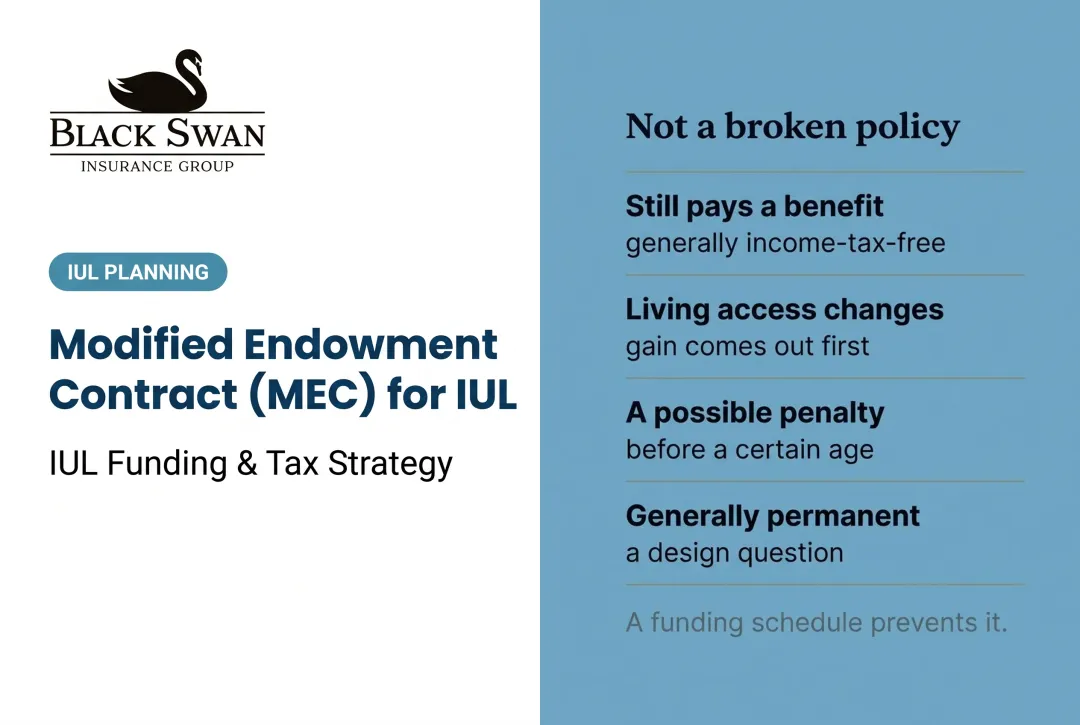
This is where people panic unnecessarily. MEC classification is not a lapse, a surrender or a cancellation. The policy keeps functioning as life insurance. Cash value still grows tax-deferred and the death benefit remains in place, subject to contract terms and performance.
What changes is how the IRS treats money you take out while alive. The potential tax-advantaged access a non-MEC contract offers — conditional on the policy being properly structured, funded and managed — is precisely what MEC status removes.
How the Seven-Pay Test Works
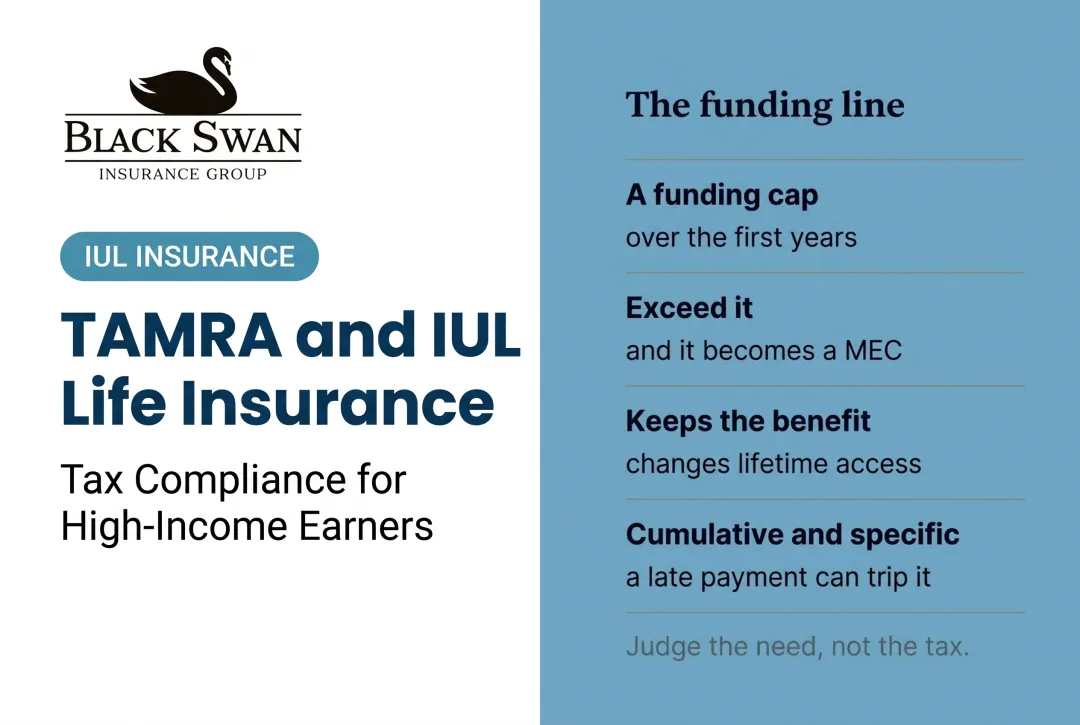
The test compares premiums actually paid during the first seven years against a calculated limit: the total premium the contract could have received under a schedule of seven level annual payments designed to pay the policy up in full.
That limit is calculated per contract using IRS-mandated interest, mortality and expense assumptions. Two people with identical death benefits can have different limits based on age, health rating, riders and design.
There is no universal dollar figure. Your illustration, contract, insurer or a licensed professional can confirm the limit that applies to you.
Three Ways to Fail
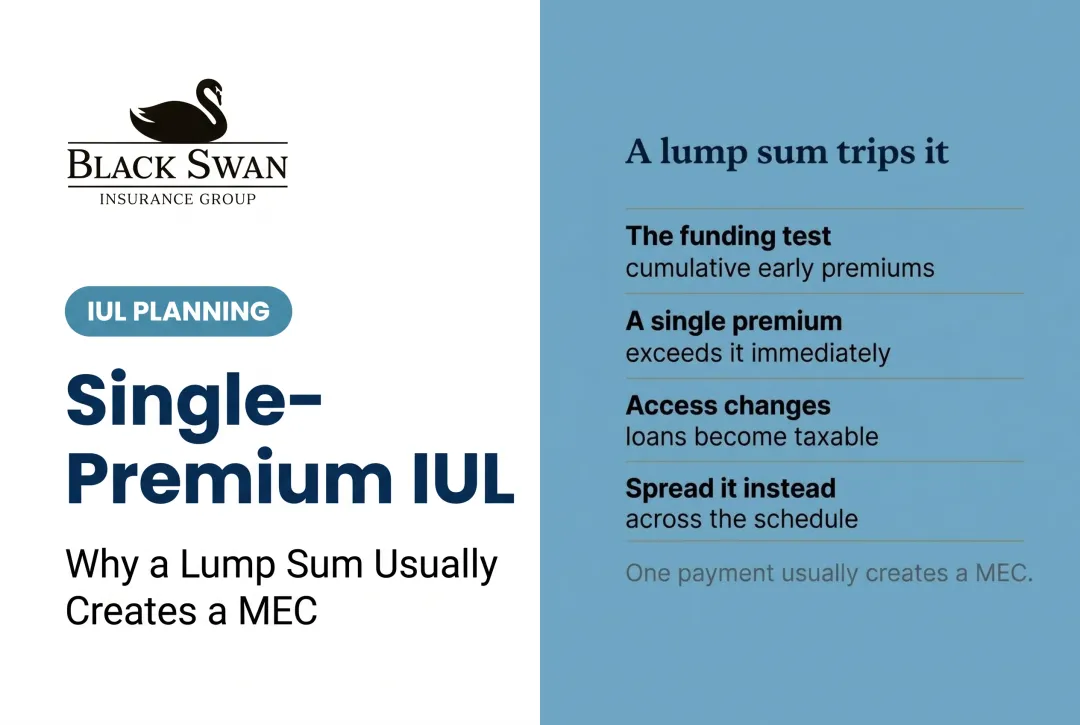
- A single large premium exceeding the seven-year limit in one payment
- A pattern of extra payments that, added together, cross the threshold
- A material change — a higher death benefit, an added rider, a new benefit structure — forcing the test to be reapplied
That third one catches people who never made an unusually large payment. A design change reapplies the test, and a policy that was compliant can fail on the new calculation.
Exchanges Carry the Label Forward
A 1035 exchange does not erase MEC status. If the original contract was a MEC, the new one generally is too, under the exchange provisions built into Section 7702A. There is no clean-slate route.

A hypothetical, illustrative only. A policy with a seven-pay limit of $10,000 a year for the first seven years: pay $10,000 each year and it stays compliant. Pay a single $50,000 premium in year one and the cumulative limit is likely breached, making it a MEC. Real limits vary by contract — confirm yours with the carrier.
What Changes for Tax
MEC classification does not change death benefit tax treatment. It rewrites the rules for anything taken out while living.
FIFO Becomes LIFO
Non-MEC policies generally let you access your own basis — the premiums paid in — before touching earnings, first-in-first-out. MEC distributions flip that. Withdrawals and loans are treated as coming from earnings first, last-in-first-out.
- Non-MEC: withdrawals up to basis typically are not taxed while the policy remains active
- MEC: any gain in the contract is taxed before you reach your basis at all
Loans Get Taxed Too
In a properly structured, funded and managed non-MEC policy, loans are generally not treated as immediate taxable income. In a MEC, IRS guidance treats policy loans — and even amounts pledged or assigned against the policy — as distributions taxed to the extent of gain, as ordinary income rather than capital gains.
That single change removes the feature most people bought the policy for.
The Age 59½ Penalty
Taxable MEC distributions before age 59½ can trigger an additional 10% federal tax on the includible amount, on top of ordinary income tax. Exceptions exist for disability and certain substantially equal periodic payments, and a tax professional should confirm whether any applies.

Permanent, with side effects. Stopping or reducing future premiums will not reverse it. Loans and withdrawals still reduce cash value and death benefit. Outstanding loans at lapse or surrender can create an unexpected tax bill.
What the Critics Get Right
The criticism aimed at this corner of the industry is accurate and worth stating.
Critics are right that "max-funded" is used as a selling phrase while the MEC line — the exact boundary that makes max-funding work or fail — goes unexplained. They are right that a buyer who overfunds on an agent's encouragement and then discovers the tax treatment has lost the feature they were sold. And they are right that the permanence of the classification is rarely emphasised at the point of sale.
Where the criticism runs out is that the rule itself is sensible. TAMRA exists because the tax treatment of life insurance was being used for something other than insurance. The line is not arbitrary — it is the boundary between a policy and a shelter, and knowing where it sits is basic competence for anyone designing one.
When an Intentional MEC Makes Sense
MEC status is not automatically bad. It depends entirely on what the policy is for.
What still works in your favour: cash value continues growing tax-deferred; the death benefit remains in place; large sums can still be placed into a single contract for estate-planning purposes; and legacy-focused strategies, including certain trust structures, still function.
What you give up: lifetime liquidity, since gains are taxed on the way out before basis; ordinary-income treatment on distributed earnings rather than capital gains rates; possible early-distribution penalties before 59½; permanent classification with no reset; and loans that erode the death benefit over time.
Stronger Fit for an Intentional MEC
- Legacy or wealth transfer is the priority over lifetime access
- Emergency reserves and other retirement resources are already built
- Household income of $150K+ with no expectation of needing policy loans or withdrawals during your lifetime
- The death benefit, not the cash value, is the reason for the contract
- A trust or estate structure where the policy is never intended to be touched while alive
Weaker Fit
Not everyone should buy an IUL. If the plan is to overfund aggressively and worry about the MEC line later, do not start.
- You need flexible retirement income you can draw on tax-efficiently
- You want the ability to take policy loans without a tax consequence
- Access to basis before earnings matters to your plan
- Cash flow is uncertain and the policy is part of your cushion
- Not everyone should hold a MEC, and most people who end up with one did not choose it

The Ultimate IUL Blueprint
If you are designing an indexed policy for cash value, the MEC line is the single most important number in the design. The Blueprint covers how to max-fund without crossing it, and what to demand from an illustration.
Before You Make a Large Payment
Confirm the seven-pay limit with your insurer in writing. Ask whether any planned design change — a death benefit increase, a new rider — would reapply the test. Check whether a 1035 exchange you are considering would carry MEC status forward. And model what MEC treatment would do to the access strategy you were counting on.
The IRS line is the one you cannot cross if you want the policy to keep its intended tax treatment. Cross it by accident and there is no route back.
Tax treatment depends on policy design, distribution type, your age, your basis, and current federal and state law. This is not a substitute for advice from a professional familiar with your full picture.
Risks to Understand
- MEC status is permanent — no reduction in future premiums reverses it
- A 1035 exchange carries the label forward, so there is no clean-slate option
- A material change reapplies the test, and a compliant policy can fail on recalculation
- LIFO treatment taxes gain before basis on every withdrawal and loan
- Loans in a MEC are taxable distributions to the extent of gain, removing the feature most owners wanted
- A 10% additional tax may apply to taxable distributions before 59½
- Outstanding loans at lapse or surrender can create a substantial bill with no cash received
- Cost of insurance and charges continue regardless of classification
- No universal seven-pay figure exists, so assumptions based on someone else's policy are worthless
Find Out Where You Actually Stand
This starts with the Tax-Free Wealth Blueprint Fit Review. If you own a policy or are designing one, we confirm the seven-pay limit with the carrier, check current MEC status, model whether a planned funding schedule or design change would cross the line, and test what that would do to your access plan. If it does not fit, we will tell you that too.
Frequently Asked Questions
Can MEC status be reversed?
Generally no. It is permanent, and reducing or stopping future premiums does not undo it. A 1035 exchange carries the classification forward to the new contract.
Does a MEC still pay a death benefit?
Yes. The policy continues functioning as life insurance and the death benefit remains subject to contract terms. Only the tax treatment of lifetime distributions changes.
What is the seven-pay limit on my policy?
There is no universal figure. It is calculated per contract using IRS-mandated interest, mortality and expense assumptions, and it varies by age, health rating, riders and design. Ask your insurer in writing.
How are MEC loans taxed?
As distributions to the extent of gain in the contract, taxed as ordinary income, with a possible 10% additional tax before age 59½. Amounts pledged or assigned against the policy receive the same treatment.
Would I ever want a MEC on purpose?
Sometimes — where legacy or wealth transfer is the priority, reserves are already built, and there is no expectation of touching the policy while alive. It is a deliberate trade of lifetime access for a simpler funding path.
Does term insurance have this problem?
No. Most term policies carry no cash value, so there is nothing for the seven-pay test to measure. It is one more way term is simpler than permanent coverage.
Sources
- 26 U.S.C. § 7702A — Modified endowment contract defined
- IRS Revenue Ruling 2007-38
- NAIC — Life Insurance
- NAIC — Life Insurance Illustrations
- Technical and Miscellaneous Revenue Act of 1988 (TAMRA) and Rev. Proc. 2008-39
Disclosure: This article is educational and is not personal tax, legal or investment advice. Indexed universal life is life insurance first. The hypothetical seven-pay figures used here are illustrative and are not a calculation of any actual limit. Tax treatment depends on policy design, distribution type, age, basis and current federal and state law. Actual results depend on policy design, carrier, crediting options, caps, participation rates, expenses, funding and ongoing management. Consult a qualified tax professional before making a large premium payment or taking a distribution. Policy loans and withdrawals reduce cash value and the death benefit, and can create tax consequences if the policy lapses or becomes a modified endowment contract. Illustrated values are not guarantees; actual results depend on policy terms, crediting, costs and funding. This strategy is not appropriate for everyone.
And remember, it's not what you earn, it's what you keep… enjoy the ride.