By Robert Balgac, Founder, Black Swan Insurance Group | October 9, 2026
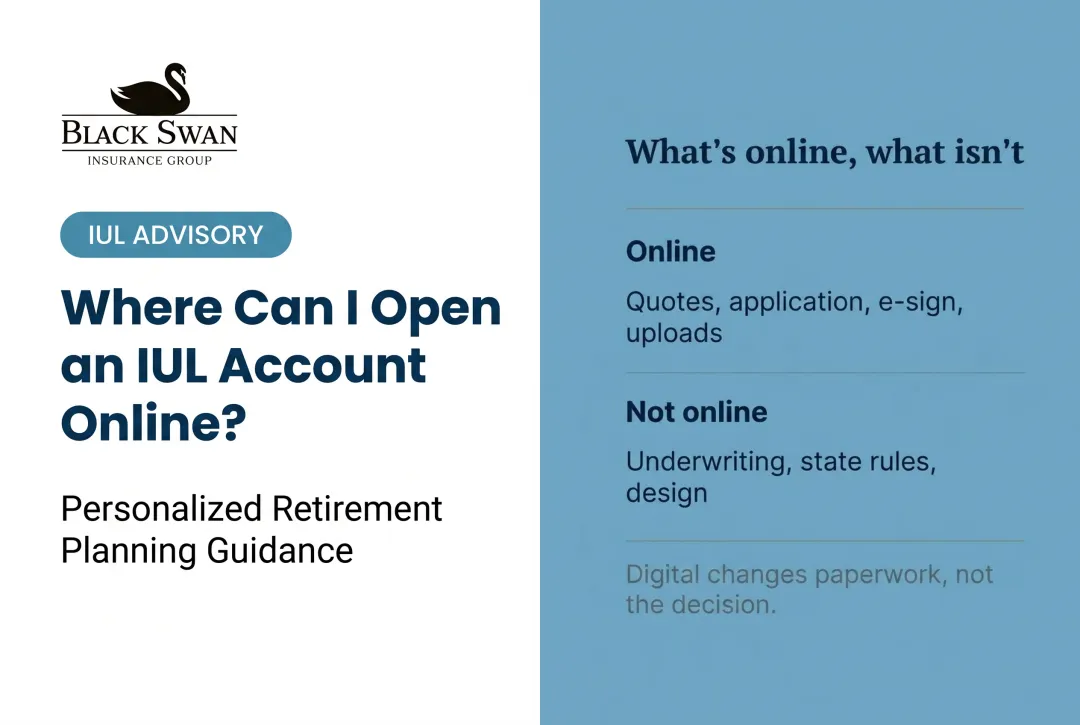
If you have searched for the best place to open an IUL account, the first thing worth knowing is that there is no such thing as an IUL account. Indexed universal life is a permanent life insurance contract issued by a carrier — not a bank or brokerage product you deposit into.
That distinction is not pedantry. It changes who you talk to, what happens next, and what can go wrong.
The short answer: You do not open an IUL, you apply for one and a carrier decides whether to insure you. For most buyers the right starting point is a licensed independent professional who can assess suitability and compare carriers, rather than someone presenting a single product from one shelf. The channel you choose determines which carriers you can reach, the quality of underwriting guidance, and whether anyone reviews the policy after issue.
Key Takeaways
- An insurance carrier issues the policy; agents, brokerages, banks and platforms only help arrange it
- Independent brokerages typically offer broader carrier comparison than single-carrier channels
- Financial strength, charges, crediting methods and loan provisions matter more than a slick application
- It suits buyers with a genuine permanent need and long-term funding capacity — not as a savings substitute
- Always review guaranteed and non-guaranteed illustrations before committing
What You Are Actually Buying
Permanent life insurance with three core features: a death benefit, flexible premiums, and cash value that may earn interest linked to an external index. Crediting runs through carrier-specific floors, caps, participation rates and spreads.
You do not invest in the index. A floor, often 0%, limits how far credited interest can fall in a bad year. It does not eliminate ongoing charges, and cash value can still decline when charges outpace credited interest.
Zero is your hero in a down year — but the floor applies to the credit, not to the charges.

New annualised premium for individual life insurance reached $17.5 billion in 2025, with IUL a meaningful share of that growth. More products means more variation in quality, terms and distribution.
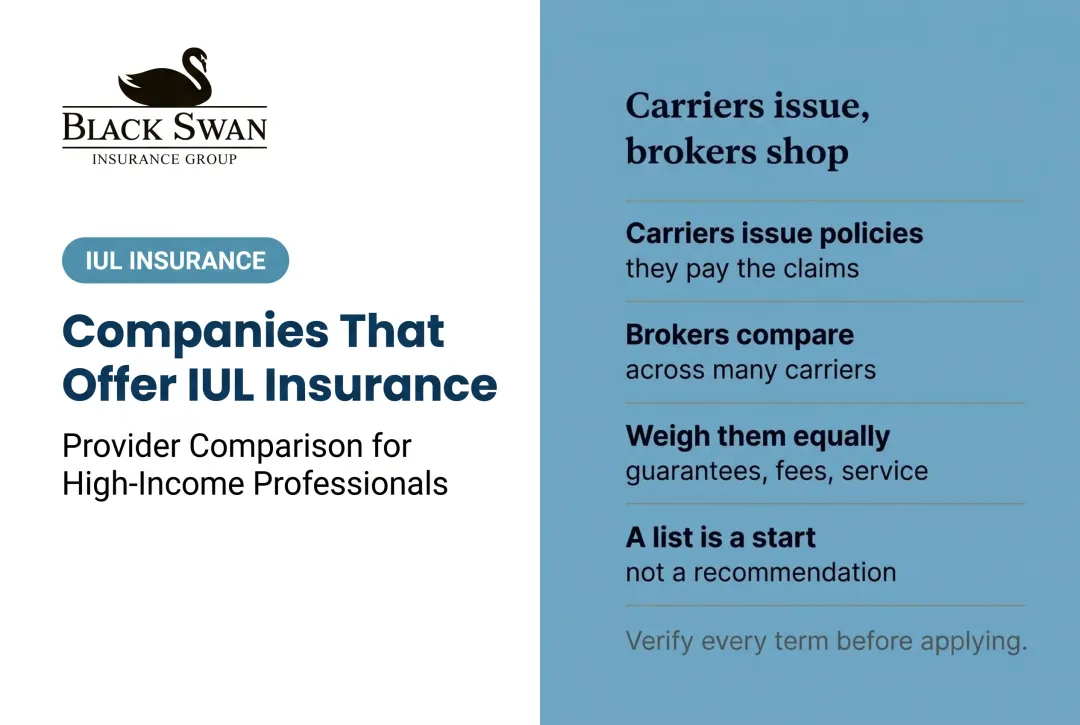
Three parties are involved: the carrier issues and services the contract, sets terms and pays claims; the licensed agent or broker advises on design and submits the application; a bank, if involved, may introduce a policy or arrange financing but is not the issuer.
The Ultimate IUL Blueprint
Before you apply anywhere, the Blueprint covers what the design has to survive: funding levels, caps and charges, the MEC line, loan timing, and what to demand from an illustration.
The Channels, Compared
Weighed on carrier access, independence, expertise, transparency, underwriting support and service after issue.
Independent brokerage. For most buyers the strongest starting point, because it can compare across insurers and match design to age, health, income and goals. Confirm the professional holds a valid licence in your state, explains how they are compensated and discloses conflicts, provides multiple illustrations rather than one carrier's projection, and will discuss whether IUL is the right fit at all rather than assuming it.
Black Swan Insurance Group, an Ohio-founded independent brokerage, operates this way — reporting more than 20,000 families and businesses assisted since 2017, an A+ Better Business Bureau rating, and access to multiple carriers through a partnership with Equis Financial. Its process runs financial goals review, policy customisation, strategy, application and approval, then annual review.
That last step is where most of the value sits, and where most buyers are abandoned. Reputation and process are useful context — they are not a substitute for your own suitability review, and they do not make any specific policy right for you.

Directly through a carrier. You get that company's products and internal service, limited to a single shelf with no side-by-side comparison. Reasonable if you have already done the comparison work and trust an existing relationship — even then, having an independent professional review a complex design before signing is worth the step.
Bank or private-bank relationship. Banks generally do not issue these policies; they may refer you to an affiliated producer, distribute select products, or discuss premium financing. The appeal is convenience. The trade-offs are limited carrier choice, potential conflicts in product selection, variable financing rates that can erode projected results, and leverage risk most buyers do not need.
Premium financing deserves separate scrutiny. U.S. Bank's own guidance flags rising borrowing costs, collateral demands, and the risk that policy performance falls short of what the financing assumptions require. Treat it as a specialised strategy for financially qualified buyers, entirely separate from where you buy.
Digital platform. Fast quoting, electronic applications, simplified underwriting for those who qualify. The limits appear once the case gets complex: few carrier options, limited customisation, no support analysing illustrations, MEC limits or loan provisions, and little monitoring after issue. This is not a term policy you can set and forget.
Financial adviser or wealth manager. Useful for situating the decision inside retirement, tax, estate or business planning — but not every adviser holds a life producer licence or specialises in policy design. Ask who actually designs and services the policy, whether they can compare multiple carriers, how compensation is structured, and whether the recommendation complements or displaces your 401(k), Roth and reserves.
What the Critics Get Right
The sharpest criticism of the whole "where to open an IUL" question is that it presumes the decision has already been made.
Search traffic for this phrase comes from people who have been told IUL is the answer and are now shopping for a venue. The more useful question — whether you need permanent insurance at all, and whether you have filled the cheaper buckets first — gets skipped entirely. Every channel listed above has a commercial interest in not raising it.
The honest version: for a large share of people asking where to open one, the answer is nowhere yet.
How to Judge the Channel
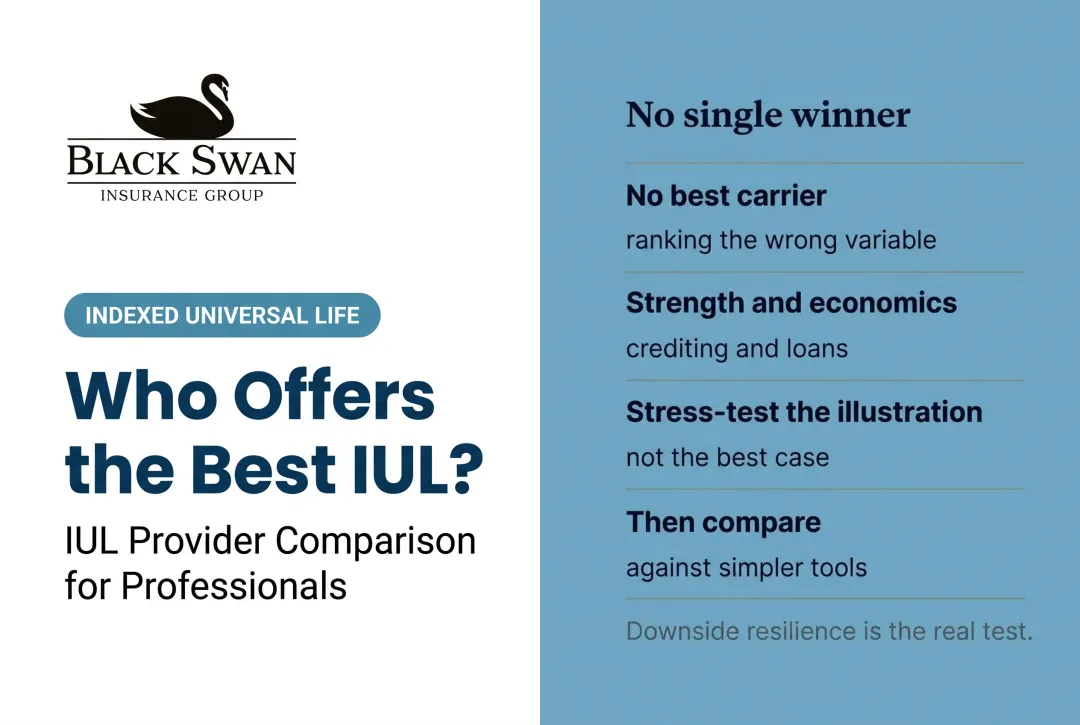
Carrier access and financial strength. The carrier matters more than the distributor — it sets terms, credits interest, deducts charges and pays claims decades out. Verify the issuing insurer's current rating (not the parent's), state licensing and availability, complaint history relative to market share, and operating track record. Brokerages working with established carriers give you more to compare than a single-carrier pitch.
Design, guarantees and crediting. Compare death benefit structure and premium schedule, cost of insurance and administrative and surrender charges, crediting methods with floors, caps and participation rates, and loan provisions including how unpaid interest is handled.
Separate guaranteed from illustrated values. The NAIC's guidance exists precisely because indexed products can be illustrated misleadingly when crediting assumptions run optimistic.
An illustration is a model, not a guarantee.

Ask for stress tests showing reduced or skipped premiums, lower-than-illustrated credits, rising charges and accumulating unpaid loan interest.
Adviser quality and ongoing service. Ask directly which carriers are being compared, how the adviser is paid, what alternatives were considered and ruled out, and who monitors the policy after issue and how often. A policy that looked sustainable at issue drifts if funding lapses, caps shift or loan balances grow unchecked.
Stronger Fit
- Earning $150K+ with stable surplus cash flow beyond everyday expenses
- A genuine need for permanent rather than temporary coverage
- Willingness to fund long term and capacity to monitor a complex product
- Insurable at a reasonable underwriting class
Weaker Fit
Walk away or wait if you need low-cost temporary coverage only, may need the cash within a few years, have unstable funding capacity, have not addressed high-interest debt or emergency reserves, or are relying on optimistic projections to make the numbers work.
Compare it against term, whole life, employer plans, IRAs or Roth strategies, brokerage investing and basic emergency savings. It works as a complement where a permanent protection and tax-diversification need already exists.
Risks to Understand Before You Apply
- This is underwriting, not a deposit — health questionnaires, possibly medical records, financial documentation and beneficiary designations.
- Caps and participation rates can be lowered after issue, within contract limits.
- Cost of insurance rises with age, and underfunding is the leading cause of failure.
- Premium financing adds leverage risk that most buyers neither need nor should carry.
- MEC status is generally permanent and changes loan and withdrawal taxation.
- Lapsing with a loan outstanding can create taxable income with no cash received.
Find Out Where You Actually Stand
This starts with the Tax-Free Wealth Blueprint Fit Review. If you earn $150K+ and are trying to work out where to buy, we start a step earlier — whether you should at all. Then we compare appropriate carriers side by side, walk the trade-offs honestly, stress-test illustrations against pessimistic scenarios, and stay available after any policy is issued. If the answer is your 401(k), a Roth and a term policy, we will say so. If IUL does not fit, we will tell you that too.
Frequently Asked Questions
Where is the best place to open an IUL account?
There is no IUL account. The policy is arranged through a licensed life insurance professional and issued by a carrier. An independent brokerage typically offers the broadest comparison and ongoing guidance.
Who is an IUL best for?
Buyers with a genuine permanent insurance need, stable long-term funding capacity and the discipline to review the policy over time — after 401(k)s, Roth strategies and reserves have been considered.
Is it better to buy from a bank or an independent agent?
Banks may offer convenience or financing relationships but typically limit you to select products. Independent agents generally provide broader carrier access. Premium financing is a separate decision that adds risk and is unnecessary for most buyers.
Can I get life insurance if I live abroad?
It depends on residence, citizenship, travel patterns, health and each carrier's rules for international applicants. Requirements vary significantly, so consult a licensed professional.
What should I compare before choosing a policy?
Carrier financial strength, guarantees against illustrated values, charges, crediting mechanics, loan terms, funding requirements and available alternatives — plus who reviews the policy annually after issue.
How long does the application take?
It depends on file completeness, whether medical records or labs are required, and carrier workload. This is an approval process with underwriting, not an account opening.
Sources
- LIMRA — U.S. individual life insurance new premium tops $17.5 billion in 2025
- NAIC — Life Insurance Illustrations
- U.S. Bank — insurance premium financing
Disclosure: This article is educational and is not personal tax, legal or investment advice. Indexed universal life is life insurance first. Carrier availability, underwriting requirements, product terms and state licensing vary and must be confirmed before applying; ratings reflect an insurer's claims-paying ability, not the suitability of any contract. Premium financing is a specialised strategy carrying additional leverage, collateral and interest-rate risk. Illustrated values are not guarantees; actual results depend on policy terms, crediting, costs and funding. Any potential tax-advantaged access depends on the policy being properly structured, funded and managed. Actual results depend on policy design, carrier, crediting options, caps, participation rates, expenses, funding and ongoing management. This strategy is not appropriate for everyone. Policy loans and withdrawals reduce cash value and the death benefit, and can create tax consequences if the policy lapses or becomes a modified endowment contract. Consult your own tax, legal and financial professionals for advice specific to your situation.
And remember, it's not what you earn, it's what you keep… enjoy the ride.