By Robert Balgac, Founder, Black Swan Insurance Group | October 5, 2026
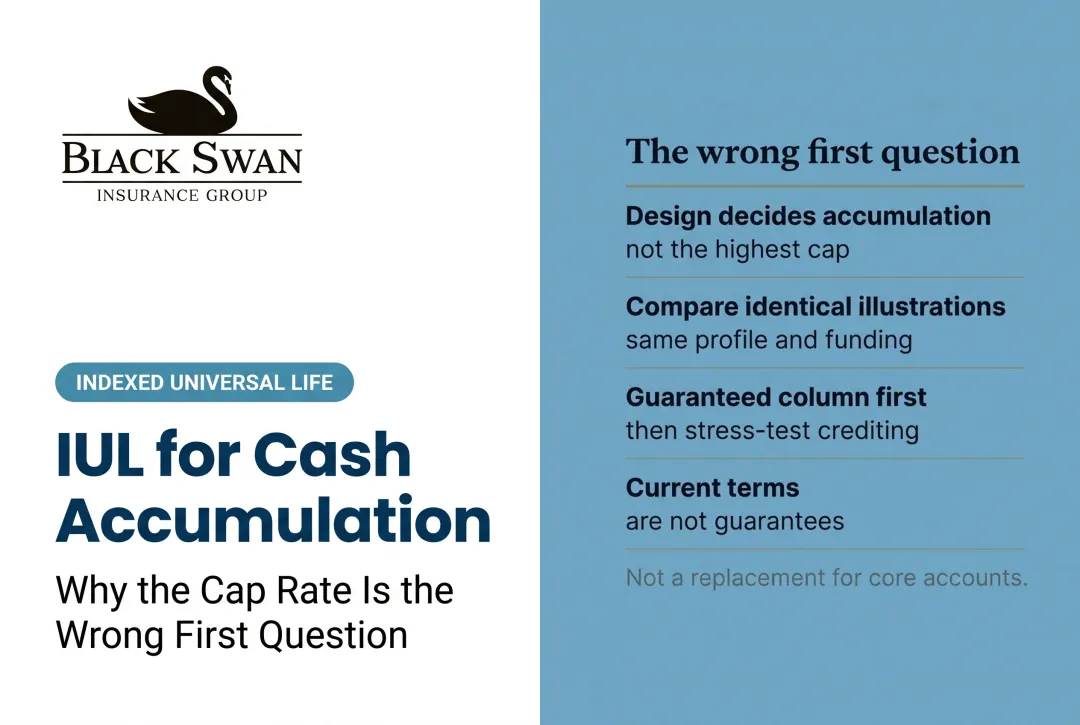
Searching for the best IUL usually turns into a hunt for the highest cap rate or the most attractive hypothetical. That is the wrong starting point, and it is the reason so many of these policies disappoint the people who bought them.
An indexed universal life policy is a thirty-year contract, not a one-year product pick. The cap you are shown today can be changed by the carrier tomorrow. What cannot be changed is the guarantee structure, the loan provisions and whether you can actually fund the thing through a bad year.
If you earn $150K+, run a business, or sit in an executive seat and are looking at permanent protection, tax diversification or supplemental income outside a concentrated business asset, understand that a bad fit here is expensive to unwind. Surrender charges and early-year costs make the first exit the most painful one.
The short answer: The right IUL is the one whose guarantees, costs, funding requirement and loan structure match the job you need done and the premium you can sustain for decades. Rank carrier financial strength, contractual guarantees, fee structure and loan design above any illustrated rate — the illustration is a projection under stated assumptions, and the non-guaranteed elements can move. Fund one only after term coverage, emergency reserves and qualified retirement contributions are handled.
Key Takeaways
- The best fit depends on the job: accumulation, retirement income, protection, living benefits or estate planning
- Rank carrier strength, costs, guarantees and loan provisions above any single illustration
- Treat illustrations as projections and stress-test conservative crediting and reduced-funding scenarios
- Fund a policy only after term coverage, emergency savings and qualified retirement contributions are in place
- The 0% floor does not stop internal charges — they continue whether the index credits 0% or 15%
How the Product Actually Works
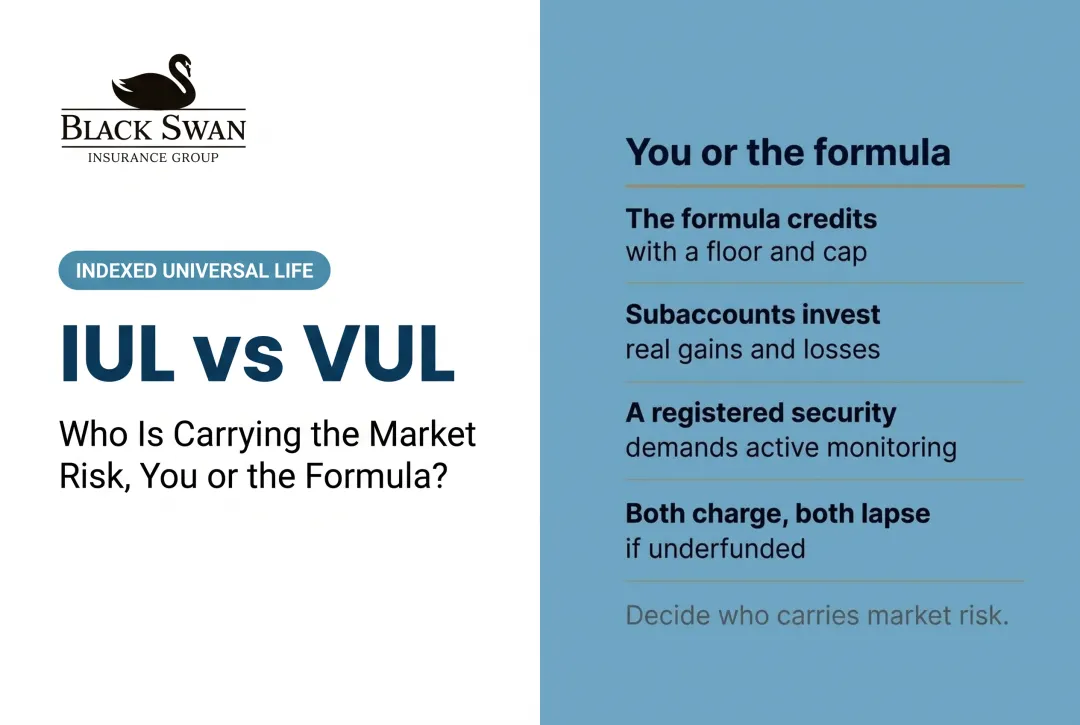
An IUL is permanent life insurance first, built around a death benefit and a cash-value account. Cash value can grow through interest credited on a formula tied to an external index such as the S&P 500. You do not own shares and you do not receive dividends; the index movement is an input to a calculation.
Every premium dollar splits several ways:
- Cost of insurance — the mortality charge for the death benefit
- Policy administration fees
- Optional rider charges such as chronic illness or long-term care
- Whatever remains, allocated to cash value
Underfund the policy, or let internal charges rise faster than expected, and lapse becomes a real possibility even when the index performs reasonably.
The Crediting Formulas
- Annual point-to-point — measures index change over 12 months, then applies participation rate, floor and cap
- Monthly point-to-point — locks each month's result and totals them at year end, so a few bad months can offset several good ones
- Monthly averaging — averages index values across the year rather than using single start and end points
With a 10% cap, 100% participation and a 0% floor: an index rising 14% credits 10%; an index falling 8% credits 0%, not negative 8%. Simplified, and not a forecast.

Zero is your hero in a down year — but the floor applies to the credit, not to the charges. That distinction is the whole ballgame.
Loans, Withdrawals and the MEC Line
Policy loans provide access to cash value, generally without immediate taxation while the contract stays active. Loans accrue interest and reduce both cash value and death benefit. A lapse with an outstanding loan and gain in the contract can create taxable income — with no cash received to pay it.
Overfund too aggressively and the contract becomes a modified endowment contract, which changes how loans and withdrawals are taxed for the life of the policy. Any potential tax-advantaged access is conditional on the policy being properly structured, funded and managed.
Against the Alternatives
| Feature | Term life | Whole life | IUL | Roth IRA / 401(k) |
|---|---|---|---|---|
| Permanent coverage | No | Yes | Yes | N/A |
| Guaranteed cash growth | No | Yes | No | Market-dependent |
| Premium flexibility | Low | Low | High | N/A |
| Contribution limits | None | None | Governed by MEC rules | IRS annual limits |
| Complexity | Low | Moderate | High | Low to moderate |
Carriers, by the Job They Are Built For
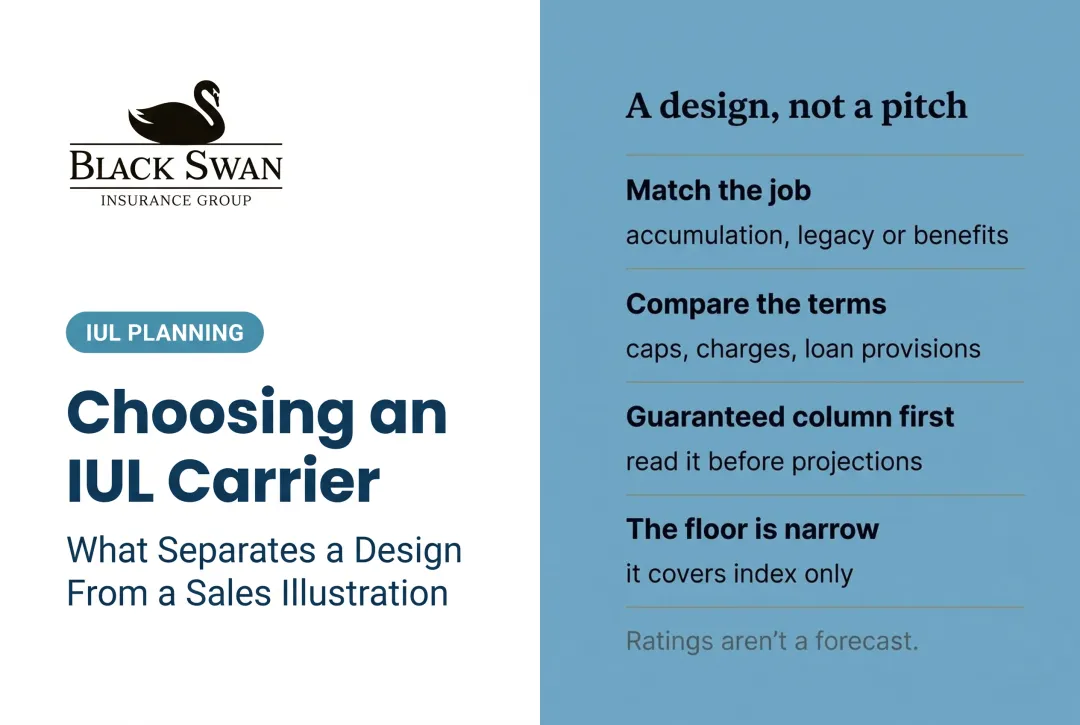
Match the product to the goal, not to a headline cap. Compare suitability for your specific job, financial strength and claims-paying ability, transparency between guaranteed and non-guaranteed values, cost structure and loan design, and how the carrier treats existing policyholders.
Pacific Life
Flagship Pacific Horizon IUL 2 launched April 2024 with five indexed accounts, a fixed account, and a Fixed Charge Indexed Loan carrying a guaranteed 4.5% loan-interest rate. A no-lapse guarantee to age 90 is available on eligible policies, with an option to extend to lifetime coverage.
Account options include S&P 500, Invesco QQQ and BlackRock iBLD Endura volatility-control strategies, with current caps between 10% and 24% depending on the account — all subject to change.
As of August 2025 Pacific Life carries an AM Best A+ rating with strong marks from Moody's, S&P and Fitch. Premier Chronic Illness and Premier LTC riders are available, varying by state, and survivorship options run through Pacific Horizon Survivorship IUL 2.
Trade-off: multiple account choices add complexity, and caps and participation rates are not guaranteed.
Nationwide
Lineup includes Indexed UL Accumulator III, YourLife IUL Accumulator and Indexed UL Protector II 2020. Accumulator III offers four indices, 11 indexed strategies, an Overloan Lapse Protection Rider and a Long-Term Care Rider.
Current disclosed rates, subject to change, include a 10.50% S&P 500 point-to-point cap and Multi-Index Monthly Average strategies with caps as high as 25%. Nationwide states explicitly that past index performance does not indicate future crediting rates.
Nationwide Life Insurance Company holds A+ from both AM Best and S&P per its 2025 annual report.
Watch: compare guaranteed values against current cap history rather than anchoring to today's rate.
Allianz Life
The Allianz Life Accumulator IUL launched July 2024, replacing the prior Pro+ Advantage product. It introduced an Index Lock feature allowing a policyholder to lock an index value once per crediting period, plus an Auto Lock option triggered by preset targets.
Index choices include the S&P 500 Futures Index ER and the Bloomberg US Dynamic Balance III ER Index. Allianz is direct that bonus allocations carry trade-offs: higher surrender charges, longer surrender periods, or lower caps and participation rates than non-bonus accounts.
Allianz Life Insurance Company of North America holds AM Best A+ (affirmed March 2026) and S&P AA.
Watch: loans and withdrawals reduce cash value and may trigger ordinary income tax if they exceed basis. Not the right choice for someone who wants the simplest possible design.
Penn Mutual
A mutual company since 1847. IUL products — Accumulation IUL and Accumulation Builder Flex IUL — are issued through The Penn Insurance and Annuity Company.
Accumulation Builder Flex includes a 1% minimum interest guarantee even in years with zero or negative index performance, plus a death-benefit guarantee for up to 30 years under policy terms. The loan structure offers a traditional loan at 1% net cost in years one to five, dropping to 0% after year six, and an indexed loan option with a guaranteed 5% fixed rate.

Penn Mutual carries AM Best A+ (affirmed April 2026). Accumulation IUL is not available in New York.
Limitation: less suited to short time horizons or inconsistent funding.
What the Critics Get Right
The people who say "best IUL" lists are mostly marketing are right, and it is worth conceding before going further.
They are right that current caps are the least durable thing a carrier publishes and the most heavily promoted. They are right that ranking carriers on illustrated values rewards whoever chose the most aggressive assumption. And they are right that a brokerage's own reputation metrics say nothing about an insurer's ability to pay a claim decades from now — those are separate questions and should never be blended.
Where the criticism runs out is in treating the whole comparison as theatre. Guarantee structures, loan mechanics, rider pricing and no-lapse provisions differ materially between these carriers, and those differences persist. The comparison is real; the dimension being advertised is not.
How to Compare Properly
Request the full policy ledger, not the summary page. It should show premium outlay by year, cost of insurance and administrative charges, cash value and surrender value, death benefit, and the loan assumptions.
Then stress-test it: lower crediting rates, reduced or missed premiums, changing caps, extended loans, and retirement-phase withdrawals. The NAIC guidance on life insurance illustrations is explicit that non-guaranteed values are estimates under specific assumptions, not promises.

Check current AM Best, Moody's, S&P and Fitch ratings directly from the carrier or state insurance department resources.
Six mistakes that recur:
- Choosing the carrier with the highest current illustration
- Treating the policy as a direct market investment
- Underfunding in the early years
- Assuming premiums can always be skipped without consequence
- Ignoring loan risk — a lapse with a loan can create taxable income (Kitces on policy loan taxation)
- Replacing existing coverage without a documented side-by-side comparison
As WSJ Buy Side notes, policy fees keep accruing whether the index credits 0% or 15%. If performance runs weaker than illustrated, additional premium may be needed to keep the contract from lapsing.
An IUL illustration without a risk section is a restaurant menu with no prices. Everything looks delicious until the check shows up.
The Ultimate IUL Blueprint
If you are holding ledgers from several carriers, the Blueprint covers exactly what to pull from each: the guaranteed column, the loan provisions, the seven-pay limit, and what the design has to survive.
Who This Actually Fits
Stronger Fit
- Household income of $150K+ with stable or growing cash flow
- A genuine permanent protection, legacy or business-continuity need
- Funding capacity of roughly $500–$2,500 a month that does not touch emergency reserves
- Already funding retirement accounts, or deliberately building a second tax-advantaged bucket
- A long time horizon and willingness to review the contract annually
- Insurable, and clear that this is not a market replacement
Weaker Fit
Not everyone should buy an IUL. A policy that cannot be funded through a bad year is not the best anything.
- Unstable income or inconsistent funding capacity
- Thin emergency reserves, or high-interest debt needing triage
- Money likely needed before the contract builds accessible value
- The goal is the cheapest coverage — term insurance answers that outright and should be said plainly
- The goal is guaranteed growth — whole life offers stronger guarantees with less complexity
- Retirement objectives already met through a 401(k), IRA or brokerage account
Risks to Understand Before You Choose
- Caps and participation rates are not guaranteed and can be adjusted within contract limits after you commit
- Internal charges continue in flat years, and cost of insurance rises with age
- Underfunding in the early years is the most common cause of later failure
- Surrender charges run for years and differ substantially between carriers
- Bonus allocations carry trade-offs — longer surrender periods, higher charges, or lower caps
- Loans reduce cash value and death benefit, and a lapse with a loan outstanding and gain in the contract can create taxable income
- Crossing the seven-pay limit makes the contract a MEC under I.R.C. § 7702A and changes distribution taxation permanently
- State availability varies — some products are simply not offered where you live
- Ratings reflect claims-paying ability, not policy performance, and can be revised
Find Out Where You Actually Stand
This starts with the Tax-Free Wealth Blueprint Fit Review. If you earn $150K+ and are comparing carriers, we read the full ledgers rather than the summaries, stress-test each design against lower crediting and imperfect funding, compare the loan provisions properly, and price the alternatives including term. If it does not fit, we will tell you that too.
Frequently Asked Questions
Are IULs worth it?
For someone who needs permanent coverage, can sustain long-term funding and has already handled the other priorities, yes, potentially. For anyone seeking the cheapest coverage or guaranteed growth, usually not.
What are the main risks?
Rising internal charges, changing caps and participation rates, underfunding, loan balances and lapse. Illustrations carry uncertainty, and a lapse with loans outstanding can produce an unexpected tax bill.
How do I choose between carriers?
Compare financial strength, contractual guarantees, fees, crediting methods, loan provisions and available riders — not the current illustrated rate. How a carrier treats its existing policyholders matters as much as what it offers new ones.
Is an IUL better than whole life?
Neither is universally better. Whole life offers stronger guarantees and predictable premiums. An IUL offers funding flexibility and index-linked upside, with more complexity and more non-guaranteed elements.
How much should I fund?
It depends on income, coverage need, age, health and competing priorities. Test a sustainable funding level and a reduced-funding scenario. Never pick a premium purely to make an illustration look better.
Should I buy term instead?
If the requirement is maximum death benefit for the lowest premium over a defined period, term insurance is the cleaner answer and deserves to be said before anyone designs a permanent policy.
Sources
- NAIC — Life Insurance Illustrations
- NAIC — Life Insurance
- Kitces — Life insurance loan taxation at death or lapse
- WSJ Buy Side — Indexed universal life insurance
- I.R.C. § 7702A and Rev. Proc. 2008-39 (modified endowment contracts and the seven-pay test)
Disclosure: This article is educational and is not personal tax, legal or investment advice. Indexed universal life is life insurance first. Carrier products, ratings, caps and participation rates change; confirm current terms and state availability directly. Actual results depend on policy design, carrier, crediting options, caps, participation rates, expenses, funding and ongoing management. Policy loans and withdrawals may reduce cash value and death benefit and can create tax consequences if the policy lapses or becomes a modified endowment contract. This strategy is not appropriate for everyone. Illustrated values are not guarantees; actual results depend on policy terms, crediting, costs and funding. Consult your own tax, legal and financial professionals for advice specific to your situation.
And remember, it's not what you earn, it's what you keep… enjoy the ride.