By Robert Balgac, Founder, Black Swan Insurance Group | October 5, 2026
There are four different premium numbers attached to any indexed universal life policy, and most buyers are shown one of them without being told which.
That is not a small detail. The gap between the minimum premium and the premium that actually builds what the illustration shows is where most disappointment in this product originates. A policy funded at minimum keeps the death benefit technically alive and builds almost nothing — and it looks identical on the application to one funded properly.
Maryland professionals, practice owners and parents who need lifelong protection alongside cash value deserve to know which number they were handed. If you earn $150K+ and have a proposal in front of you, start there.
The short answer: An IUL is a long-term insurance contract, not a market position. Crediting is tied to an index with caps, floors and participation rates bounding the actual result. Four premium levels exist — minimum, planned, target and maximum non-MEC — and they produce very different policies from the same product. Maryland requires illustrations to separate guaranteed from non-guaranteed elements and prohibits language implying non-guaranteed values are guaranteed. Compare guaranteed values against the illustration before applying.
Key Takeaways
- Crediting is tied to an index such as the S&P 500, with caps, floors and participation rates limiting the actual result
- Flexible premiums sound appealing; underfunding or heavy loans push a policy toward lapse
- Fit depends on protection need, liquidity, health and funding capacity — not an illustrated projection
- Maryland law requires guaranteed and non-guaranteed elements to be clearly separated
- Always compare guaranteed values against non-guaranteed illustrations before applying
How the Policy Works
Permanent life insurance staying in force for life while you meet the policy's requirements. Two main parts: a death benefit, and a cash-value account that grows over time and helps cover ongoing insurance costs.
Each premium splits. Part covers the cost of insurance and administrative fees. The rest goes into cash value, where it may earn interest tied to an external index.
Caps, Floors and Participation
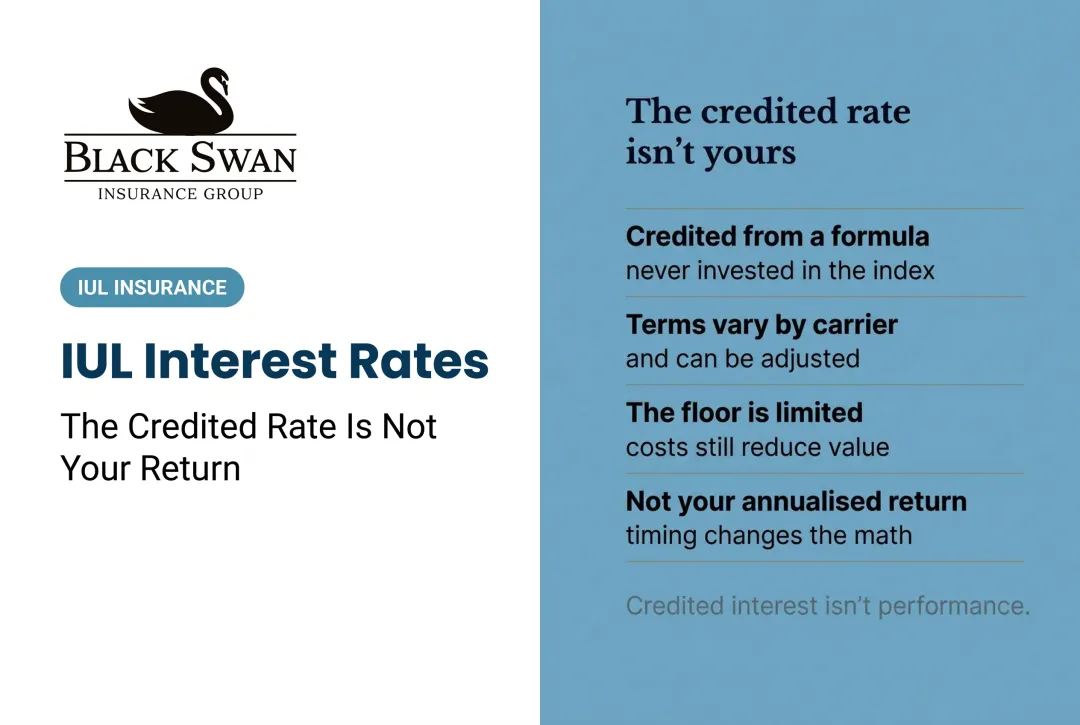
You never own the index. The insurer credits interest on a formula built from:
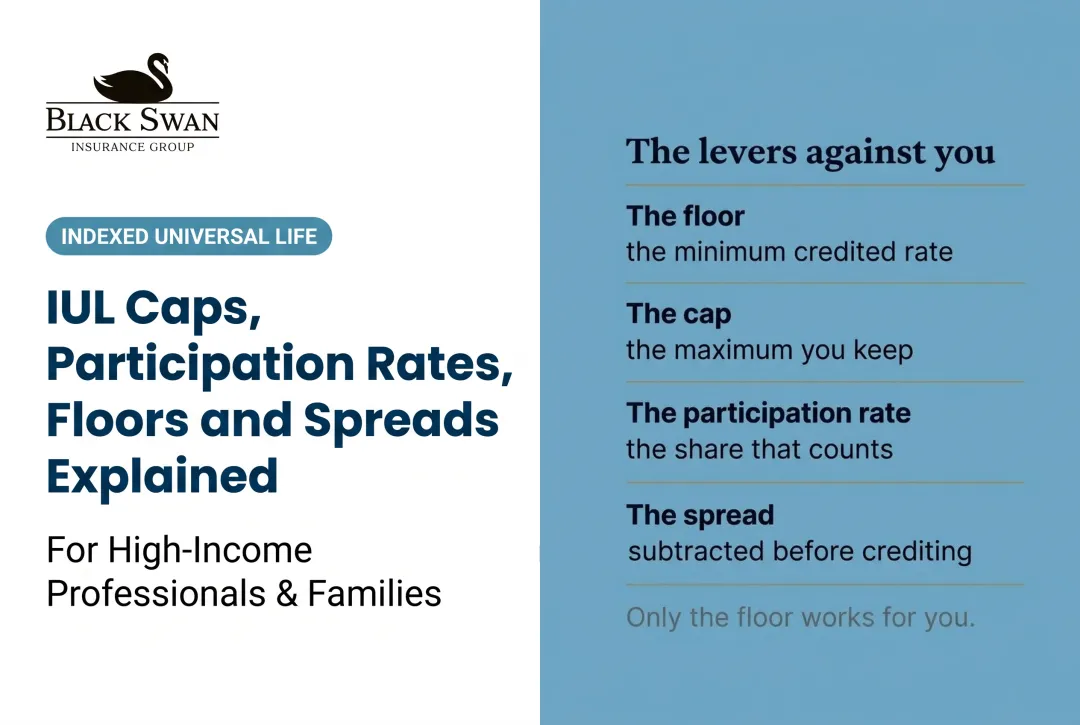
- Cap rate — the maximum crediting rate, however well the index performs
- Participation rate — the percentage of index gains counting toward your credit
- Spread — a deduction the insurer subtracts from the index return, where the contract uses one
- Floor — the minimum crediting rate, often 0%, protecting against a negative index year
The catch: a floor stops negative index credits. It does not stop policy charges. Cost of insurance, administrative fees and rider costs come out every month, so cash value can shrink in a year the floor supposedly protected you.
Zero is your hero in a down year — but the floor applies to the credit, not to the charges.
| Product | Cash value | Premium flexibility | Market exposure |
|---|---|---|---|
| IUL | Index-linked, capped | Flexible within limits | Indirect, capped |
| Whole life | Guaranteed growth | Fixed premiums | None |
| Variable UL | Investment subaccounts | Flexible | Direct, uncapped |
| Term insurance | None | Fixed, temporary | None |
What Maryland Requires of Your Illustration
State rules require IUL illustrations to clearly separate guaranteed elements from non-guaranteed ones, and to show the insured's age, sex, underwriting class and product form. Maryland prohibits language implying that non-guaranteed premiums or values are guaranteed.
That prohibition exists because the industry needed it. If your illustration blurs the line, that is a regulatory problem and worth raising.

The Four Premiums
There is no fixed monthly price for a $1 million Maryland policy. Two applicants the same age can receive very different quotes on health, underwriting class and design.
What drives cost: age, sex and tobacco use; health history and underwriting class; coverage design and death-benefit option, level versus increasing; riders such as chronic illness or waiver of premium; the premium schedule and funding strategy; and insurer-specific pricing.
Coverage amount and funding amount are not the same thing. A $1 million death benefit does not dictate what you need to pay to pursue a cash-value goal. The design does.
- Minimum premium — keeps the policy from lapsing and rarely builds meaningful cash value
- Planned premium — what you intend to pay based on your goals
- Target premium — a carrier benchmark, often tied to commissions and long-term sustainability
- Maximum premium — capped by IRS rules to avoid modified endowment contract status
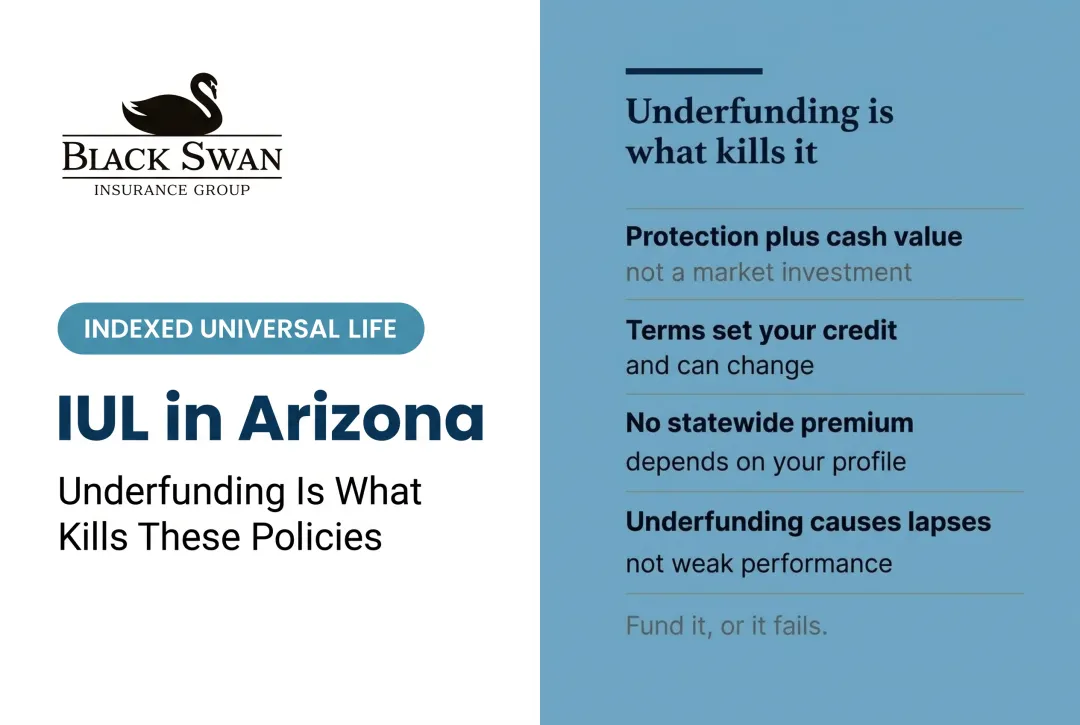
Paying only the minimum can leave a policy underfunded for decades. The problem usually surfaces much later, when charges rise and cash value cannot keep up — at an age when fixing it is expensive and replacing the coverage may not be possible.
Comparing Two Proposals
- Guaranteed values against current, non-guaranteed assumptions
- How long premiums are planned to continue
- The death-benefit option selected
- Break-even timing on cash value
- The surrender charge schedule and when it ends
- Sensitivity to credited rates lower than illustrated
What the Critics Get Right
The criticism aimed at this product is accurate about the mechanics, and saying so is more useful than defending the category.
Critics are right that a cap of 9% means you never see more than 9%, even in a year the index gains 25%, and that this asymmetry is under-explained at the point of sale. They are right that the target premium exists partly as a commission benchmark, which is a conflict worth naming. And they are right that minimum-funded policies sold to people who could not sustain more are a known and repeated failure.
Where the criticism runs out is the protection need. Nothing in that list tells you whether your coverage requirement outlasts a term. If it does, term insurance eventually stops being an option and the question becomes which permanent design survives your funding. If it does not, the critics are simply right and you should buy term.
Benefits, Access and Risk
What it offers: lifelong protection while the policy stays funded; adjustable premiums and death-benefit options within contract limits; tax-deferred cash-value growth; and access to cash value through withdrawals or loans, with potential tax-advantaged treatment when the contract is properly structured, funded and managed.
The trade: index-linked crediting offers upside without direct market investment, and caps, participation rates and fees erode that advantage.
Loans and Tax
Policy loans are real debt. They accrue interest and reduce available cash value, surrender value and the death benefit until repaid. If an outstanding loan grows too large relative to cash value, the policy lapses.
Under IRS rules on non-MEC life insurance, surrender proceeds are taxable only above your investment in the contract — the premiums paid in. Lapsing with an outstanding loan can create taxable income even though you receive no cash.

The Ultimate IUL Blueprint
If a permanent need genuinely exists, the Blueprint covers the funding decisions that determine the outcome: funding levels, the MEC line, index-strategy selection and loan timing.
Who It Fits
Stronger Fit
- A permanent protection need, not a temporary one
- Household income of $150K+ with funding sustainable through downturns and life changes
- Lower-cost tax-advantaged accounts such as a 401(k) or Roth IRA already maxed
- Comfort monitoring a contract with moving parts for decades
- Insurability supporting reasonable underwriting
Weaker Fit
Not everyone should buy an IUL. If you were quoted the minimum premium, the policy you were shown is not the policy you were sold.
- No lasting need for permanent insurance — term insurance answers a temporary need better and far more cheaply
- A short holding period in mind
- No emergency reserves outside the policy
- Unstable income or significant existing debt
- Reliance on optimistic, non-guaranteed projections to make the case
Physicians, attorneys and executives reaching peak earnings in their late 40s or 50s face a compressed runway that changes the arithmetic. Weigh insurability, sustainable premiums and liquidity needs against the shorter horizon before committing.
This is not automatically better or worse than term plus separate investing, whole life, fixed annuities, or maxing qualified accounts. Each carries different guarantees, flexibility and risk. There is no universal winner.
Practice and business owners considering this for succession planning or estate liquidity should coordinate ownership and beneficiary structure with legal and tax advisors first. The policy is one piece of a plan, not a standalone fix.
Buying and Reviewing One
- Define the protection need — permanent coverage, income replacement or a business obligation
- Establish the sustainable funding level, not the minimum
- Request comparable illustrations from more than one carrier on matched assumptions
- Read the guaranteed column first, then the current one, then a lower-rate stress test
- Verify the carrier's financial strength and the producer's Maryland licence
- Use the free-look period to read the contract rather than the illustration
- Review annually — credited interest, funding status, loan balances and any cap changes

An illustration is a model, not a forecast. Ask for all three columns — guaranteed, current, and a lower-rate stress test — not the one that looks best.
Risks to Understand Before You Apply
- Being quoted the minimum premium and treating it as the plan is the most common failure in this product
- Charges continue in a 0% crediting year, so cash value can fall with the floor intact
- Cost of insurance rises with age and is deducted regardless of crediting
- Caps and participation rates are non-guaranteed and can be reduced after issue
- A 9% cap means 9%, even in a year the index gains 25%
- Surrender charges run for years and make an early exit costly
- Loans are real debt and a lapse with a loan outstanding and gain in the contract creates taxable income with no cash received
- Crossing the seven-pay limit makes the contract a MEC and changes distribution taxation permanently
- A compressed time horizon magnifies every one of these for a late starter
Find Out Where You Actually Stand
This starts with the Tax-Free Wealth Blueprint Fit Review. If you earn $150K+ in Maryland, we identify which of the four premium levels you were actually quoted, read the guaranteed column against the illustration, run a lower-rate stress test, and price term plus your existing accounts on identical terms. If it does not fit, we will tell you that too.
Frequently Asked Questions
What does a $1 million IUL cost in Maryland?
There is no fixed figure. Age, sex, tobacco use, health, underwriting class, design, riders and funding level all drive it, and two applicants the same age can be quoted very differently.
What is the difference between minimum and planned premium?
Minimum keeps the policy from lapsing and builds little cash value. Planned is what you intend to pay to reach your goals. Confirm which one you were quoted — the difference is usually the difference between a policy that works and one that does not.
What does Maryland require on an illustration?
Guaranteed elements must be clearly separated from non-guaranteed ones, the insured's age, sex, underwriting class and product form must be shown, and language implying non-guaranteed values are guaranteed is prohibited.
Does the 0% floor protect my cash value?
No. It prevents a negative index credit. Cost of insurance, administrative fees and rider charges continue every month, so cash value can still fall.
Can a policy loan cause a lapse?
Yes. If the outstanding balance grows too large relative to cash value, the policy terminates — and a lapse with a loan outstanding and gain in the contract can create taxable income.
Should I buy term insurance instead?
If the protection need has an end date, yes. Term is cheaper and simpler, and it deserves pricing before anyone designs a permanent policy.
Sources
- COMAR 31.09.09.06 — Maryland life insurance illustration requirements
- IRS Revenue Ruling 2009-13 — life insurance contract dispositions
- NAIC — Life Insurance Illustrations
- NAIC — Life Insurance
- I.R.C. § 7702A and Rev. Proc. 2008-39 (modified endowment contracts and the seven-pay test)
Disclosure: This article is educational and is not personal tax, legal or investment advice. Indexed universal life is life insurance first. State rules, carrier product availability and licensing requirements change; confirm current details before applying. Actual results depend on policy design, carrier, crediting options, caps, participation rates, expenses, funding and ongoing management. Policy loans and withdrawals may reduce cash value and death benefit and can create tax consequences if the policy lapses or becomes a modified endowment contract. This strategy is not appropriate for everyone. Illustrated values are not guarantees; actual results depend on policy terms, crediting, costs and funding. Consult your own tax, legal and financial professionals for advice specific to your situation.
And remember, it's not what you earn, it's what you keep… enjoy the ride.