By Robert Balgac, Founder, Black Swan Insurance Group | October 9, 2026
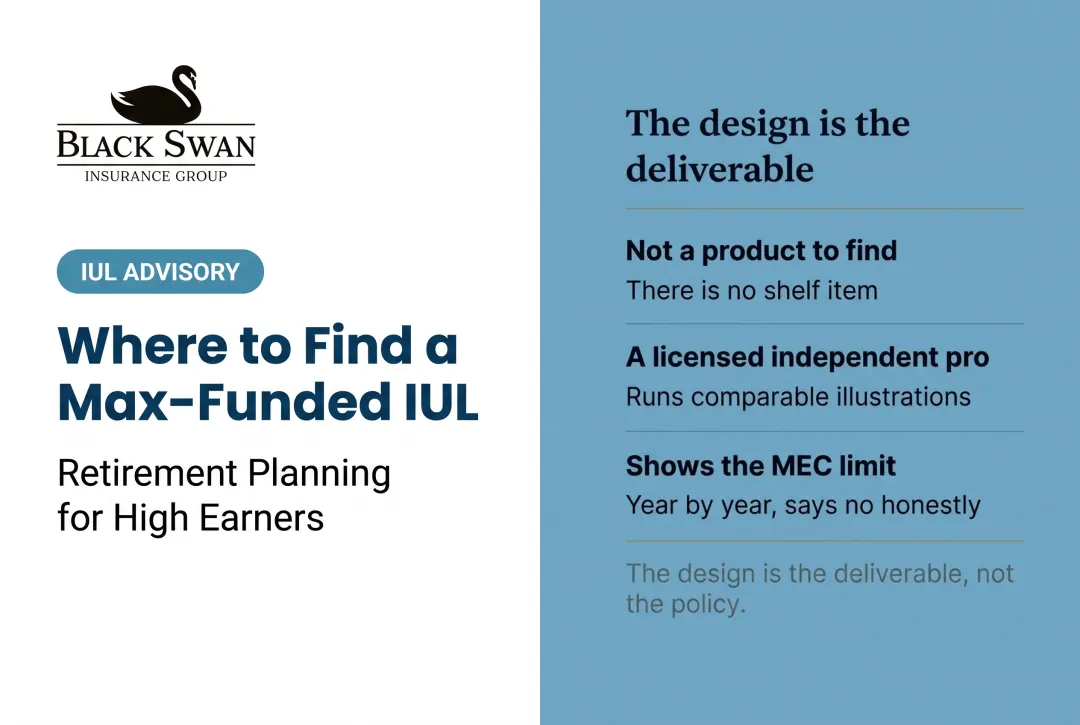
If you earn $150K+, you have maxed the 401(k), you are past the Roth phase-out, and you have started searching for where to buy a max-funded IUL, you are going to be disappointed by the honest answer: there is nowhere to buy one. There is no account type, no shelf product, no online calculator that produces the right number.
A max-funded IUL is a design. Its quality depends almost entirely on who builds it, which carrier chassis they build it on, and whether that person will still be taking your call in year seven. The purchase decision you are actually making is about a professional, not a product.
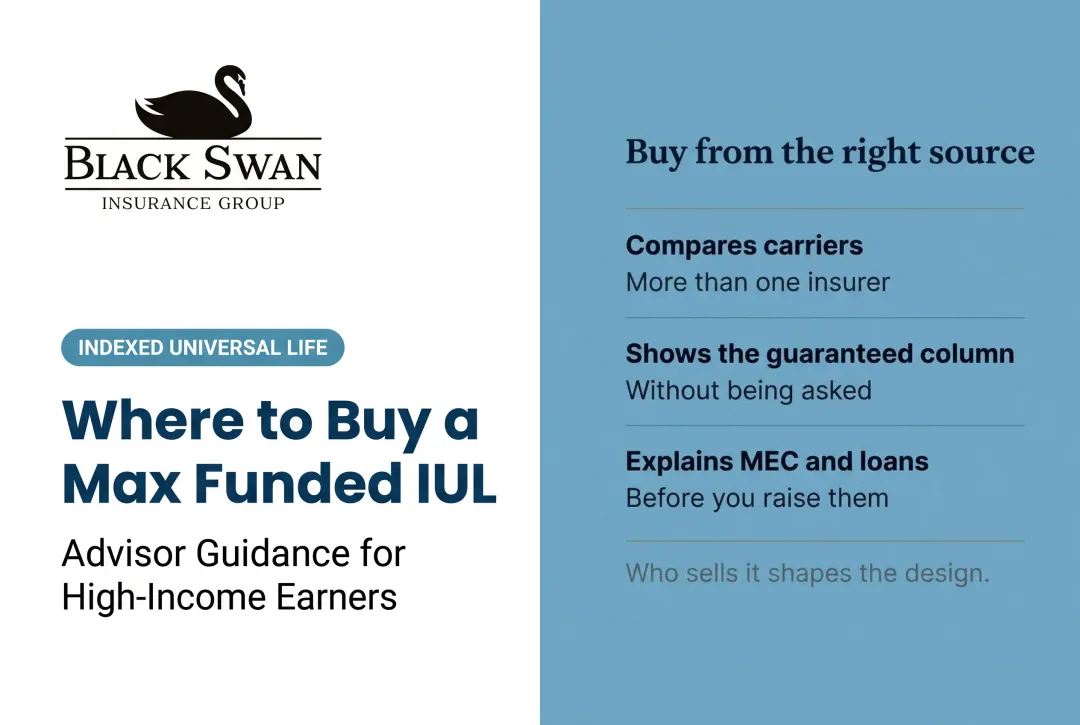
The short answer: Get it through a licensed independent brokerage that can compare multiple carriers, calculate your specific non-MEC ceiling, and build the design around a real protection need rather than your appetite for cash value. Captive agents see one shelf. Direct-to-carrier gives you no comparison and little design flexibility. And the single best signal you have found the right person is that they are willing to tell you not to buy.
IUL new premium hit $4.5 billion in 2025, up 17% year over year. More people are buying. Fewer understand how funding limits, crediting mechanics and carrier selection interact.
Key Takeaways
- A max-funded IUL is a funding strategy, not a separate product — judge the source and the design, not the label
- Sections 7702 and 7702A set how much premium a contract can accept before it becomes a MEC
- Illustrations show projected, non-guaranteed values; demand the guaranteed figures separately
- Independent brokerages typically offer more carrier choice than captive agents or direct channels
- The right adviser will tell you when an IUL is not the fit, not just how to fund one
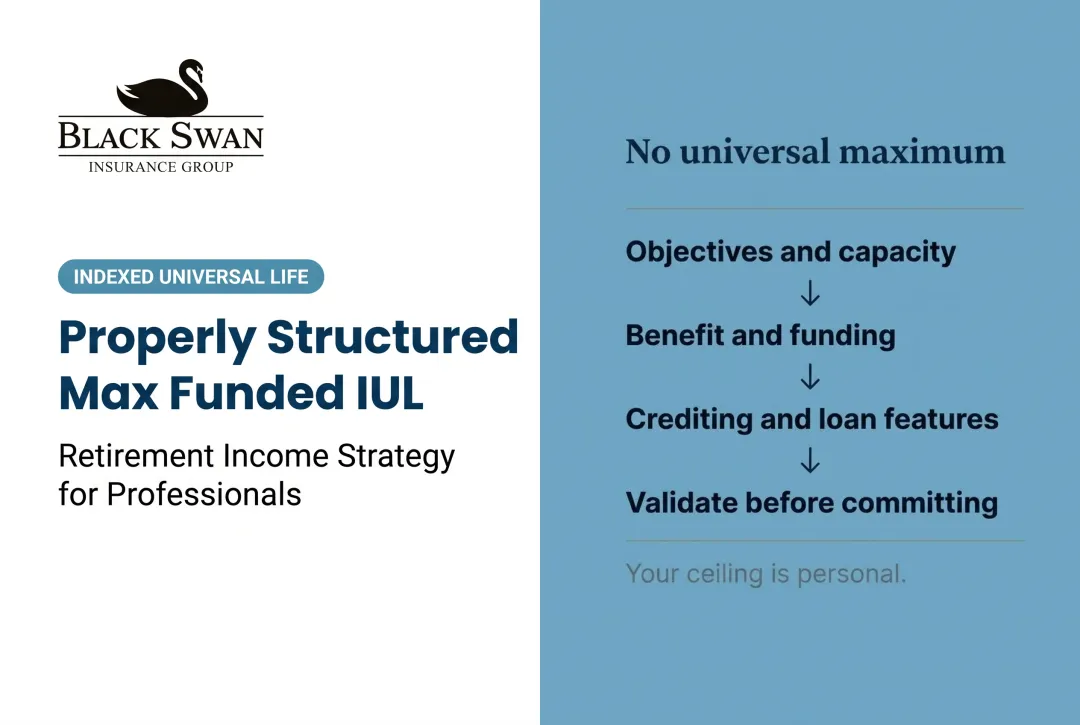
- Two people buying the same face amount can have completely different max-funding ceilings
What You Need to Know Before You Shop
"Max funded" means directing as much premium as possible into a policy while staying under the federal limits that preserve its tax treatment. It is a configuration decision made during design.
The 7702 and 7702A Framework
- Section 7702 defines what qualifies as life insurance for tax purposes, using either a cash value accumulation test or a guideline premium and corridor test.
- Section 7702A introduces the seven-pay test, which determines whether a policy becomes a Modified Endowment Contract when too much premium arrives too fast.
There is no single dollar figure that applies to every policy. The IRS has confirmed that maximum funding calculations depend on the insured's age, health classification, premium schedule and the death benefit selected.
Why this matters when choosing where to buy: if premiums exceed the seven-pay limit the policy becomes a MEC, loans and withdrawals are taxed gain-first, and early distributions can carry an additional 10% tax. Nobody designing a max-funded policy intends to cross that line. People cross it anyway, usually because the person who sold the design was not the person monitoring it.
Index Crediting Is Not Investing
Cash value is not invested in the S&P 500 or any other index. It is credited based on index performance, subject to caps (a ceiling on the credit), participation rates (the share of index gains you receive), spreads (a deduction some carriers apply first) and floors (a minimum credit, often 0%).
A 0% floor sounds reassuring. It does not mean cash value holds steady. Monthly cost of insurance, administrative fees and rider costs come out even in a year with zero index credit.
Zero is your hero in a down year — but the floor applies to the credit, not to the charges.
Projections Versus Promises
Every proposal carries two sets of numbers: guaranteed values reflecting contractual minimums, and non-guaranteed illustrated values reflecting an assumed crediting rate that is not locked in.
NAIC's illustration guidelines require carriers to separate guaranteed from non-guaranteed elements, and requirements effective in 2026 also mandate an alternate-scale ledger shown with equal prominence. Walk through both, side by side, before signing.
An illustration is a model, not a guarantee.

The Four Channels, and What Each Costs You
| Channel | Strengths | Limitations |
|---|---|---|
| Independent brokerage | Access to multiple carriers, side-by-side comparisons | Compensation structures vary by carrier |
| Captive / single-carrier agent | Deep product knowledge of one company | Limited to what that one insurer offers |
| Financial professional + licensed agent | Coordinated planning across accounts | Requires two professionals working together |
| Carrier direct inquiry | No agent commission on some policies | No independent comparison, limited design flexibility |
Start with a licensed professional who can compare multiple suitable carriers. A single high projected rate on an illustration tells you almost nothing — illustrated crediting assumptions vary by carrier, and the carrier with the flashiest projection today may not hold the strongest contract terms or financial footing tomorrow.
Five Questions to Ask Before Anyone Runs Numbers
- Which carriers do you actually represent, and how many max-funded IUL policies have you placed with each?
- How are you compensated, and is there any fee I pay you directly?
- Can you show me guaranteed and non-guaranteed values on separate ledgers?
- How will you monitor my policy to keep it under the MEC limit if I increase funding?
- What happens to my death benefit and cash value if I need to reduce or skip a premium?
Someone who answers these without hesitation is doing the job. Someone who deflects has told you something useful.
What a Strong Process Looks Like
Goals first, then design, then carrier comparison, then continued involvement after issue through annual reviews — not a one-time illustration handoff.
Black Swan Insurance Group, based in Springboro, Ohio, works with clients nationwide on that model, comparing carriers including F&G Annuities and Life, Transamerica, Mutual of Omaha, Corebridge and John Hancock rather than defaulting to a single product.
A quote or illustration is a starting point, not an issued policy. Your final offer depends on your state, your application, underwriting results and carrier approval.

The Ultimate IUL Blueprint
Before you pick a channel, the Blueprint covers what the design has to survive: funding levels, caps and charges, the MEC line, loan timing, and exactly what to demand from an illustration.
What the Critics Get Right
The strongest fair criticism of this entire distribution model is that almost everyone you will meet is paid when you buy and paid more when you buy bigger. Independent brokerages are not exempt from that. Compensation varies by carrier, which means the comparison you are shown is produced by someone with a financial interest in its conclusion.
That is real. Pretending otherwise would insult your intelligence, and the correct response is not to avoid advisers — it is to make the conflict visible. Ask how compensation differs across the carriers being compared. Ask for the design you are not being recommended and why. A professional who can answer both has nothing to hide.
What the criticism misses is that the alternative — buying direct, with no comparison and no one monitoring the seven-pay limit — reliably produces worse outcomes, not better ones.
A great IUL is engineered. A bad IUL is sold.
How to Vet the Person, Not the Brochure
Licensing and Relevant Experience
Verify the licence through your state insurance department before you discuss premium. Then ask specifically about MEC avoidance on high-premium cases, policy loan structuring, business-owner and executive planning, and coordinating IUL with retirement-income strategy.
Insist on at Least Two Designs
One illustration shows you nothing about trade-offs. Request a side-by-side covering planned premium and funding duration; death benefit amount and option (level versus increasing); cash surrender value at multiple points; policy charges and the surrender schedule; cap, participation and spread assumptions; and loan provisions with guaranteed minimums.
The lowest death benefit is not automatically the right design. A smaller death benefit pushes more premium into cash value, but it also leaves less protection and shrinks your non-MEC room — which can matter badly in a bonus year when you want to put more in. Cash-value efficiency has to be weighed against the actual protection need.
Stress-Test Before You Sign
Ask what happens under lower-than-illustrated crediting for several consecutive years; a missed or reduced premium; an early withdrawal or loan; rising cost of insurance; and a lapse while a loan is outstanding. If the adviser cannot show you those, ask directly. A design that only works in the best case is not a design.
Research the Carrier Separately
A financial-strength rating from AM Best, S&P or Fitch speaks to claims-paying ability over time. It says nothing about whether your illustration or your design holds up. Review the rating and the contract's guaranteed terms together.

What the Buying Process Actually Looks Like
- Financial goals review — cash flow, protection need, and what the policy must accomplish
- Preliminary carrier comparison — a few suitable options side by side
- Application and underwriting — health history, financial information, sometimes a medical exam
- Illustration review — guaranteed and non-guaranteed values, before signing
- Approval and policy delivery
- Premium funding begins
- Annual reviews — actual performance against the original illustration
Underwriting moves faster when your file is ready: income and net worth details, existing coverage, retirement contribution history, dependant information, and the intended premium and funding period. Business owners should also prepare notes on obligations and succession plans.
Review the final issued policy, not the original proposal. Confirm the death benefit, riders, premium schedule, loan terms, surrender charges and premium-change procedures all match expectation. Proposals and issued contracts do not always align after underwriting adjustments.
Talk to your tax and legal professionals about ownership structure, business use and estate planning before you sign.
Stronger Fit
- A genuine need for permanent life insurance, not just a savings vehicle
- Stable surplus cash flow after core expenses and maxed retirement contributions
- A long horizon, typically 15+ years
- Emergency reserves already in place, held outside the policy
- Willingness to maintain funding through market ups and downs
- Late-start high earners, often 45 to 55, who want an honest read on whether enough runway remains
Weaker Fit
This strategy is not appropriate for everyone. Step back if:
- Income is uncertain or inconsistent year to year
- You will need liquidity inside the next five to seven years
- You could not keep funding through a downturn
- Health issues limit insurability
- There is no meaningful permanent insurance need — term is cheaper and simpler
- Basic retirement accounts, including an employer match, are still unfunded
| Option | Best for | Trade-off |
|---|---|---|
| 401(k) with match | Immediate employer match, tax deferral | Contribution limits, required distributions |
| Roth IRA / 401(k) | Tax-free growth and withdrawals | Income limits on direct Roth IRA contributions |
| Max-funded IUL | Tax diversification plus permanent protection | Requires sustained funding, insurability |
| Term life | Low-cost, temporary protection | No cash value accumulation |
| Taxable brokerage | Liquidity, no funding commitment | No tax deferral, no death benefit |
Risks to Understand Before You Choose a Source
- The wrong channel narrows your options invisibly. A captive agent's best design is still only their carrier's best design.
- Non-guaranteed elements can move after issue; caps and participation rates are not fixed for life.
- MEC status is generally permanent and nobody will call to warn you before the money lands.
- Charges continue in flat years, including surrender charges in the early period.
- Lapse with a loan outstanding can create taxable income with no cash received. The loan is not the problem; the unmanaged loan is the problem.
- Nobody monitors a policy you bought from someone who has moved on. Ask who owns the annual review before you ask about caps.
Find Out Where You Actually Stand
This starts with the Tax-Free Wealth Blueprint Fit Review. If you earn $150K+ and are trying to work out where to buy, we run the needs analysis first, compare designs across multiple carriers rather than one, calculate your specific non-MEC ceiling, stress-test the funding across lower-return and zero-credit years, and show you the guaranteed column next to the illustrated one. Suitability, underwriting and state availability ultimately decide it. If IUL does not fit, we will tell you that too.
Frequently Asked Questions
Where is the best place to get a max-funded IUL?
Usually a licensed, transparent independent brokerage that can compare carriers and structure the design around your goals, protection need, cash flow and MEC limit — then stay involved for annual reviews.
How do I find a qualified adviser?
Verify the state licence, ask about experience with high-premium IUL design, check how many carriers they represent, and confirm they will disclose compensation and provide ongoing reviews.
Should I buy directly from an insurance company?
Direct access limits you to one company's products and design options, with no independent comparison. An independent adviser typically gives broader comparison and more guidance through underwriting.
What should I compare across illustrations?
Planned premium and death benefit; guaranteed versus non-guaranteed values; charges, surrender values and loan provisions; and MEC testing results alongside stress-tested lower-crediting performance.
Is a max-funded IUL right for every high-income earner?
No. High income alone is not enough. You also need a genuine permanent insurance need, sustainable cash flow, a long horizon, adequate liquidity outside the policy and willingness to monitor it.
Does the carrier or the adviser matter more?
The adviser decides the design, and the design decides most of your outcome. The carrier decides the contract terms and the claims-paying ability behind it. You need both right, in that order.
Sources
- LIMRA — individual life insurance new premium sets record in 2025
- IRS — written determination on life insurance funding limits (24-0008)
- NAIC — Life Insurance Illustrations
Disclosure: This article is educational and is not personal tax, legal or investment advice. Indexed universal life is life insurance first. Carrier availability, product terms, underwriting standards and state availability vary and must be confirmed before applying. Illustrated values are not guarantees; actual results depend on policy terms, crediting, costs and funding. Any potential tax-advantaged access depends on the policy being properly structured, funded and managed. Actual results depend on policy design, carrier, crediting options, caps, participation rates, expenses, funding and ongoing management. This strategy is not appropriate for everyone. Policy loans and withdrawals reduce cash value and the death benefit, and can create tax consequences if the policy lapses or becomes a modified endowment contract. Consult your own tax, legal and financial professionals for advice specific to your situation.
And remember, it's not what you earn, it's what you keep… enjoy the ride.