By Robert Balgac, Founder, Black Swan Insurance Group | October 9, 2026
Three permanent products, one spectrum. At one end, whole life, where the insurer holds the investment risk and charges you a fixed premium for holding it. At the other, variable universal life, where you hold all of it and pay fund expenses for the privilege. Indexed universal life sits between them, splitting the difference with a floor you keep and a ceiling the carrier controls.
Pick your position on that spectrum first. For a $150K+ earner who has maxed the 401(k) and hit the Roth phase-out, that single decision eliminates two of the three products before anyone opens an illustration.
The short answer: whole life is the most expensive and the most certain. VUL is the cheapest to start, the most volatile, and the most likely to require more money at exactly the wrong moment. IUL is the compromise, which means it inherits a piece of each problem — non-guaranteed crediting terms and a real funding obligation. All three are life insurance first, and none of them is a retirement plan.
Key Takeaways
- Whole life delivers fixed premiums, guaranteed cash-value growth and predictable permanent protection
- IUL offers flexible premiums and index-linked crediting, shaped by caps, participation rates and policy charges
- VUL invests cash value directly in separate accounts, raising both growth potential and loss exposure
- The three differ most in who carries investment risk and how much maintenance the contract demands
- Fit depends on your primary goal, not on the cash-value projection printed on page one
The Spectrum, Mechanic by Mechanic
How cash value grows
| Product | Growth mechanism | Key limitation |
|---|---|---|
| Whole life | Guaranteed cash value growth per the contract, plus potential non-guaranteed dividends | Dividends are never guaranteed |
| IUL | Interest credited through an index-linked formula (no direct index ownership) | Subject to caps, participation rates, and spreads |
| VUL | Cash value invested in separate accounts tied to market performance | Account value can rise or fall with the market |
Whole life's guaranteed values come straight from the contract. IUL's crediting depends on a formula the insurer can adjust. VUL cash value simply moves with the investments you selected.
Premiums and the flexibility trap
Whole life runs on scheduled, fixed premiums. IUL and VUL both offer flexible structures within policy limits.
Flexible is not optional forever. Underfunding a universal life policy raises lapse risk the moment cash value cannot cover insurance costs and charges. Skip enough payments, or pay too little for long enough, and the contract fails.
Guarantees and market risk
- Whole life: cash value and death benefit are contractually guaranteed, assuming premiums are paid as scheduled.
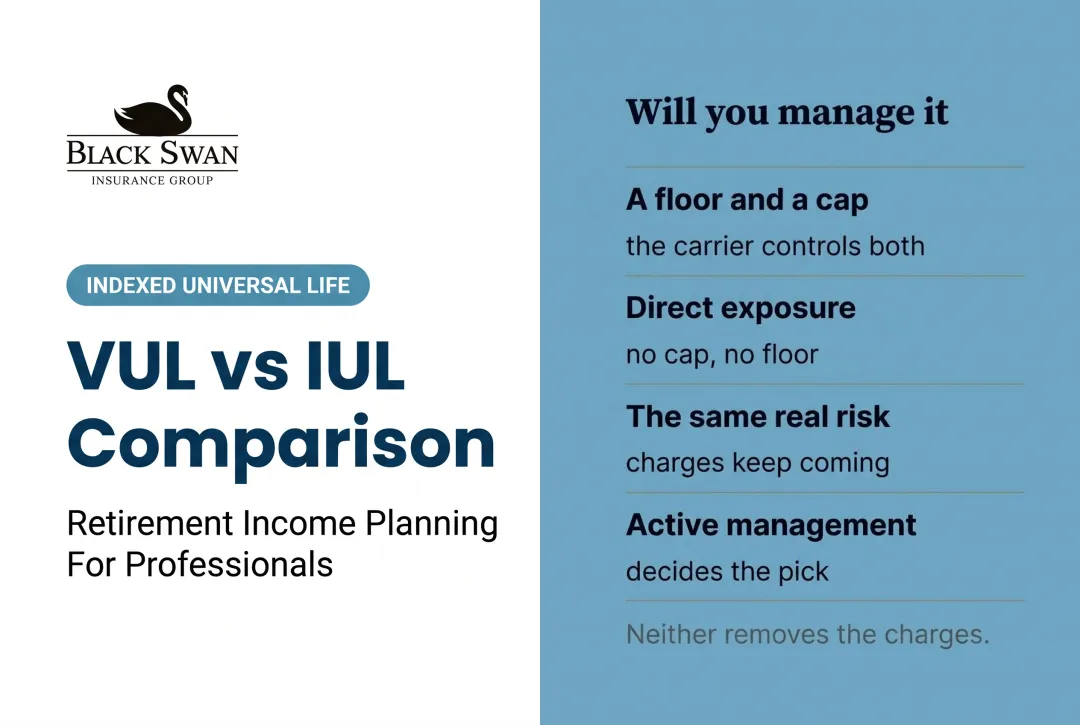
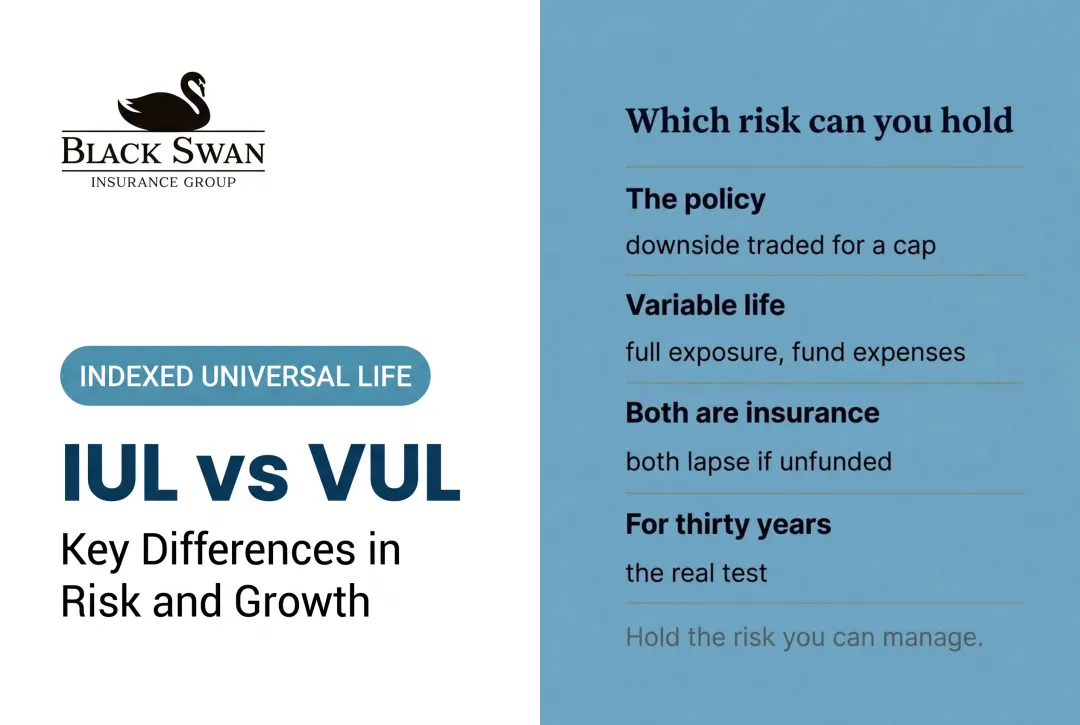
- IUL: a floor typically limits negative index crediting, often at 0%, but it does not protect against fees, cost-of-insurance charges, loan interest or lapse.
- VUL: cash value declines whenever separate-account investments lose value. There is no floor at all.
The SEC's investor guidance on variable life insurance is blunt: VUL cash value and death benefit depend directly on the performance of the investment options you choose, and losses reduce your policy value.
Zero is your hero in a down year — but the floor applies to the credit, not to the charges.
Control and maintenance
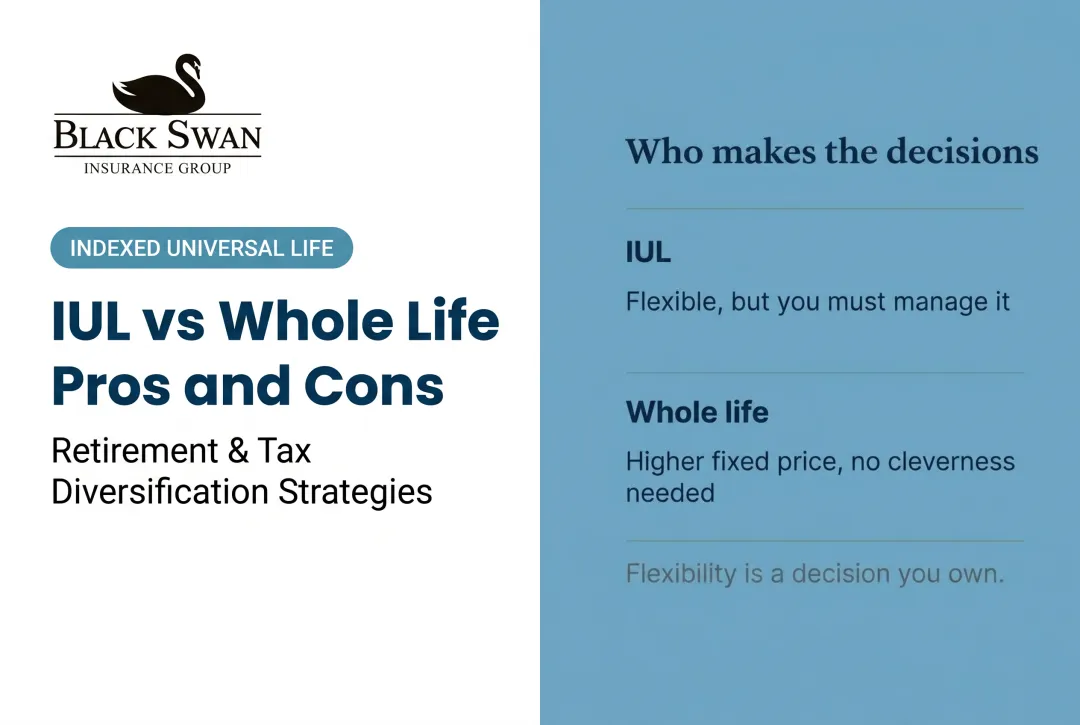
Whole life needs the least oversight. Funded correctly, the guaranteed structure does the work.
IUL needs periodic review of crediting assumptions, because insurers can change caps or participation rates and last year's illustration may not describe this year's contract. VUL demands active management — selecting and rebalancing allocations, essentially running a brokerage account wrapped inside an insurance policy.

A real review checks funding adequacy against current charges, death-benefit sustainability, outstanding loan balances, changes in cost-of-insurance rates, and whether your original goals still match the policy's trajectory.
This is not set-it-and-forget-it. It is design-it, fund-it, review-it.
Cost and access
Permanent insurance costs more than term coverage. That premium buys lifelong protection, cash value, and — with whole life — contractual guarantees.
Loans and withdrawals reduce cash value and can shrink the death benefit in all three. If a policy lapses or is surrendered with a loan outstanding, you can owe tax on income you never received in cash. Verify current treatment with a qualified tax adviser before building cash-value access into a plan.
The Three Products, Defined
Indexed universal life
Permanent life insurance with flexible premiums, where cash-value crediting is linked to an external index such as the S&P 500 rather than direct ownership of it. Four mechanics drive the credit: the cap (maximum rate credited), the participation rate (share of index gain used), the spread (an amount subtracted before crediting), and the floor (a minimum credit, often 0%).
An index gains 10%, the policy has an 8% cap and 100% participation, you are credited 8%. These terms are not fixed forever; insurers adjust them, so check current policy documents rather than historical averages.
For the right buyer, IUL offers permanent protection, funding latitude, index-linked crediting potential and cash value access. The risks are equally real: policy expenses, shifting crediting terms, non-guaranteed assumptions, and lapse if funding falls short.
Variable universal life
Permanent insurance where cash value sits in insurer-provided separate accounts resembling mutual fund portfolios. You select the allocation; market performance determines the result. Sustainability depends on investment selection, fund-level and policy fees, and the insurance costs inside the contract.
VUL appeals to experienced investors who want direct market participation and control. It is also a security, which means an SEC-required prospectus — read it, along with the contract, before trusting any illustration figure.
Whole life
Typically designed with fixed premiums, a guaranteed death benefit and guaranteed cash-value growth, provided contractual requirements are met. Participating policies may pay dividends, never guaranteed, dependent on the insurer's financial performance and not to be confused with the contractual guarantees.
Whole life appeals to buyers who want predictable funding, legacy protection with contractual certainty, and a cash-value strategy that does not require market monitoring. The trade-offs: less premium flexibility than universal life, often higher scheduled premiums than term insurance, and slower early cash-value accumulation. Surrender charges and loan terms vary by insurer.
What the sales figures do and do not tell you
According to LIMRA's 2025 individual life insurance sales data, whole life generated $6.4 billion in new premium in 2025, IUL $4.5 billion, and VUL $2.6 billion.
Those are volume figures. They measure what was sold, not what performed or what suited the buyer. Fit depends on the death benefit, insurance costs, guarantees, liquidity and tax treatment together.

The Ultimate IUL Blueprint
If the indexed middle of this spectrum is where you are landing, the Blueprint covers what that design has to survive: funding levels, caps and charges, the MEC line, loan timing, and what to demand from an illustration.
What the Critics Get Right
The strongest argument against all three, made fairly, is that most households buying permanent insurance would be better served by term coverage and a boring index fund — and that the industry knows this and sells permanent anyway.
For most households, that is correct. Term is cheaper, simpler, and matched to needs that expire. Anyone whose protection need ends when the mortgage does should hear that, plainly, and most never do.
Where the argument stops working is at the point where the cheaper buckets are already full. A high earner past the Roth phase-out, maxing a 401(k), with a permanent estate or business-continuity need, is not choosing between permanent insurance and an index fund. They already own the index fund. They are choosing which permanent structure to add, and at that point the comparison is genuine.
How to Decide Which One Fits
Start with the protection need. Income replacement, family protection, estate liquidity, business succession, legacy. If the need is large, temporary and cost-sensitive, term insurance fits better. Permanent insurance earns its place when the need outlives any term.
Then weigh guarantees against growth potential. Whole life if you want contractual guarantees and predictable premiums first. IUL if you want index-linked crediting with a floor on index returns and can accept caps, complexity and funding responsibility. VUL if you have a long horizon, real risk tolerance, investment experience and the willingness to manage market exposure inside a policy.
Then test funding durability. A premium that feels comfortable today may not survive a job change, a business downturn, a health event or a market decline. Review guaranteed versus current assumptions, minimum funding to keep the policy in force, planned premium duration, surrender values at different years, and what happens if premiums are reduced or paused.
Then place it in the wider plan. Emergency reserves, high-interest debt, employer retirement plans, IRAs, taxable investments, disability coverage, existing term insurance, business succession. A well-designed policy supports retirement and estate goals; it does not replace diversified savings or professional advice.
The NAIC's Life Insurance Buyer's Guide recommends asking which premiums or values are not guaranteed, requesting illustrations of future benefits, and asking how high premiums could rise to keep coverage active. Take all three questions into every meeting.

Stronger Fit
Permanent coverage of some kind deserves consideration if you:
- Earn $150K+ with dependable surplus after reserves, debt and maxed retirement contributions
- Have a genuine lifelong protection, estate or business-continuity need
- Are insurable at a reasonable rate with a long horizon
- Will fund the contract through a bad year rather than pausing it
Weaker Fit
Not everyone should buy any of these. Step back if you need inexpensive temporary coverage, have uneven cash flow, carry higher-priority debt or a retirement savings gap, need liquidity within ten years, or would stop funding during a downturn — which rules VUL out entirely.
Three Buyers, Three Answers
The guarantee-focused family. A married couple in their early 40s raising two children, wanting predictable premiums and a permanent death benefit independent of markets. Whole life warrants the close look. The trade-off to review: higher scheduled premiums and slower early cash-value growth. Stress-test premium affordability in a single-income scenario.
The high-income professional seeking flexibility. A 48-year-old physician with surplus cash flow beyond her 401(k) and brokerage accounts, wanting permanent protection plus index-linked crediting potential. IUL is worth evaluating alongside term coverage for any temporary gap, without assuming historical index performance repeats. Stress-test what happens if caps drop.
The experienced investor with real risk tolerance. A 39-year-old business owner, comfortable with volatility, investing on a 20-plus year horizon, wanting control over allocation. VUL may be worth considering, because he already understands downside risk from a brokerage account. Stress-test a prolonged bear market against cash value and lapse risk.

Risks to Understand Before You Choose
- Lapse risk rises as guarantees fall. Whole life is the hardest to lose by inattention; VUL the easiest.
- Caps and participation rates are adjustable on IUL, subject to contract minimums.
- VUL has no floor, and a drawdown can increase the premium required to keep coverage in force.
- Dividends are never guaranteed on participating whole life, however long the record.
- Cost of insurance rises with age on every permanent design.
- Loans and withdrawals reduce cash value and death benefit; an unpaid loan at lapse can be taxable with no cash received.
- Replacing existing coverage triggers new underwriting, surrender charges and fresh contestability.
Find Out Where You Actually Stand
This starts with the Tax-Free Wealth Blueprint Fit Review. If you earn $150K+ and you are trying to place yourself on this spectrum rather than be placed on it, we define the job the coverage has to do, read guaranteed against illustrated values side by side, compare charge and loan mechanics across all three structures, and stress-test each through lower crediting, a market decline and a reduced-income year. If term solves your problem, we will say so and you will have spent nothing. If IUL does not fit, we will tell you that too.
Frequently Asked Questions
What are the key differences between IUL and VUL?
IUL credits interest using an index-linked formula with caps and a floor, generally avoiding direct losses from the index itself. VUL invests cash value in separate accounts that gain or lose value directly with market performance.
Can you withdraw money from a VUL policy?
Yes, subject to policy terms, charges, available cash value and tax rules. Withdrawals reduce cash value and the death benefit, and may trigger tax or increase lapse risk.
Which is better: IUL, VUL or whole life?
None universally. Whole life prioritises contractual guarantees; IUL links credited interest to an index with caps and a floor; VUL offers direct market exposure with more upside and more downside.
Is term life insurance better than VUL?
For affordable, temporary protection, yes. The three permanent options carry cash value features and different risk profiles. Choose on how long you need coverage, your budget and your risk tolerance.
Which needs the most ongoing attention?
VUL, then IUL, then whole life. If nobody will review the contract annually, that ordering should narrow your choice before any illustration does.
Sources
- SEC Investor.gov — variable life insurance
- LIMRA — U.S. individual life insurance new premium tops $17.5 billion in 2025
- NAIC — Life Insurance Buyer's Guide
Disclosure: This article is educational and is not personal tax, legal or investment advice. Indexed universal life is life insurance first. Variable universal life is a security sold by prospectus; read it before investing. Product features, guarantees, dividends and availability vary by carrier and state, and all guarantees are subject to the issuing insurer's claims-paying ability. Illustrated values are not guarantees; actual results depend on policy terms, crediting, costs and funding. Actual results depend on policy design, carrier, crediting options, caps, participation rates, subaccount performance, expenses, funding and ongoing management. This strategy is not appropriate for everyone. Policy loans and withdrawals reduce cash value and the death benefit, and can create tax consequences if the policy lapses or becomes a modified endowment contract. Consult your own tax, legal and financial professionals for advice specific to your situation. Any potential tax-advantaged access depends on the policy being properly structured, funded and managed.
And remember, it's not what you earn, it's what you keep… enjoy the ride.