By Robert Balgac, Founder, Black Swan Insurance Group | October 9, 2026
Two names that sound nearly identical, one letter apart, and a difference that decides whether your policy is still standing in year twenty-five. Universal Life and Indexed Universal Life both build cash value, both let you adjust premiums, and both offer a death benefit that can flex. They do not grow your money the same way, and that gap shows up in monthly costs, cash-value performance, and how reliably the contract can support retirement income.
If you earn $150K+, have maxed the 401(k) and are now looking at permanent coverage, this is the first fork in the road. Getting it wrong is expensive in a way that takes a decade to become visible.
The National Association of Insurance Commissioners classifies IUL as a type of Universal Life that uses a different interest-crediting method — not a separate category of insurance. That framing is the clearest way to hold the comparison in your head: same chassis, different engine.
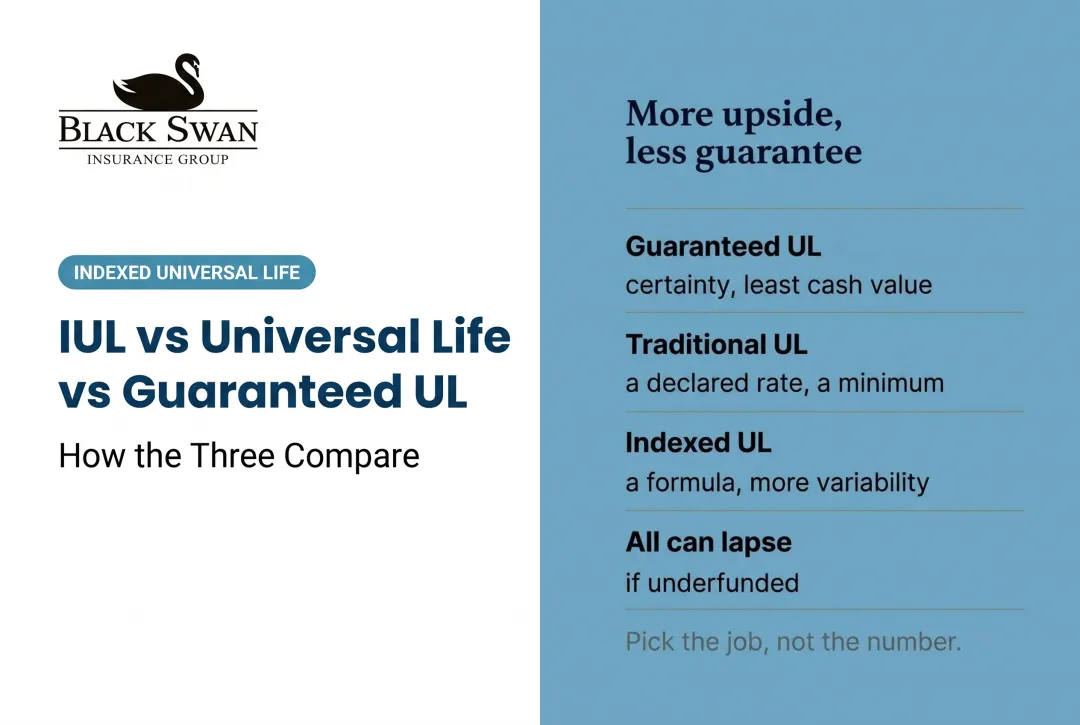
The short answer: UL credits an insurer-declared rate with a contractual minimum. IUL credits by formula against an index, bounded by a floor, a cap and a participation rate the carrier can mostly reset after you buy. UL is simpler and more predictable within a narrower band. IUL offers more potential and demands active management. Both lapse the same way — when charges outrun cash value — and that failure mode, not the crediting method, is what should drive your choice.
Key Takeaways
- UL earns an insurer-set rate; IUL credits follow an index formula with caps, floors and participation rates
- Both policies can lapse if premiums and cash value fail to cover ongoing charges
- IUL offers more growth potential but needs closer funding and monitoring than UL
- Choose based on funding capacity, risk tolerance and genuine need for permanent protection
- Term life or a retirement account may fit better when there is no true permanent need
How Each One Builds Cash Value
Both products pair a death benefit with a cash-value account. The difference is how that account earns interest — and what still drains it when markets fall.
Universal Life
Each premium payment splits three ways:
- Cost of insurance — pays for the underlying mortality risk
- Administrative fees — cover policy expenses
- Cash value — earns interest, typically at an insurer-declared rate with a contractual minimum
Coverage stays active only as long as cash value and premiums can cover those ongoing charges. That contractual minimum is the thing UL has and IUL mostly does not: a floor under the rate, not just under the index credit.
Indexed Universal Life
Structurally the same, with a different crediting formula. Cash value growth tracks an external index such as the S&P 500 through a contract-defined formula, not through direct index ownership.
Four terms drive it:
- Floor — the minimum credited rate during a down market, often 0%
- Cap — the maximum credited rate during a strong market
- Participation rate — the percentage of index gain actually credited
- Spread — an amount subtracted from the index gain before crediting
A 0% floor sounds reassuring. It only protects the index-crediting portion. Cost-of-insurance charges, administrative fees and loan interest keep applying regardless of what the index does.
Zero is your hero in a down year — but the floor applies to the credit, not to the charges.
Worth knowing: caps and participation rates on most IUL contracts are non-guaranteed. The carrier can revise them after issue within contract limits. The declared rate on a UL is also not guaranteed above the contractual minimum — so neither product locks in what you were shown. The difference is in how far each can move.
Shared Features, Shared Risks
Both offer flexible premiums and adjustable death benefits, access to cash value through loans and withdrawals, surrender charges in the early years, and exposure to Modified Endowment Contract treatment if overfunded.
Overfunding matters more than most buyers realise. Under IRS guidance on the seven-pay test, a policy that fails the test becomes a MEC — generally permanently. MEC status changes how loans and withdrawals are taxed, income-first instead of basis-first.
Always separate guaranteed contract elements from illustrated, non-guaranteed projections. Tax outcomes vary by circumstance, so involve a qualified tax or legal professional before making assumptions about your own.

Side by Side
| Factor | Universal Life | Indexed Universal Life |
|---|---|---|
| Growth method | Insurer-declared interest rate | Index-linked formula with cap, floor, participation rate |
| Premium flexibility | Adjustable within contract limits | Adjustable within contract limits |
| Death benefit | Adjustable, may require underwriting to increase | Adjustable, may require underwriting to increase |
| Complexity | Lower | Higher, requires ongoing monitoring |
| Growth ceiling | Limited to insurer-declared rate | Capped by product terms |
Premium and Death Benefit Flexibility
Flexibility does not mean premiums can be skipped freely. Skip too many and cash value absorbs the shortfall until it runs out. Test your funding plan against conservative crediting assumptions rather than best-case scenarios, rising cost-of-insurance charges as you age, and potential income interruptions across the policy's lifetime.
Increasing a death benefit later usually triggers new underwriting, which means your health at 55 decides what is available then. Taking a loan or switching death-benefit options can also shrink what beneficiaries eventually receive.
Costs, Fees, and Lapse Risk
IUL demands more attention because caps and participation rates can change and crediting results swing year to year. Review cost-of-insurance charges, premium loads, surrender charges and loan interest using the insurer's actual illustration, not a sales brochure.
Neither policy is self-funding. The New York State Department of Financial Services warned consumers in 2019 that many Universal Life policyholders paid premiums for years expecting stable coverage, only to face lapse or steep additional premiums after interest rates or other assumptions shifted.
That is the most important paragraph on this page. It describes traditional UL, the simpler product — which means simplicity does not protect you. Underfunding does the damage in both.
This is not set-it-and-forget-it. It is design-it, fund-it, review-it.
The Ultimate IUL Blueprint
Before you choose between them, the Blueprint covers what either design has to survive: funding levels, caps and charges, the MEC line, loan timing, and what to demand from an illustration.
What the Critics Get Right
The strongest criticism of IUL in this particular comparison is that the added complexity buys you less than it appears to. You accept a cap, a participation rate and a spread — three carrier-controlled levers instead of UL's one — in exchange for upside that gets truncated in exactly the years it would have mattered most. A 30% index year under a 10% cap credits 10%. Meanwhile the illustration you were shown assumed a smooth mid-single-digit credit forever, which no index has ever delivered.
The critic's conclusion is reasonable: if you want simple permanent coverage, traditional UL or whole life gives you fewer moving parts and more contractual certainty, and the NYDFS warning above shows that even those can fail when underfunded.
Where the criticism overreaches is in treating the cap as pure loss. For a buyer who would otherwise hold conservative fixed-income assets inside a permanent policy, index-linked crediting with a floor is a genuinely different risk profile — not better, different. The honest framing is that IUL trades certainty for optionality, and whether that trade is worth it depends almost entirely on whether you will actually monitor the contract.
A great IUL is engineered. A bad IUL is sold.
Which One Fits
Start with purpose, not projected returns. Permanent protection, estate planning, business succession, retirement-income flexibility, or some combination.
Consider Universal Life when you want a simpler crediting structure and more predictable interest, while accepting that declared rates are not guaranteed to stay high and lapse risk remains real.
Stronger Fit for IUL
- A genuine permanent insurance need
- Sustainable surplus cash flow beyond emergency savings, typically at $150K+ income
- A long horizon, usually a decade or more
- Comfort reviewing caps, participation rates and funding performance every year
Weaker Fit
Neither may fit. Not everyone should own permanent coverage. Walk away if you only need temporary income replacement, cannot reliably fund a permanent policy, have not built emergency reserves, or are treating life insurance as a substitute for a diversified retirement plan.

Compare both against term life insurance for lower-cost, time-limited protection; whole life for guaranteed, non-indexed cash-value growth; 401(k)s and Roth accounts for tax-advantaged retirement savings; and brokerage accounts or annuities for other liquidity and income needs. No single alternative wins universally. Fit depends on income stability, horizon and existing savings.
Risks to Understand Before You Choose
Work through this before signing anything:
- Confirm the permanent coverage need and the appropriate death-benefit amount
- Review guaranteed and non-guaranteed values separately
- Compare conservative, current and adverse funding scenarios
- Examine caps, participation rates, spreads, floors and surrender charges
- Ask how the policy performs if premiums drop or index credits fall short
- Check the issuing insurer's financial-strength ratings — for the entity issuing your contract
- Schedule annual reviews rather than treating this as a one-time purchase
An illustration is a model, not a guarantee.
Two cases make the point. A 42-year-old physician earning $280,000 who maxes her 401(k) and wants tax-diversified retirement planning alongside permanent protection has a 20-plus-year horizon and stable surplus cash flow — IUL can fit when funding stays sustainable and she reviews crediting terms yearly. A 50-year-old practice owner with most of his net worth inside the business wants protection and liquidity held personally, separate from business risk. Depending on cash flow and horizon, UL, IUL or term layered with other planning tools can all be reasonable starting points.
In both cases the real test is identical: can premiums survive a slow market, a career change or rising insurance costs? A policy that looks excellent under rosy assumptions becomes a liability when funding falls short, and regulators have documented that pattern in real Universal Life cases.
The loan is not the problem. The unmanaged loan is the problem.

Find Out Where You Actually Stand
This starts with the Tax-Free Wealth Blueprint Fit Review. If you earn $150K+ and are weighing UL against IUL, we confirm the protection need first, put UL, IUL, term, whole life and qualified accounts side by side under identical assumptions, read guaranteed values against illustrated ones, and stress-test each through lower crediting, paused funding and extended loans. We explain compensation before anyone funds anything, and tax or legal questions go to your own advisers. If sustainable funding, horizon or protection need do not yet support permanent coverage, the honest recommendation is to wait or use a different tool — and we will say so. If IUL does not fit, we will tell you that too.
Frequently Asked Questions
What is the difference between indexed universal life and universal life?
IUL is a type of UL, but its cash value is credited using a formula tied to an external market index, subject to caps, participation rates and a floor. Traditional UL credits interest at an insurer-declared rate with a contractual minimum instead.
Which is better, IUL or term life insurance?
It depends on the need. Term suits temporary, lower-cost protection and does that job completely. IUL suits someone with a genuine permanent need, a long horizon and sustainable funding capacity.
Is indexed universal life insurance an investment in the stock market?
No. Cash value is not invested in index securities. Interest is credited through a contract-defined formula tied to index performance, subject to policy limits and charges.
Can a universal life or IUL policy lapse?
Yes. Either can lapse if premiums and cash value fall short of covering ongoing charges — a risk that grows with loans, withdrawals or lower-than-illustrated crediting. Regulators have flagged this for traditional UL specifically.
Are IUL cash-value gains guaranteed?
No. Guaranteed contract elements are distinct from non-guaranteed index-linked credits. Caps, participation rates, spreads and policy charges can all reduce actual results.
Can I borrow from a universal life or IUL policy?
Often yes, once cash value accumulates. Loans accrue interest, reduce the death benefit and raise lapse risk. They can also trigger taxable income if the policy lapses or ends with a balance outstanding.
Sources
- NAIC — Life insurance
- IRS — Revenue Ruling 2007-38
- NYDFS — Consumer alert on universal life insurance (2019)
Disclosure: This article is educational and is not personal tax, legal or investment advice. Indexed universal life is life insurance first. Carrier products, declared rates, caps, participation rates, charges and state availability change frequently and must be confirmed against current policy forms before applying. Illustrated values are not guarantees; actual results depend on policy terms, crediting, costs and funding. Any potential tax-advantaged access depends on the policy being properly structured, funded and managed. Actual results depend on policy design, carrier, crediting options, caps, participation rates, expenses, funding and ongoing management. This strategy is not appropriate for everyone. Policy loans and withdrawals reduce cash value and the death benefit, and can create tax consequences if the policy lapses or becomes a modified endowment contract. Consult your own tax, legal and financial professionals for advice specific to your situation.
And remember, it's not what you earn, it's what you keep… enjoy the ride.