By Robert Balgac, Founder, Black Swan Insurance Group | October 5, 2026
Every benefit an indexed universal life policy offers is real. Every one of them is also conditional, and the conditions are the part that gets left out of the brochure.
Industry-wide IUL premium rose 17% in 2025 with policy count up 8%, according to LIMRA's fourth-quarter 2025 sales data. Sales growth tells you a product is being sold well. It tells you nothing about whether it fits your household.
So here is the version worth reading: what an IUL actually gives a $150K+ earner, what each of those features costs to obtain, and the specific circumstances in which the whole thing stops working.
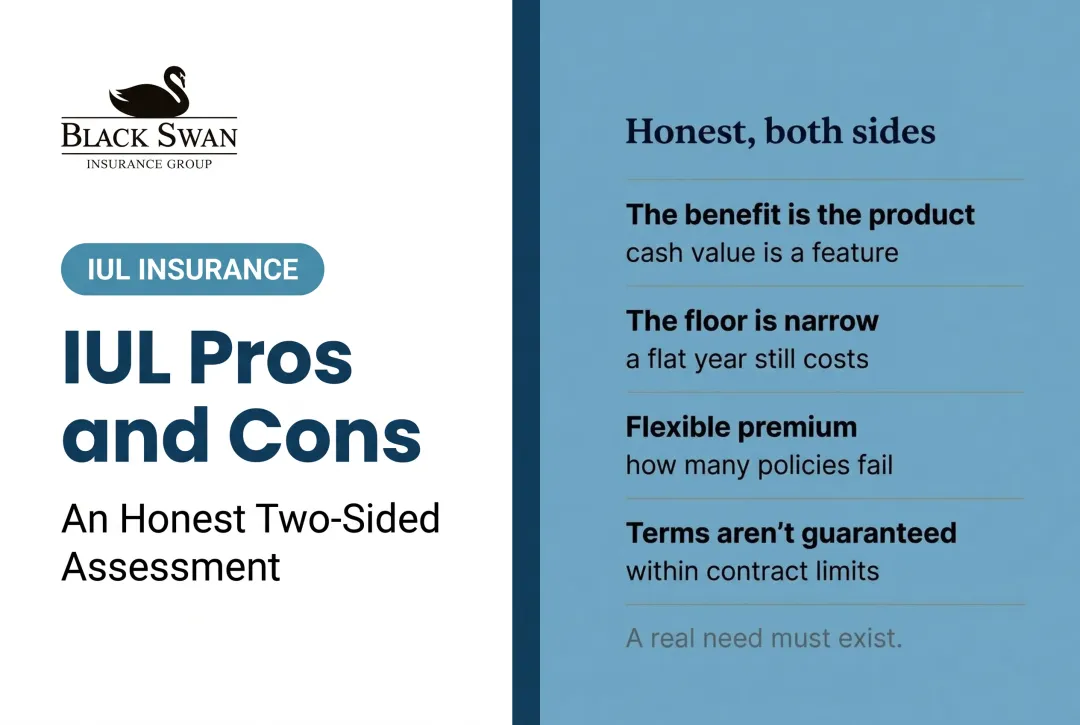
The short answer: An IUL pairs permanent life insurance with cash value credited on a formula tied to a market index. The genuine benefits are permanent protection, flexible premiums within contract limits, index-linked crediting with a floor, and potential tax-advantaged access through loans and withdrawals when the policy is properly structured, funded and managed. Every one of those depends on design and funding discipline. The 0% floor protects the credited interest — not the fees, not the loan interest, and not the cost of insurance, which keeps rising with age.
Key Takeaways
- An IUL is permanent life insurance first, with cash value credited on a formula referencing a market index — you never own the index
- Flexible premiums, adjustable coverage and policy loans add planning options; none of them remove the ongoing charges
- The 0% floor protects against a negative index credit, not against fees, loan interest or rising cost of insurance
- It works alongside qualified retirement accounts, not instead of them
- Fit comes down to funding capacity, health, time horizon and willingness to review the contract every year
What an IUL Actually Is
An IUL provides a death benefit and a cash-value component for as long as the policy stays adequately funded and in force. Unlike term insurance, the coverage does not expire on a schedule.
The insurer credits interest to cash value based partly on the performance of a selected index such as the S&P 500. The distinction that matters: you never own the index or the shares in it. The index is a reference point in a formula.
Several moving parts decide what gets credited, and what survives the charges:
- Cap — the maximum credited interest for that strategy period, however well the index does
- Participation rate — how much of the index-linked gain the policy can credit
- Spread — a deduction taken before crediting, used by some strategies instead of a cap
- Floor — a minimum credited rate, often 0%, protecting against a negative index year
- Cost of insurance and administrative charges — deducted monthly regardless of index performance
This is life insurance that may support broader financial goals. It is not a substitute for a brokerage account, a 401(k) or a diversified portfolio, and a page claiming otherwise is selling something.
The Benefits, and What Each One Costs
Before assuming any of these apply to you, ask for an illustration showing guaranteed values beside the non-guaranteed projections, the current caps and participation rates, and a full fee breakdown. An illustration is a model, not a promise.
Index-Linked Growth Potential
Index-linked crediting can outperform a fixed-rate cash-value policy in strong market years. When the index rises, the policy may capture part of that gain, subject to the cap or participation rate.
North American Company's guide to IUL mechanics describes an annual point-to-point strategy: measure index movement over 12 months, apply the participation rate, subtract any spread. The credited rate cannot fall below zero. That is a mechanism, not a return.

The cost of getting it: dividends paid by companies in the index are excluded from the calculation, and the cap limits how much of a strong year you keep. You trade some upside for crediting protection. That is the deal, stated plainly.
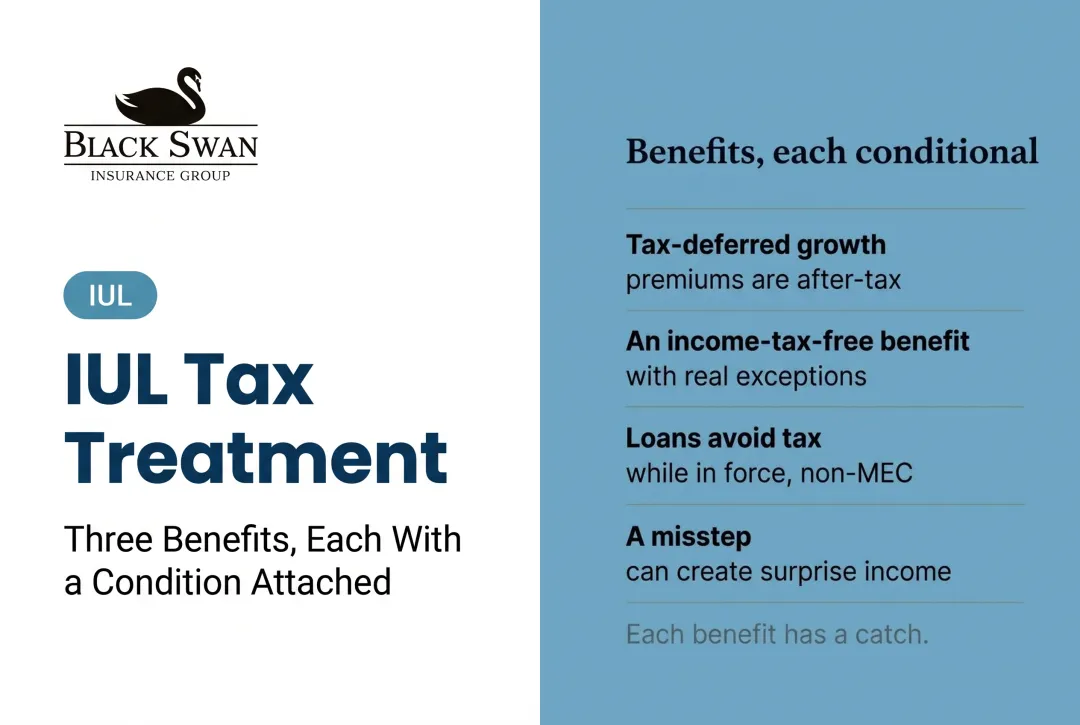
Growth inside the policy is generally tax-deferred while the contract stays in force, and can later support supplemental income or legacy goals. Use that accumulation only after emergency reserves, core protection and qualified accounts are already handled.
Downside Protection — Within Limits
The floor is the headline feature. If the index falls during a crediting period, a 0% floor stops a negative interest credit from being applied.
Here is what most illustrations skate past: a 0% floor does not mean total policy value cannot decline. Cost of insurance, administrative fees, surrender charges and outstanding loan interest all accrue regardless of index performance. In a flat year those charges can exceed credited interest and reduce policy value.
Zero is your hero in a down year — not because the policy has no costs, but because the index crediting did not follow the market off the cliff. In a good year we talk about what was credited. In a bad year we talk about what was protected.
Against a variable universal life policy, where cash value sits in market subaccounts, an IUL carries less direct investment risk. Caps and participation limits also cap the upside. The floor is a deliberate trade, not free protection.
Flexibility, and the Obligation That Comes With It
Many contracts let you vary premium payments within contractual limits — genuinely useful for business owners and commission-based professionals with uneven income.
- Death benefit adjustments — increasing coverage usually requires new underwriting; decreasing it weakens the protection you bought it for
- Allocation choices — split cash value between indexed strategies and a fixed-interest option
- Policy loans and withdrawals — access for eligible needs, with interest accruing and unpaid balances reducing the death benefit
- Loan lapse exposure — a policy that lapses or is surrendered with a loan outstanding and gain in the contract can create a taxable event
This is not set-it-and-forget-it. It is design-it, fund-it, review-it. Flexibility is an obligation dressed up as a feature.
What the Critics Get Right
The people who call IUL overhyped are right about more than the industry likes to admit.
They are right that the 0% floor is the most oversold line in this business, because it gets presented as protection against loss when it only protects the credited interest. They are right that cap and participation rates are set by the carrier and can move against you after you have committed. And they are right that the fee load is real and shows up hardest in the early years, which is exactly when a buyer is most likely to walk away disappointed.
Where the criticism overshoots is treating those facts as a verdict on the tool rather than a description of it. A good IUL is engineered. A bad IUL is sold. Most of what gets criticised is the second one.
Where It Goes Wrong
The most common error is buying permanent coverage without confirming a permanent need. If the real requirement is affordable temporary protection — replacing income until the children finish college — a properly structured term policy is usually the better answer, and saying so costs nothing.
The rest of the failures come from neglect:
- Underfunding. Funding to an optimistic illustration rather than a realistic one erodes cash value and produces unexpected premium demands later
- Treating loans as costless. Loan interest accrues, and an unpaid balance at lapse can produce a tax bill at the worst moment
- Skipping the alternatives. Term, whole life, qualified plans, Roth accounts and brokerage assets all deserve a comparison before you commit
A policy stays in force only while cash value covers ongoing insurance costs. Miss the annual review and underperformance goes unnoticed until the repair is harder and more expensive.

The Ultimate IUL Blueprint
If you want the framework behind a design that survives real life — funding levels, the MEC line, loan timing, and the numbers to demand from an illustration — that is what the Blueprint covers.
Who These Benefits Actually Reach
Stronger Fit
- Household income of $150K+ with stable or growing cash flow
- Roughly $500–$2,500 a month of funding capacity that does not touch emergency reserves
- A genuine permanent protection, legacy or business-continuity need
- Already funding retirement accounts, or deliberately seeking a second tax-advantaged bucket
- A long time horizon and willingness to review the contract annually
- Insurable, and clear that this is not a stock-market replacement
Weaker Fit
Not everyone should buy an IUL. Each benefit listed above carries a cost, and for many households the costs outweigh every one of them.
- Unstable income, or no emergency savings
- High-interest debt that needs clearing before a decades-long premium commitment
- Money likely needed before the contract builds accessible value
- Only wanting the cheapest death benefit — term insurance is the better answer, and there is no shame in that being the conclusion
- Unwilling to review the policy, or expecting the floor to do the work
How to Extract the Value
Start with a needs assessment covering the permanent protection need and beneficiaries, retirement income and liquidity goals, current insurability and household cash flow, and any business obligations tied to the policy.
Request full illustrations with guaranteed values beside multiple non-guaranteed scenarios. Compare caps, participation rates, fees, surrender schedules and the insurer's financial strength.
Stress-test it against lower credited interest than illustrated, reduced caps or participation rates over time, missed or reduced premiums, rising cost of insurance with age, and loans that draw cash value down faster than planned.
Review it every year. Credited interest, current cash value, funding status, index-strategy allocation, and whatever changed in your life.

Do not buy the highlight reel. Watch the game film. If the policy only works in the best-case column, that is not a plan.
Risks to Understand Before You Fund One
- Cost of insurance rises with age and is charged whether or not the index credits anything
- Administrative charges, rider costs and early-year surrender charges hit hardest in the years the illustration looks best
- Caps and participation rates are not fixed and may be adjusted within contract limits
- Dividends are excluded from index crediting, so the reference is not total market return
- Loan interest compounds against cash value, and an outstanding loan at lapse or surrender with gain can create taxable income with no cash received
- Underfunding is the most common failure mode, and it usually traces back to the illustration used at the sale
- Crossing the seven-pay limit makes the contract a modified endowment contract under I.R.C. § 7702A and changes distribution taxation
- Illustrated values are not guarantees. Read the guaranteed column first
Find Out Where You Actually Stand
This starts with the Tax-Free Wealth Blueprint Fit Review. If you earn $150K+ and want to know whether these benefits are reachable on your numbers, we run the funding, stress-test the design, show the fees, the caps and the loan assumptions, and say what the policy would actually have to do. If it does not fit, we will tell you that too.
Frequently Asked Questions
What are the real advantages of an IUL?
Permanent coverage, flexible premiums within contract limits, index-linked crediting with a floor, and potential tax-advantaged access through loans and withdrawals when the policy is properly structured, funded and managed. Each is limited by fees, caps and the need for consistent funding.
What is the average rate of return on an IUL?
There is no reliable single average. Results depend on carrier, index strategy, cap, participation rate, fees and how the policy was funded. Compare guaranteed and non-guaranteed illustrations rather than chasing a headline number.
Does the 0% floor protect my policy value?
No, and this is the most important correction on the page. The floor applies to the credited interest. Cost of insurance, administrative charges and loan interest continue in a flat year, so policy value can still fall.
Is an IUL a replacement for my 401(k)?
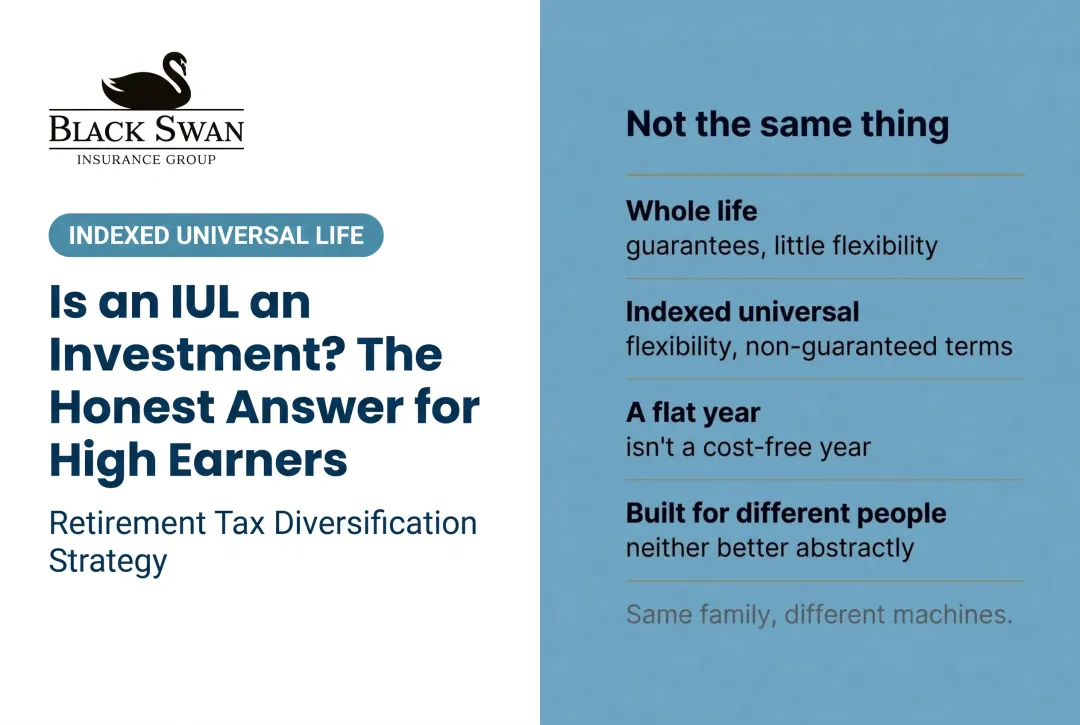
No. A 401(k) is not the enemy; depending on it as the only serious bucket is the part worth examining. An IUL is generally considered as a second bucket after the match is captured and the obvious accounts are funded.
When is term insurance the better answer?
When the need is temporary and the goal is maximum death benefit for the lowest premium. That is a legitimate and common conclusion, and it deserves to be said before a permanent policy is designed.
What does Dave Ramsey say about IUL?
Ramsey Solutions argues that caps, fees and complexity undermine the case for it as an accumulation vehicle. Much of that criticism lands against badly designed policies. Whether it applies to you depends on your protection need and how the specific contract is built.
Sources
- LIMRA — Fourth-quarter 2025 individual life sales growth estimates
- North American Company — Indexed universal life crediting mechanics
- Ramsey Solutions — Indexed universal life insurance
- NAIC — Life Insurance
- NAIC — Life Insurance Illustrations
Disclosure: This article is educational and is not personal tax, legal or investment advice. Indexed universal life is life insurance first. Actual results depend on policy design, carrier, crediting options, caps, participation rates, expenses, funding and ongoing management. Policy loans and withdrawals may reduce cash value and death benefit and can create tax consequences if the policy lapses or becomes a modified endowment contract. This strategy is not appropriate for everyone. Illustrated values are not guarantees; actual results depend on policy terms, crediting, costs and funding. Consult your own tax, legal and financial professionals for advice specific to your situation.
And remember, it's not what you earn, it's what you keep… enjoy the ride.