By Robert Balgac, Founder, Black Swan Insurance Group | October 9, 2026
If you earn $150K+, you have maxed the 401(k), and you have found yourself at midnight comparing indexed universal life quotes on three different websites, you already know what is bothering you. The quote arrives in ninety seconds. The decision lasts forty years. Those two facts do not belong in the same transaction, and nothing on the page tells you that.
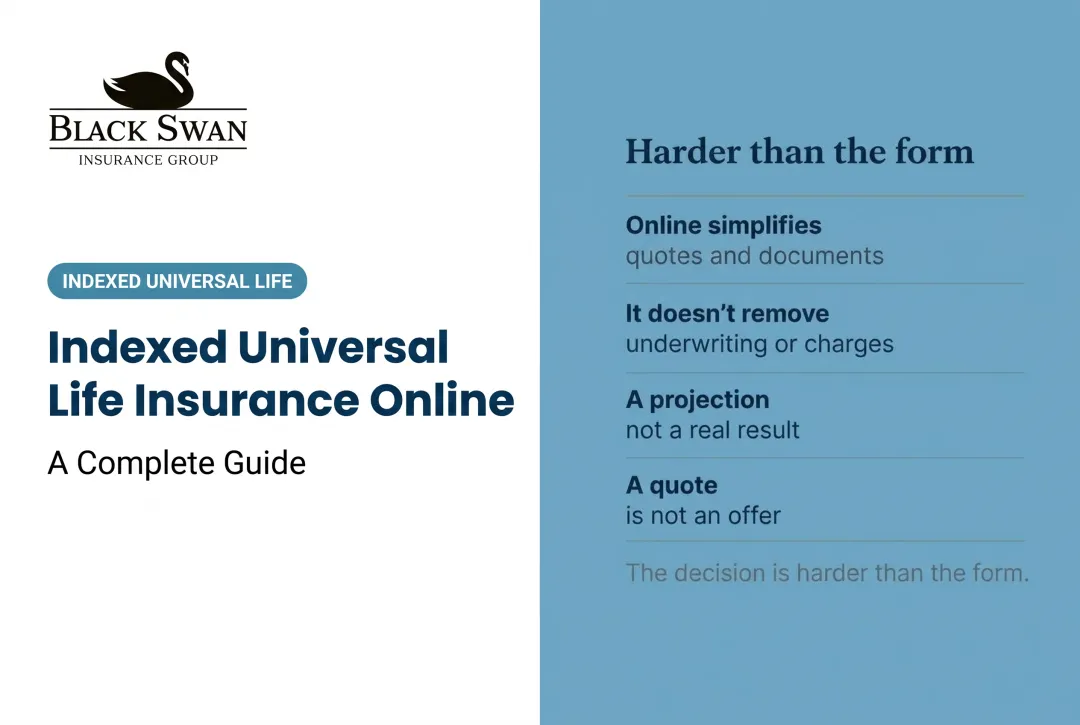
Online buying genuinely improves the early stages. Requesting information, comparing carriers, reaching a licensed professional without three office visits — all of that is better than it was a decade ago. What the screen does not compress is underwriting, illustration review, or the decades of funding and monitoring that decide whether the policy works. The convenience is real. It just sits at the front of the process, not where the risk lives.
The short answer: You can start an IUL purchase online and you should — it is a faster, cheaper way to compare carriers and get to a real illustration. But no online flow can tell you whether you need permanent coverage, and no instant quote is a guarantee. The number that matters is not the premium on the landing page; it is the premium that keeps the contract in force when you are seventy.
This is life insurance first. The cash value is second. If you are shopping purely for projected growth and you have no permanent protection need, you are buying the wrong product efficiently, which is worse than buying it slowly.
Key Takeaways
- IUL pairs permanent coverage with index-linked cash value — you are not invested in the market directly
- Online tools speed comparison and application; underwriting and medical review still apply
- Caps, participation rates, floors, loan provisions and charges drive real results — illustrations do not
- A 0% floor limits negative index credit; it does not stop charges from reducing cash value
- Review protection need, sustainable funding and existing retirement accounts before choosing IUL
- Lapse rates on policies without a secondary guarantee are measurably higher — funding discipline is the product
What You Are Actually Buying
Indexed universal life is permanent coverage with two moving parts: a death benefit for your beneficiaries, and a cash value account that may earn interest linked to an external market index such as the S&P 500. The policy is never invested in that index.
Every premium payment is divided before anything reaches cash value. Cost of insurance comes out. Administrative charges come out. Any riders you selected are funded. What remains adds to cash value. That ordering is why policy values can still decline from charges, loans, withdrawals or underfunding even in a year the indexed account credits its floor.
Floors, Caps and Participation Rates
Three terms decide how much interest your cash value might earn in a given period:
- Floor — the minimum crediting rate, often 0%, protecting against negative index returns
- Cap — the maximum rate the policy will credit, however high the index climbs
- Participation rate — the share of index gain actually used in the crediting formula
A simplified, non-predictive example. Say the policy carries a 60% participation rate and a 9% cap.
If the index gains 10%, participation math produces 6%, which stays under the cap. If the index gains 20%, participation math produces 12%, but the 9% cap trims the credit to 9%. That gap between index return and credited interest is the price of the floor, and it is not a defect — it is the trade.
Now flip it. If the index drops 15%, the 0% floor prevents a negative credit. It does not mean the policy cannot lose value. Monthly charges are deducted whether the market is up or down.
Zero is your hero in a down year — but the floor applies to the credit, not to the charges.

Flexibility Cuts Both Ways
IUL lets you adjust premiums and, within limits, the death benefit. High earners with uneven income like this, and reasonably so. It is also the mechanism by which policies fail. Skip too many payments, or underfund early, and you raise the odds of a lapse twenty years out — long after anyone is paying attention.
Cash value can be reached through withdrawals or policy loans. Loans accrue interest and reduce the death benefit and cash value until repaid.
Under IRC Section 7702A, a policy that fails the seven-pay test becomes a Modified Endowment Contract. That status changes how withdrawals and loans are taxed, generally permanently. Lapsing or surrendering a policy with an outstanding loan can also create taxable income with no cash in hand.
Talk to a qualified tax professional before assuming any distribution is tax-advantaged.
How the Online Purchase Actually Unfolds
The online path typically runs five stages, and only the first two are genuinely fast.

- Submit an initial request — complete a needs questionnaire or request information online.
- Discuss your goals — talk with a licensed professional about coverage amount, beneficiaries, time horizon, budget and existing policies.
- Compare carrier options — review illustrations from carriers suited to your profile.
- Apply and complete underwriting — submit the application, finish electronic disclosures and identity verification, answer health questions. Many applicants still face medical or financial underwriting.
- Review and accept — confirm the contract, set up premium payments, and store the illustration and policy documents where you can find them in ten years.
What to Have Ready
Carriers and agents will ask for a consistent set of details:
- Age, state of residence and tobacco use
- Income, assets and debts
- Dependents and business obligations
- Current life insurance coverage
- Medical history and current prescriptions
- Beneficiary names and intended premium range
The Comparison Checklist
Before signing anything, compare:
- Issuing carrier and state availability
- Financial-strength ratings and complaint history
- Policy charges and cost-of-insurance assumptions
- Guaranteed values against projected values
- Cap and participation-rate history, not just current figures
- Index-crediting method and loan provisions
- Surrender schedule, riders and no-lapse features
- Ongoing service and annual review access
An instant quote is not a guarantee, and neither is a projected income figure. The NAIC's illustration standards require insurers to show guaranteed figures alongside non-guaranteed ones. Only the guaranteed column is locked in at issue. Read that column first; it is the one the carrier is contractually bound to.
An illustration is a model, not a guarantee.
Black Swan runs online IUL purchases through a five-step framework: needs assessment, coverage exploration, policy tailoring, transparent sign-up, and continued guidance with annual reviews. We work with carriers including F&G Annuities and Life, Corebridge, Transamerica and Mutual of Omaha. Availability, underwriting and pricing still depend on the issuing carrier and your circumstances, and the annual review exists because design drifts after issue.
The Ultimate IUL Blueprint
If you are comparing online offers, the Blueprint covers what a design has to survive: funding levels, caps and charges, the MEC line, loan timing, and exactly what to demand from an illustration before you sign.
What the Critics Get Right
The sceptics have a fair point about buying this product online, and it deserves stating plainly.
An online funnel is optimised for conversion. The fast quote, the clean comparison table and the friendly chat window all exist to move you toward an application, and the person on the other end earns on the premium. That is a genuine conflict. Worse, the online format flatters the product: a landing page can show a projected income column in large type and bury the guaranteed column in a footnote, and nothing about the medium forces anyone to explain cost of insurance rising with age.
What the criticism misses is that the medium is not the problem. The same conflict exists across a desk. What protects you is not meeting in person — it is demanding the guaranteed column, a reduced-crediting scenario, and a written answer to "what premium keeps this in force to age 100." Those questions work equally well over email.
Whether an IUL Actually Fits You
The real test is whether you need permanent coverage and can fund it for decades. Cash-value growth alone is not a reason. Buying an IUL purely for projected growth, with no underlying protection need, is backwards.
Stronger Fit
- You need lifelong protection for family or estate purposes
- You are planning business continuity or succession
- You have already maxed core retirement accounts and want a supplemental, differently-taxed bucket
- You earn $150K+ with dependable surplus after reserves, debt and retirement contributions
- You want flexible premiums or living-benefit riders and will actually review the policy annually
Weaker Fit
Not everyone should buy this, and the online version makes it too easy to buy anyway. Step back if you:
- Just need affordable, temporary coverage — buy term, it is cheaper and simpler
- Have limited emergency savings or high-interest debt
- Face uncertain future cash flow
- Cannot commit to monitoring the policy long term
- Prefer simple, fully guaranteed outcomes — whole life is the honest answer there
Late-Start High Earners Face Different Math
If you are 45 to 55 and hit peak earnings later than most, the funding runway is shorter and insurability matters more. Age, health and household obligations compress the window. An honest evaluation stress-tests funding against your actual retirement timeline, not an optimistic average, because a compressed funding period leaves too little time for cash value to absorb early costs before you need access.
Stress-Test the Illustration
Run the numbers under guaranteed, current and reduced-crediting assumptions. Ask what happens if you miss payments, caps drop, or charges rise.
A 2023 SOA/LIMRA study found IUL lapse rates notably higher in 2019–2020 than in 2015–2018, and policies lacking a secondary guarantee showed higher lapse rates across nearly every policy year. That is the single most useful statistic in this article. The failure mode is not bad crediting. It is abandonment.
Then compare the proposed policy against the whole plan: employer 401(k) matching, IRA or Roth contributions, emergency reserves, term coverage, whole life and brokerage assets. IUL complements those. It does not replace them.

How IUL Compares With the Alternatives
| Option | Coverage type | Cash value / growth | Best suited for |
|---|---|---|---|
| Term life | Temporary, fixed period | None | Pure income replacement at lowest initial cost |
| Whole life | Permanent | Fixed, guaranteed growth | Predictable guarantees, lower complexity |
| IUL | Permanent | Index-linked, capped and floored | Flexible premiums with upside potential |
| Variable universal life | Permanent | Market-exposed, no floor | Investors comfortable with downside risk |
Term's low premium makes sense only if the need is genuinely temporary. If you need coverage for life, cheap term delays a more expensive decision rather than avoiding it.
Whole life trades IUL's upside potential for fixed premiums and contractual growth. Less to monitor, less room to flex when your budget changes.
Beyond the permanent-policy trade-offs, people weigh IUL against retirement accounts. Those accounts are not substitutes. A 401(k), traditional IRA, Roth IRA and taxable brokerage account are built for savings and investing. They carry no insurance cost and no death benefit. IUL carries both, plus the complexity that follows. Judge each by the job it does in your plan, not by a growth-rate comparison that ignores what one of them is actually for.
Risks to Understand Before You Apply Online
- Speed is not diligence. An electronic application can be submitted before you have read a single guaranteed-value column.
- Cost of insurance rises with age. A premium that is comfortable at 40 may not cover charges at 70.
- Caps and participation rates can be lowered, subject to contract minimums, after you buy.
- Underfunding is the main failure mode, and it surfaces decades after the mistake.
- Loans are the sharp edge. The loan is not the problem; the unmanaged loan is the problem.
- Surrender charges apply for years, so an early exit returns less than you paid in.
- MEC status is generally permanent and removes the tax-advantaged access that may have been your reason for buying.
Find Out Where You Actually Stand
This starts with the Tax-Free Wealth Blueprint Fit Review. If you earn $150K+ and you are comparing IUL offers online, we read the guaranteed column against the illustrated column, compare carrier designs side by side, model the funding schedule against the MEC limit, and stress-test the contract through lower-crediting and reduced-income years. If term solves your problem, we will say so and you will have spent nothing. If IUL does not fit, we will tell you that too.
Frequently Asked Questions
How do I buy indexed universal life insurance online?
Start with an online needs assessment, then compare carrier illustrations with a licensed professional before submitting an electronic application. Underwriting, review and policy delivery still follow. Online does not mean instant approval.
Is buying indexed universal life insurance worth it?
It can be, for buyers who need permanent coverage and can fund it sustainably while understanding the trade-offs. It is not automatically a retirement or investment replacement, and it is a poor fit if the protection need is temporary.
Can I complete an IUL application entirely online?
Many steps can be done electronically, but medical records, exams, financial documentation or carrier underwriting may still require more than a screen.
What should I compare before buying an IUL policy?
Guaranteed against non-guaranteed values, policy charges, caps, participation rates, floors, loan provisions, surrender charges, riders, and the issuing carrier's financial strength and service record.
What happens if I stop paying an IUL premium?
Available cash value may temporarily cover ongoing charges, but underfunding raises lapse risk and can reduce the death benefit. If the policy lapses with an outstanding loan, you may face tax consequences on income you never received in cash.
Does an online quote lock in my premium?
No. A quote reflects assumptions about your age, health and tobacco use. The final offer comes from underwriting, and it can differ materially from the screen.
Sources
- 26 U.S.C. § 7702A — Modified endowment contract defined
- NAIC — Life Insurance Illustrations
- SOA/LIMRA — 2015–2021 UL Lapse Rate Study
Disclosure: This article is educational and is not personal tax, legal or investment advice. Indexed universal life is life insurance first. Product features, carrier availability, caps, participation rates and charges vary by carrier and state, and all guarantees are subject to the issuing insurer's claims-paying ability. Illustrated values are not guarantees; actual results depend on policy design, carrier, crediting options, caps, participation rates, expenses, funding and ongoing management. This strategy is not appropriate for everyone. Policy loans and withdrawals reduce cash value and the death benefit, and can create tax consequences if the policy lapses or becomes a modified endowment contract. Consult your own tax, legal and financial professionals for advice specific to your situation. Any potential tax-advantaged access depends on the policy being properly structured, funded and managed.
And remember, it's not what you earn, it's what you keep… enjoy the ride.