By Robert Balgac, Founder, Black Swan Insurance Group | October 5, 2026
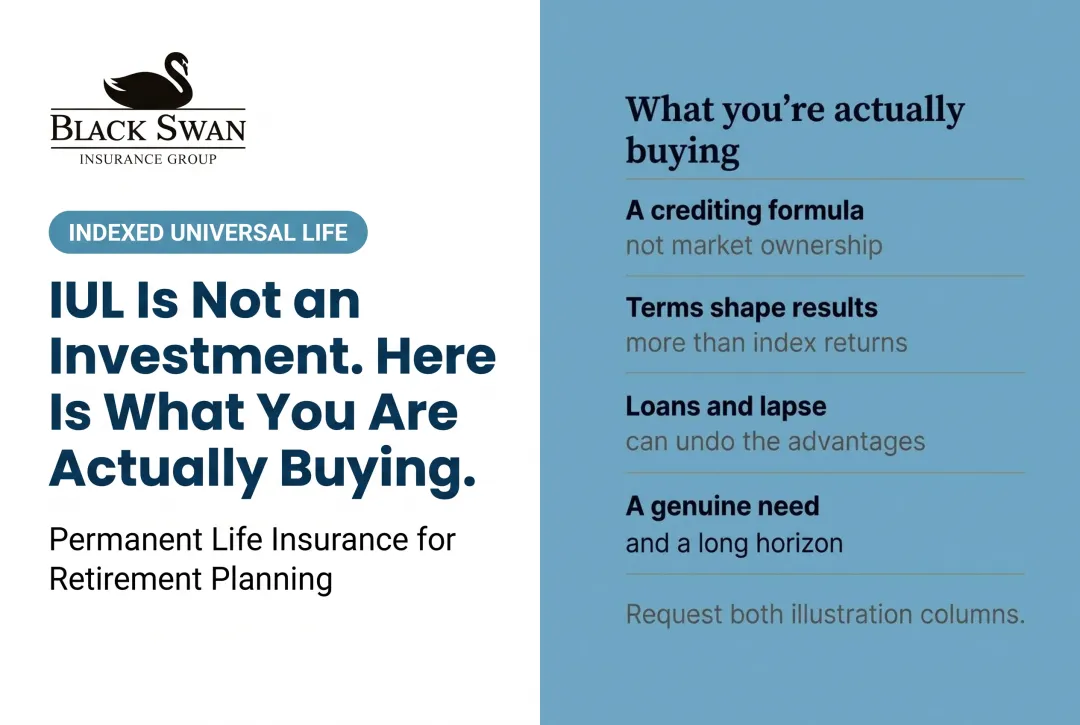
An indexed universal life policy is life insurance first. It builds cash value through interest linked to a market index, and that is not the same thing as putting money into an index fund. No stock ownership, no dividends, no direct market exposure inside the contract.
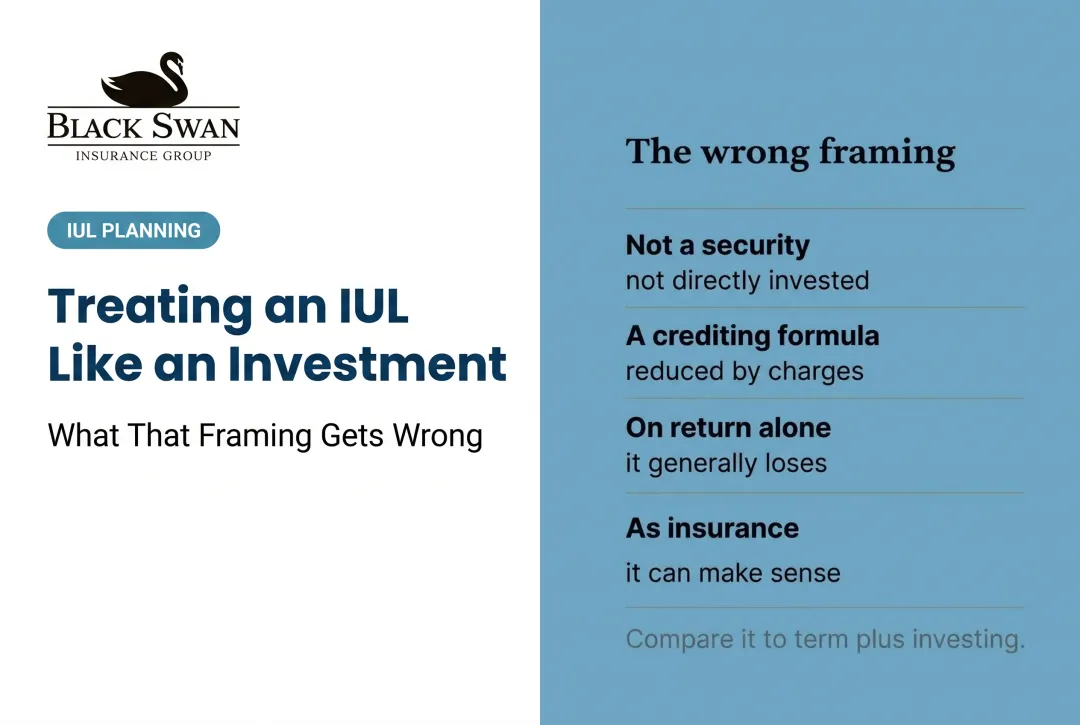
So when someone asks whether an IUL is a good investment, the honest first move is to reject the frame. Judged purely on accumulation, against a low-cost index fund in a Roth, it loses — capped upside, dividends excluded, a cost of insurance charged monthly. That comparison is not close and pretending otherwise damages the credibility of everything else on the page.
The real question is narrower and more useful: if you earn $150K+, have a genuine permanent protection need, and have already filled the obvious buckets, does this contract do a job the others cannot?
The short answer: An IUL is permanent life insurance with an index-linked cash value feature — not a direct market investment, and it should not be bought as one. Caps, participation rates and policy charges limit what you actually keep. A 0% floor blocks a negative index credit but fees still reduce account value. It fits only with a permanent coverage need, sustainable funding, a long horizon, and a clear advantage over a Roth IRA or 401(k) that you have actually tested rather than assumed.
Key Takeaways
- It is permanent life insurance with an index-linked cash value feature, not a direct market investment
- Caps, participation rates and policy charges limit the cash value growth you keep
- A 0% floor blocks negative index credits; fees can still reduce your account value
- It fits only with a permanent coverage need, sustainable funding, sufficient time horizon, and a demonstrated edge over the alternatives
How the Contract Works
Two core pieces: a death benefit paid to beneficiaries, and a cash value account that can earn indexed interest.
When you pay a premium, part covers the cost of insurance, administrative charges and any riders. The rest goes to cash value. Interest is calculated with a formula tied to an external index, commonly the S&P 500.
Your premium is not invested in that index. You do not own shares and you do not receive dividends. The insurer uses the index's price movement as a reference to decide how much interest to credit, per North American Company's overview of indexed universal life.
The Crediting Terms
- Cap — maximum interest credited in a period, however much the index gained
- Participation rate — the share of index gains credited; 80% of a 10% gain credits 8%
- Spread — an amount subtracted from index gains before crediting
- Floor — the minimum credited rate, often 0%, so index losses do not create negative interest
- Bonus — extra credit some policies add; always check whether it is guaranteed
These vary by carrier and can change. Confirm the current definitions on your illustration.
Guaranteed Versus Non-Guaranteed
Every illustration shows two sets of numbers. The NAIC's Life Insurance Illustrations Model Regulation requires insurers to clearly label non-guaranteed elements and prohibits showing them more favourably than the current illustrated scale. Treat current assumptions as projections, not promises.

Loans, Withdrawals and Tax
Policy loans let you borrow against cash value, usually without immediate tax while the policy is in force. Unpaid loans accrue interest and reduce both cash value and the death benefit. Withdrawals create taxable income once you exceed your basis.
- MEC status — fund faster than the IRS seven-pay test allows and the contract becomes a modified endowment contract. Distributions are then income-first, with a possible 10% additional tax on the taxable portion
- Loan lapse — if the loan balance exceeds cash surrender value the policy can lapse, and the outstanding loan is taxed like a withdrawal
- Surrender gain — per IRS Publication 525, surrender proceeds above cost basis count as taxable income
Any potential tax-advantaged access is conditional on the policy being properly structured, funded and managed. Talk to a qualified tax professional before relying on a specific outcome.
What the Critics Get Right
On the investment question specifically, the critics win, and conceding that is the only way the rest of this is worth reading.
They are right that a capped, dividend-excluded credit will trail a broad index fund across most long stretches. They are right that the cost of insurance is a permanent drag no brokerage account carries. And they are right that anyone comparing an IUL illustration to market returns is comparing a projection net of nothing against a benchmark net of everything.
Where the criticism stops is the protection need. If you need permanent coverage regardless — estate liquidity, a business obligation, a lifelong dependent — then you are not choosing between a policy and an index fund. You are choosing how to hold coverage you were going to buy anyway, and whether the cash-value feature earns its keep alongside it. That is a legitimate question with a technical answer, and it is the only version of this question worth spending time on.
The Benefits, and What Sits Beside Them
What it offers: a permanent death benefit while properly funded; tax-deferred cash value growth with loans or withdrawals available subject to policy terms; a floor against negative index crediting, paired with caps limiting the upside; premium flexibility within contract limits.
What sits beside all of that:
- Cost of insurance, admin fees, riders and surrender charges reduce cash value even in weak index years
- Caps and participation rates can change, so today's illustration may not match later crediting
- Surrender charges limit early liquidity and cut into value if you exit in the first several years
- Premium dollars used here are not available for retirement accounts, emergency reserves or debt payoff
- If premiums and cash value cannot cover rising insurance costs, the policy lapses and outstanding loans may become taxable
Consider a year when the index is flat or negative and the policy credits 0%. Account value can still fall, because monthly insurance and administrative charges continue regardless. The floor limits negative crediting. It does not shield net account value from fees.

Lapse risk shows in the data. A SOA Research Institute and LIMRA lapse study covering 2015–2021 found higher universal life lapse rates by policy count than by dollar amount in early policy years, including IUL. Smaller policies lapse more, which tells you something about who was sold them.
Against the Alternatives
Against Term Insurance Plus Investing
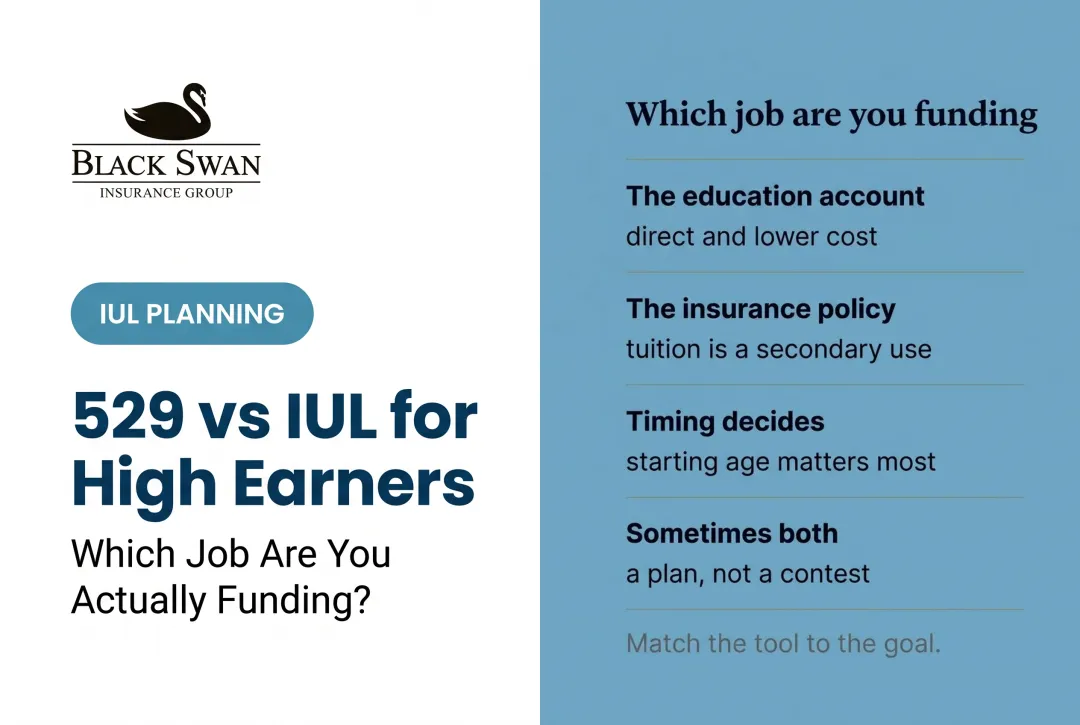
Term insurance covers a defined period at a much lower cost with no cash value. Invest the premium difference and you get direct market exposure and full liquidity — and no coverage once the term ends.
An IUL trades that lower cost for permanent coverage, contract-limited crediting and more complexity. Which fits depends on how long you genuinely need coverage, your investing discipline, and your liquidity needs. If the need has an end date, term wins.
Against a Roth IRA
A Roth IRA is a retirement investment account, not insurance. Income eligibility limits, annual contribution caps, direct investment choices, typically lower fees, and tax-free qualified withdrawals.
An IUL does not replace a Roth you are still eligible to fund. Max the available Roth space first, then evaluate whether a policy adds anything for tax diversification or protection.
Against a 401(k)
Review the employer match before anything else. That match is usually the highest-return dollar available anywhere in your financial life. Compare plan costs, investment options and contribution limits too.
A 401(k) is not the enemy and these are not competing products. They serve different purposes and can coexist in a tax-diversified plan.

| Criteria | IUL | Roth IRA | 401(k) | Term plus investing |
|---|---|---|---|---|
| Purpose | Permanent protection plus cash value | Retirement savings | Retirement savings | Temporary protection plus direct investing |
| Market exposure | Indirect, index-linked, capped | Direct | Direct | Direct |
| Downside treatment | Floor on crediting, not on fees | Full market risk | Full market risk | Full market risk |
| Liquidity | Limited early, surrender charges | Contribution basis any time; earnings restricted | Restricted, penalties before 59½ | High |
| Tax treatment | Tax-deferred growth; loans generally untaxed in force | Tax-free qualified withdrawals | Pre-tax or Roth options | Taxable investment gains |
| Fees | Insurance, admin, rider, surrender | Fund and account fees | Plan and fund fees | Brokerage fees |
| Primary risk | Lapse, capped growth, cost increases | Contribution limits | Contribution limits | No permanent coverage |
The Ultimate IUL Blueprint
If a permanent need genuinely exists and you are past the framing question, the Blueprint covers the design decisions that follow: funding levels, minimum death benefit, the MEC line and loan timing.
Who It Fits
Stronger Fit
- A genuine need for permanent life insurance, not temporary coverage
- Household income of $150K+ with sustainable surplus cash flow beyond emergency reserves and existing retirement contributions
- A long time horizon for cash value to accumulate and absorb the early costs
- Solid insurability and willingness to review the policy annually
Common profiles: high-income professionals and executives seeking tax diversification after maxing employer plans and IRA options; business and practice owners wanting protection and assets outside the business without straining operating liquidity; late-start high earners needing an honest read on horizon, underwriting and realistic funding rather than a rosier illustration.
Weaker Fit
Not everyone should buy an IUL. If you are evaluating it purely on return, you have already found your answer.
- Insufficient emergency savings, or unstable income
- High-interest debt not yet addressed
- Short-term liquidity needs
- No genuine permanent insurance need — where the need is temporary, term insurance is the correct answer
- A preference for simple, low-cost vehicles, which is a perfectly rational preference
Treat funding claims carefully even when the profile looks right. "Max-funded" and "overfunded" are marketing words that do not erase insurance costs, funding requirements, MEC considerations or lapse risk. Each needs a policy-specific analysis, not a slogan.
How to Evaluate One
- Request both ledgers — guaranteed and current, side by side
- Identify every assumption — crediting rates, caps, participation rates, spreads, bonuses and index strategies, and which the insurer can change later
- Review the full cost picture — premium requirements, cost of insurance, the surrender schedule, rider costs, loan provisions
- Stress-test it — lower crediting, a missed premium, rising insurance costs, an active loan
- Confirm MEC status — whether the proposed funding schedule would trigger it, and what happens if it does
Compare against realistic alternatives using the same contribution, horizon and coverage need, with conservative assumptions on both sides. Avoid comparisons built on cherry-picked historical index periods.
Ask directly who is compensated, and whether more than one carrier or design is being presented.

A great IUL is engineered. A bad IUL is sold. The difference shows up in the guaranteed column, not the headline.
Risks to Understand Before You Buy
- Judged on accumulation alone it usually loses to a low-cost index fund, and accumulation alone is the wrong reason to buy it
- Charges continue in a 0% crediting year, so net account value can fall with the floor intact
- Cost of insurance rises with age and is deducted every month
- Caps, participation rates and bonuses are frequently non-guaranteed and can be reset
- Surrender charges restrict early liquidity, and early-year lapse rates are elevated
- Loans reduce cash value and death benefit, and a lapse with a loan outstanding and gain in the contract creates taxable income with no cash received
- Crossing the seven-pay limit makes the contract a MEC under I.R.C. § 7702A and changes distribution taxation permanently
- Premium dollars are not available elsewhere — the opportunity cost is real and belongs in the comparison
- Illustrated values are projections, not promises
Find Out Where You Actually Stand
This starts with the Tax-Free Wealth Blueprint Fit Review. If you earn $150K+ and are trying to answer the investment question honestly, we compare the policy against a Roth, a 401(k) and term-plus-investing on identical assumptions, read the guaranteed column, and test the funding against a bad decade. If it does not fit, we will tell you that too.
Frequently Asked Questions
Is an IUL a good investment?
It is a life insurance contract with a cash-value feature, and comparing it to an index fund on returns alone will always favour the index fund. The useful question is whether you need permanent coverage, and if so, whether this structure serves that need better than the alternatives.
What is the average rate of return?
There is no reliable single figure. Outcomes depend on crediting method, caps, participation rates, fees, funding level and market conditions. Verify any number against your own illustration.
How much do I need to open one?
Minimum premiums vary by insurer, age, health, desired death benefit and design. Decide on what you can sustainably fund long term, not the quoted minimum — the minimum is what keeps the policy open, not what makes it work.
Can I take money out?
Yes, through withdrawals or policy loans, both with trade-offs: loan interest, reduced cash value or death benefit, possible surrender charges, and tax consequences if the policy lapses with a loan outstanding.
Is it better than a Roth IRA?
Neither is universally better, but if you are still eligible to fund a Roth, fund the Roth. A policy is a separate conversation about protection, not a substitute for retirement account space you have not used.
Should I just buy term and invest the difference?
Where the protection need is temporary, yes, and that is frequently the right answer. It depends on genuinely investing the difference, every year, through a bad market.
Sources
- North American Company — Indexed universal life overview
- NAIC — Life Insurance Illustrations Model Regulation
- IRS Publication 525 — Taxable and Nontaxable Income
- SOA Research Institute and LIMRA — 2015–2021 UL lapse rate study
- I.R.C. § 7702A and Rev. Proc. 2008-39 (modified endowment contracts and the seven-pay test)
Disclosure: This article is educational and is not personal tax, legal or investment advice. Indexed universal life is life insurance first. Actual results depend on policy design, carrier, crediting options, caps, participation rates, expenses, funding and ongoing management. Policy loans and withdrawals may reduce cash value and death benefit and can create tax consequences if the policy lapses or becomes a modified endowment contract. This strategy is not appropriate for everyone. Illustrated values are not guarantees; actual results depend on policy terms, crediting, costs and funding. Consult your own tax, legal and financial professionals for advice specific to your situation.
And remember, it's not what you earn, it's what you keep… enjoy the ride.