By Robert Balgac, Founder, Black Swan Insurance Group | October 9, 2026
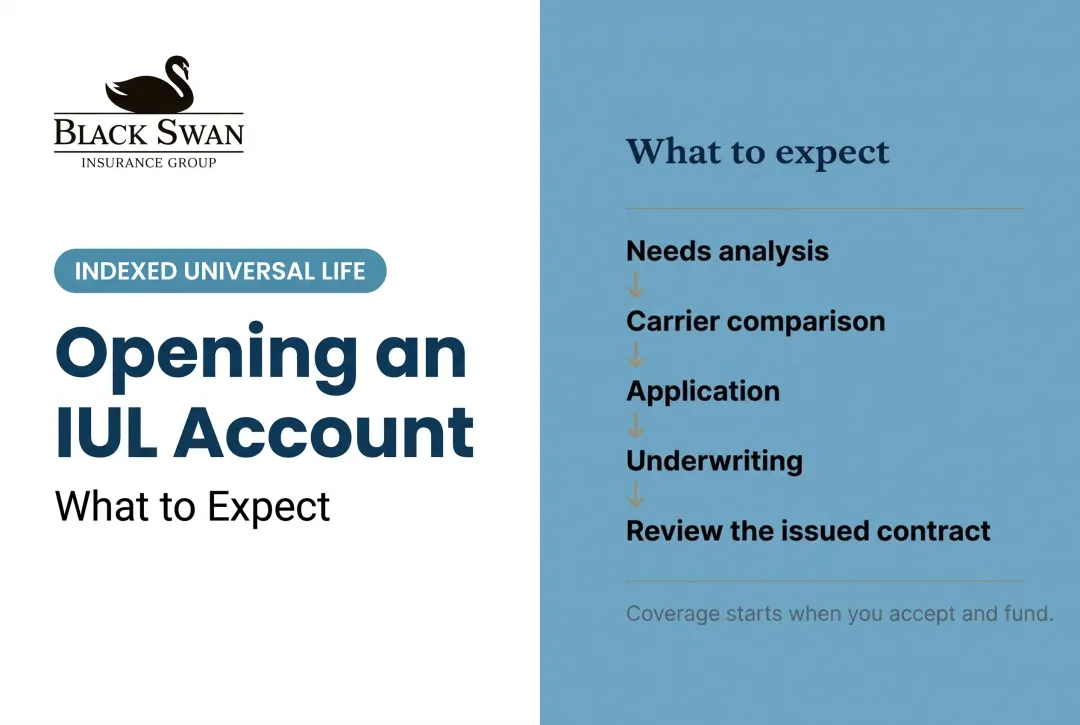
There is no IUL account to open in Texas or anywhere else. No teller, no login, no account number waiting. What you are doing is applying for an indexed universal life insurance policy through a licensed Texas insurance professional, issued by a carrier authorised to do business in the state — and being underwritten for it.
That framing changes the whole exercise. An account opening is administrative. An insurance application is a decision someone else gets to make about you, at a price they set, after reviewing your health and finances.
The short answer: In Texas this is a regulated application process with two verification steps most buyers skip — checking the agent's licence and the carrier's authorisation through the Texas Department of Insurance. After that, the work is comparing illustrations across more than one financially strong insurer on identical assumptions, funding at a level you can sustain rather than the minimum that keeps the contract alive, and reviewing it annually. Texas free-look periods generally run 10 to 20 days.
This matters most if you earn $150K+, have captured the employer match, maxed the 401(k) and run into the Roth phase-outs. That profile gets pitched IUL constantly across Dallas, Houston and Austin, and is the profile most likely to fund one properly — and to be sold one it did not need.
Key Takeaways
- Treat this as life insurance first and a cash-value strategy second; confirm a genuine protection need before chasing accumulation
- Verify both the agent's and the carrier's Texas authorisation through TDI before signing anything
- A low minimum premium does not mean the policy is funded well enough to do the job you bought it for
- Caps, participation rates, floors, surrender schedules and MEC limits swing results more than any advertised rate
- Compare against your 401(k), IRA, brokerage account and term coverage before you apply
Step 1: Define the Purpose and the Sustainable Premium
Before contacting anyone, write down the primary goal: permanent family protection, estate or business planning, supplemental retirement flexibility, cash-value access later, or some combination.
Separate the insurance need from the accumulation goal. They are related. They are not the same thing, and conflating them produces policies that do neither job well.
Then look honestly at income stability, emergency reserves, existing debt, current coverage, employer benefits, retirement contributions and liquidity needs over the next several years. Estimate a sustainable premium range — not the number lifted from an illustration's most optimistic column.
Flexible premiums are a feature, not permission to underfund indefinitely. A contract funded at the bare minimum for years drifts toward lapse even when the index performs respectably.
Step 2: Verify Texas Authorisation
This is the step that is specific to buying in Texas, and it takes ten minutes.
The agent's licence. Use the Texas Department of Insurance agent lookup tool and confirm the professional holds the correct life insurance licence, not merely some licence.
The carrier's authorisation. TDI maintains lists of companies licensed to sell insurance in Texas. Confirm the specific insurer is authorised for the product being proposed.
Then understand who is sitting across from you. A captive agent represents one carrier. An independent agent or broker can compare cost structures, underwriting treatment and crediting options across several. Ask directly how the professional is compensated, which carriers they can access, and whether they conduct annual reviews after issue or disappear at signing.
If you are considering any firm based outside Texas — including ours — confirm with TDI that the specific agent and carrier are authorised to do business in your state before anything is signed.
Step 3: Compare Carriers, Never a Single Illustration
Request comparable illustrations from more than one financially strong insurer, holding death benefit, premium schedule, riders and assumptions consistent enough to compare fairly. Carriers commonly reviewed include F&G Annuities and Life, Corebridge, Transamerica and Mutual of Omaha, among others, though the right fit depends entirely on your underwriting profile and goals.
Compare line by line: cost-of-insurance charges and administrative fees; premium loads and surrender charge schedules; index-account and fixed-account choices; cap and participation-rate history, separating guaranteed from current; loan provisions and death-benefit options.
The Texas Department of Insurance publishes guidance confirming that illustrated cash-value growth is a projection, not a promise. Nobody should present a carrier as "the best" without stating the criteria and confirming the figures are current.
An illustration is a model, not a guarantee.
The Ultimate IUL Blueprint
Before you apply in Texas, the Blueprint covers what the design has to survive: funding levels, caps and charges, the MEC line, loan timing, and exactly what to demand from an illustration.
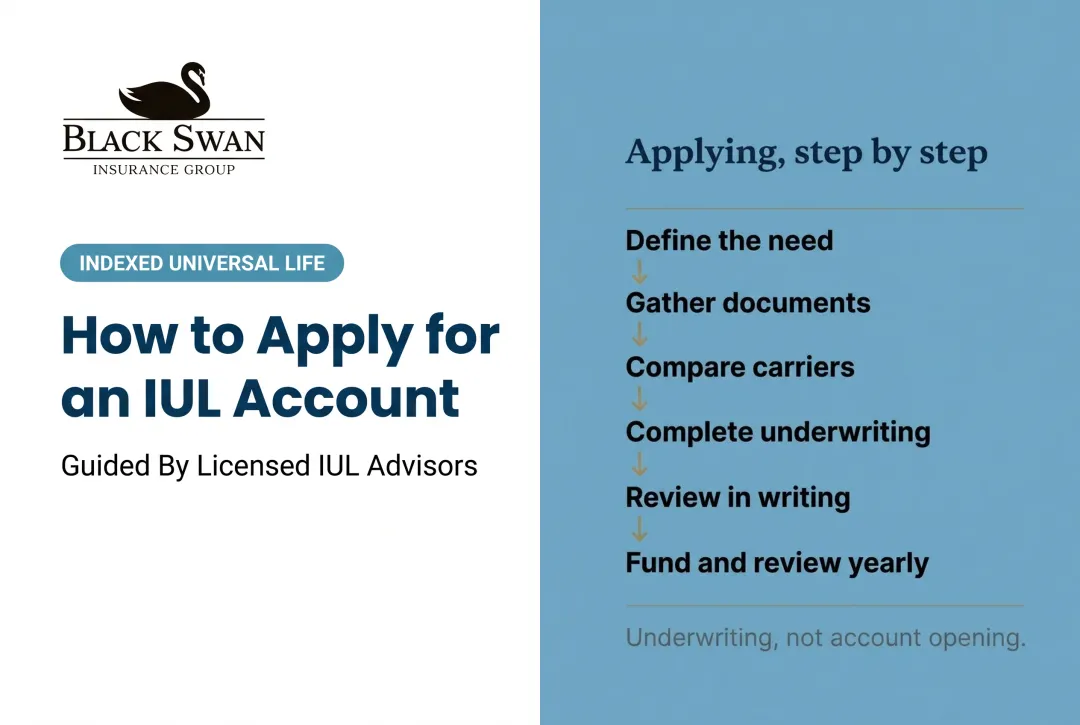
Step 4: Application, Underwriting, Issue and Review
Accuracy matters more than speed. Prepare personal, financial and beneficiary information; health history, prescriptions and tobacco or nicotine use; occupation, travel and lifestyle details including hazardous hobbies. Omissions and inconsistencies delay underwriting at best and create problems at claim time at worst — a problem your family inherits, not you.
Depending on profile and coverage amount, underwriting may involve a paramedical exam with blood and urine samples, an attending physician statement or electronic medical records, a prescription-history check, and financial documentation for larger amounts. Some carriers offer accelerated or no-exam paths; treat any exam waiver as a possibility, not a promise.
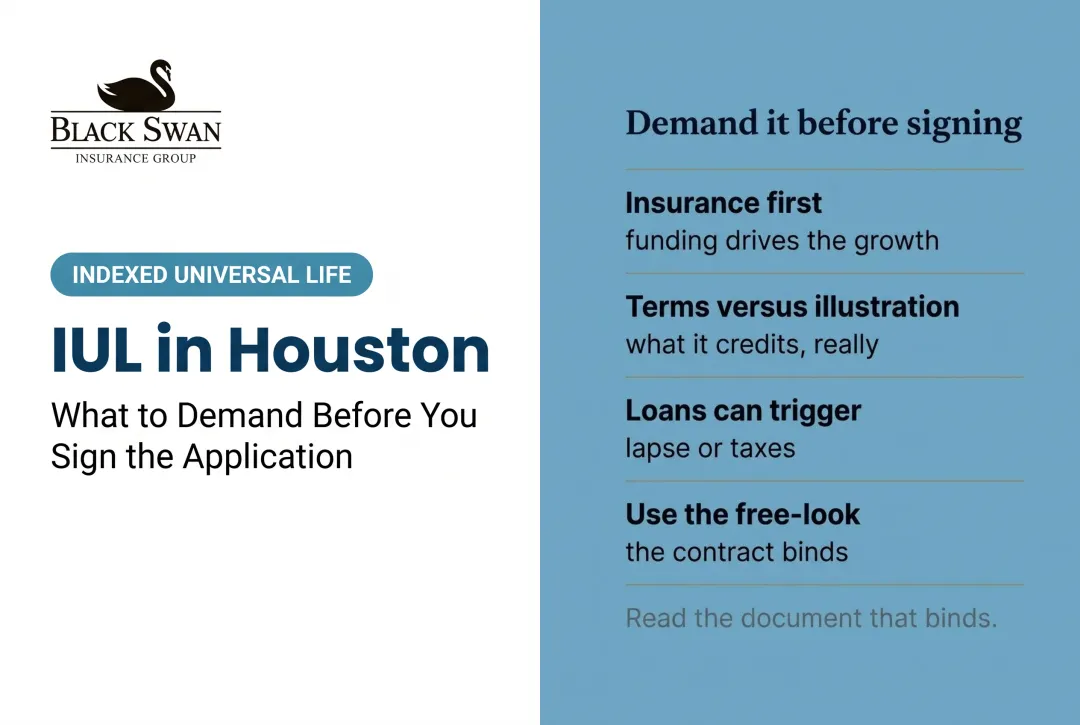
The policy you are issued can differ from the illustration you started with. Before accepting, review the actual delivery documents, exclusions and riders; the premium schedule as issued rather than as proposed; and your free-look period, which Texas generally sets between 10 and 20 days depending on the contract, during which you can cancel for a full refund.
Walk the guaranteed and non-guaranteed columns side by side — projected cash value, death benefit, break-even timing, and what happens if premiums are reduced or stopped. Then confirm the first premium, payment method, beneficiary designations and delivery requirements. Submitting an application is not activating a policy; that happens only once delivery requirements are satisfied.
After issue, schedule in-force reviews comparing current cash value, charges, credited interest, premium history, loan balance and lapse risk against the original plan. A new job, a health change, a growing family or a shift in retirement timing should each trigger one.
This is not set-it-and-forget-it. It is design-it, fund-it, review-it.
Black Swan Insurance Group structures the relationship around needs assessment, coverage exploration, policy tailoring, transparent sign-up and continued guidance with annual reviews.

What the Critics Get Right
The strongest fair criticism is that the complexity itself is the risk, and Texas buyers are not protected from it by state licensing.
Verifying a licence confirms someone is permitted to sell you a policy. It says nothing about whether the design is sound, whether the funding level is realistic, or whether the person will still be returning calls in year nine. Critics are right that illustrations have been used to flatter products, that early cash value regularly disappoints relative to what buyers remember being shown, and that the person presenting the design is usually paid on premium.
A great IUL is engineered. A bad IUL is sold.
The correct response is not to avoid the product. It is to verify authorisation, compare carriers on identical conservative assumptions, and insist on being told when the answer is no.
Who This Fits in Texas
Stronger Fit
- A lasting need for permanent life insurance, not a defined-period need
- Cash flow able to sustain premiums for decades, not just this year
- A long time horizon
- Willingness to monitor a genuinely complex contract over the years
High-income professionals and executives: this complements rather than replaces a 401(k), emergency reserves, diversified investments and appropriate term coverage.
Business and practice owners: the conversation reaches succession planning, buy-sell funding, liquidity held outside the business and personal protection. These structures carry legal and tax complexity — involve your CPA or attorney.
Late-start high earners: the compressed funding runway changes everything. Current insurability, sustainable premium levels and liquidity needs deserve far more scrutiny than they would at 30.
Weaker Fit
Not everyone should buy this. Walk away or wait if you have unstable income or thin emergency reserves, a short horizon, difficulty maintaining premiums long term, a need for low-cost coverage only, discomfort with non-guaranteed values, or a goal a simpler product would meet just as well.

| Alternative | May fit better when… |
|---|---|
| Term life insurance | You need affordable coverage for a defined period |
| Whole life insurance | You want more predictable, guaranteed cash-value growth |
| 401(k) / IRA / Roth IRA | You have not maximised tax-advantaged retirement contributions |
| Brokerage account | You prioritise liquidity and direct market investing |
| Annuities | You want contractual income in retirement |
What to Have Ready Before Applying
Personal and beneficiary: government ID and Social Security information, contact details and dates of birth, employment and income details, and each beneficiary's legal name, relationship, date of birth and intended allocation.
Financial and coverage: existing policy statements and requested coverage amount, household or business obligations, assets and liabilities, income documentation and premium budget, and how you intend to use cash value. Larger amounts prompt additional financial justification.
Health and lifestyle: physician details, diagnoses, medications, surgeries and hospitalisations; family health history; tobacco or nicotine use; hazardous hobbies and driving history; recent medical records where available.
Texas compliance: the agent's Texas authorisation, carrier identity, product materials, compensation disclosures, and the TDI complaint process.
For strategies involving retirement income, business ownership, trusts, large coverage amounts or tax-sensitive loans, bring in a CPA, tax adviser or estate-planning attorney before signing.
How the Mechanics Actually Work
Crediting runs on four moving parts: the floor, often 0%, setting the minimum credit; the cap, limiting the maximum; the participation rate, setting the share of index movement used; and the spread, subtracted before interest is credited. The index is used only to calculate interest — you do not own the underlying securities.
Zero is your hero in a down year — but the floor applies to the credit, not to the charges.
Cost of insurance, administrative fees, premium loads, rider costs and surrender charges all reduce how much premium builds cash value. Understand the difference between minimum premium, target premium and accumulation-focused funding. Overfunding too aggressively triggers modified endowment contract status under the IRC Section 7702A seven-pay test, after which IRS guidance treats loans and withdrawals on an income-first basis, with a possible additional 10% tax on distributions before age 59½.
Policy loans accrue interest and, unpaid, reduce the death benefit. Withdrawals reduce cash value directly. Before taking either, request an updated in-force illustration.
The loan is not the problem. The unmanaged loan is the problem.

Risks to Understand Before You Apply in Texas
- Skipping the needs analysis. Buying on a projected retirement-income figure rather than a real coverage need is the single most common error. Compare guaranteed values and sustainable premium scenarios first.
- Chasing the lowest premium without comparing charges, surrender schedules and long-term funding requirements.
- Incomplete health or financial disclosure, which delays underwriting and can create claim problems years later.
- Assuming a floor means no downside. Floors do not erase charges, loan interest or lapse risk.
- Caps and participation rates can be lowered after issue, within contract minimums, and cost of insurance rises with age.
- Lapsing or surrendering with a loan outstanding can create taxable income with no cash received.
Find Out Where You Actually Stand
This starts with the Tax-Free Wealth Blueprint Fit Review. If you earn $150K+ in Texas and are weighing this, we work through the protection need first, verify carrier authorisation for your state, model funding against the MEC limit, stress-test through lower-crediting and zero-credit years, and put competing carrier designs side by side on identical assumptions with charges and loan terms in plain numbers. If term coverage plus maxed retirement accounts serves you better, we will say so. If IUL does not fit, we will tell you that too.
Frequently Asked Questions
How much is needed to start an IUL in Texas?
It varies by carrier, age, health, coverage amount and design. A carrier's stated minimum premium is not the same as adequate funding for your protection and cash-value goals.
Is IUL better than a 401(k)?
Neither is universally better. Employer matching and qualified-plan contributions normally come first. An IUL adds permanent insurance and potential tax-advantaged access when properly structured, funded and managed — things a 401(k) does not provide.
What documents do I need to apply in Texas?
Identification, beneficiary details, financial and existing-coverage information, and health and medication history. Some applicants also need income documentation or medical records depending on the carrier.
Do I need a medical exam?
It depends on the carrier, your profile and the coverage amount. Some applicants qualify for accelerated underwriting with no exam, but waivers and approval cannot be guaranteed in advance.
How long does approval take?
It depends on file completeness, medical records, exam requirements and carrier workload — from a few hours under accelerated underwriting to several weeks under traditional. Ask for a carrier-specific estimate.
How do I check an agent or carrier is authorised in Texas?
Use the Texas Department of Insurance agent lookup for the licence, and TDI's company lists for the carrier. Do both before sharing medical or financial records.
Sources
- Texas Department of Insurance — Agent lookup
- Texas Department of Insurance — Life insurance consumer guidance
- IRS — Revenue Ruling 2007-38
Disclosure: This article is educational and is not personal tax, legal or investment advice. Indexed universal life is life insurance first. Agent licensing, carrier authorisation, product availability and free-look periods vary by state and must be verified independently with the Texas Department of Insurance. Illustrated values are not guarantees; actual results depend on policy design, carrier, crediting options, caps, participation rates, expenses, funding and ongoing management. This strategy is not appropriate for everyone. Policy loans and withdrawals reduce cash value and the death benefit, and can create tax consequences if the policy lapses or becomes a modified endowment contract. Consult your own tax, legal and financial professionals for advice specific to your situation.
And remember, it's not what you earn, it's what you keep… enjoy the ride.