By Robert Balgac, Founder, Black Swan Insurance Group | October 5, 2026
Mississippi buyers comparing permanent life insurance run straight into a wall of vocabulary: market-linked cash value, flexible premiums, caps, floors, participation rates, and decades of policy costs that never surface in the conversation.
Most of them still cannot tell whether the illustration in front of them describes a realistic path or a best case that rarely plays out. That is true of first-time buyers and it is equally true of $150K+ earners who have already maxed a 401(k), run into the Roth income limits, and been told a policy is the obvious next bucket.
Indexed universal life sits at the centre of that confusion. It is pitched as lifelong protection plus index-linked growth with a floor limiting market losses. The pitch leaves out how caps, fees and funding choices decide the actual result.
One clarification before anything else: an IUL is a life insurance contract with a cash-value feature, not an investment in the S&P 500 or any index. Terms, caps and fees vary by carrier and by contract.
The short answer: An IUL combines permanent protection, flexible premiums and index-linked cash value — minus charges, caps and participation rates. A 0% floor blocks negative index credits; fees, loans, withdrawals and underfunding can still shrink cash value. Compare carrier strength, illustration assumptions, charges and surrender schedules rather than projected returns. Ask three questions before signing: what happens if the cap drops, what premium keeps the policy in force under guaranteed charges, and what the illustration looks like after ten years of below-assumption crediting.
Key Takeaways
- Permanent protection, flexible premiums and index-linked cash value — minus charges, caps and participation rates
- A 0% floor blocks negative index credits; fees, loans, withdrawals and underfunding still shrink cash value
- Compare carrier strength, illustration assumptions, charges and surrender schedules, not projected returns
- High-income households with long horizons may fit; weigh term, whole life, 401(k)s, Roths and annuities too
- Verify the carrier and producer through the Mississippi Insurance Department before applying
How the Policy Works
Two main parts: the death benefit paid to beneficiaries, and a cash-value account you may access while alive. Both are designed to last your whole life, provided the policy stays funded.
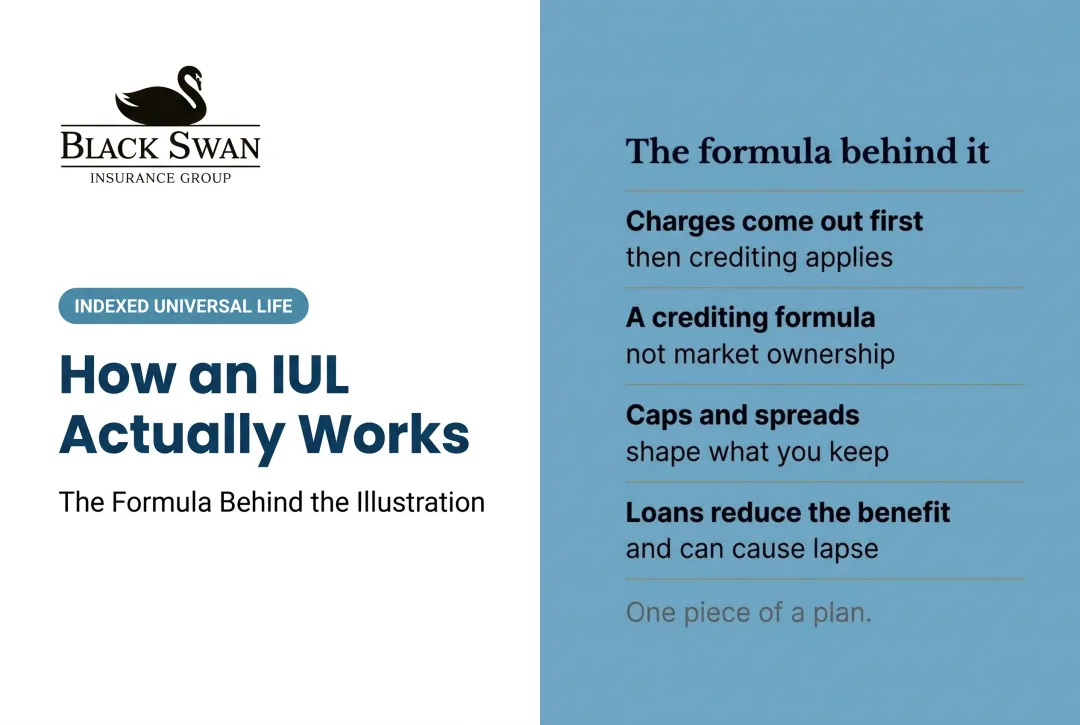
Each premium is not credited to cash value in full. The insurer first deducts:
- Cost of insurance, which increases as you age
- Administrative and premium-load fees
- Rider costs where optional benefits are added
- Other contract-specific deductions
Whatever remains is allocated to a fixed account, one or more indexed crediting strategies, or a combination, depending on your contract.
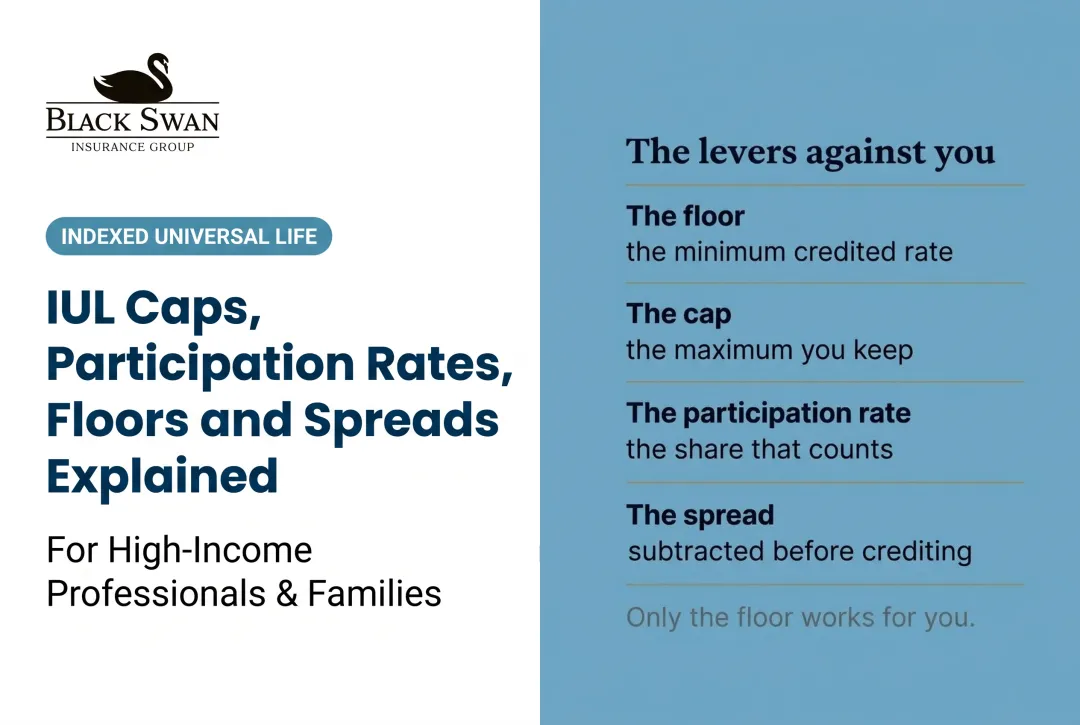
Floors, Caps and Participation Rates
| Term | Hypothetical value | What it means |
|---|---|---|
| Floor | 0% | Minimum crediting rate for the period, even if the index drops |
| Cap | 9% | Maximum credited rate, even if the index gains more |
| Participation rate | 100% | Share of the index gain used in the crediting formula |
If the reference index gained 15%, this policy credits 9% because of the cap. If the index dropped 10%, it credits 0% because of the floor.
Illustrative only. Actual caps, floors and participation rates vary by carrier and change over time. As FINRA explains, indexed universal life follows a stock index's performance without investing premium dollars in that index.

Flexible Does Not Mean Automatic
Crediting resets annually and each period is measured independently. Past index performance does not guarantee future crediting. Even in a positive year, cash value can decline when cost of insurance and fees exceed the credited amount, when a loan or withdrawal is outstanding, or when premium funding has been insufficient.
"Flexible premiums" means you can adjust timing and amount within contract limits. It does not mean the policy runs itself. As insurance costs rise with age, the contract needs enough funding to stay in force. Skip too many payments and lapse risk climbs quickly.
Zero is your hero in a down year — but the floor applies to the credit, not to the charges.
What It Costs
There is no standard Mississippi premium. Pricing depends on age, health, tobacco use, underwriting class and the death benefit requested, plus policy design, funding level, riders and carrier. Two people applying the same day for similar coverage can receive very different quotes.
Ask every carrier to break these out in writing:
- Cost of insurance — rises with age and can meaningfully erode cash value later in life
- Premium loads and monthly policy fees — charged regardless of index performance
- Rider charges — for chronic illness, accelerated death benefit and similar options
- Surrender charges — applying if you cancel or reduce coverage in the early years
- Index-account expenses or spreads — built into some crediting strategies
- Loan interest — charged on any outstanding balance
Any hypothetical premium figure you see online, including in this guide, is an illustrative example rather than a Mississippi average.
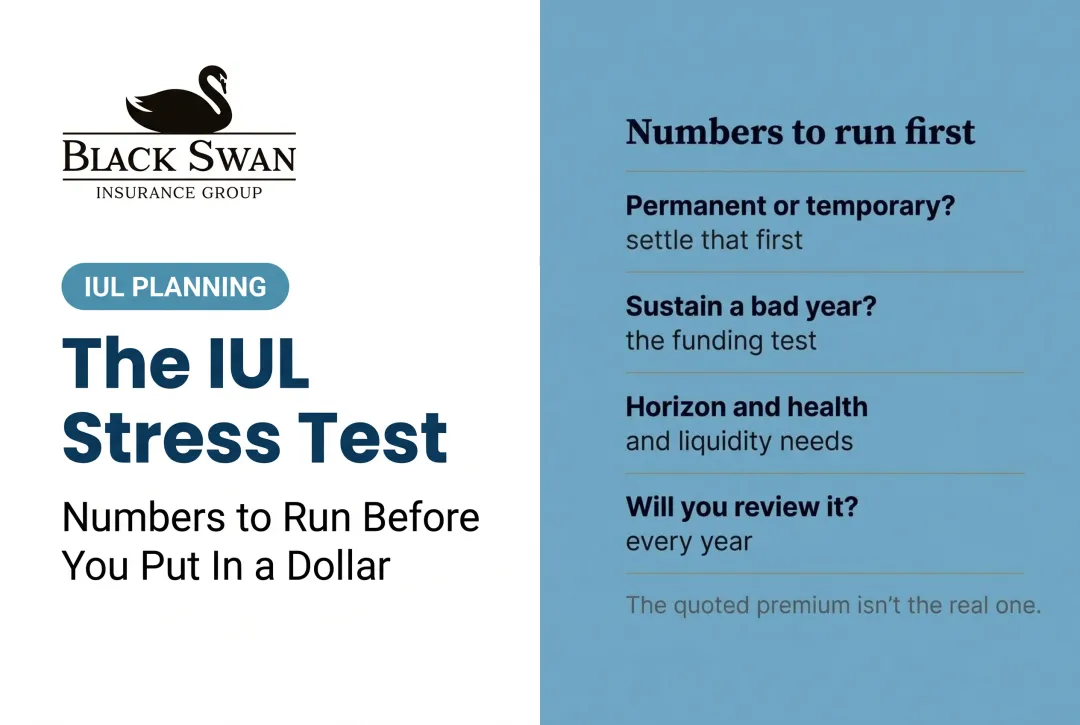
The Three Questions
Every illustration should separate guaranteed values from non-guaranteed current-assumption values. NAIC guidance on life insurance illustrations confirms that indexed performance cannot be predicted from an illustration, and that guaranteed and non-guaranteed elements must be shown separately.
Before signing, ask:
- What happens if the cap or participation rate drops next year?
- What premium is required to keep this policy in force under guaranteed charges?
- How does the illustration change if credited rates run below the current assumption for ten straight years?
If any of those answers arrives vague, that is the answer.
Mississippi Oversight
The Mississippi Insurance Department licenses insurers and producers, reviews policy form filings and handles consumer complaints. It does not guarantee performance or prevent an underfunded policy from lapsing. Before applying, confirm the insurer is authorised in Mississippi, the specific product is currently available in the state, the carrier's independent financial-strength ratings, and that the actual contract terms match what you were shown.
Verify producer and company licensing through MID's licensing search.
What the Critics Get Right
Scepticism here is well earned, and it is worth engaging rather than working around.
Critics are right that a colourful illustration is a marketing document and the contract is the binding one, and that most buyers never read the second. They are right that "flexible premiums" is sold as a benefit and functions as the mechanism by which a policy starves. And they are right that caps can be reduced after you have committed, which makes any thirty-year projection a statement of intent rather than obligation.
Where the criticism stops is the protection need. None of those objections tell you whether your coverage requirement outlasts a term. If it does not, term insurance is the answer and this page is not for you. If it does, the criticism becomes a checklist rather than a verdict.
Who It Fits
Stronger Fit
- A need for permanent rather than temporary life insurance protection
- Household income of $150K+ with stable surplus cash flow beyond emergency savings and retirement contributions
- Ability to commit to funding for many years, not a few
- Interest in flexible premiums plus potential tax-advantaged access to cash value when the policy is properly structured, funded and managed
- Willingness to review the contract annually
This appeals most to high-income professionals, business owners, affluent families and late-start high earners who have already evaluated qualified retirement plans and want additional protection or tax diversification.
Weaker Fit
Not everyone should buy an IUL. If the three questions above do not get clean answers, walk away.
- The lowest-cost death benefit is the goal — term insurance answers that directly
- Coverage is needed for a defined short period
- Emergency reserves are not yet in place
- You expect to stop funding soon
- You prefer guaranteed, low-maintenance products
Term insurance or whole life is usually the more responsible starting point in those cases, and saying so is not a sales failure.
| Option | Best for | Trade-off |
|---|---|---|
| Term insurance | Affordable, temporary coverage | No cash value; coverage ends with the term |
| Whole life | Predictable guarantees, fixed premiums | Less premium flexibility |
| Variable universal life | Higher potential upside | Direct investment risk; cash value can fall |
| 401(k), IRA, Roth, brokerage | Straightforward accumulation | No death benefit |
The Ultimate IUL Blueprint
If a permanent need genuinely exists, the Blueprint covers the funding decisions that determine whether it survives: funding levels, the MEC line, index-strategy selection and loan timing.
Loans, MECs and Lapse
Policy loans and withdrawals reduce cash value and death benefit, and loan interest accrues. If the policy lapses or is surrendered with an outstanding loan and gain in the contract, the forgiven amount can become taxable income — with no cash received to pay it.
Overfund too aggressively and the contract fails the IRS seven-pay test, becoming a modified endowment contract and changing how loans and withdrawals are taxed permanently. Involve a tax professional before overfunding or treating a policy as a primary retirement-income strategy.

Buying One Properly
Before comparing carriers, put your numbers on paper. That worksheet becomes the benchmark for whether an illustration fits your life rather than just your budget.
Capture income replacement needs and outstanding debts; dependents, business obligations and estate goals; existing coverage, retirement assets and liquidity needs; and sustainable premium capacity — the amount that survives a bad year, not the amount that fits this month.

If you cannot explain the strategy to your spouse in plain English, it is not ready for your household.
Risks to Understand Before You Apply
- Charges continue in a 0% crediting year, so cash value can fall with the floor intact
- Cost of insurance rises with age and erodes cash value most in later years
- Caps and participation rates are non-guaranteed and can be reduced after issue
- Underfunding is the leading cause of lapse, and flexible premiums make drifting easy
- Surrender charges apply in the early years
- Loans reduce cash value and death benefit, and a lapse with a loan outstanding and gain in the contract creates taxable income
- Crossing the seven-pay limit makes the contract a MEC and changes distribution taxation permanently
- State licensing and product availability vary and change — verify before applying
- Illustrated values are projections, and only the guaranteed column commits the insurer
Find Out Where You Actually Stand
This starts with the Tax-Free Wealth Blueprint Fit Review. If you earn $150K+ in Mississippi, we put the three questions to the carrier on your behalf, read the guaranteed column against the illustration, model a decade of below-assumption crediting, and price term plus your existing accounts on identical terms. If it does not fit, we will tell you that too.
Frequently Asked Questions
What does an IUL cost in Mississippi?
There is no state average. Age, health, tobacco use, underwriting class, death benefit, design, riders and funding level all drive it. Ask for a personalised illustration with its assumptions labelled.
Does the 0% floor protect my cash value?
No. It prevents a negative index credit. Cost of insurance, fees and loan interest continue regardless, so cash value can still fall in a flat year.
What are the three questions I should ask?
What happens if the cap or participation rate drops; what premium keeps the policy in force under guaranteed charges; and how the illustration looks after ten years of below-assumption crediting.
How do I verify a carrier or agent here?
Through the Mississippi Insurance Department's licensing search, plus independent financial-strength ratings from at least two agencies.
What is a MEC and why does it matter?
A contract that fails the IRS seven-pay test. Loans and withdrawals are then taxed income-first with a possible additional tax before 59½, and the change is permanent.
Should I buy term insurance instead?
If the protection need has an end date, yes. Term is cheaper and simpler for income replacement, and it deserves pricing before anyone designs a permanent policy.
Sources
- FINRA — Insurance products
- NAIC — Life Insurance Illustrations
- Mississippi Insurance Department — licensing search
- NAIC — Life Insurance
- I.R.C. § 7702A and Rev. Proc. 2008-39 (modified endowment contracts and the seven-pay test)
Disclosure: This article is educational and is not personal tax, legal or investment advice. Indexed universal life is life insurance first. State rules, carrier product availability and licensing requirements change; confirm current details before applying. Actual results depend on policy design, carrier, crediting options, caps, participation rates, expenses, funding and ongoing management. Policy loans and withdrawals may reduce cash value and death benefit and can create tax consequences if the policy lapses or becomes a modified endowment contract. This strategy is not appropriate for everyone. Illustrated values are not guarantees; actual results depend on policy terms, crediting, costs and funding. Consult your own tax, legal and financial professionals for advice specific to your situation.
And remember, it's not what you earn, it's what you keep… enjoy the ride.