By Robert Balgac, Founder, Black Swan Insurance Group | October 9, 2026
Choosing an IUL is not about finding the highest cap rate on a brochure. It is about what happens to your cash value when the index underperforms, when you miss a premium, and when you want a loan ten years from now.
Most buyers compare illustrations the way they compare phone plans — looking for the biggest number. That misses the only question that matters: will this policy still be standing, funded, and doing its job in year 20?
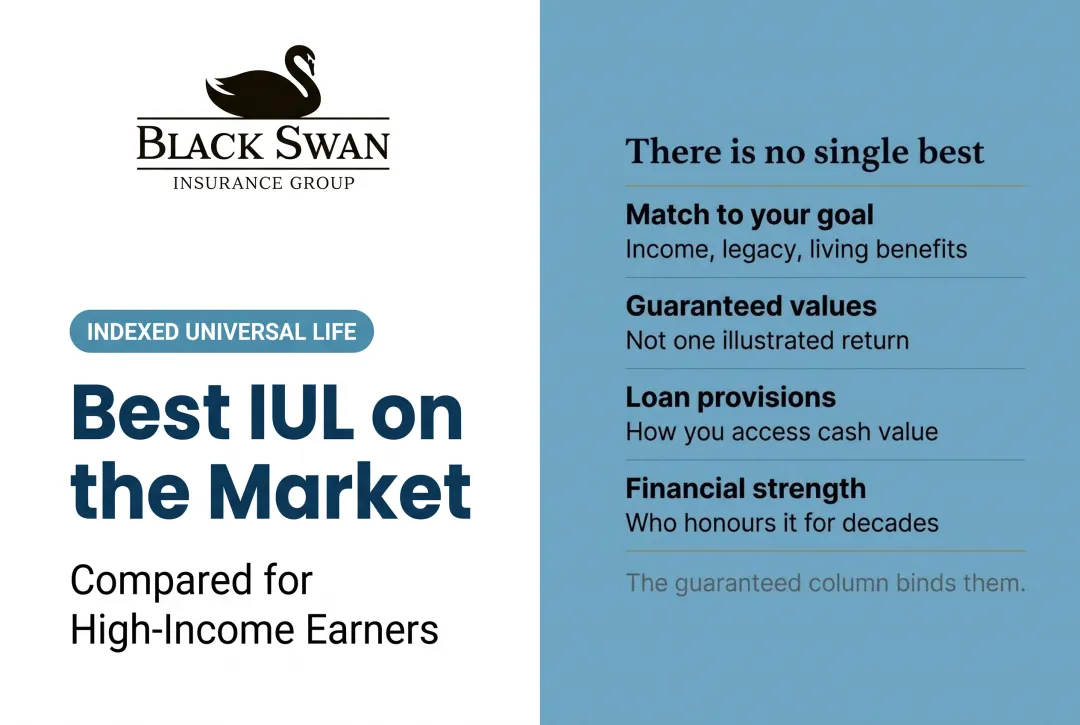
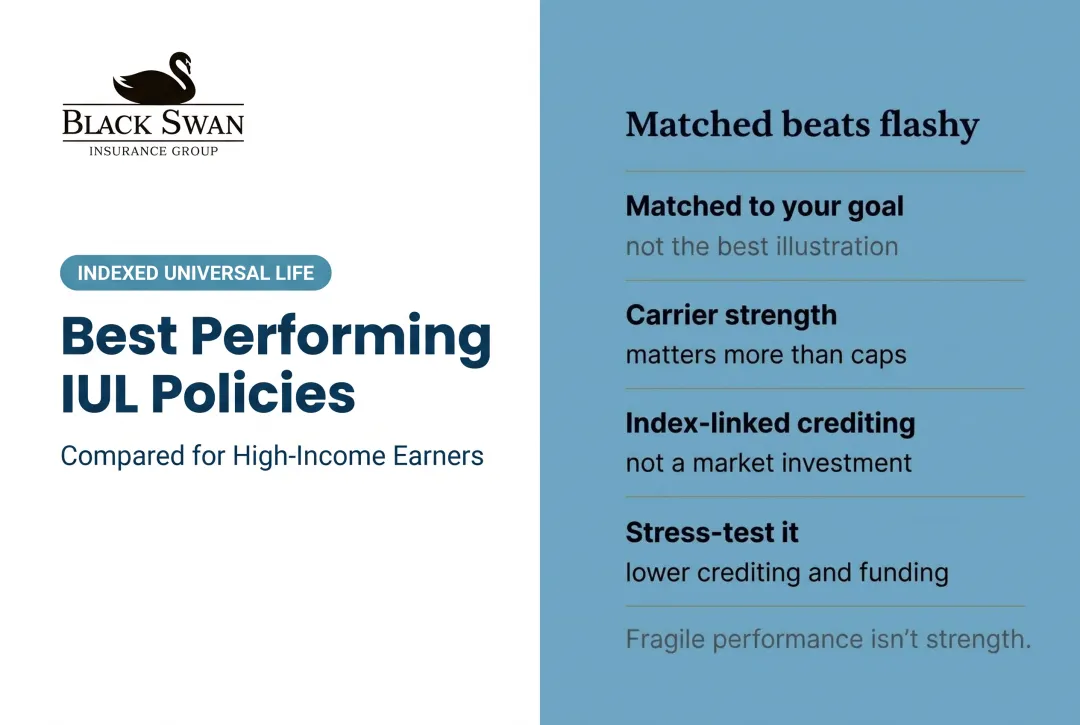
The short answer: The best accumulation policy is the one whose costs, guarantees, funding requirements and loan structure survive a weak decade. Current caps, participation rates and illustrated returns are not guarantees — they change. Compare cost of insurance, charges, crediting design, loan terms and lapse protection, using identical assumptions across carriers.
Key Takeaways
- The best policy depends on your goal: accumulation, retirement income, legacy or living benefits
- Current caps, participation rates and illustrated returns are not guarantees
- Compare cost of insurance, charges, crediting design, loan terms and lapse protection — not projected cash value
- Always request multiple illustrations using identical age, health class, death benefit and premium
- This is life insurance first; accumulation is the secondary benefit
How Cash Value Actually Builds
Permanent life insurance pairing a death benefit with a cash-value account credited by reference to an index, without your premium entering that index.
A portion of each premium covers cost of insurance and administrative charges; what remains builds cash value. Consistent, adequate funding matters because thin premiums mean thin accumulation — especially early, when charges take the biggest bite.
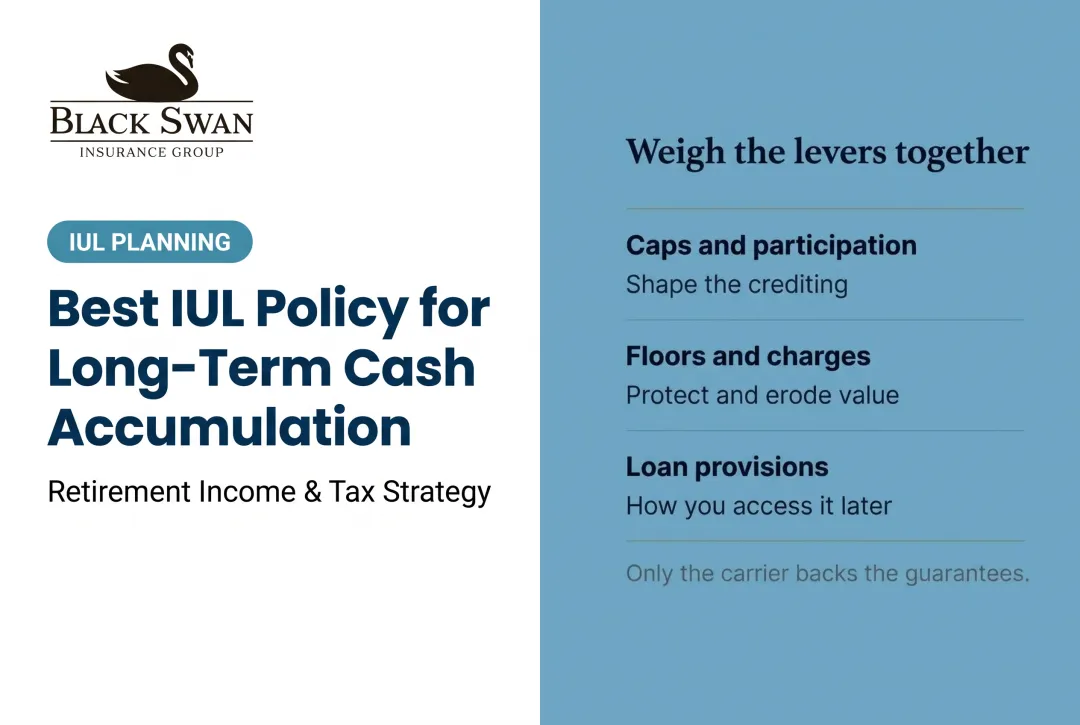
Every indexed account has four moving parts: the floor (often 0% or 1%), the cap (maximum credit regardless of index performance), the participation rate (share of gains credited), and the spread (deduction before crediting).
A 0% floor protects you from index losses. It does not protect you from policy charges, loan interest or withdrawals, any of which can reduce cash value or push the policy toward lapse if funding falls short.
Zero is your hero in a down year — but the floor applies to the credit, not to the charges.
Every illustration carries guaranteed and non-guaranteed columns. Per NAIC guidance, illustrations must clearly separate guaranteed benefits, premiums and charges from non-guaranteed projections. Ask to see the policy stress-tested under lower-crediting and lower-funding scenarios, not just the optimistic version.

| Type | Cash value growth | Premium | Best fit |
|---|---|---|---|
| IUL | Indexed, capped, floor-protected | Flexible | Accumulation plus permanent protection |
| Whole Life | Fixed, guaranteed | Fixed | Predictability and guaranteed growth |
| Term Life | None | Low, fixed-term | Temporary, lower-cost protection |
| Variable UL | Direct market investment | Flexible | Higher risk tolerance, direct equity exposure |
If guarantees matter above all, whole life fits better. If you need coverage for twenty years, term is cheaper and that is the honest answer. IUL sits in the middle.
The Ultimate IUL Blueprint
Before funding for accumulation, the Blueprint covers what the design has to survive: funding levels, caps and charges, the MEC line, loan timing, and what to demand from an illustration.
Carriers, By Accumulation Objective
Eight criteria: cash-value efficiency, financial strength, cost structure, crediting transparency, loan design, contractual guarantees, underwriting fit and suitability. Features and availability vary by state and underwriting — a starting point, not a recommendation.
Black Swan Insurance Group is an Ohio brokerage founded in 2017. It does not issue contracts; it helps evaluate IUL, annuity and retirement options across carriers through needs assessment, policy tailoring, index-strategy selection, transparent sign-up and annual review.

Carrier selection is not one-size-fits-all: a physician in their 40s with a compressed runway needs a different design from a business owner diversifying outside a practice. Ask any broker how they are compensated and whether it affects the recommendation; how many carriers they actually access; whether anyone reviews the policy annually; and what alternatives — whole life, term, the 401(k), Roth — were considered first.
Pacific Life. Pacific Horizon IUL 2 and Horizon ECV IUL, with designs varying by state. Ratings A+ (AM Best), AA− (Fitch), Aa3 (Moody's), AA− (S&P) across 2026 reports. Horizon ECV includes a fixed account with a 1% guaranteed minimum and indexed accounts at a 0% floor; its optional early cash-value rider can raise surrender value in the first seven to ten years, though rider charges apply and surrender charges can persist through the first decade. Suits affluent professionals running complex strategies — but a larger coverage amount does not mean better cash-value performance.
Penn Mutual. A policyholder-owned mutual, which changes the incentive structure relative to publicly traded insurers. Accumulation IUL, Protection IUL and Survivorship IUL, issued through The Penn Insurance and Annuity Company. Ratings A+ (AM Best), Aa3 (Moody's), A+ (S&P), AA− (Fitch). Six S&P 500-linked account options, from capped accounts with 0% or 1% floors to uncapped accounts with spread deductions.
One detail worth flagging: the guaranteed fixed indexed-loan charge is 5% for Accumulation and Survivorship IUL and 6% for Protection IUL. Since indexed loan credits vary, your actual net borrowing cost can swing against you. Request an illustration showing the illustrated rate, a lower crediting assumption, and planned loans.
Nationwide. Indexed UL Accumulator III (cash-value growth) and Indexed UL Protector II (death-benefit protection). Ratings A+ (AM Best), A+ (S&P), A1 (Moody's). Accumulator III is flexible-premium, generally positioned for ages 30–55, with multiple indexed strategies at a 0% guaranteed floor plus living-benefit riders including chronic illness and an Overloan Lapse Protection Rider. Riders carry their own costs and eligibility rules, and some cannot be combined on the same policy — read the contract rather than the summary.
Allianz Life. The Life Accumulator launched in 2024. Ratings A+ (AM Best), Aa3 (Moody's), AA (S&P). Several index choices including S&P 500 and multi-asset blended strategies, plus Index Lock allowing one lock per crediting period. Bonus allocations typically come with lower caps or participation rates in exchange. Locking can produce more or less credited interest than leaving the segment alone — this is not a set-and-forget product.
What the Critics Get Right
Against a low-cost index fund, IUL loses on returns and it is not close: capped upside, dividends excluded from most crediting calculations, and charges compounding from day one.
That criticism is correct, and any illustration appearing to beat the market is showing assumptions rather than outcomes. The honest case is not higher returns. It is a differently-taxed bucket attached to a death benefit you genuinely need, for someone who has already filled the cheaper buckets. If you have not filled them, the critics are simply right and you should go and do that instead.
How These Were Assessed
Policy mechanics, not brand recognition or advertised rates.
Financial strength and carrier behaviour — independent ratings, the issuing subsidiary, and crucially how each carrier has historically managed caps and participation rates for in-force policyholders rather than new business. Past treatment of existing customers predicts more than any current rate.
Cash-value efficiency — cost of insurance, premium loads, administrative charges, surrender charges, and how much of each premium dollar reaches cash value.
Crediting and loan mechanics — index transparency, floor and cap structures, fixed against variable loan rates. Loan design matters more than buyers realise, because indexed loans can produce a net cost above the guaranteed charge when credited interest disappoints.
Stress-testing — a policy that looks strong at 7% illustrated can look very different at 4%, with skipped premiums or planned withdrawals.

A LIMRA study of universal life lapse experience 2015–2021 found a significant share of IUL exposure occurs in the first five policy years. Early funding discipline is what keeps a policy alive long enough to build anything.
Under IRS rules a policy exceeding the seven-pay limit becomes a modified endowment contract, changing how loans and withdrawals are taxed — confirm with a tax adviser before overfunding anything.
Stronger Fit
- Earning $150K+ with surplus cash flow after reserves, debt and maxed retirement contributions
- A genuine, lasting permanent protection need
- A horizon measured in decades and the discipline to fund through a weak year
- Willing to review the policy annually
Weaker Fit
Not everyone should buy one. Step back if you have an unclaimed employer match, thin reserves, high-interest debt, near-term liquidity needs, or only need a death benefit for a defined period.
Risks to Understand Before You Fund
- Underfunding in the first five years is where most policies fail, per the lapse data above.
- Caps and participation rates can be lowered after issue, within contract limits.
- Indexed loans can cost more than they credit, as Penn Mutual's own figures show.
- Rider conflicts exist — some living benefits cannot run together.
- MEC status is generally permanent and changes loan and withdrawal taxation.
- Lapse with a loan outstanding can create taxable income with no cash received.
This is not set-it-and-forget-it. It is design-it, fund-it, review-it.
Find Out Where You Actually Stand
This starts with the Tax-Free Wealth Blueprint Fit Review. If you earn $150K+ and accumulation is the goal, we build identical illustrations across carriers, prioritise guaranteed values over optimistic projections, model the loan mechanics under both favourable and unfavourable crediting, and confirm the protection purpose still holds if the index disappoints. No promises on approval, returns or tax outcomes. If IUL does not fit, we will tell you that too.
Frequently Asked Questions
What is the best policy for cash accumulation?
There is no single answer. It depends on funding capacity, age, health and horizon. Compare current illustrations and guaranteed values across several carriers.
Is IUL a good way to build cash value?
It can be. It offers permanent protection and tax-deferred growth with flexible premiums. Fees, caps and lapse risk mean it works alongside other retirement accounts, not instead of them.
How do I compare policies?
Identical funding and coverage assumptions across carriers, then compare financial strength, guaranteed against current ledgers, cost of insurance, loan terms and stress-tested performance.
What should I look for in an illustration?
Separate guaranteed from non-guaranteed. Check credited-rate assumptions, caps, participation rates, charges, and how loans or reduced premiums affect long-term sustainability.
Can I lose money?
Yes. The floor protects against index losses, but fees, insurance charges, loans and insufficient premiums can still reduce cash value or cause a lapse, sometimes with tax consequences.
How do loans affect cash value and the death benefit?
They accrue interest and reduce both until repaid, and they increase lapse risk. Review loan effects under both favourable and unfavourable crediting before relying on them.
Sources
- NAIC — Life Insurance Illustrations
- LIMRA — universal life lapse and surrender experience 2015–2021
- IRS Revenue Ruling 2007-38 — modified endowment contracts
Disclosure: This article is educational and is not personal tax, legal or investment advice. Indexed universal life is life insurance first. Carrier products, loan charges, rider eligibility, index options and state availability change frequently and must be confirmed against current policy forms before applying; ratings reflect an insurer's claims-paying ability, not the suitability of any contract, and parent-company ratings may differ from the issuing subsidiary's. Illustrated values are not guarantees; actual results depend on policy terms, crediting, costs and funding. Any potential tax-advantaged access depends on the policy being properly structured, funded and managed. Actual results depend on policy design, carrier, crediting options, caps, participation rates, expenses, funding and ongoing management. This strategy is not appropriate for everyone. Policy loans and withdrawals reduce cash value and the death benefit, and can create tax consequences if the policy lapses or becomes a modified endowment contract. Consult your own tax, legal and financial professionals for advice specific to your situation.
And remember, it's not what you earn, it's what you keep… enjoy the ride.